

Introduction
In the high-velocity world of modern software development and enterprise architecture, documentation often lags behind design. Teams frequently find themselves trapped in a cycle of manual exports, static image uploads, and version control nightmares. As architectural models evolve, technical manuals quickly become obsolete, creating a dangerous gap between what is built and what is documented. This disconnect not only wastes valuable engineering hours but also introduces significant risk through outdated information and misaligned stakeholder expectations.
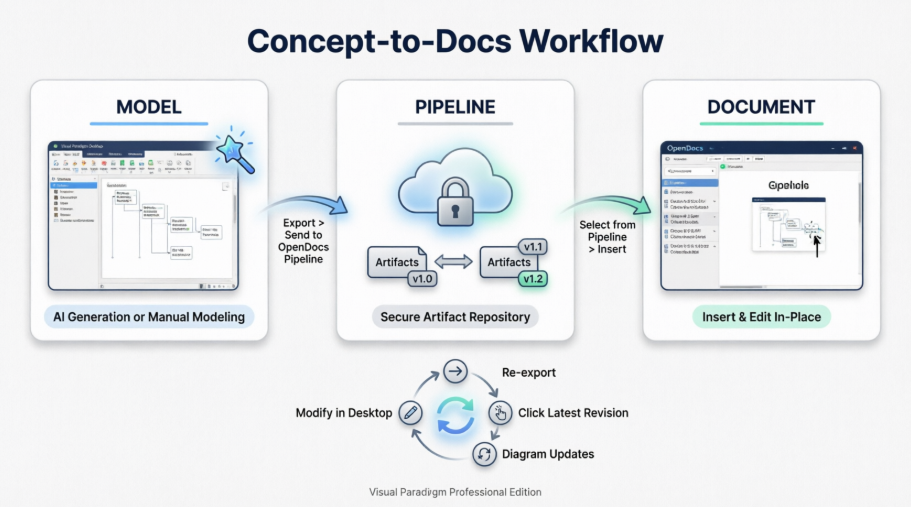
The Visual Paradigm OpenDocs Pipeline emerges as a transformative solution to this perennial challenge. By bridging professional design environments—such as Visual Paradigm Desktop, VP Online, and AI Chatbots—with a unified knowledge platform, the Pipeline treats diagrams not as static outputs, but as dynamic, version-controlled assets. This case study explores how this intelligent ecosystem redefines knowledge management, enabling teams to create living documentation that evolves in lockstep with their designs. Through automated synchronization, preserved editability, and seamless integration, the OpenDocs Pipeline allows organizations to shift their focus from administrative file management to strategic innovation and clarity.
Core Ecosystem Components
The OpenDocs Pipeline is not merely a file transfer tool; it is an intelligent ecosystem designed to maintain the integrity and utility of visual assets throughout their lifecycle.
- Visual Paradigm (Desktop / Online / AI Chatbot): This serves as the generation tier where raw visual materials are constructed. Whether building complex software architectures, BPMN flows, or data charts manually, or leveraging conversational AI prompts for rapid prototyping, this layer ensures high-fidelity model creation.
- The Pipeline: Acting as a secure, cloud-based asset transit hub and repository, the Pipeline tracks continuous asset modifications. It logs user comments, automates revision histories, and eliminates the need for manual screenshots or file saves, ensuring a single source of truth for all visual assets.
- OpenDocs: This is the unified, AI-powered knowledge management workspace. It combines structured Markdown text with real-time visual embeddings, allowing users to integrate live diagrams directly into their technical manuals, requirements documents, and project wikis.
The Challenge: Fragmented Workflows in Modern Development
Before the introduction of the OpenDocs Pipeline, teams using Visual Paradigm tools encountered several significant friction points that hindered productivity and accuracy:
- Manual Export Cycles: Diagrams created in Visual Paradigm Desktop or VP Online required manual export as PNG or JPG files before being uploaded to documentation platforms. This repetitive task consumed valuable time.
- Loss of Editability: Once exported as static images, diagrams could not be easily modified. Any change required returning to the source tool, making adjustments, and repeating the entire export and upload process.
- Version Control Gaps: Keeping documentation aligned with evolving models demanded meticulous manual tracking. Without automated links, inconsistencies were common, leading to confusion among developers and stakeholders.
- Collaboration Barriers: Different team members working in different tools struggled to share and update assets efficiently, creating silos between architects, developers, and technical writers.
These challenges were particularly acute in agile environments where requirements and designs evolve rapidly, demanding documentation that can keep pace without becoming a bottleneck.
The Solution: OpenDocs Pipeline as a Centralized Asset Transit Hub
The Visual Paradigm OpenDocs Pipeline addresses these challenges by functioning as a secure, cloud-based repository for “artifacts”—the valuable assets created across the Visual Paradigm ecosystem. Rather than treating diagrams as static outputs, the Pipeline preserves them as live, editable cloud assets that maintain a direct link to their source models.
Core Architecture
The Pipeline operates as a bidirectional bridge connecting:
- Visual Paradigm Desktop: For professional-grade modeling and AI-assisted diagram generation.
- VP Online: For cloud-based collaborative diagramming.
- AI Chatbot: For rapid concept visualization through natural language prompts.
- OpenDocs: For integrated knowledge management and documentation.
This architecture ensures that a diagram created in any environment can flow seamlessly into documentation while retaining its intelligence and editability.
Key Benefits Realized
Elimination of Manual File Handling
Teams no longer need to download images, take screenshots, or manage file uploads. The Pipeline automates the transfer process, reducing administrative overhead and minimizing human error.
Preserved Editability and Fidelity
Diagrams inserted into OpenDocs via the Pipeline maintain their vector quality and remain fully editable. Changes made to source models can be reflected in documentation without recreating visuals from scratch.
Automatic Change Synchronization
When a source model is updated and pushed to the Pipeline, OpenDocs receives sync notifications. Users can compare revisions and update embedded diagrams with a single click, ensuring documentation always reflects the current design state.
Built-in Version Control
Every artifact pushed to the Pipeline is automatically versioned. Teams can attach contextual notes to revisions, browse historical versions, and roll back if needed—all without leaving the OpenDocs interface.
Implementation Workflow: A Three-Step Cycle
Step 1: Send the Artifact to the Pipeline
From Visual Paradigm Desktop:
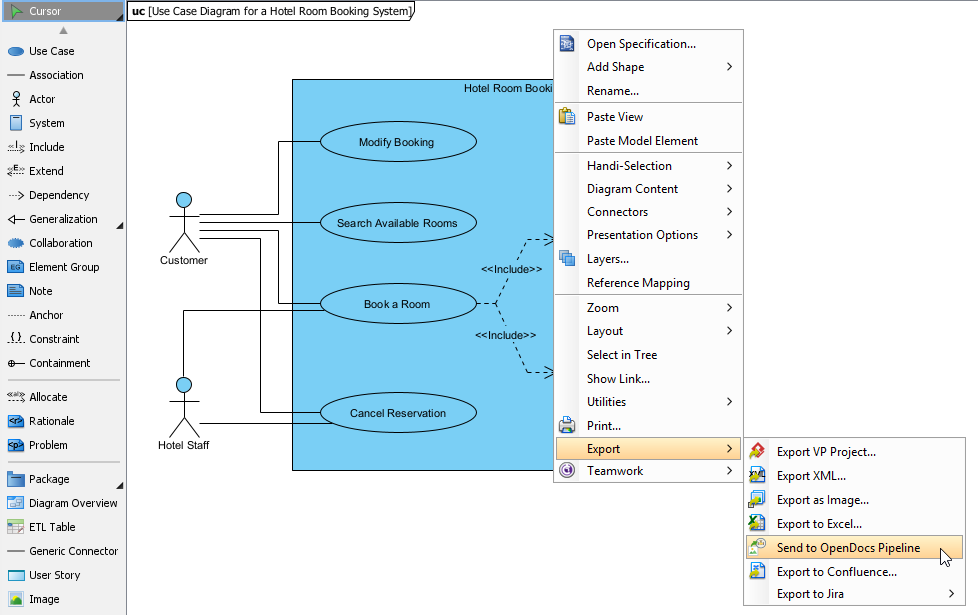
- Open your diagram in the Desktop application.
- Right-click anywhere on the canvas.
- Select Export > Send to OpenDocs Pipeline (or use the drawer button on the right edge).
- Add an optional comment to provide context for the artifact.
- Confirm to save and push the diagram to the cloud repository.
From VP Online:
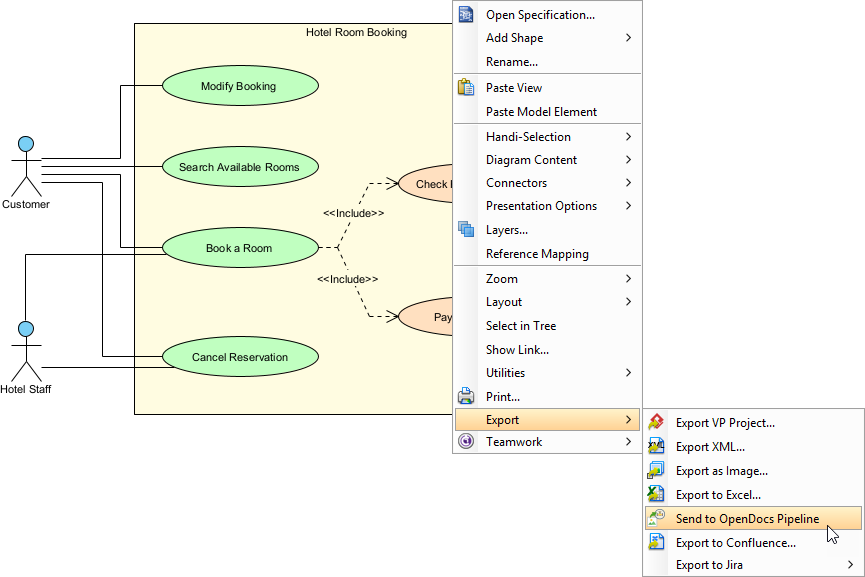
- Open your canvas or design in the web interface.
- Click Export in the top-right corner.
- Choose Send to OpenDocs Pipeline.
- The artifact is immediately available in your OpenDocs workspace.
From AI Chatbot:
- Generate a diagram using natural language prompts.
- Once the AI renders your process or architecture, click the Export command.
- Select Send to OpenDocs Pipeline to transfer the artifact directly.
Step 2: Insert into OpenDocs
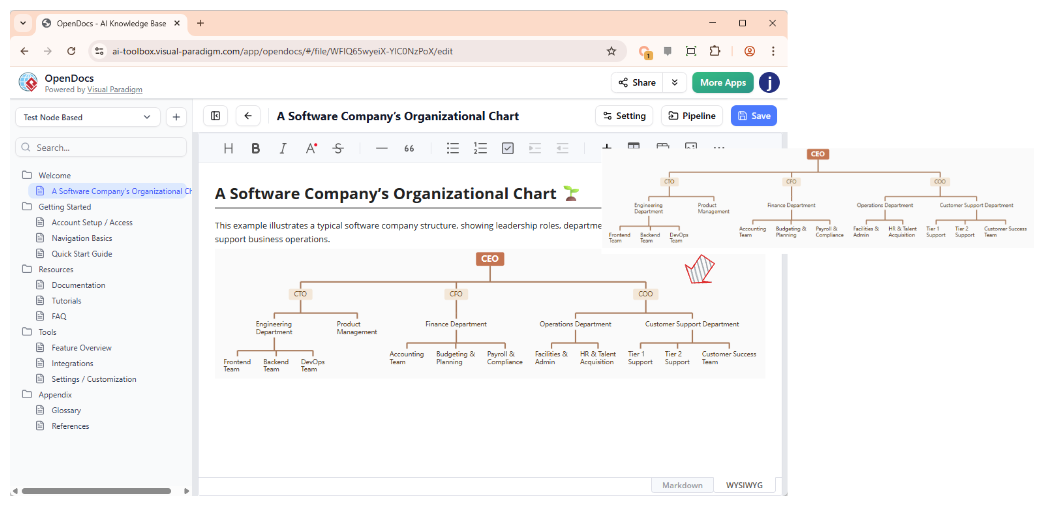
- Open your web-based OpenDocs workspace and navigate to the text page you wish to edit.
- Click the Insert button on the editor toolbar.
- Select Pipeline from the pop-up options to access your asset repository.
- Browse your list of artifacts, filter by name or revision if needed.
- Select your desired artifact and insert its current revision directly at your cursor position.
The inserted diagram appears as a live, interactive element within your document—not a static image.
Step 3: Update and Manage Revisions
When source models evolve:
- Update the diagram in your modeling software (Desktop, Online, or via AI).
- Push the revised version to the Pipeline using the same export workflow.
- For VP Desktop users: After the initial manual push, subsequent project commits can automatically update the artifact’s history stream.
In OpenDocs:
- An update indicator appears in the Pipeline side panel whenever a newer diagram version is available.
- Click the indicator to compare revision histories side-by-side.
- Instantly switch your document to the preferred layout revision with a single action.
Native Ad-Hoc Workspace Workflow
Alternatively, users can bypass external authoring tools entirely by designing directly within their documents using the OpenDocs Integrated Diagram Editor. This approach is ideal for quick sketches or when immediate context is required without switching applications.
- Create Ad-Hoc Canvas: While authoring a text section, click Insert > Diagrams and choose your notation standard (such as UML or Data Flow Diagrams).
- Employ AI Assistance: Use the Create with AI prompt helper to generate functional initial layouts from plain text descriptions.
- Save Directly: Hit save to embed the finalized visual structure immediately into the document flow.
Real-World Impact: Transforming Documentation Practices
Case Scenario: Enterprise Architecture Team
A mid-sized financial services company adopted the OpenDocs Pipeline to manage documentation for a core banking system modernization project. Previously, their architecture team spent approximately 15 hours per week manually synchronizing UML diagrams with Confluence documentation. After implementing the Pipeline:
- Time Savings: Reduced diagram maintenance overhead by 80%, freeing ~12 hours weekly for higher-value analysis.
- Accuracy Improvement: Eliminated version mismatches that previously caused 3-4 documentation errors per sprint.
- Collaboration Enhancement: Enabled business analysts to view live diagrams in OpenDocs while architects refined models in Desktop—without coordination delays.
- Onboarding Acceleration: New team members could explore versioned diagram histories to understand design evolution, reducing ramp-up time by 40%.
Case Scenario: Agile Product Development
A SaaS startup integrated the Pipeline into their two-week sprint cycles. Product managers used the AI Chatbot to rapidly prototype user journey maps, which were then pushed to OpenDocs for stakeholder review. Key outcomes included:
- Faster Iteration: Concept-to-documentation time reduced from 2 days to under 2 hours.
- Stakeholder Alignment: Live, editable diagrams in shared OpenDocs spaces improved feedback quality and reduced revision cycles.
- Knowledge Retention: Versioned artifact histories created an auditable trail of design decisions for compliance and retrospective analysis.
Best Practices for Maximizing Pipeline Value
- Establish Naming Conventions: Use consistent, descriptive artifact names and comments to simplify browsing and retrieval in the Pipeline repository.
- Leverage Optional Comments: When pushing artifacts, add contextual notes explaining the diagram’s purpose, scope, or key changes—this metadata proves invaluable during revision reviews.
- Schedule Regular Sync Reviews: Incorporate Pipeline revision checks into sprint retrospectives or documentation maintenance cycles to ensure living docs stay current.
- Train Cross-Functional Teams: Ensure both modelers and documentation specialists understand the end-to-end workflow to maximize collaboration benefits.
- Utilize Version Context Notes: Attach meaningful descriptions to revisions to create a narrative of design evolution alongside the visual artifacts.
Conclusion
The Visual Paradigm OpenDocs Pipeline represents more than a technical integration—it embodies a philosophical shift toward living, intelligent documentation. By treating diagrams as dynamic, versioned assets rather than static outputs, the Pipeline enables organizations to build knowledge bases that evolve in lockstep with their designs. This case study demonstrates that when visual modeling and documentation workflows are unified through a centralized asset transit hub, teams achieve measurable gains in efficiency, accuracy, and collaboration.
For organizations navigating complex system designs, agile development cycles, or enterprise architecture initiatives, the Pipeline offers a practical path to reduce documentation debt while enhancing knowledge accessibility. As AI-assisted modeling continues to accelerate the pace of design exploration, tools like the OpenDocs Pipeline become essential infrastructure for ensuring that documentation remains a strategic asset rather than a maintenance burden. The future of technical communication lies not in static manuals but in adaptive, interconnected knowledge ecosystems. With the Visual Paradigm OpenDocs Pipeline, that future is already here—ready to transform how your team creates, shares, and maintains the visual intelligence that drives innovation.
References
- A Case Study on Streamlining Knowledge Management with Visual Paradigm OpenDocs Pipeline: Explores how organizations can optimize their knowledge management strategies by integrating Visual Paradigm’s OpenDocs Pipeline.
- From Concept to Knowledge Base: A Third-Party Review of Visual Paradigm’s OpenDocs Workflow: Provides an independent review of the OpenDocs workflow, highlighting its effectiveness in transforming concepts into structured knowledge bases.
- From Silos to Synergy: How Visual Paradigm OpenDocs Transforms Team Documentation Through AI-Powered Visual Collaboration: Discusses how OpenDocs breaks down team silos and enhances collaboration through AI-driven visual tools.
- Visual Paradigm OpenDocs: The Definitive Guide: A comprehensive guide detailing the features and capabilities of the OpenDocs platform.
- Sync AI Diagram to OpenDocs Pipeline Guide: Technical documentation on how to synchronize AI-generated diagrams with the OpenDocs Pipeline.
- AI Diagram to OpenDocs Pipeline: Release notes and features regarding the integration of AI diagrams into the Pipeline.
- OpenDocs Features: Overview of the key features and functionalities of the OpenDocs platform.
- AI Breakdown Structure Chart Maker in OpenDocs: Details on the AI-powered breakdown structure chart maker within OpenDocs.
- Visual Paradigm OpenDocs Pipeline Tutorial: Video tutorial demonstrating the usage of the OpenDocs Pipeline.
- Visual Paradigm OpenDocs Workflow Demo: Demonstration of the complete OpenDocs workflow.
- My Journey with Visual Paradigm Pipeline: How This Asset Transit Hub Transformed My Documentation Workflow: A personal account of how the Pipeline improved documentation efficiency.
- My Journey to Seamless Documentation: Sending Visual Paradigm Creations Directly to OpenDocs: Insights on achieving seamless documentation through direct integration.
- Visual Paradigm’s Pipeline: Hands-On Review of Visual Paradigm’s Desktop-to-OpenDocs Integration: A detailed hands-on review of the integration between Desktop and OpenDocs.
- Visual Paradigm Online to OpenDocs Export: Information on exporting from VP Online to OpenDocs.
- From Model to Manual: A Software Engineer’s Guide to Syncing Visual Paradigm Desktop Diagrams with OpenDocs: A guide for software engineers on syncing diagrams with documentation.
- Solving the Documentation Chaos: How Visual Paradigm’s Pipeline Creates a Frictionless Concept-to-Docs Workflow: Analysis of how the Pipeline reduces documentation chaos.
- OpenDocs AI-Powered Knowledge Platform: Landing page for the AI-powered OpenDocs platform.
- OpenDocs AI-Powered Knowledge Platform Release: Release information for the AI-powered knowledge platform.
- OpenDocs Features Overview: Detailed look at OpenDocs features.
- Sync AI Diagram to OpenDocs Pipeline Guide: Additional resources on syncing AI diagrams.
- New in OpenDocs: AI-Powered Data Flow Diagram (DFD) Support: Announcement of AI-powered DFD support in OpenDocs.
- OpenDocs Diagramming Tutorial: Video tutorial on diagramming in OpenDocs.
- OpenDocs AI Features Demo: Demonstration of AI features in OpenDocs.
- OpenDocs Workflow Example: Example of a complete OpenDocs workflow.