


Introduction
Understanding complex object-oriented architecture in PHP applications can be challenging, especially when onboarding new team members, conducting code reviews, or auditing legacy codebases. Visual Paradigm is excited to announce a major enhancement to VPasCode: native support for visualizing PHP source code as comprehensive UML Class Diagrams. As a unified diagram-as-code tool, VPasCode bridges the gap between raw source code and architecture diagrams. Whether you need a quick free PHP editor or a dedicated online PHP diagram tool, VPasCode handles the rendering automatically so you can focus on system design and architecture.
What is VPasCode?
If you are new to VPasCode (Visual Paradigm as Code), it is an all-in-one diagram-as-code tool designed to simplify diagram creation using popular text-to-diagram Domain Specific Languages (DSLs) and programming code. VPasCode combines a lightweight, free code editor experience with an instant side-by-side graphical renderer.
Beyond PHP, VPasCode supports a vast array of formats and languages, including:
-
Diagram & Visualization Tools: PlantUML, Mermaid, Graphviz, Markmap, ECharts
-
Structured Data & Query Languages: JSON, YAML, XML, CSV, TOML, SQL
-
Programming Languages: Java, TypeScript, Go, Rust, C#, Python, C, C++, PHP, Ruby, Scala, Zig, Kotlin, Swift, and Elixir
How PHP-to-UML Visualization Works
Creating UML diagrams from your existing PHP project takes just a few seconds. VPasCode provides a streamlined interface where your code lives on the left and your visual architecture renders live on the right.
1. Paste, Type, or Drag & Drop
You can directly write or paste your Object-Oriented PHP code into the editor. If you are working with an existing file on your machine, simply drag and drop the PHP source file directly into the VPasCode workspace. The editor instantly ingests the code and generates the corresponding class structures, interfaces, properties, methods, and relationships.
2. Real-Time Diagram Preview
As you modify class definitions, visibility modifiers (public, protected, private), inheritance, or interface implementations in the editor, your UML Class Diagram updates instantaneously. It acts as both a rapid free PHP editor and an interactive online PHP diagram tool.
3. Seamless Sharing and Export Options
Once your diagram is ready, sharing your architecture with team members or adding it to documentation is frictionless:
-
No-Login Link Sharing: Share an exact interactive preview of your code and diagram via a simple hyperlink, with no user registration required.
-
Vector Export (SVG): Download high-resolution SVG files ideal for web embedding and detailed technical specifications.
-
Image Export (PNG): Save image files for quick reports or presentation slides.
-
Clipboard Copy: Copy rendered images directly to your system clipboard for quick pasting into Slack, Teams, or email.
See It in Action: New PHP Object-Oriented Example
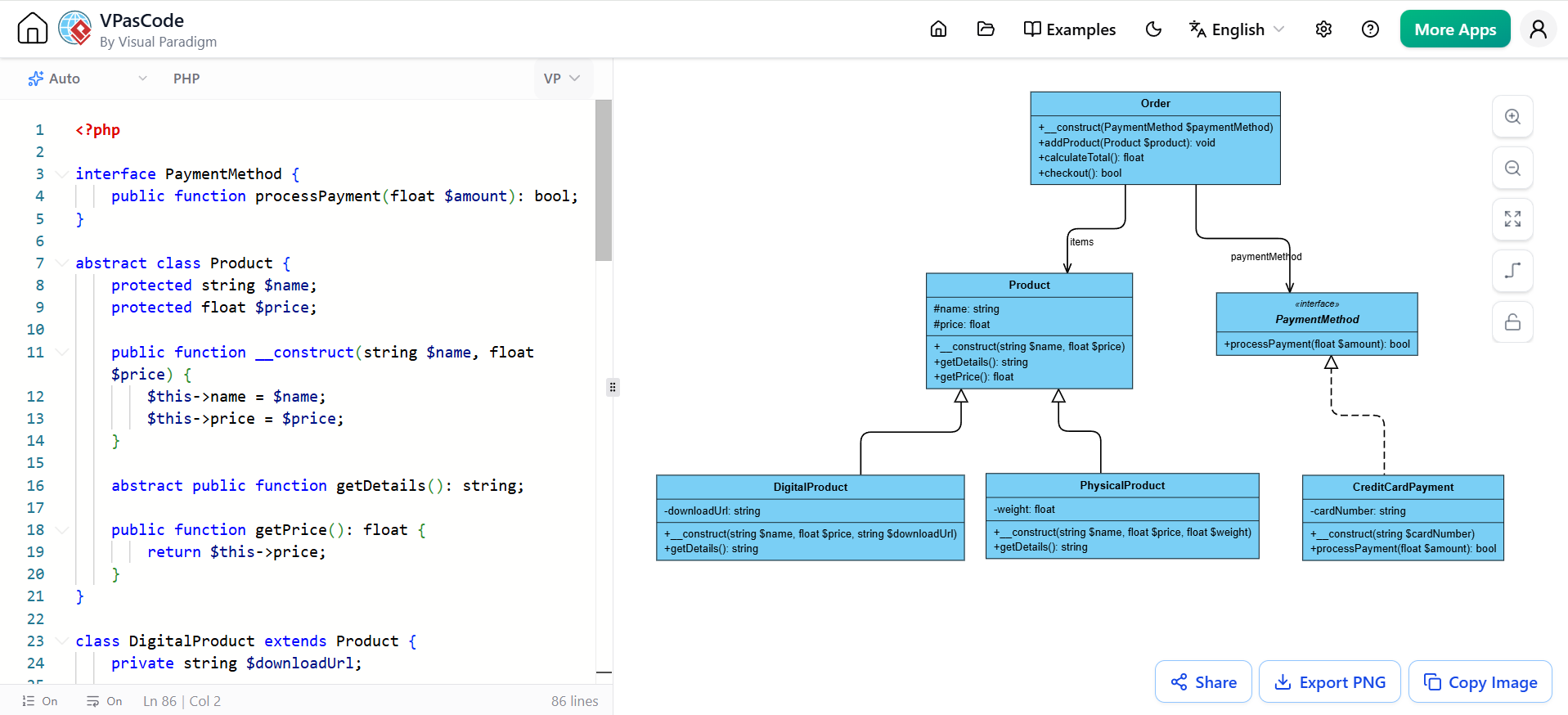
To demonstrate how cleanly VPasCode parses class hierarchies, abstract classes, and interfaces, consider the following Object-Oriented PHP code sample defining a simple e-commerce domain model:
<?php

interface PaymentMethod {
    public function processPayment(float $amount): bool;
}

abstract class Product {
    protected string $name;
    protected float $price;

    public function __construct(string $name, float $price) {
        $this->name = $name;
        $this->price = $price;
    }

    abstract public function getDetails(): string;

    public function getPrice(): float {
        return $this->price;
    }
}

class DigitalProduct extends Product {
    private string $downloadUrl;

    public function __construct(string $name, float $price, string $downloadUrl) {
        parent::__construct($name, $price);
        $this->downloadUrl = $downloadUrl;
    }

    public function getDetails(): string {
        return "Digital: " . $this->name . " (URL: " . $this->downloadUrl . ")";
    }
}

class PhysicalProduct extends Product {
    private float $weight;

    public function __construct(string $name, float $price, float $weight) {
        parent::__construct($name, $price);
        $this->weight = $weight;
    }

    public function getDetails(): string {
        return "Physical: " . $this->name . " (Weight: " . $this->weight . "kg)";
    }
}

class CreditCardPayment implements PaymentMethod {
    private string $cardNumber;

    public function __construct(string $cardNumber) {
        $this->cardNumber = $cardNumber;
    }

    public function processPayment(float $amount): bool {
        // Simulate payment processing
        return true;
    }
}

class Order {
    /** @var Product[] */
    private array $items = [];
    private PaymentMethod $paymentMethod;

    public function __construct(PaymentMethod $paymentMethod) {
        $this->paymentMethod = $paymentMethod;
    }

    public function addProduct(Product $product): void {
        $this->items[] = $product;
    }

    public function calculateTotal(): float {
        $total = 0.0;
        foreach ($this->items as $item) {
            $total += $item->getPrice();
        }
        return $total;
    }

    public function checkout(): bool {
        return $this->paymentMethod->processPayment($this->calculateTotal());
    }
}
When parsed inside VPasCode, this snippet visually illustrates:
-
The
PaymentMethodinterface contract. -
The abstract base class
Productwith protected properties and an abstract method. -
Concrete classes
DigitalProductandPhysicalProductinheriting fromProduct. -
The
CreditCardPaymentclass implementing thePaymentMethodinterface. -
Aggregation and association relationships between
Order,Product, andPaymentMethod.
Conclusion
Visualizing PHP source code as UML class diagrams no longer requires manual drawing or outdated, disconnected tools. With VPasCode, developers and architects can instantly transform raw PHP code into clear, interactive, and shareable architecture diagrams. By keeping your documentation in sync with your codebase through a seamless diagram-as-code workflow, you can improve team collaboration, accelerate onboarding, and maintain a robust understanding of your system’s design. Try pasting your own PHP code into VPasCode today and experience the future of visual modeling.
References
-
Introducing VPasCode: The Ultimate Unified Text-to-Diagram Platform: Overview of VPasCode as an integrated environment combining a free code editor with high-performance diagram rendering.
-
Visualize Java Code to UML Class Diagrams Instantly: Demonstrates VPasCode’s capability to generate UML class diagrams from Java source code.
-
Visualize XML Instantly with VPasCode: Highlights the tool’s feature for pasting, editing, formatting, and rendering XML structures.
-
Free Online JSON Editor & Visualizer: Explores side-by-side editing and visualization of JSON data using VPasCode.
-
Visualize TypeScript Code as UML Class Diagrams: Shows how VPasCode converts TypeScript code into clear architectural diagrams.