

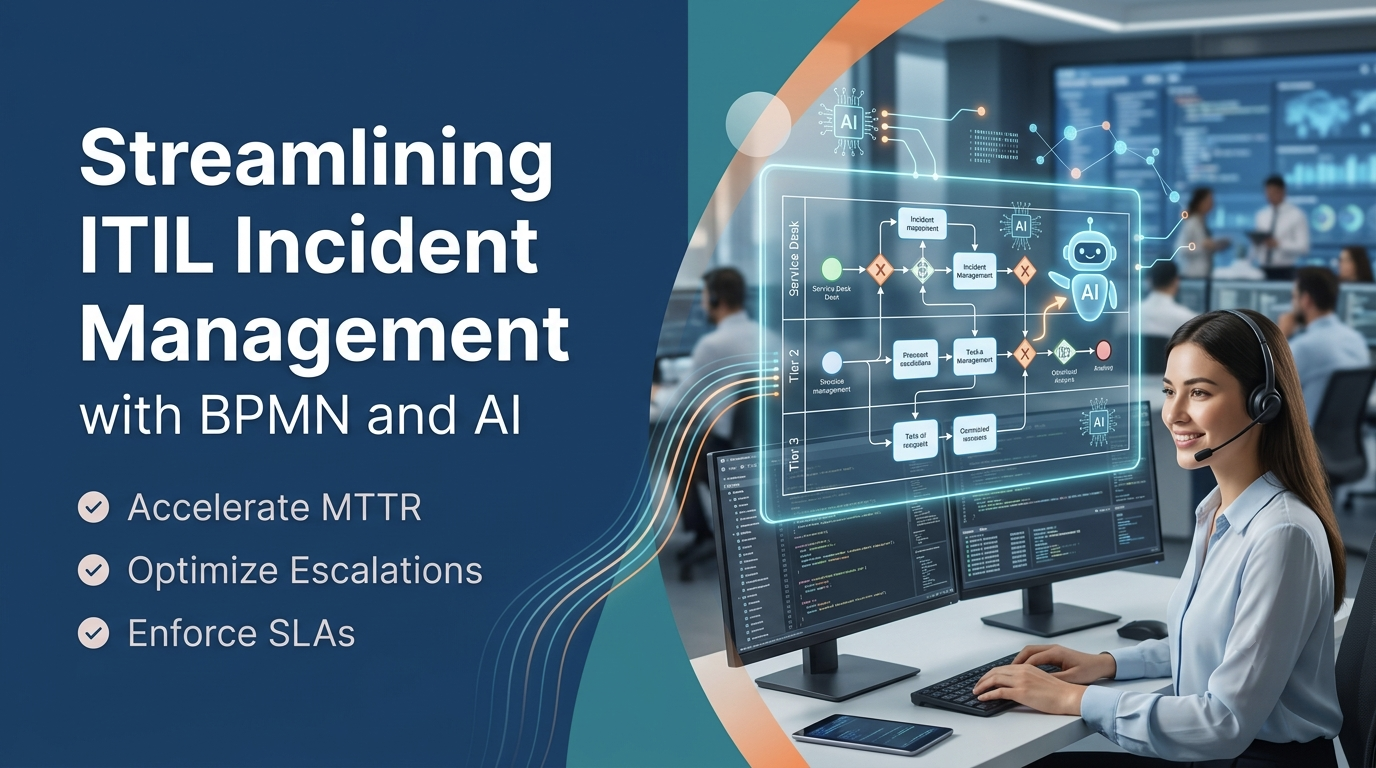
In modern enterprise IT environments, system downtime or service degradation can severely impact operational continuity and revenue. The IT Infrastructure Library (ITIL) framework provides a proven blueprint for managing IT service incidents, ensuring services are restored as quickly as possible. However, translating high-level ITIL guidelines into clear, actionable workflows across Helpdesk, Tier 2/3 Support, and DevOps teams remains a significant operational challenge.
To bridge the gap between ITIL policy and daily execution, IT Service Management (ITSM) leaders rely on Business Process Model and Notation (BPMN 2.0). By mapping ITIL incident escalation paths with visual modeling standards, organizations establish clear accountability, enforce strict Service Level Agreements (SLAs), and improve incident response velocity. This is where Visual Paradigm shines: leveraging its advanced AI BPMN Tool, teams can generate and refine these complex ITIL process maps faster and more reliably than ever before.
The Challenges of ITIL Incident Response Workflows
ITIL incident management covers the entire lifecycle of an issue—from initial detection and logging to triage, investigation, resolution, and closure. Without a standardized visual workflow managed by a robust platform like Visual Paradigm, IT organizations frequently encounter friction points:
- Unclear Escalation Boundaries: Helpdesk agents may misroute complex incidents or delay escalating tickets to tier 2 or tier 3 engineering teams due to ambiguous documentation.
- SLA Breach Risks: Without explicit timer events and automated notification pathways, critical priority incidents (P1/P2) risk exceeding agreed response and resolution windows.
- Siloed Communication: Incidents involving multiple infrastructure teams (e.g., database, networking, security) suffer from fragmented handoffs and uncoordinated troubleshooting.
Anatomy of an ITIL Incident Management BPMN Workflow
A well-structured BPMN 2.0 incident management model, such as those created in Visual Paradigm, clearly defines roles, decision criteria, and escalation triggers across distinct swimlanes:
1. Detection and Logging (Service Desk)
The workflow initiates via a Start Event triggered by an automated system alert (monitoring tool API) or an end-user ticket submission. The Helpdesk team logs the incident, categorizes the issue, and assesses urgency and impact to determine priority level (P1 to P4).
2. Initial Triage and Resolution (Tier 1 Support)
Tier 1 support attempts first-contact resolution using existing knowledge base articles. An exclusive gateway evaluates success: if resolved, the ticket moves to closure; if unresolved, an automated timer event monitors the SLA threshold while the ticket is escalated.
3. Escalation and Advanced Diagnosis (Tier 2/3 & DevOps)
The incident passes across swimlanes to specialized engineering groups. For major P1 outages, a parallel gateway simultaneously triggers the formation of a Major Incident Response Team (MIRT), broadcasts status updates to stakeholders, and initiates root-cause analysis.
Accelerating ITIL Workflow Mapping with Visual Paradigm’s AI BPMN Tool
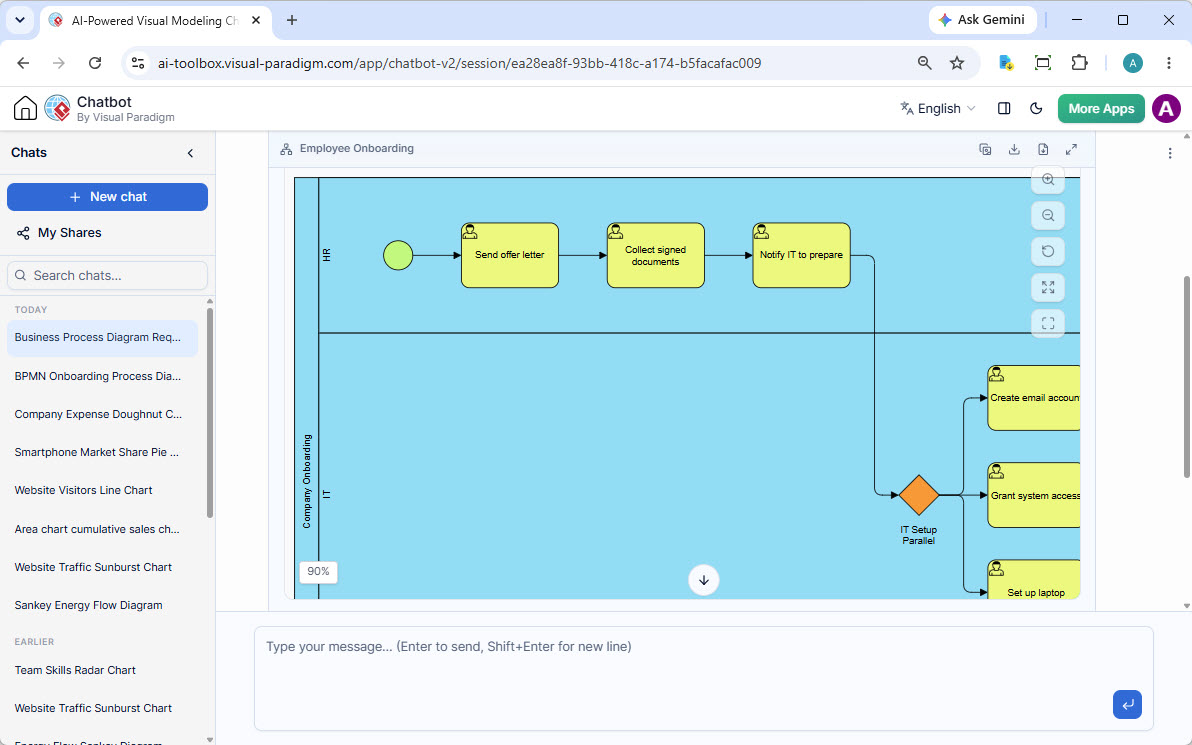
Building comprehensive ITIL workflows manually requires significant effort to align gateway logic, swimlane assignments, and exception-handling paths. Using Visual Paradigm‘s AI BPMN Tool streamlines this process significantly.
By inputting standard operating procedures (SOPs) or ITIL policy documentation in plain text, Visual Paradigm automatically generates standard-compliant incident response models in seconds. Unlike generic diagramming tools, Visual Paradigm understands the semantic nuances of ITIL processes.
Using Visual Paradigm provides key benefits for IT Service Management teams:
- Rapid Documentation of Existing SOPs: Convert legacy text manuals and runbooks into clear, structured BPMN diagrams instantly using Visual Paradigm‘s natural language processing engine.
- Automated Exception Handling: Easily incorporate complex error paths—such as vendor escalations, rollback procedures, or SLA breach notifications—using simple prompts within Visual Paradigm.
- Consistent Industry Standards: Visual Paradigm ensures that proper BPMN 2.0 syntax (such as message intermediate catch events and timer boundary events) is enforced across all IT workflow models, eliminating human error.
Best Practices for Implementing BPMN in ITSM Operations
To maximize the impact of your ITIL process models, follow these strategic guidelines using Visual Paradigm:
1. Embed Visual Models into Incident Management Portals
Publish generated BPMN diagrams directly to your IT service desk knowledge base or interactive team portals (e.g., ServiceNow, Jira Service Management). With Visual Paradigm, you can export these visual maps seamlessly, giving support agents immediate clarity on escalation paths during live outages.
2. Link Process Models to Enterprise Architecture
Ensure your incident management workflows are part of a broader visual modeling platform. Visual Paradigm allows you to connect process tasks directly to underlying system infrastructure specs, database diagrams, and API dependencies, assisting engineers in holistic root-cause investigation.
3. Continuously Review and Refine Workflows Post-Incident
Following a major service outage, conduct a post-incident review (PIR) using your BPMN process map. Identify handoff bottlenecks or delayed escalations, and use Visual Paradigm to instantly update the process model for future incidents, ensuring continuous improvement.
Frequently Asked Questions
Can an AI BPMN tool help map workflows for other ITIL processes?
Yes. Beyond Incident Management, Visual Paradigm‘s AI BPMN tool can instantly generate process models for Change Enablement, Problem Management, Service Request Fulfillment, and Asset Management simply by inputting text descriptions of your policies.
How do timer events in BPMN represent ITIL SLAs?
In BPMN 2.0, boundary timer events are attached to investigation or resolution tasks. If the task is not completed within the designated SLA window, the timer triggers an alternative sequence flow that automatically escalates the issue or notifies management. Visual Paradigm makes configuring these time-based triggers intuitive and accurate.
Why use Visual Paradigm instead of standard flowchart software for ITIL mapping?
Standard flowcharts lack formal semantics for time-based triggers, asynchronous messages, and multi-system swimlanes. Visual Paradigm provides the precise, standardized BPMN 2.0 notation required to execute and automate complex IT service management workflows, offering a professional-grade environment for ITSM professionals.
Conclusion
Adopting BPMN 2.0 for ITIL incident management transforms text-heavy procedures into actionable, standardized visual workflows. By eliminating ambiguity in escalation paths and SLA enforcement, IT organizations can significantly reduce Mean Time to Resolution (MTTR). Leveraging Visual Paradigm, a dedicated AI BPMN tool, enables IT service managers to design, audit, and optimize complex service management processes effortlessly, bridging the gap between ITIL strategy and operational excellence.