

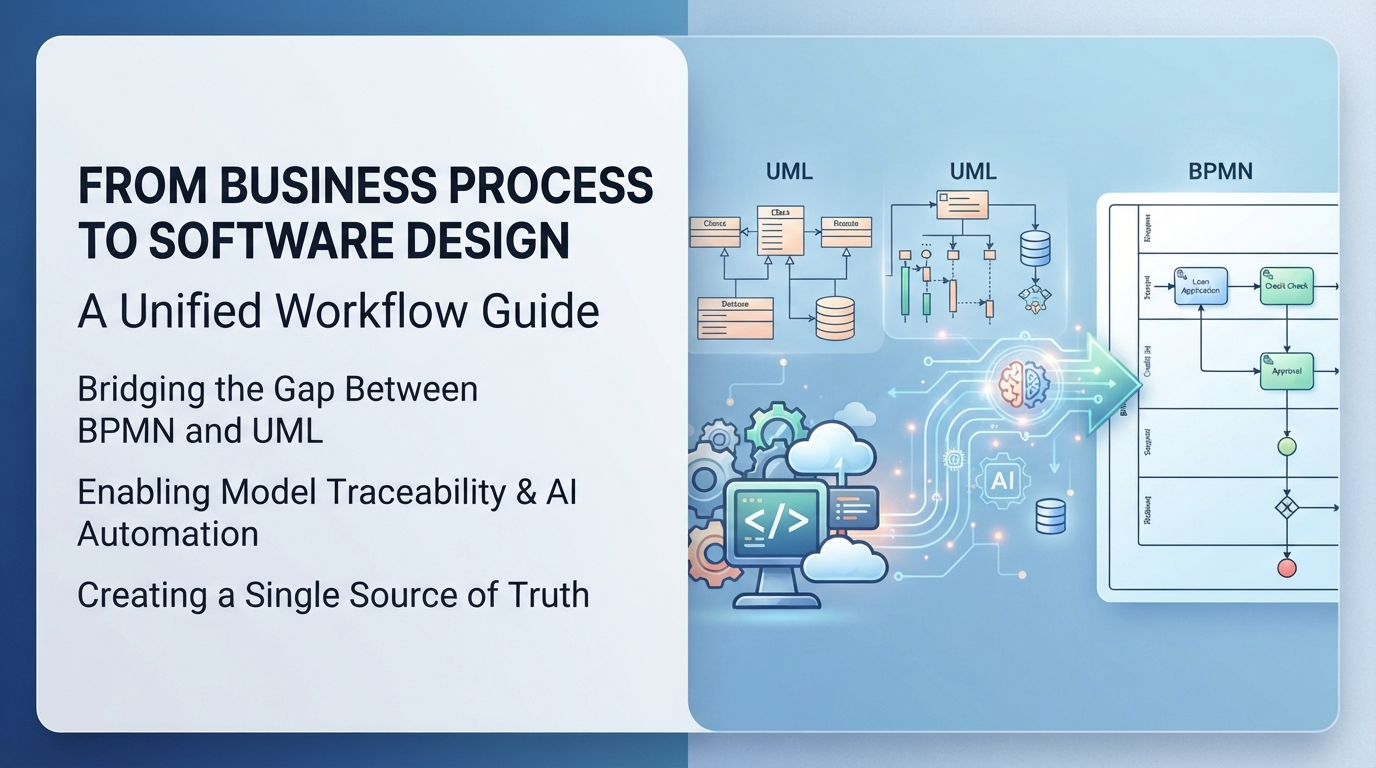
In many large organizations, a significant disconnect exists between the “Business” side and the “IT” side. Business analysts often document high-level workflows using BPMN (Business Process Model and Notation), while software architects design technical solutions using UML (Unified Modeling Language). Historically, these two disciplines operated in silos, utilizing different tools and exporting data that was difficult to reconcile.
The Challenge of the Handoff
Consider a scenario where a bank needs to automate its loan approval process. The business team creates a detailed BPMN flowchart showing the steps: Application -> Credit Check -> Approval -> Disbursement. Meanwhile, the IT team sits down to build the software. They must interpret those steps and create Class Diagrams, Sequence Diagrams, and Database schemas to support them.
If the teams use different tools, the BPMS (Business Process Management System) diagram might be exported as a PDF or image. The developers then have to re-draw the logic in their UML tool. During this re-creation:
- Subtle logic rules may be missed.
- Attributes defined in the business layer are not automatically mapped to database fields.
- Changes in the business process require a full re-translation effort.
This fragmentation slows down development and increases the risk of building software that does not perfectly align with business needs.
The Solution: A Unified Modeling Ecosystem
The most efficient solution is to treat both BPMN and UML as part of a single, interconnected model. Instead of separate documents, they become layers of the same system specification. In a unified environment, a change in the business process can trigger updates in the software design, and vice versa.
This approach relies on Model Traceability. If a specific step in a BPMN activity requires a new database table, the connection is explicit. If a software constraint changes the business rule, the impact is visible immediately across both standards.
Bridging the Gap with AI and Automation
While manual mapping is possible, the speed of modern development requires automation. Advanced visual modeling platforms now utilize AI to assist in this transition. By analyzing a business process description, an AI engine can suggest the corresponding software components, such as classes, interfaces, and sequence flows.
This capability transforms the workflow from “translate manually” to “generate and refine.” An architect can describe a complex workflow, and the system can propose a structural design that aligns with standard patterns. However, this only works if the underlying tool supports both standards natively.
For instance, a robust AI-powered modeling ecosystem allows users to start with a high-level business requirement, generate a preliminary BPMN or Use Case diagram, and then seamlessly derive detailed UML models (like Class or Sequence diagrams) from that same context. This ensures that the technical design remains faithful to the original business intent.
Key Benefits of a Unified Approach
Adopting a unified workflow offers several strategic advantages for organizations:
1. Single Source of Truth
When business and technical models reside in the same repository, there is no ambiguity. Stakeholders can see exactly how a business rule translates into code, eliminating the “telephone game” effect common in disconnected teams.
2. Automated Documentation
Documentation generation becomes automatic. Since the models are linked, generating a requirements specification document or a technical API guide involves simply pulling data from the existing models, ensuring the documentation is always up-to-date.
3. Faster Iteration
When business requirements change, the impact analysis runs across both BPMN and UML layers. Teams can instantly see which parts of the software design need to be updated, drastically reducing the time spent on regression testing and rework.
Implementing the Workflow
To implement this effectively, teams should look for tools that support the full spectrum of standards without requiring data migration between applications. The ideal workflow looks like this:
- Ideation: Define the business process using BPMN or a text prompt via AI.
- Derivation: Use the platform’s AI to suggest the necessary software components (Classes, Interfaces).
- Refinement: Deep dive into the UML details, adding attributes, methods, and constraints.
- Validation: Run traceability checks to ensure every business step has a corresponding technical implementation.
- Execution: Generate code or deploy the process directly from the unified model.
Why Visual Paradigm Fits the Need
Visual Paradigm has long recognized the importance of unifying these disparate standards. Their platform is designed to handle the entire spectrum from business analysis to software engineering within a single workspace.
By leveraging their AI capabilities, teams can rapidly convert business concepts into technical blueprints. The platform supports not just UML and BPMN, but also ArchiMate for enterprise architecture and SysML for system engineering, providing a truly holistic view of the organization’s digital transformation.
For organizations tired of managing multiple disconnected tools, moving to a unified modeling platform is the logical next step. It ensures that the vision of the business analyst is perfectly realized in the code written by the developer.