
Mastering Smart City Architecture: An ArchiMate Tutorial with PlantUML
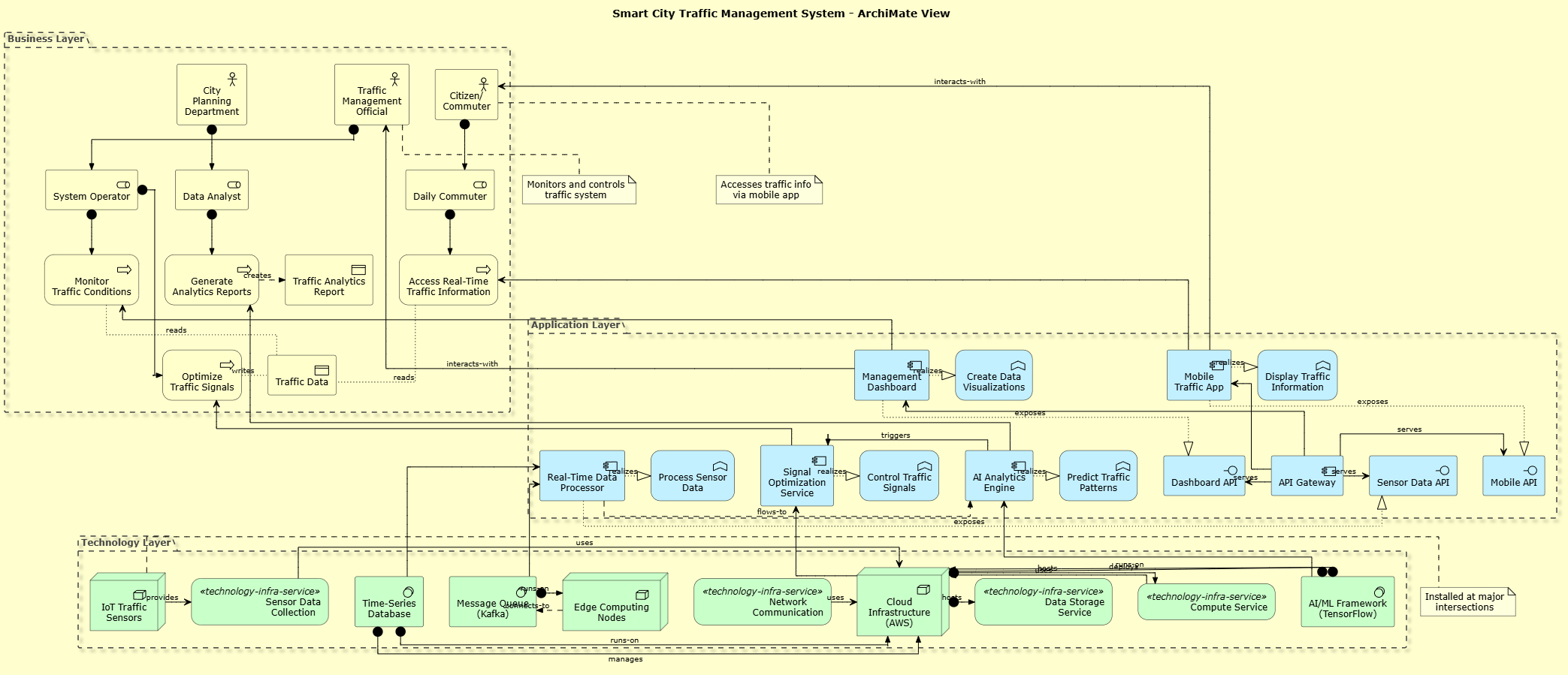
Designing complex systems like a Smart City Traffic Management System requires more than just coding; it requires a clear blueprint. In the world of enterprise architecture, ArchiMate is the standard language used to model, analyze, and visualize these systems. By combining ArchiMate’s structured approach with the automation power of PlantUML, architects can create living documentation that evolves with the project.
This tutorial will guide you through the architecture of a Smart City Traffic System, breaking down the logic into three distinct layers: Business, Application, and Technology. We will explore the code behind the visualization to show you how to model real-world interactions, data flows, and infrastructure.
1. The Three-Layer Architecture Strategy
The core principle of ArchiMate is separation of concerns. We divide the system into three horizontal layers to ensure clarity and modularity:
- Business Layer: The “Why” and “Who.” This layer defines the organization’s goals, processes, and actors (people or departments). It focuses on business value, such as “Monitoring Traffic Conditions.”
- Application Layer: The “How.” This layer represents the software and applications that support the business processes. It includes components like the “Mobile Traffic App” and “AI Analytics Engine.”
- Technology Layer: The “What.” This layer describes the physical and logical hardware and software infrastructure, such as “IoT Sensors,” “Cloud Infrastructure (AWS),” and “Kafka Message Queues.”
Vertical relationships connect these layers. For instance, a Business Process is realized by an Application Component, which runs on a Technology Node.
2. Modeling the Business Layer
The Business Layer sets the stage for the system. It identifies the stakeholders and the value they seek. In our traffic system, we have three primary actors:
- Citizen/Commuter: The end-user seeking real-time traffic information.
- Traffic Management Official: The operator responsible for monitoring and optimizing signals.
- City Planning Department: The analyst tasked with generating long-term reports.
To make the diagram readable, we define specific roles (e.g., Daily Commuter) and map them to processes (e.g., Access Real-Time Traffic Information).
PlantUML Implementation
Using PlantUML, we define these actors and processes explicitly. The BusinessActor and BusinessProcess tags create the visual boxes, while Rel (Relationship) defines the flow of value.
@startuml
' Define colors for clarity
skinparam backgroundColor #FEFECE
skinparam borderColor black

title Smart City Traffic Management System - ArchiMate View

' === BUSINESS LAYER ===
' Business Actors
Business_Actor(citizen, "Citizen/
Commuter")
Business_Actor(traffic_official, "Traffic
Management
Official")
Business_Actor(city_planner, "City
Planning
Department")

' Business Processes
Business_Process(monitor_traffic, "Monitor
Traffic Conditions")
Business_Process(optimize_signals, "Optimize
Traffic Signals")
Business_Process(generate_reports, "Generate
Analytics Reports")
Business_Process(access_info, "Access Real-Time
Traffic Information")

' Relationships
Rel(citizen, commuter_role, "assigned-to")
Rel(traffic_official, operator_role, "assigned-to")

' Processes performing relationships
Rel(commuter_role, access_info, "performs")
Rel(operator_role, monitor_traffic, "performs")
Rel(operator_role, optimize_signals, "performs")
@enduml
3. The Application Layer: Automation & Services
The Application Layer acts as the bridge between human intent and machine execution. Here, we map business processes to software components.
Key Components:
- Mobile Traffic App: Realizes the Access Real-Time Information process.
- Management Dashboard: Realizes Monitor Traffic Conditions and Generate Analytics Reports.
- AI Analytics Engine: A critical backend service that predicts patterns and triggers optimizations.
- Signal Optimization Service: The direct controller for traffic lights.
We use the ApplicationComponent tag for software blocks and ApplicationFunction for specific capabilities they provide (e.g., Predict Traffic Patterns).
' === APPLICATION LAYER ===
' Application Components
Application_Component(mobile_app, "Mobile
Traffic App")
Application_Component(dashboard, "Management
Dashboard")
Application_Component(analytics_engine, "AI Analytics
Engine")
Application_Component(signal_controller, "Signal
Optimization
Service")

' Application Functions
Application_Function(predict_patterns, "Predict Traffic
Patterns")
Application_Function(control_signals, "Control Traffic
Signals")
Application_Function(display_info, "Display Traffic
Information")

' Relationships - Realization
Rel(mobile_app, display_info, "realizes")
Rel(analytics_engine, predict_patterns, "realizes")
Rel(signal_controller, control_signals, "realizes")

' Data Flow within Application Layer
Rel(data_processor, analytics_engine, "flows-to")
Rel(analytics_engine, signal_controller, "triggers")
4. The Technology Layer: Infrastructure
Every application runs on something. The Technology Layer defines the hardware and system software that make the architecture possible. This is where we handle scalability and reliability.
Core Infrastructure:
- IoT Sensors: The source of truth for traffic data. They use the MQTT Protocol for lightweight communication.
- Cloud Infrastructure (AWS): Hosts the heavy lifting, including the AI/ML Framework (TensorFlow) and the Time-Series Database.
- Edge Computing: Located closer to the sensors to reduce latency for critical decisions.
- Message Queue (Kafka): Essential for an event-driven architecture. It allows the system to handle high volumes of sensor data asynchronously.
' === TECHNOLOGY LAYER ===
' Technology Nodes
Technology_Node(iot_sensors, "IoT Traffic
Sensors")
Technology_Node(cloud_infrastructure, "Cloud
Infrastructure
(AWS)")
Technology_Node(edge_computing, "Edge Computing
Nodes")

' System Software
System_Software(message_queue, "Message Queue
(Kafka)")
System_Software(database, "Time-Series
Database")
System_Software(ai_framework, "AI/ML Framework
(TensorFlow)")

' Relationships - Technology
Rel(iot_sensors, sensor_collection, "provides")
Rel(cloud_infrastructure, ai_framework, "deploys")
Rel(cloud_infrastructure, database, "manages")
Rel(message_queue, network_service, "runs-on")
5. Cross-Layer Relationships: The Connective Tissue
The magic of ArchiMate lies in the vertical relationships. The code below demonstrates how the layers interact:
- Business to Application: How does the Monitor Traffic Conditions process work? It is used-by the Management Dashboard.
- Application to Technology: How does the Mobile App work? It runs-on the API Gateway, which in turn interacts with the backend.
' === CROSS-LAYER RELATIONSHIPS ===
' Business to Application
Rel(access_info, mobile_app, "used-by")
Rel(monitor_traffic, dashboard, "used-by")
Rel(optimize_signals, signal_controller, "used-by")

' Application to Technology
Rel(mobile_app, api_gateway, "runs-on")
Rel(dashboard, api_gateway, "runs-on")
Rel(data_processor, message_queue, "uses")
Rel(analytics_engine, ai_framework, "uses")
6. Key Architectural Principles
By following this structure, we demonstrate several critical design principles:
- Event-Driven Architecture: The use of Kafka allows the system to process sensor data without blocking. If the AI engine is busy, messages wait in the queue.
- Scalability: Cloud infrastructure (AWS) and edge computing allow the system to grow. We can add more sensors or processing power without rewriting the business logic.
- Separation of Concerns: The Business Layer doesn’t need to know about the database type (Time-Series). The Application Layer doesn’t need to know about the specific IoT hardware model. This modularity makes maintenance and updates significantly easier.
Conclusion
Visualizing a Smart City Traffic System using ArchiMate and PlantUML provides a comprehensive view of how data flows from the physical world (sensors) to the digital world (dashboards) and back to the physical world (traffic lights). By mastering these modeling techniques, architects can ensure that complex systems are robust, scalable, and aligned with business goals.