
Mastering Business Process Model and Notation (BPMN): The Universal Language for Process Architecture
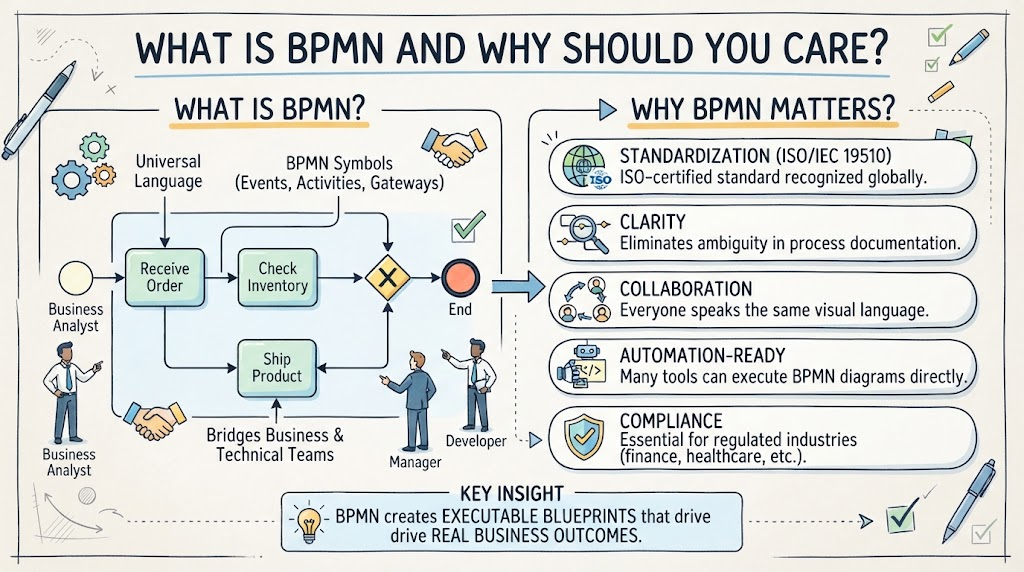
In the complex world of software development and business operations, communication breakdowns between stakeholders, analysts, and developers are costly. This is where Business Process Model and Notation (BPMN) steps in. BPMN is the industry-standard graphical representation for specifying business processes. Think of it as the “Universal Language” that bridges the gap between business strategy and technical execution.
Whether you are using Visual Paradigm or any other modeling tool, understanding the core architecture of a BPMN diagram is essential for creating executable blueprints that drive real business outcomes.
1. The Core Concept: Bridging the Gap
At its heart, BPMN serves as a bridge. On one side, you have the Business Analyst who defines the “What” and “Why” of a process. On the other, you have the Developer who needs to understand the “How” to build the software. BPMN symbols—such as Events, Activities, and Gateways—provide a standardized vocabulary that eliminates ambiguity.
2. Anatomy of a Standard Process Flow
Let’s break down a typical order fulfillment process to understand how these components interact. A robust BPMN diagram usually follows a flow from a starting point to an ending point, utilizing specific logical gates.
Key Components Explained
- Start Event: The trigger for the process. In an order system, this is often “Receive Order.”
- Tasks (Activities): These are the actual work items, such as Check Inventory or Ship Product.
- Gateways: These are the decision points (usually diamond-shaped) that control the flow. They determine which path the process takes based on specific data or conditions.
- End Event: The conclusion of the process, signaling success or failure.
Visualizing the Logic
Consider a scenario where an order is received. The system must decide if the item is in stock. If it is, the product ships. If not, the process might halt or route to a backorder notification. This branching logic is the power of BPMN.
flowchart TD
    Start((Receive Order)) --> CheckInv{Check Inventory?}

    CheckInv -- "Yes, In Stock" --> Ship[Ship Product]
    CheckInv -- "No, Out of Stock" --> Wait[Wait for Stock]

    Ship --> End((End Process))
    Wait --> CheckInv
In a BPMN diagram, this would be represented by specific shapes: a circle for the Start Event, a rounded rectangle for the Tasks, and a diamond for the Gateway. The lines connecting them represent the Sequence Flow.
3. Why BPMN Matters: The Strategic Advantage
Adopting BPMN isn’t just about drawing pretty pictures; it is about operational efficiency. Here is why industry leaders rely on it:
- Standardization (ISO/IEC 19510): BPMN is an ISO-certified standard. This means a diagram created by a developer in New York is understood perfectly by a business analyst in London.
- Clarity: It eliminates ambiguity. Text-heavy specifications often lead to misinterpretation. Visual models provide a clear, unambiguous view of the process.
- Collaboration: Because it is a visual language, everyone “speaks the same language.” Managers can review flows without needing to read code.
- Automation-Ready: Modern tools can actually execute BPMN diagrams directly. Your model can become the engine that runs your business logic.
- Compliance: Essential for regulated industries (finance, healthcare), BPMN provides an audit trail of exactly how a process should behave.
4. From Model to Execution
The ultimate goal of a BPMN model is to create an Executable Blueprint. When you model a process using tools like Visual Paradigm, you aren’t just documenting; you are defining rules. These rules can be translated into code or directly executed by a Business Process Management (BPM) engine.
By mastering BPMN, you ensure that your technical implementations align perfectly with business goals, reducing rework and ensuring that the software you build actually solves the problem it was designed for.