Executive Summary
The traditional approach to Business Process Model and Notation (BPMN 2.0) engineering is plagued by operational friction. Legacy workflows require cross-functional stakeholders to endure multi-hour alignment workshops, manually standardize vocabulary, and painstakingly drag visual shapes onto canvas software. This manual visual layout process often consumes significantly more time than the actual strategic analysis, resulting in outdated documentation and delayed optimization initiatives.
The emergence of modern Artificial Intelligence (AI) process architecture engines introduces the “Describe, Don’t Draw” paradigm. By leveraging Natural Language Processing (NLP) and context-aware Large Language Model (LLM) architectures, enterprise teams can instantly translate high-level business narratives into formal, standard-compliant BPMN 2.0 workflows. Rather than manually placing tasks, gateways, events, and message flows, analysts simply articulate operational realities, allowing automated reasoning pipelines to structure and lay out complex process models.
This guide explores the end-to-end AI transformation pipeline, provides comprehensive domain-specific examples, and details how organizations can leverage tools like Visual Paradigm to bridge the gap between business strategy and technical execution.
1. The End-to-End AI Transformation Pipeline
The AI transformation process transitions raw domain knowledge into structured technical documentation across four distinct stages. This pipeline eliminates the need for manual diagramming while ensuring strict adherence to BPMN 2.0 standards.

graph LR
    A["Natural Language Input"] --> B["Structured Story Gen (AI)"]
    B --> C["Instant BPMN 2.0 Model Gen"]
    C --> D["Automated Analytics & Reports"]
Stage 1: Natural Language Input
The pipeline ingests process descriptions in plain English. Inputs can include:
-
Standard Operating Procedures (SOPs)
-
Problem statements or meeting transcripts
-
User stories from agile backlogs
-
Email threads describing workflow bottlenecks
No strict formatting or code syntax is required. The AI interprets the semantic meaning behind the text.
Stage 2: Structured Story Generation
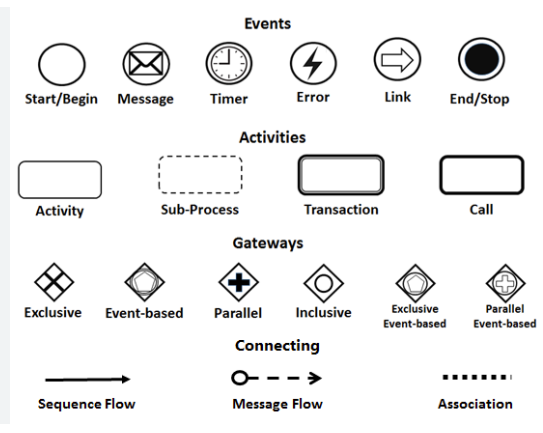
Acting as an expert business analyst, the AI decomposes the narrative into discrete operational entities:
-
Pools/Lanes: Identifying actors and departments.
-
Triggers: Defining start and end events.
-
Tasks: Isolating specific actions.
-
Gateways: Recognizing decision points and parallel paths.
-
Message Flows: Mapping interactions between different entities.
These elements are structured into a sequential Interaction Story, serving as the intermediate representation before visualization.
Stage 3: Instant BPMN 2.0 Visualization
The structured story compiles automatically into a standard-compliant BPMN 2.0 visual model. The AI applies sophisticated layout rules, such as:
-
Keeping sequence flows within lanes.
-
Routing message flows across pool boundaries.
-
Balancing converging and diverging gateways for readability.
Stage 4: Refinement, KPIs, & Governance Artifacts
Beyond visualization, the AI leverages the underlying semantic model to:
-
Extract operational Key Performance Indicators (KPIs).
-
Detect single-point-of-failure risks.
-
Synthesize structured implementation roadmaps.
-
Generate complementary models (UML Class Diagrams, ERDs).
2. Key Concepts & Concrete BPMN 2.0 Examples
Below are three comprehensive, domain-specific examples demonstrating how natural language descriptions map directly into structured BPMN 2.0 constructs.
Example 1: Enterprise Procurement & Invoice Approval
This example illustrates conditional routing using Exclusive Gateways (XOR) and cross-departmental communication.
Natural Language Input:
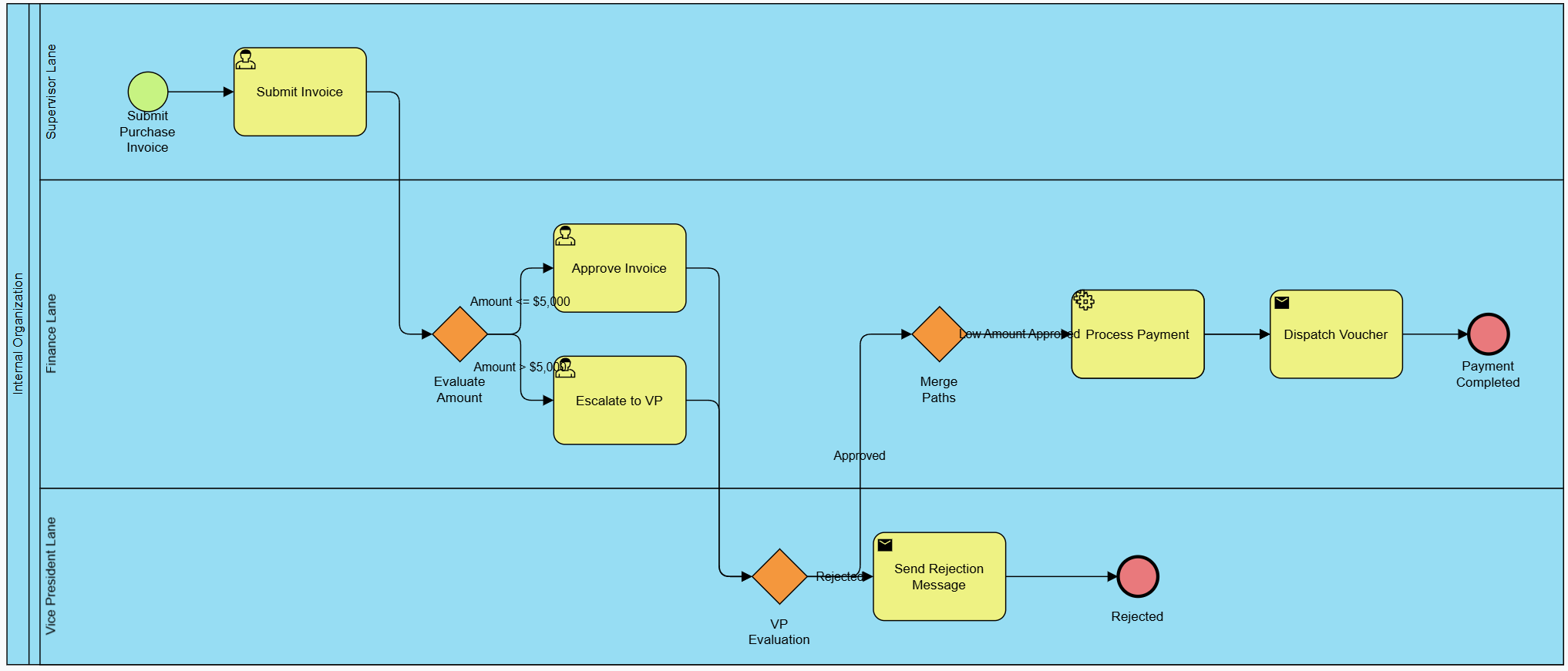
“A department supervisor submits a purchase invoice for approval. If the amount is below $5,000, the Finance Manager automatically approves it and issues payment. If it exceeds $5,000, it requires Vice President approval. If the VP rejects the invoice, a notification is sent to the department supervisor, and the process terminates. If approved, Finance schedules the payment transfer and sends a payment voucher to the vendor.”
Structured Interaction Story (AI Generated):
-
Supervisor Lane: Submits Purchase Invoice (Start Event).
-
Finance Lane: Evaluates Invoice Amount threshold ($5,000) (Exclusive Gateway / XOR Split).
-
Branch A (≤ $5,000): Direct approval by Finance Manager.
-
Branch B (> $5,000): Escalates to Vice President Lane.
-
-
VP Lane: Evaluates high-value invoice (Exclusive Gateway / XOR Split).
-
If Rejected: Send Rejection Message to Supervisor → (End Event: Rejected).
-
If Approved: Merge with Branch A (Exclusive Gateway Merge).
-
-
Finance Lane: Process Payment & Dispatch Payment Voucher to Vendor Pool → (End Event: Payment Completed).
BPMN 2.0 Element Mapping:
| BPMN Element Category | Process Component | BPMN 2.0 Standard Notation |
|---|---|---|
| Pools / Lanes | Internal Organization | Lanes: Supervisor, Finance Manager, Vice President |
| Start Event | Invoice Receipt | None / Message Start Event |
| Gateways | Amount & Approval Routing | Exclusive Gateways (XOR) for conditional paths |
| End Events | Termination States | End Event (Invoice Rejected) / End Event (Payment Dispatched) |
Example 2: B2C E-Commerce Order Fulfillment & Exception Handling
This example demonstrates parallel execution (AND Gateways), timer events, and external message flows.
Natural Language Input:
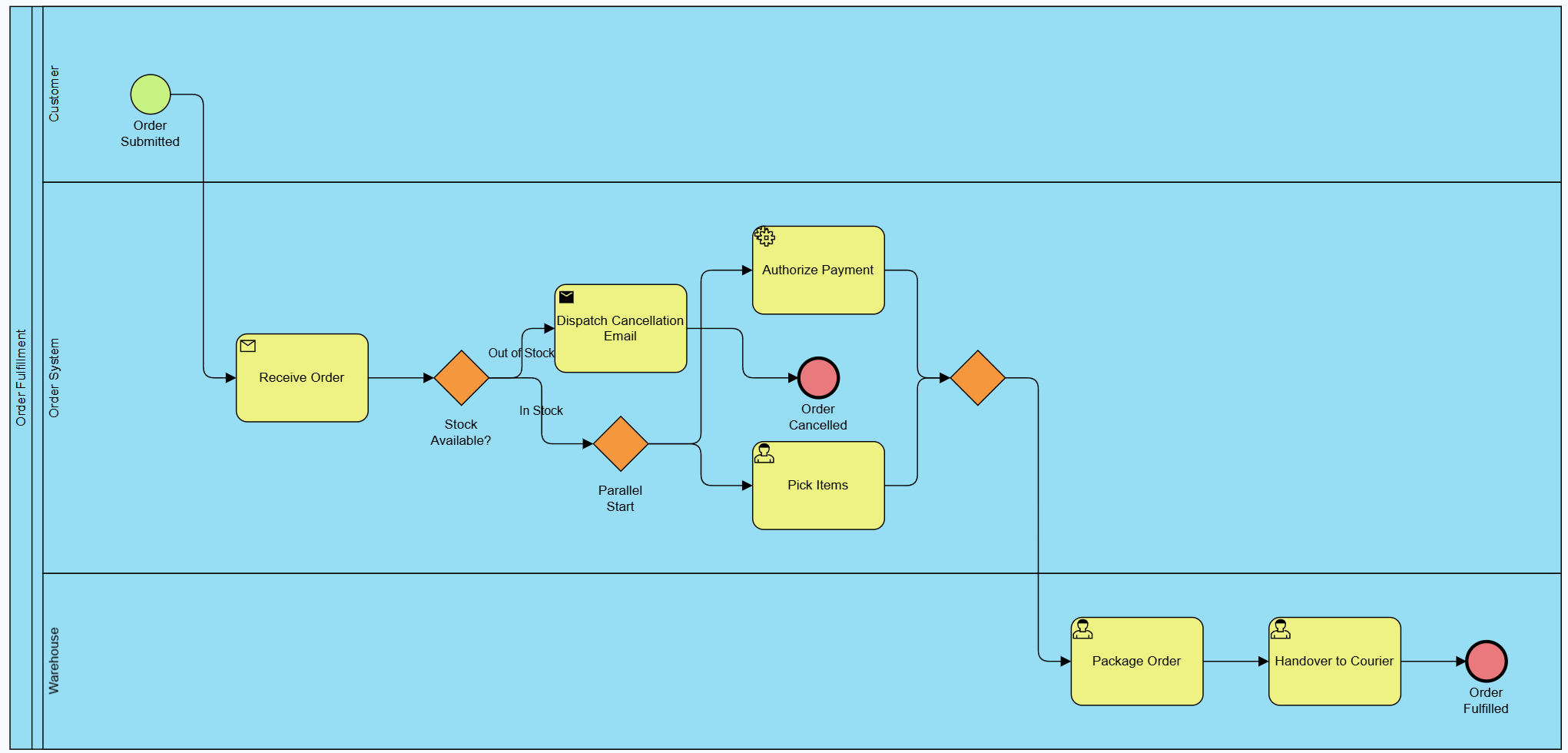
“When a customer places an online order, the Order System checks item inventory. If out of stock, an immediate cancellation email is dispatched to the customer. If in stock, payment authorization and warehouse picking occur simultaneously. If payment fails within 15 minutes, the order is cancelled. Once picking and payment both succeed, the warehouse packages the order and hands it to the courier service.”
Structured Interaction Story (AI Generated):
-
Customer Pool: Places Order → Order System Pool (Message Start Event).
-
Order System: Evaluates Stock Availability (Exclusive Gateway).
-
Out of Stock: Dispatch Cancellation Email → (End Event: Order Cancelled).
-
In Stock: Split execution (Parallel Gateway / AND Fork).
-
-
Parallel Execution:
-
Branch 1: Authorize Payment (Attached: 15-min Timer Boundary Event → Cancel Order).
-
Branch 2: Pick items in Warehouse.
-
-
Synchronization: Rejoin parallel branches (Parallel Gateway / AND Join).
-
Warehouse Lane: Package Order & Handover to Courier Pool → (End Event: Order Fulfilled).
BPMN 2.0 Element Mapping:
| BPMN Element Category | Process Component | BPMN 2.0 Standard Notation |
|---|---|---|
| Gateways | Inventory & Concurrent Tasks | Exclusive Gateway (XOR), Parallel Gateway (AND Fork/Join) |
| Events | 15-Minute Payment Timeout | Timer Interrupting Boundary Event |
| Message Flows | External Interaction | Dashed arrows between Customer, Order System, and Courier Pools |
Example 3: IT Incident Response & Escalation Framework
This example highlights timer-based escalations and parallel resolution activities.
Natural Language Input:
“An automated monitoring alert triggers an Incident Ticket. Service Desk Level 1 investigates within 30 minutes. If resolved, the ticket is updated and closed. If unresolved after 30 minutes, the ticket automatically escalates to Level 2 Engineering. Level 2 conducts diagnostic repairs. If a critical system bug is identified, a patch is released to production while simultaneously updating the customer success team.”
Structured Interaction Story (AI Generated):
-
Monitoring System: Fires error payload → Service Desk (Message Start Event).
-
Level 1 Support: Conducts triage (30-min Timer Boundary Event attached).
-
Exclusive Gateway: Check resolution status.
-
Resolved: Close Ticket → (End Event: Closed).
-
Unresolved / Timeout: Escalate to Level 2 Engineering.
-
-
Level 2 Engineering: Perform root-cause diagnostics.
-
Parallel Gateway: Deploy production hotfix AND notify Customer Success Team → (End Event: Incident Resolved).
BPMN 2.0 Element Mapping:
| BPMN Element Category | Process Component | BPMN 2.0 Standard Notation |
|---|---|---|
| Events | SLA Timer | Non-Interrupting Timer Boundary Event |
| Gateways | Resolution Check & Parallel Fix | Exclusive Gateway (XOR), Parallel Gateway (AND) |
| Tasks | Diagnostic & Deployment | Service Task / Manual Task |
3. Automated KPI Synthesis & Governance Artifacts
One of the most powerful features of AI-driven BPMN generation is the ability to infer governance metrics from the process topology. When compiling natural language narratives into BPMN models, the AI evaluates the structure to recommend relevant Key Performance Indicators (KPIs).
| Process Domain | Critical BPMN Node / Flow | AI-Suggested KPI Metric | Strategic Insight |
|---|---|---|---|
| Procurement | VP Approval Gateway | Approval Dwell Time | Tracks approval latency for high-value purchases. |
| E-Commerce | Timer Boundary Event (15 min) | Payment Timeout Drop-off Rate | Identifies friction in payment gateway authorizations. |
| IT Incident | Escalation Gateway (L1 to L2) | First-Contact Resolution (FCR) & MTTR | Evaluates L1 triage effectiveness and resolution speeds. |
Multi-Model Outputs
Beyond BPMN 2.0 diagrams, modern AI process engines extract relational context to generate complementary engineering models from the same input:
-
UML Class Diagrams: Mapping domain entities, attributes, and structural associations.
-
Entity-Relationship Diagrams (ERDs): Generating database schemas required to persist process states.
-
Implementation & Risk Assessment Reports: Highlighting operational single points of failure, compliance gaps, and resource requirements.
4. Key Benefits of AI Transformation
-
Speed and Efficiency: Moving from an unstructured problem description to a complete BPMN 2.0 model takes minutes instead of hours or days of manual workshop sketching.
-
Standards Compliance: Generates syntactically accurate models that adhere strictly to BPMN 2.0 standards, ensuring consistency across business and IT divisions.
-
Bridging the Business-IT Strategy Gap: Converts high-level business goals directly into technical specifications, reducing misunderstandings during system implementation.
-
Enhanced Governance: Automatically suggests KPIs and risk metrics, enabling proactive process optimization rather than reactive troubleshooting.
5. Conclusion & Tooling Spotlight
The “Describe, Don’t Draw” paradigm transforms how modern enterprises design, document, and optimize business processes. By automating the mechanical translation of natural language descriptions into formal BPMN 2.0 architectures, organizations eliminate manual modeling overhead while elevating the clarity and precision of their operational documentation.
Leading enterprise analysis platforms, such as Visual Paradigm’s Intelligent BPM and Analysis Suite, exemplify this technology. Through its integrated AI wizard and automated modeling pipelines, Visual Paradigm allows enterprise architects to convert business narratives into fully compliant BPMN 2.0 diagrams, complete with stakeholder interaction models, automated KPI suggestions, and executive implementation reports.
By taking advantage of Visual Paradigm’s AI capabilities, teams can spend less time manually drawing shapes and more time driving strategic business transformation. As AI continues to evolve, the role of the business analyst will shift from diagram drafter to strategic orchestrator, leveraging these tools to ensure that every process model is not just a diagram, but a living blueprint for operational excellence.
