
From Text to Enterprise Model: Mastering VPasCode for BPMN-as-Code
In the world of Business Process Management (BPM), there has long been a trade-off between speed and standards. Traditional modeling tools offer deep standards compliance but are slow and often require a steep learning curve for non-technical users. Conversely, text-based tools offer speed but often lack the semantic rigor required for enterprise-grade workflows.
VPasCode bridges this gap by introducing a “BPMN-as-Code” paradigm. This tutorial explores the architectural flow of transforming simple text descriptions into fully operational enterprise models, ensuring that your processes are not only drafted quickly but are also simulation-ready and standards-compliant.
The VPasCode Workflow: A Four-Step Architecture
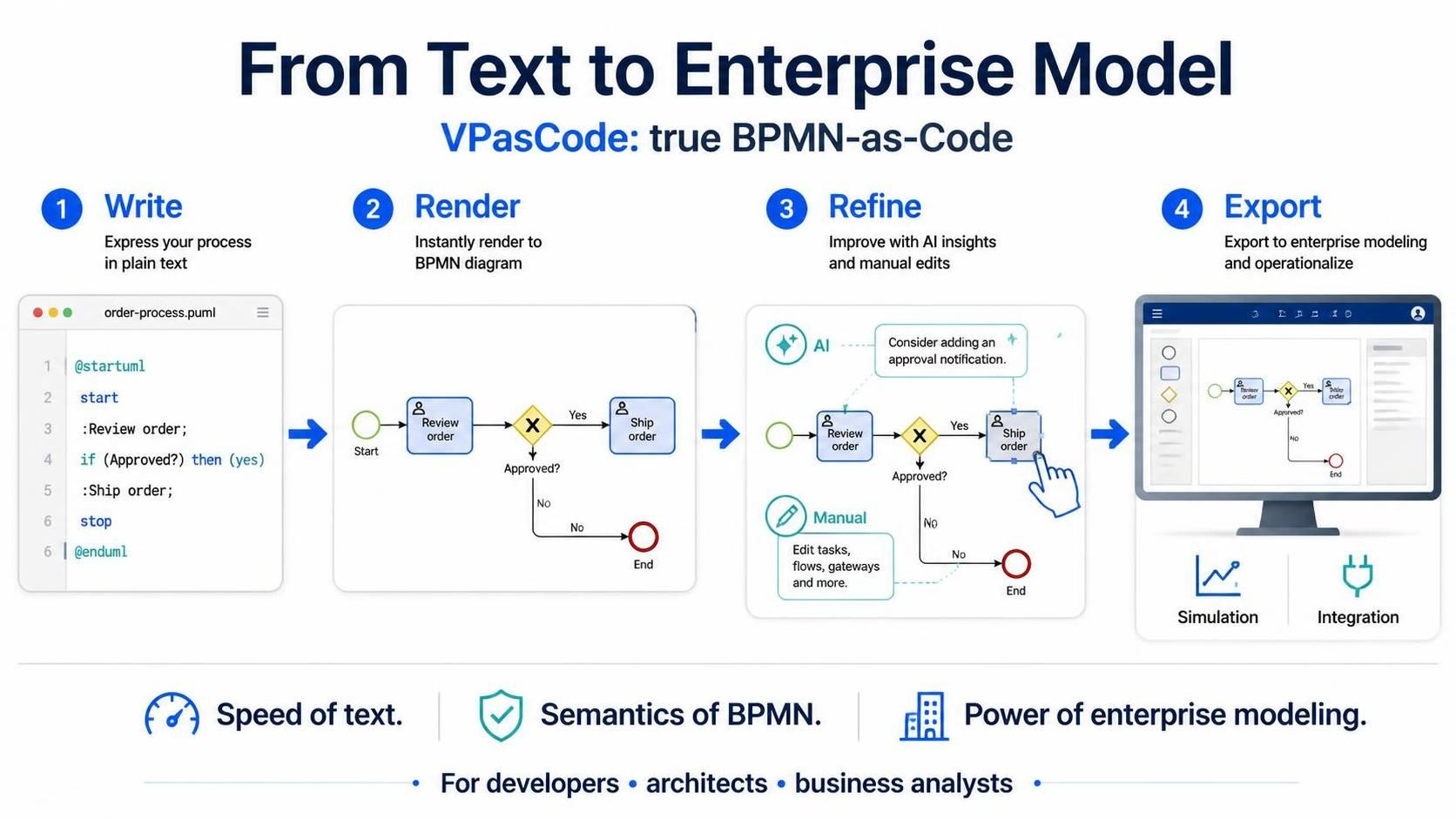
The core philosophy of VPasCode is to redefine what “diagram-as-code” means for business processes. It is not merely about drawing shapes faster; it is about modeling smarter. The system architecture operates through a seamless four-stage pipeline:
1. Write: Express Your Process in Plain Text
The workflow begins with the “Write” stage. Instead of dragging and dropping boxes, developers and business analysts express logic using a familiar, text-based syntax. VPasCode utilizes a syntax that closely resembles PlantUML, making it accessible to those familiar with documentation-as-code.
During this phase, you define the start, end, and the logic flow of your process. The tool parses natural language-like commands to understand the sequence of events.
@startuml
start
:Review order;
if (Approved?) then (yes)
  :Ship order;
endif
stop
@enduml
Notice how the conditional logic if (Approved?) then (yes) is written directly in the text file. This allows for version control (Git) and rapid iteration without the friction of mouse clicks.
2. Render: Instantly Render to BPMN Diagram
Once the text is written, the VPasCode engine instantly compiles it into a visual representation. This “Render” step translates the abstract text into a concrete BPMN 2.0 compliant diagram.
- Semantic Task Types: The system automatically assigns the correct BPMN shapes. For example, “Review order” becomes a User Task, and the “Approved?” condition becomes a Exclusive Gateway (XOR).
- Visual Accuracy: The output isn’t a rough sketch; it is a standard-compliant diagram ready for review.
The engine ensures that the resulting diagram adheres to strict enterprise modeling standards, eliminating the ambiguity often found in hand-drawn diagrams.
3. Refine: Improve with AI Insights and Manual Edits
The “Refine” stage is where the system transitions from a drafting tool to a collaborative partner. VPasCode integrates with the Visual Paradigm AI Chatbot to offer intelligent suggestions.
As you refine the model, you have two primary modes of editing:
- AI Assistance: The AI can analyze your process flow and suggest improvements, such as “Consider adding an approval notification” for critical steps.
- Manual Edits: You can directly edit tasks, flows, and gateways within the visual interface. This allows for fine-tuning the BPMN semantics that might be too complex to express purely in text.
This hybrid approach ensures that the model remains flexible. You can toggle between code-based logic and visual adjustments effortlessly.
4. Export: Export to Enterprise Modeling and Operationalize
The final step is “Export.” Once the model is refined, VPasCode serves as a bridge to the broader Visual Paradigm Desktop environment. This is crucial for the “Enterprise” aspect of the workflow.
Exporting to the desktop environment unlocks:
- Full Simulation: Run the process to identify bottlenecks before deployment.
- Integration: Export the model to execute on actual workflow engines (e.g., Camunda, Bonita).
- Traceability: Maintain a link between the code and the enterprise model for audit purposes.
Why This Architecture Matters
The “From Text to Enterprise Model” approach solves the fragmentation often seen in software development. By using a single source of truth (the text file) that can be rendered instantly and exported to powerful enterprise tools, teams achieve:
- Speed of Text: Rapid prototyping without the UI lag of traditional tools.
- Semantics of BPMN: Guaranteed compliance with industry standards.
- Power of Enterprise Modeling: Access to high-level simulation and integration capabilities.
For developers, architects, and business analysts who demand both speed and standards, VPasCode is the definitive tool for the future of BPMN modeling.