
Democratizing Systems Modeling with VP AI Ecosystem
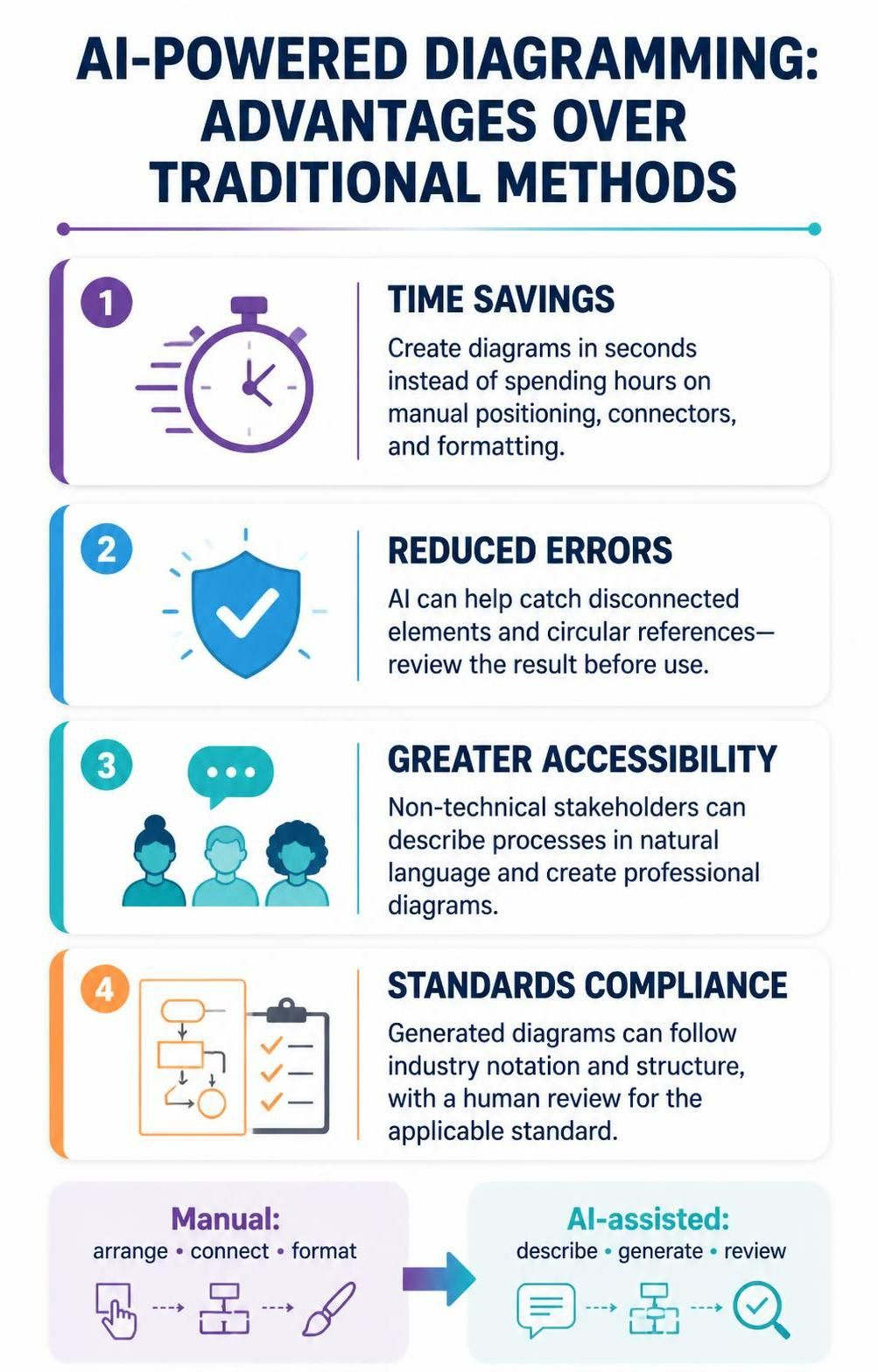
In the rapidly evolving landscape of software engineering and business analysis, the barrier to entry for creating professional system architecture diagrams has traditionally been steep. It required mastery of complex tools, deep knowledge of notation standards (like UML or BPMN), and hours of tedious manual layout work. However, a new paradigm is shifting this dynamic. By leveraging Artificial Intelligence, tools like Visual Paradigm are now enabling non-technical stakeholders to generate accurate, standards-compliant diagrams through natural language descriptions.
This tutorial explores the technical and conceptual shift from manual diagramming to AI-assisted modeling, analyzing the four key advantages that are redefining how we document system architecture.
1. The Efficiency Revolution: Time Savings
The most immediate impact of AI-driven diagramming is the drastic reduction in “time-to-value.” In traditional environments, creating a high-quality Data Flow Diagram (DFD) or a UML Sequence Diagram involves a significant amount of “friction.”
- Manual Positioning: Engineers often spend more time dragging and dropping boxes to ensure they don’t overlap than they do defining the actual logic.
- Formatting: Ensuring lines are orthogonal and colors are consistent requires attention to detail that distracts from the core modeling task.
- Connectors: Manually drawing every arrow is a repetitive, error-prone process.
AI automation eliminates this friction. The system automatically calculates the optimal position for elements, draws the connectors based on the logical flow, and applies the correct styling. What traditionally took hours of manual labor can now be achieved in seconds, allowing architects to focus on the “what” and “why” of the system rather than the “how” of the drawing.
2. Logical Integrity: Reduced Errors
One of the most insidious problems in manual modeling is logical inconsistency. When a human draws a diagram, it is easy to miss a connection, create a circular reference, or violate a rule of the specific notation being used. These errors often only surface during code implementation or stakeholder reviews, leading to costly rework.
AI engines operate on a logic-first basis. When generating a diagram, the system validates the relationships between entities. It ensures that:
- Every external entity has a defined flow.
- Data stores are accessed logically.
- Circular dependencies are flagged or prevented.
By enforcing these rules automatically, the AI acts as a real-time validator, ensuring the resulting model is structurally sound before a human ever looks at it.
3. Accessibility: The Natural Language Bridge
Perhaps the most transformative advantage is accessibility. Historically, diagramming tools were designed for “modelers”—people with specific technical training. Business analysts, product managers, and domain experts often struggled to translate their mental models into precise diagrammatic syntax.
AI-assisted tools bridge this gap by acting as a translator. Instead of forcing a stakeholder to learn the specific syntax of a tool, they can describe a process in plain English (or their native language). The AI parses this natural language, identifies the actors, processes, and data flows, and constructs the diagram.
This democratization allows for better collaboration. The “diagram creation process” is no longer a bottleneck reserved for IT specialists; it becomes a shared activity where business logic is instantly visualized.
4. Standards Compliance: Professional Quality by Default
In professional environments, diagrams are not just sketches; they are documentation that must adhere to strict industry standards (such as ISO standards for BPMN or the UML specification). Manual diagramming often results in “diagrammatic drift,” where symbols are used incorrectly or layouts are inconsistent.
AI generation ensures strict adherence to these conventions. The system knows that a decision diamond in a flowchart must have exactly two exit paths (True/False) or a specific set of symbols in UML Class diagrams. By automating the adherence to these rules, the generated diagrams are inherently professional and compliant, removing the need for deep knowledge of diagramming conventions to produce high-quality results.
Conclusion: The Future of Modeling
The transition from “Manual” to “AI-Assisted” represents a fundamental change in the workflow. The manual process is defined by arrange, connect, and format—a mechanical execution of design. The AI-assisted process is defined by describe, generate, and review—a strategic execution of design.
By offloading the mechanical aspects of diagramming to AI, technical and non-technical teams alike can achieve higher fidelity in their documentation, faster turnaround times, and a clearer understanding of complex system architectures.