
Mastering BPMN Sequence Flow: The Backbone of Process Execution in Visual Paradigm
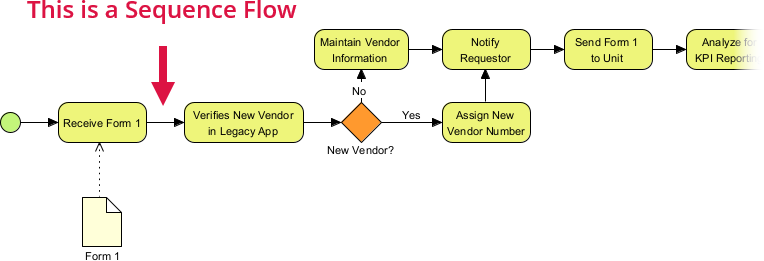
In the world of business process modeling and system architecture, the movement of information is just as critical as the information itself. When you look at a diagram like the one provided, you are seeing a story of logic, decision-making, and operational flow. At the center of this narrative is the Sequence Flow.
This tutorial will guide you through the fundamental role of Sequence Flow within the Visual Paradigm environment. We will dissect how it acts as the primary driver of control flow, how it interacts with gateways to manage logic, and the specific best practices for maintaining diagram integrity.
Defining the Sequence Flow
The Sequence Flow is the standard connector used to represent the order in which steps or activities are executed. Unlike Message Flows, which jump between different pools, the Sequence Flow is the “glue” that holds a process together. It is the primary driver of control flow within a process, ensuring that the process token—the virtual agent executing the logic—moves from the Start Event to the End Event in the correct order.
In the context of the “Vendor Registration” process shown in the reference image, the Sequence Flow connects the Receive Form 1 task directly to the Verifies New Vendor in Legacy App task. This establishes a strict dependency: the verification cannot happen until the form is received.
Key Characteristics of Sequence Flow
- Scope: Sequence Flows are strictly contained within a single pool or lane. They cannot cross pool boundaries.
- Function: They define the path the process token takes from start to end.
- Execution: When an activity finishes, execution automatically moves along the Sequence Flow to the next node.
Managing Logic with Gateways
While Sequence Flows represent the standard path of execution, real-world processes are rarely linear. They involve decisions, loops, and parallel processing. This is where the Gateway becomes essential.
Looking at the provided diagram, you will see a diamond-shaped gateway labeled New Vendor?. This is a decision point. Here is how Sequence Flow behaves when interacting with gateways:
- Incoming Flow: A Sequence Flow brings the token into the gateway.
- Decision Logic: The gateway evaluates a condition (e.g., Is this a new vendor? Yes/No).
- Outgoing Flow: Depending on the result, the Sequence Flow branches out. The token travels along only one path.
- If the answer is Yes, the flow goes to Assign New Vendor Number.
- If the answer is No, the flow goes to Maintain Vendor Information.
The Sequence Flow does not just connect shapes; it carries the logic of the decision. Without the Sequence Flow, the gateway would be an isolated island with no way to direct the process.
Visual Paradigm Implementation Best Practices
When modeling in Visual Paradigm, ease of use is often balanced with strict architectural rules. Visual Paradigm is designed to be intuitive, but understanding its validation logic is crucial for professional modeling.
The Drag-and-Drop Mechanism:
In Visual Paradigm, creating a Sequence Flow is as simple as dragging a connector from one shape to another. However, the software enforces strict boundaries based on the location of the shapes.
The Pool Boundary Rule
One of the most common errors for beginners is the accidental creation of invalid flows. If you drag a connector from a task inside one pool to a task in a different pool, Visual Paradigm will not allow it to become a Sequence Flow. Instead, it will trigger a validation error or attempt to create a Message Flow (which requires specific configuration).
Correct Usage: Ensure you only drag connectors between shapes that reside within the same pool or lane. This ensures the diagram accurately reflects that the activities are part of the same process execution context.
Conclusion
The Sequence Flow is the heartbeat of any BPMN diagram. It transforms a static collection of shapes into a dynamic, executable model. By understanding how it drives control flow and how it interacts with decision gateways, you can build robust process models in Visual Paradigm that are both visually clear and logically sound.