Object-oriented programming (OOP) relies heavily on the principles of inheritance and polymorphism to create scalable, maintainable software architectures. When modeling these systems, Unified Modeling Language (UML) class diagrams serve as the blueprint for developers. Understanding how to represent these complex relationships visually is critical for clear communication between stakeholders and engineering teams. This guide explores the mechanics of inheritance and polymorphism within the context of UML, providing a structured approach to modeling these concepts effectively.
Understanding Inheritance in UML 🏗️
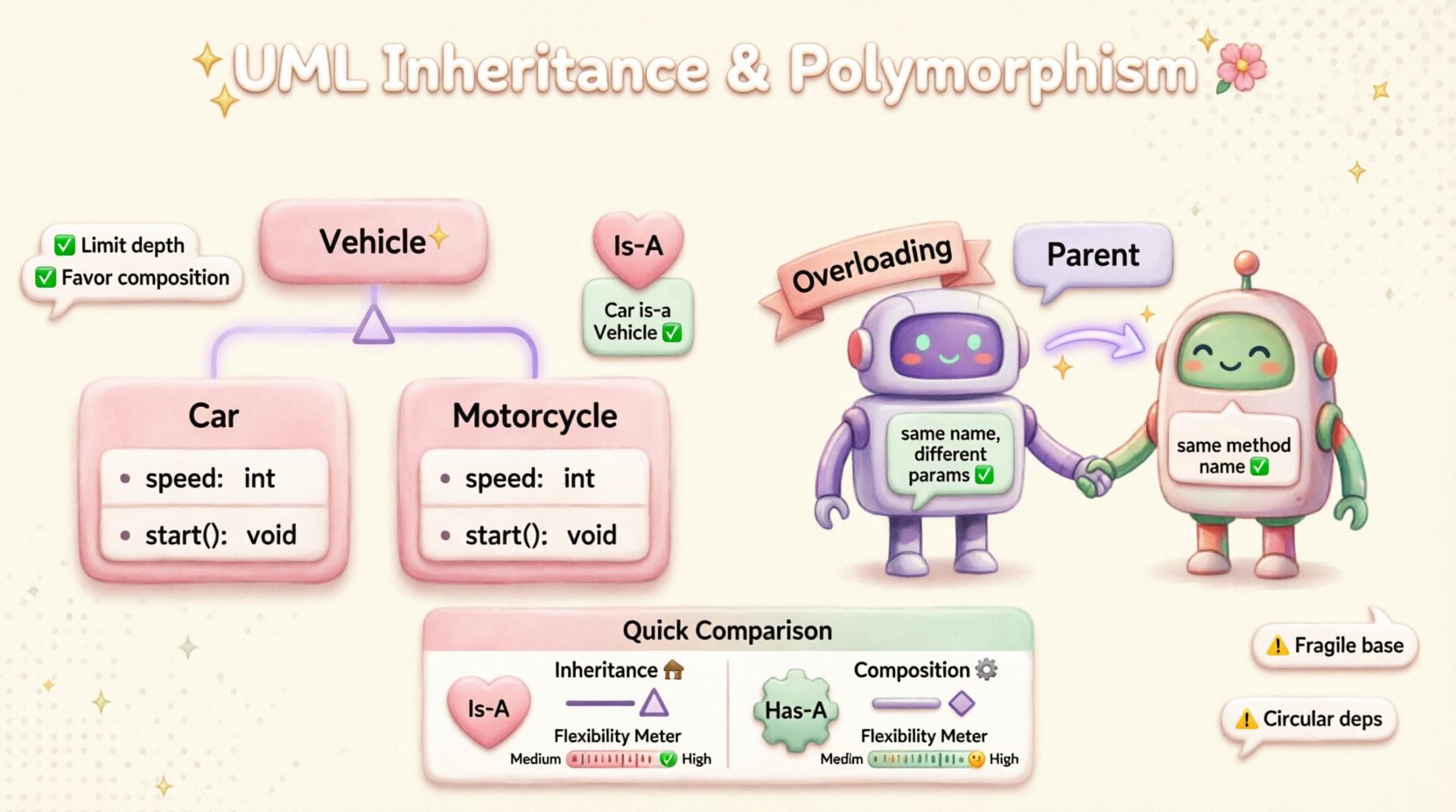
Inheritance is a mechanism where a new class derives properties and behaviors from an existing class. This relationship establishes a hierarchy, allowing code reuse and logical organization. In UML, this is formally known as generalization. It represents a “Is-A” relationship. For instance, a Car is a Vehicle. This structure reduces redundancy and allows for the centralization of common attributes.
The Generalization Relationship 📐
The core of inheritance lies in the Generalization relationship. When you define a superclass (or parent class), you define a contract that subclasses (or child classes) must adhere to. This relationship is directional. The arrow in a UML diagram points from the subclass to the superclass. This directionality is crucial for understanding the flow of dependency and responsibility.
- Superclass: The general class that holds common attributes and methods.
- Subclass: The specialized class that inherits from the superclass.
- Attributes: Data fields shared across the hierarchy.
- Methods: Behaviors that can be overridden or extended.
The “Is-A” Concept 🧠
Validating an inheritance relationship often comes down to the “Is-A” test. If you can say the subclass is a type of superclass without the statement being false, inheritance is appropriate. Consider the following examples:
Employeeis aPerson✅Manageris aEmployee✅Caris aVehicle✅Engineis aCar❌ (This is a “Has-A” relationship, requiring composition or aggregation).
Using inheritance incorrectly can lead to rigid code structures that are difficult to modify. It is vital to ensure that the hierarchy makes logical sense before drawing the lines.
Visualizing Inheritance in UML 🛠️
The notation for inheritance is standardized across UML tools. Recognizing the visual cues ensures that any developer reading the diagram understands the architecture immediately.
- Solid Line: Indicates a direct relationship.
- Hollow Triangle Arrowhead: Points toward the superclass (parent).
- Class Boxes: Rectangular shapes divided into sections for Class Name, Attributes, and Methods.
When multiple subclasses inherit from a single superclass, the diagram shows a tree structure. This visual hierarchy helps in identifying shared responsibilities and distinct specializations.
Polymorphism Explained 🔄
Polymorphism allows objects of different classes to be treated as objects of a common superclass. This capability enables flexibility in design, allowing methods to behave differently depending on the object they act upon. In UML, polymorphism is often implicit through inheritance, but specific notations can highlight interfaces and abstract methods.
Compile-Time vs Runtime Polymorphism ⏱️
Understanding the timing of polymorphism is essential for accurate modeling. The two primary forms are:
- Compile-Time (Static): Also known as method overloading. Different methods share the same name but differ in parameters. This is less about inheritance and more about method signatures.
- Runtime (Dynamic): Also known as method overriding. A subclass provides a specific implementation of a method that is already defined in its superclass. This is the core of polymorphism in inheritance hierarchies.
Overloading vs Overriding 🔄
Distinguishing between these two concepts prevents confusion during the design phase. Overloading occurs within a single class, whereas overriding occurs across classes in a hierarchy.
| Feature | Overloading | Overriding |
|---|---|---|
| Context | Same Class | Parent and Child Classes |
| Method Signature | Different Parameters | Same Parameters |
| Return Type | Can be different | Must be the same |
| UML Notation | Often implicit in class box | Explicitly shown with override keyword |
UML Notation Details for Polymorphism 📝
To accurately represent polymorphic behavior, specific annotations are used within the class diagram. These details clarify which methods are abstract and which are concrete implementations.
Abstract Classes and Methods 📌
Abstract classes cannot be instantiated directly. They serve as templates for subclasses. In UML, the name of an abstract class is typically written in italics. Similarly, abstract methods are italicized. This visual cue informs developers that these methods must be implemented by any concrete subclass.
- Abstract Class:
PaymentProcessor - Abstract Method:
processPayment()
Interfaces 🌐
While inheritance allows for code reuse, interfaces define a contract. A class can implement multiple interfaces, even if it inherits from only one superclass. In UML, interfaces are often represented by a class box with the <<interface>> stereotype. Alternatively, a class box with a specific icon is used.
- Implementation Relationship: Dashed line with a hollow triangle arrowhead pointing to the interface.
- Usage Relationship: Sometimes used to show dependency on an interface.
Best Practices for Class Modeling ✅
Designing effective class diagrams requires adherence to established principles. Following these guidelines ensures the model remains understandable and scalable over time.
- Limit Depth: Deep inheritance hierarchies become difficult to manage. Aim for 2-3 levels of depth maximum.
- Favor Composition: If the relationship is “Has-A” rather than “Is-A”, use composition or aggregation instead of inheritance.
- Single Responsibility: Each class should have one reason to change. Avoid creating “God Classes” that do too much.
- Encapsulation: Hide implementation details. Use visibility modifiers (
+for public,-for private) clearly. - Consistency: Maintain consistent naming conventions across all classes and relationships.
Common Pitfalls ⚠️
Even experienced designers encounter errors when modeling complex systems. Recognizing these pitfalls early can save significant refactoring work later.
The Fragile Base Class Problem 💔
This occurs when a change in a superclass breaks the functionality of subclasses. Because subclasses depend on the internal implementation of the superclass, modifying the parent can have unforeseen consequences. To mitigate this, rely on interfaces and abstract classes where the contract is stable, but the implementation is not.
Circular Dependencies 🔁
Classes should not depend on each other in a loop. If Class A depends on Class B, and Class B depends on Class A, the system becomes tightly coupled. This often indicates a design flaw where the responsibilities are not properly separated.
Misusing Inheritance for Code Reuse 🔄
Inheritance is often misused simply to copy code. If two classes share functionality but are not related by an “Is-A” relationship, inheritance is the wrong tool. In these cases, extract the shared logic into a utility class or use composition to delegate tasks.
Comparison: Inheritance vs Composition 📊
Choosing between inheritance and composition is one of the most common decisions in object-oriented design. Composition is often preferred for flexibility, while inheritance is better for type hierarchy.
| Criteria | Inheritance | Composition |
|---|---|---|
| Relationship | “Is-A” | “Has-A” |
| Flexibility | Low (Compile-time) | High (Runtime) |
| Code Reuse | Yes, via hierarchy | Yes, via delegation |
| UML Line | Solid with hollow triangle | Solid with filled diamond |
| Lifecycle | Independent | Dependent (Child part dies with parent) |
Advanced Scenarios 🚀
Complex systems often require handling multiple inheritance scenarios or abstract interfaces. While standard UML does not support multiple inheritance for classes in all languages (like Java), it is supported in others (like C++). In diagrams, a subclass can have multiple inheritance lines pointing to multiple superclasses.
Mixins and Traits 🧩
In modern design patterns, mixins or traits allow a class to inherit behavior from multiple sources without full inheritance. In UML, these are often represented as separate class boxes connected via a dashed line with a specific stereotype indicating the mixin nature.
Interface Implementation 🛡️
When a class implements multiple interfaces, it adheres to multiple contracts. This is visualized by multiple dashed lines with hollow triangles pointing to each interface. This structure allows for polymorphism across different capabilities, such as Serializable and Comparable.
Summary of Key Concepts 🔑
Effective modeling of inheritance and polymorphism in UML class diagrams requires a clear understanding of object relationships. By adhering to standard notations and avoiding common pitfalls, you can create diagrams that accurately reflect the underlying system architecture.
- Inheritance establishes a type hierarchy using generalization.
- Polymorphism allows subclasses to override behavior while maintaining a common interface.
- UML Notation uses specific arrows and stereotypes to denote abstract classes and interfaces.
- Design Choices should prioritize composition over inheritance when flexibility is key.
By applying these principles, developers and architects can build robust systems that are easier to understand, extend, and maintain. The visual clarity provided by well-structured UML diagrams bridges the gap between theoretical design and practical implementation.