
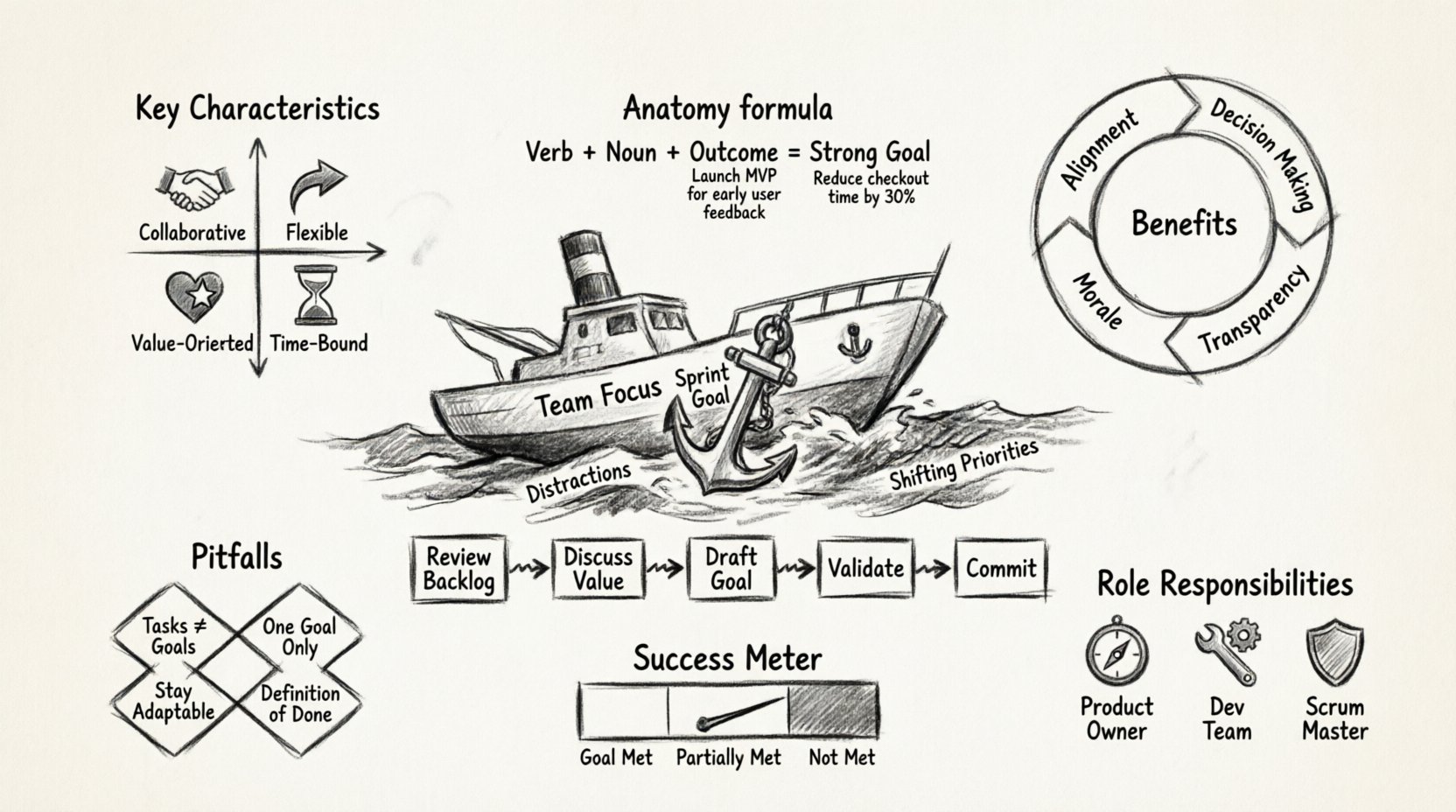
In the fast-paced environment of software development and product delivery, distraction is the enemy of progress. Teams often find themselves juggling multiple requests, shifting priorities, and a backlog that seems to grow faster than work gets completed. Without a clear destination, even the most skilled teams can drift. This is where the Sprint Goal becomes the anchor. It provides the necessary focus to ensure that every effort made during the Sprint contributes to a singular, valuable outcome.
Setting achievable Sprint Goals is not just about checking a box in a planning session. It is a strategic exercise that aligns the Development Team, the Product Owner, and stakeholders on what value is being delivered. This guide explores the mechanics of creating effective goals, why they are critical for focus, and how to maintain them throughout the Sprint lifecycle.
📌 What is a Sprint Goal?
According to the Scrum Guide, the Sprint Goal is a formalization of the value the Sprint aims to deliver. It is a short statement describing what the Development Team plans to achieve during the Sprint. While the Sprint Backlog contains the specific items selected to meet this goal, the goal itself is the why behind the work.
It is important to distinguish between a Sprint Goal and a list of tasks. A task is a technical step (e.g., “Update API endpoint”). A goal is a business outcome (e.g., “Enable users to reset passwords via email”). The goal provides flexibility. If the team discovers a technical hurdle, they can adjust the tasks in the Sprint Backlog, but the goal remains the guiding star.
Key Characteristics
- Collaborative: It is not assigned by the Product Owner alone. The Development Team must agree on its feasibility.
- Flexible: It is not a contract that binds the team to specific features regardless of technical reality. It is a target to aim for.
- Value-Oriented: It focuses on the benefit to the customer or user, not just the output of code.
- Time-Bound: It is relevant only for the duration of the current Sprint.
🚀 Why Focus Matters in Scrum
Focus is a scarce resource. In modern development contexts, cognitive load is high, and context switching is costly. A well-defined Sprint Goal reduces the need for constant decision-making regarding priorities. When the team is unsure of what to work on next, they can refer to the goal. If a task does not contribute to the goal, it can be deprioritized or moved to the backlog.
The Benefits of a Clear Goal
- Alignment: Everyone understands the shared objective. Stakeholders see progress toward the goal, not just a list of completed tickets.
- Decision Making: When scope changes occur, the goal acts as a filter. Can we still achieve the goal with the remaining time? If yes, the change is acceptable. If no, the goal might need to be adjusted.
- Morale: Completing a meaningful goal provides a sense of accomplishment that is more significant than finishing individual tasks.
- Transparency: It allows the team to communicate progress clearly. Progress is measured against the goal, not just the number of items checked off.
🛠️ The Anatomy of a Strong Sprint Goal
Not all goals are created equal. A vague goal like “Improve performance” is difficult to measure and hard to focus on. A strong goal is specific enough to guide work but flexible enough to allow for technical adaptation.
When drafting a goal, consider the following elements:
- Verb: Start with an action word (e.g., “Enable,” “Deploy,” “Integrate,” “Launch”).
- Noun: Identify the feature or capability (e.g., “user registration,” “checkout flow”).
- Outcome: Hint at the value (e.g., “to reduce drop-off,” “to support mobile users”).
Aim for brevity. The goal should fit on one line and be memorable. If it requires a paragraph to explain, it is likely too complex for a single Sprint.
📝 How to Create a Sprint Goal: Step-by-Step
Creating a Sprint Goal is a collaborative process that typically happens during Sprint Planning. It should not be an afterthought. Here is a structured approach to setting achievable goals.
Step 1: Review the Product Backlog
The Product Owner presents the highest priority items. These items represent the next best value for the customer. The team reviews these items to understand the potential scope.
Step 2: Discuss Value and Feasibility
The Development Team asks questions about the items. They clarify requirements and estimate effort. During this discussion, the Product Owner explains the value behind the items. This conversation helps identify which items can be combined to form a coherent goal.
Step 3: Draft the Goal
Based on the selected items, the Product Owner and the Development Team draft a potential goal. It should reflect the collective understanding of what is possible within the Sprint timebox.
Step 4: Validate the Goal
Does the goal make sense? Is it achievable? If the team feels the goal is too ambitious, they should speak up during planning. It is better to set a smaller, achievable goal than to fail at a large one.
Step 5: Commit to the Goal
Once agreed upon, the Sprint Goal is recorded in the Sprint Backlog. It is now the primary focus for the next 1 to 4 weeks. The team works to achieve it.
⚠️ Common Pitfalls in Goal Setting
Even experienced teams can stumble when setting goals. Awareness of common mistakes helps avoid them.
1. Confusing Goals with Tasks
A common error is listing tasks as the goal. For example, “Build login screen” is a task. “Allow new users to access the dashboard” is a goal. The former is a step; the latter is a value.
2. Setting Too Many Goals
A Sprint should have one Sprint Goal. Having multiple goals dilutes focus. If you have three distinct objectives, consider splitting them into multiple Sprints or ensuring they are tightly coupled into a single outcome.
3. Making the Goal Unchangeable
While the goal should be stable, it is not a contract. If the team realizes the goal is impossible due to unforeseen technical debt or external blockers, it is better to adjust the goal or the scope than to burn out the team.
4. Ignoring the Definition of Done
A goal is not complete until the items meet the Definition of Done. A goal that promises a feature but delivers code that is not tested is a failed goal.
📊 Examples of Sprint Goals
To illustrate the difference between weak and strong goals, review the table below.
| Category | Example Goal | Analysis |
|---|---|---|
| Vague | Improve the dashboard | Too broad. What part? How? What value? |
| Task-Based | Refactor the database schema | Describes work, not outcome. Why refactor? |
| Strong | Enable users to filter orders by date range | Specific, actionable, value-oriented. |
| Strong | Reduce checkout latency by 20% | Measurable and focused on user experience. |
🔄 Handling Changes During the Sprint
Agility implies the ability to respond to change. However, responding to change does not mean ignoring the Sprint Goal. The goal provides stability amidst change.
Scope Adjustments
If the team finishes the goal early, they can pull more items from the backlog. If they fall behind, they can remove items from the Sprint Backlog, but they must ensure the goal remains achievable. If the goal can no longer be met, the team and Product Owner must discuss whether to adjust the goal or end the Sprint early.
Emergent Work
Urgent production issues may arise. The team should address them, but this should not derail the Sprint Goal unless the issue is critical to the business. In such cases, the goal might need to be temporarily suspended or redefined.
👥 Role Responsibilities
Each role in Scrum has a specific responsibility regarding the Sprint Goal.
| Role | Responsibility Regarding the Goal |
|---|---|
| Product Owner | Ensures the goal is clear, valuable, and aligned with the product vision. They protect the goal from external interference. |
| Development Team | Decides how to achieve the goal. They own the Sprint Backlog and are responsible for delivering the outcome. |
| Scrum Master | Coaches the team on creating and maintaining the goal. They remove impediments that prevent the goal from being met. |
📈 Measuring Success
How do you know if the Sprint Goal was successful? It is not enough to say “we worked hard.” Success is defined by the achievement of the goal.
- Goal Met: The team delivered the value described in the goal. The items in the Sprint Backlog were completed to the Definition of Done.
- Goal Partially Met: The team made significant progress, but key components were missing. This should be analyzed during the Sprint Retrospective.
- Goal Not Met: The team failed to deliver the value. This is a signal to examine the planning process, external factors, or the feasibility of the goal itself.
During the Sprint Retrospective, the team should discuss why the goal was or was not met. This discussion drives continuous improvement in how goals are set and executed.
🤔 Frequently Asked Questions
- Can we have multiple Sprint Goals?
It is generally recommended to have one. Multiple goals can lead to fragmentation of effort. If you have multiple distinct goals, consider if they can be merged or if they belong in different Sprints. - What if the Product Owner changes the goal mid-Sprint?
The Product Owner should not change the goal arbitrarily. Changes should be discussed with the team. If the value has shifted significantly, the team may need to adjust the goal or finish the current one before starting a new one. - Does the Sprint Goal need to be technical?
No. The goal should be customer-facing or business-facing. Technical debt reduction can be a goal if it enables future value, but it should be framed in terms of value (e.g., “Improve system stability to reduce outages”). - What if we finish the goal early?
If the goal is met, the team can take on more work from the backlog. The Sprint does not end just because the goal is met; it ends at the timebox limit. - How detailed should the Sprint Backlog be?
The Sprint Backlog should contain the items needed to achieve the goal. It should be detailed enough for the team to start work immediately, but flexible enough to accommodate changes.
🔍 Conclusion on Goal Setting
Setting achievable Sprint Goals is a discipline that requires practice. It involves clear communication, realistic estimation, and a shared commitment to value. When done correctly, it transforms the Sprint from a list of tasks into a cohesive journey toward a specific outcome. By keeping the goal visible and prioritizing it above all else, teams can maintain focus, reduce waste, and deliver higher quality results consistently.
Remember, the Sprint Goal is a tool for focus, not a constraint for creativity. It guides the team through the complexity of development, ensuring that every line of code and every design decision moves the product forward toward the defined value.