


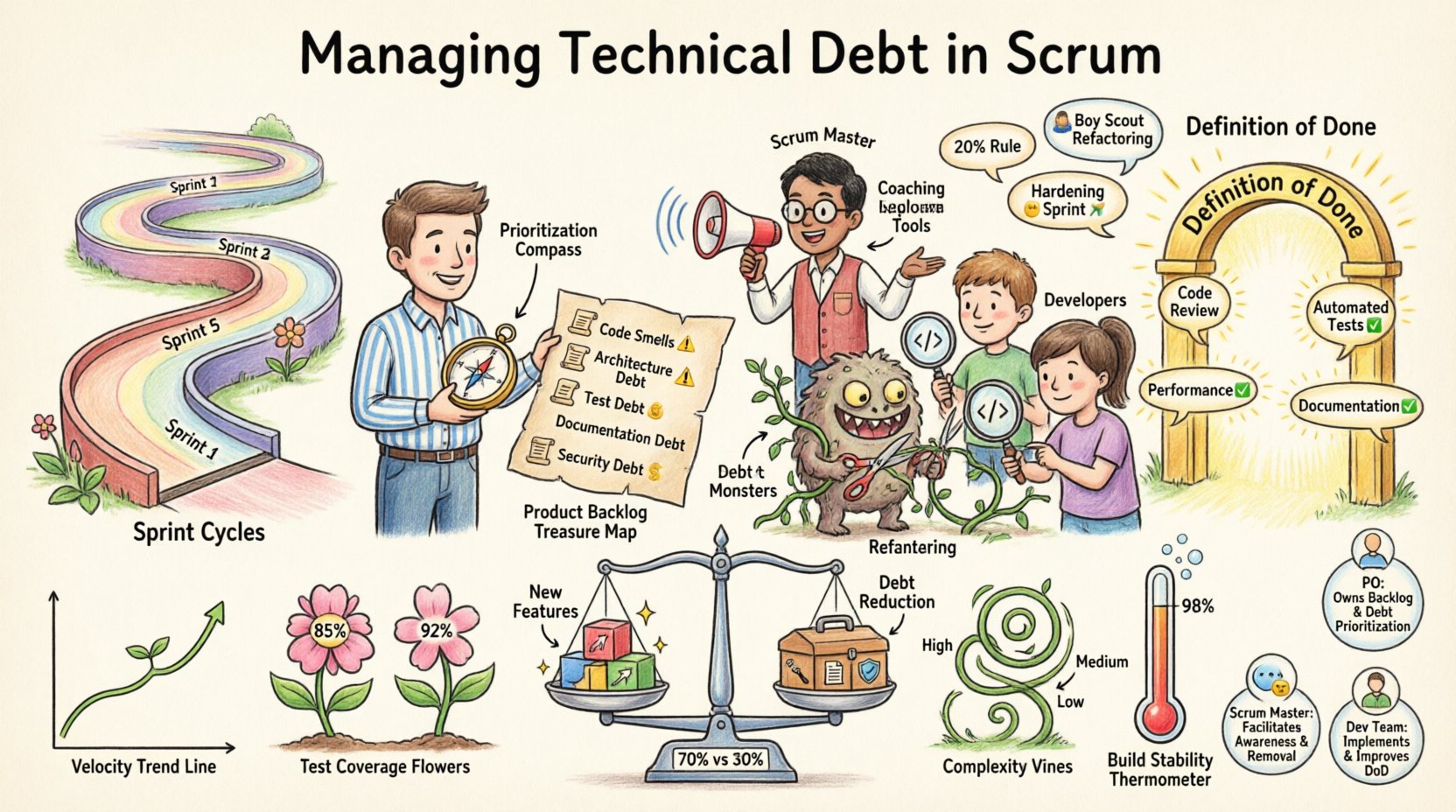
Technical debt is an inevitable reality in software development. It represents the implied cost of additional rework caused by choosing an easy, limited, or incomplete solution now instead of using a better approach that would take longer. Within the Scrum framework, this concept requires careful navigation. It is not about eliminating debt entirely, but rather managing it consciously so it does not cripple the team’s ability to deliver value.
This guide explores how to handle technical debt effectively within Scrum. We will look at prioritization strategies, the role of the Product Owner, the Definition of Done, and how to maintain velocity while paying down liability. 🧐
Understanding the Nature of Technical Debt 💸
Before addressing debt, we must define what it looks like in practice. Technical debt is not just bad code. It is a trade-off. It is a conscious decision to prioritize speed or functionality over robustness. In a Scrum context, this often happens when the team is under pressure to deliver a feature by a specific date.
Common forms of debt include:
- Code Smells: Complex logic, duplicated code, or unclear variable names that make maintenance difficult.
- Architecture Debt: Structural decisions that limit future scalability or flexibility.
- Test Debt: Lack of automated tests, leading to regression risks when changes are made.
- Documentation Debt: Missing or outdated documentation that slows down onboarding and knowledge transfer.
- Security Debt: Known vulnerabilities or outdated libraries that pose risks to the application.
Just like financial debt, technical debt incurs interest. As the codebase ages, the time required to make changes increases. Features that once took three days might take three weeks. This drag on velocity is the primary reason why debt management must be integrated into the Scrum process.
The Scrum Framework Perspective 📍
Scrum is designed for iterative development and continuous improvement. It provides mechanisms to address debt without halting progress. The framework does not explicitly mandate “refactoring” as a separate event, but it is embedded in the workflow.
Technical debt is often treated as a hidden competitor to the Product Backlog. If the backlog is filled only with new features, the debt accumulates silently. The key is visibility. Debt must be made explicit so it can be discussed, prioritized, and acted upon.
Where Does Debt Belong?
There is a debate on whether technical debt items should be added to the Product Backlog or the Sprint Backlog. The most sustainable approach is to treat them as Product Backlog Items (PBIs).
- Product Backlog: Large, structural refactoring tasks belong here. They are visible to the Product Owner (PO) and stakeholders. This allows them to weigh the cost of paying down debt against the value of new features.
- Sprint Backlog: Small, immediate fixes that occur during development should be handled within the Sprint. These are often absorbed by the team as part of the Definition of Done.
Strategies for Managing Debt in Sprints 🛠️
Integrating debt work into the flow of work requires specific strategies. The goal is to prevent the “death by a thousand cuts” scenario where no new value is delivered because the team is constantly firefighting.
1. The 20% Rule (or similar ratio)
Many teams adopt a heuristic where a percentage of capacity is reserved for debt reduction. For example, allocating 20% of Sprint capacity to technical activities. This ensures a steady reduction in liability.
- Pros: Predictable, ensures regular attention to quality.
- Cons: Rigid; sometimes a Sprint requires 100% focus on features due to market needs.
2. Refactoring as Part of Every Story
When a developer touches a specific area of code to implement a feature, they should also address the immediate debt in that area. This is often called “Boy Scout Rule” refactoring: leave the code cleaner than you found it.
- Pros: Continuous improvement, no separate meetings needed.
- Cons: Can be difficult to track or measure progress.
3. Dedicated Spikes
Spikes are time-boxed research or exploration tasks. Sometimes, a team needs to understand the impact of a large refactor before committing to it. A Spike PBI can be created to investigate the debt and propose a solution.
- Pros: Reduces risk, provides data for better decision-making.
- Cons: Does not deliver immediate functional value to the customer.
4. The “Hard” Refactoring Sprint
Occasionally, a team may take a Sprint to focus entirely on debt. This is often called a “Hardening Sprint” or “Tech Sprint”. While useful for major overhauls, this approach carries the risk of stakeholder dissatisfaction if new features are not delivered.
Prioritization and Negotiation 📊
The Product Owner is responsible for maximizing value. They must understand that technical debt reduces the team’s ability to create value in the future. Therefore, debt reduction is a value-creation activity, not just a cost.
When negotiating the backlog, use data to support the inclusion of debt items. If the team’s velocity drops by 50% due to complexity, this is a business risk.
Key negotiation points:
- Maintainability: Explain how debt slows down future delivery.
- Stability: Debt often leads to production incidents, which hurt reputation.
- Team Morale: Working with messy code leads to burnout and turnover.
Comparing Debt vs. Features
Use a weighted scoring model or a simple comparison table to visualize the trade-offs.
| Item Type | Immediate Value | Long-term Cost | Priority Level |
|---|---|---|---|
| New Feature | High | Low | High |
| Major Refactor | Low | High (Reduces Cost) | Medium/High |
| Minor Fix | Low | Medium | Medium |
| Ignored Debt | High (Speed) | Extreme | Low (Risk) |
The Definition of Done 📝
The Definition of Done (DoD) is the quality gate for every item. It ensures that work is complete and potentially shippable. If the DoD is weak, debt will accumulate faster than it can be managed.
Strong DoD examples for debt management:
- Code Review: All changes must be reviewed by at least one peer.
- Automated Tests: New code must include unit and integration tests.
- Performance: No regression in key performance metrics.
- Documentation: API documentation or user guides are updated.
If a task is “Done” without passing these checks, it is not Done. This forces the team to address quality issues immediately, preventing them from becoming long-term debt.
Measuring and Tracking Debt 📉
What gets measured gets managed. However, technical debt is notoriously difficult to quantify. Avoid vanity metrics. Focus on metrics that reflect the health of the system.
- Coverage: Percentage of code covered by automated tests.
- Cyclomatic Complexity: A measure of the number of independent paths through a program’s source code.
- Build Stability: Frequency of build failures or deployment rollbacks.
- Lead Time: Time taken from code commit to production deployment.
- Velocity Trend: Is the team’s output slowing down over time?
Track these metrics in a dashboard. Share them with stakeholders during Sprint Reviews. When stakeholders see the velocity trend line dipping, they understand the cost of debt.
Common Pitfalls to Avoid ⚠️
Even with a good strategy, teams often stumble. Here are common mistakes to watch out for.
1. Treating Debt as Invisible
If debt is not in the backlog, it cannot be prioritized. It gets buried under feature requests. Make it visible.
2. Over-Prioritizing Refactoring
Refactoring for the sake of refactoring is wasteful. Do not clean code that will never be touched again. Focus on the “hot paths” where changes are frequent.
3. Ignoring Stakeholder Feedback
If stakeholders are not informed about the debt, they may feel the team is “not delivering.” Communicate the trade-off clearly. “We can deliver Feature A now, or we can spend 2 weeks reducing debt to ensure Feature A is stable. Which do you prefer?”
4. One-Size-Fits-All
Different projects have different risk profiles. A banking app requires stricter debt management than a prototype for a startup. Adjust the DoD and debt tolerance based on context.
Role Responsibilities 🧑💻
Managing debt is a shared responsibility, but roles have specific duties.
Product Owner
- Ensure technical debt items are represented in the backlog.
- Weigh the value of debt reduction against new features.
- Communicate the impact of debt to stakeholders.
Scrum Master
- Coach the team on the importance of quality.
- Facilitate discussions about debt during Sprint Planning and Retrospectives.
- Remove impediments that prevent the team from addressing quality issues.
Development Team
- Estimate the effort required for debt reduction accurately.
- Adhere to the Definition of Done.
- Propose technical improvements during Retrospectives.
- Own the code quality collectively.
Advanced Tactics for Complex Debt 🔧
Sometimes debt is structural. It cannot be fixed by a simple code change. It requires a plan.
1. The Strangler Pattern
This involves slowly replacing a legacy system by wrapping it with a new system. You migrate functionality piece by piece. This allows for continuous delivery while the old system is phased out.
2. Time-Boxed Debt Sprints
If a major overhaul is needed, schedule a dedicated Sprint. Plan it like a normal Sprint with a goal. Ensure the PO agrees that no new features will be built during this time.
3. Automated Debt Detection
Use static code analysis tools to flag debt automatically. Configure the CI/CD pipeline to fail if complexity thresholds are exceeded. This enforces standards without manual policing.
Building a Culture of Quality 🧠
Tools and processes are useless without the right culture. The team must value quality as much as speed. This means psychological safety.
- Blameless Post-Mortems: When debt causes an incident, focus on the process, not the person.
- Knowledge Sharing: Pair programming and mob programming help spread understanding of the codebase.
- Continuous Learning: Allocate time for team members to learn new technologies that might reduce future debt.
When the team feels safe to admit mistakes, they are more likely to address debt early. Fear drives developers to hide debt until it becomes unmanageable.
Integrating with Retrospectives 🔄
The Sprint Retrospective is the primary venue for process improvement. Debt should be a regular topic.
Questions to ask:
- Did we introduce new debt this Sprint?
- Did we pay down any debt?
- Is the Definition of Done realistic?
- Are we spending too much time fixing bugs?
If the team consistently says “yes” to introducing new debt, the Sprint Goal or the planning process needs adjustment. If they say “no” to paying down debt, the backlog needs more items.
Long-Term Sustainability 🌱
The goal is not zero debt. It is manageable debt. Every product has debt. The goal is to keep the interest payments low enough that the team can still innovate.
Regularly review the architecture. Conduct technical health checks. Treat the codebase like a garden that needs constant weeding and pruning. If you wait too long, the weeds choke the flowers.
Success in Scrum is measured by the sustainable pace at which value is delivered. Technical debt management is the key to maintaining that pace over months and years, rather than weeks.
Summary of Actions ✅
- Make it Visible: Add debt items to the Product Backlog.
- Prioritize: Balance debt work with feature work using data.
- Define Done: Strengthen the Definition of Done to prevent new debt.
- Measure: Track velocity, stability, and complexity.
- Collaborate: Ensure the PO understands the business impact of debt.
- Culture: Foster a blameless environment focused on quality.
By treating technical debt as a first-class citizen in the Scrum process, teams can maintain high velocity and high quality indefinitely. The choice is yours: pay the interest now, or pay it later with compound growth. Choose wisely. 🚀