In the complex landscape of modern enterprise architecture, IT Directors face a constant barrage of competing priorities. Budget constraints, evolving technology stacks, and shifting market demands require a structured approach to governance. The Business Motivation Model (BMM) provides a standardized framework to navigate these challenges. By mapping organizational intent to operational execution, IT leaders can make decisions that are not just technically sound but strategically aligned.
This guide explores the practical application of the BMM within an IT leadership context. It details how to utilize motivation elements to clarify goals, prioritize initiatives, and measure outcomes without relying on specific vendor tools.
🏗️ Understanding the Business Motivation Model Framework
The Business Motivation Model is an OMG standard designed to describe the motivation behind an enterprise’s actions. It moves beyond simple goal setting to include the influences, strategies, and tactics that drive those goals. For an IT Director, this model acts as a blueprint for understanding the “why” behind every project request.
Instead of viewing IT initiatives as isolated technical tasks, the BMM encourages a holistic view. Every line of code, every server upgrade, and every software license is tied back to a specific business motivation. This traceability is essential for resource allocation.
Core Elements of the Model
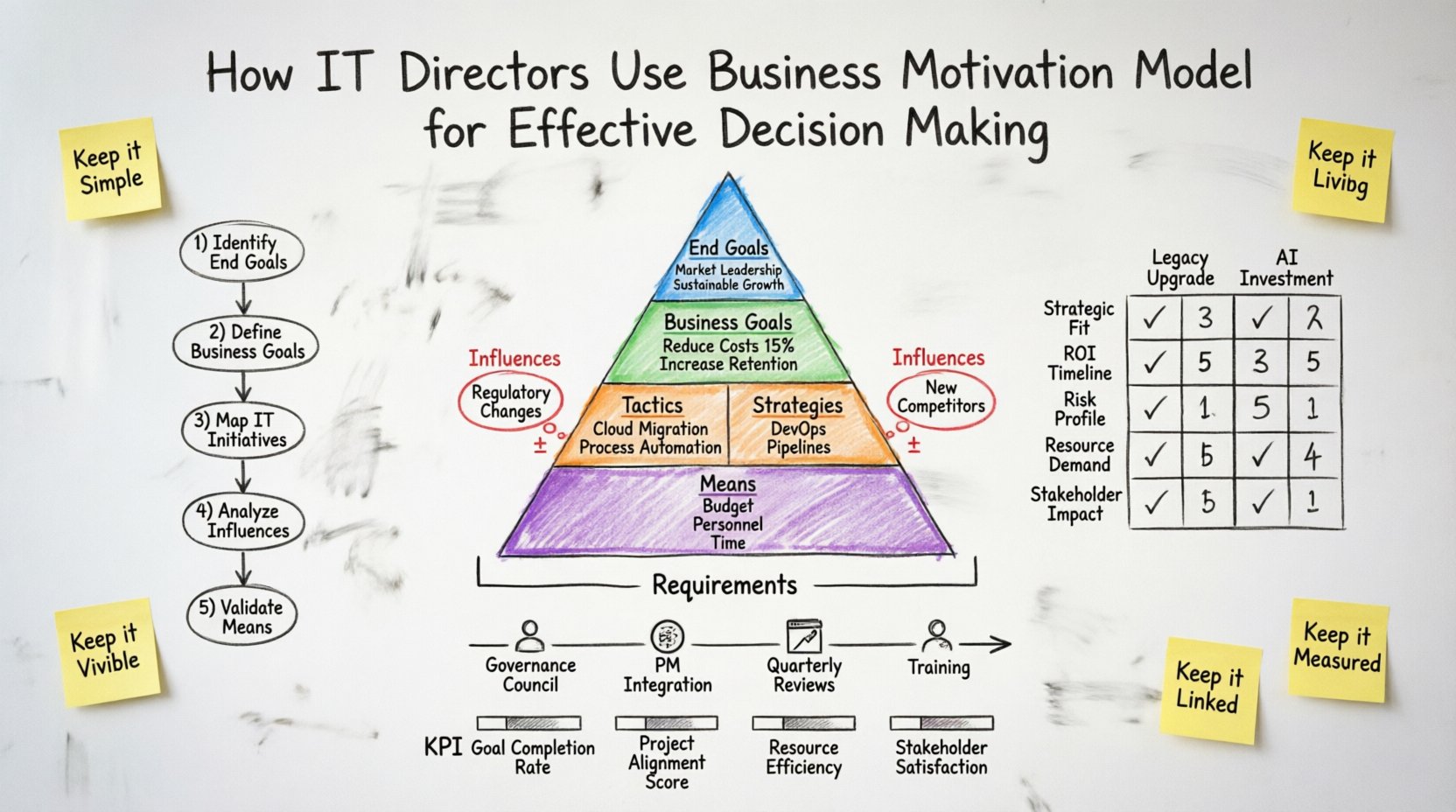
To apply this model effectively, one must understand its fundamental components. These elements form the hierarchy of motivation:
- End Goals: The ultimate aspirations of the organization. These are broad statements of intent, such as “Market Leadership” or “Sustainable Growth”.
- Business Goals: More specific targets derived from End Goals. Examples include “Reduce Operational Costs by 15%” or “Increase Customer Retention”.
- Tactics: The high-level approaches used to achieve Business Goals. This might involve “Cloud Migration” or “Process Automation”.
- Strategies: The specific plans or methodologies that support Tactics. An example is “Implementing DevOps Pipelines”.
- Influences: Factors that affect the motivation. These can be positive (opportunities) or negative (threats). Examples include “Regulatory Changes” or “New Competitors”.
- Means: The resources required to execute the plan. This includes budget, personnel, hardware, and time.
- Requirements: Specific conditions that must be met for a goal to be achieved. These define the constraints and non-negotiables.
🔗 Aligning IT Strategy with Business Goals
One of the primary responsibilities of an IT Director is ensuring that technology investments directly support the broader mission of the company. The BMM facilitates this alignment by creating a clear lineage from high-level aspirations to daily IT tasks.
When a request comes in for a new system, the IT Director can trace it back through the model. Is this system supporting a specific Business Goal? Does that goal contribute to an End Goal? If the connection is weak or non-existent, the project may be deprioritized.
Step-by-Step Alignment Process
Implementing this alignment requires a disciplined approach. IT Directors should follow these steps to ensure consistency:
- Identify End Goals: Work with C-suite executives to define the top-level aspirations of the organization.
- Define Business Goals: Break down End Goals into measurable, time-bound objectives relevant to IT.
- Map IT Initiatives: List all current and proposed IT projects and link them to specific Business Goals.
- Analyze Influences: Evaluate external and internal factors that might impact the success of these initiatives.
- Validate Means: Ensure that the necessary resources (budget, skills) are available to execute the mapped strategies.
This process prevents “zombie projects” from consuming resources. Projects that do not clearly link to a Business Goal are often candidates for cancellation or re-scoping.
⚖️ The Decision-Making Framework
Decision-making is the core utility of the BMM for IT leadership. When resources are scarce, choices must be made based on impact rather than intuition. The model provides a structured way to compare options.
Consider a scenario where an IT Director must choose between upgrading legacy infrastructure or investing in AI capabilities. Using the BMM, the Director evaluates each option against the established End and Business Goals.
Comparative Analysis Table
| Decision Criteria | Option A: Legacy Upgrade | Option B: AI Investment |
|---|---|---|
| Alignment with End Goal | Supports stability and reliability. | Supports innovation and market differentiation. |
| Business Goal Impact | Reduces downtime risk. | Enables predictive analytics. |
| Required Means | High capital expenditure. | High talent acquisition cost. |
| Influences (Risk) | Technology obsolescence. | Market adoption uncertainty. |
| Priority Score | 8/10 | 7/10 |
This table illustrates how the BMM forces a quantitative and qualitative assessment. It moves the conversation from “Which technology is cooler?” to “Which option better serves our motivation?”
Handling Conflicting Priorities
Conflicts are inevitable in IT governance. Sometimes, two departments vie for the same budget. The BMM helps resolve this by referring back to the hierarchy of goals.
- Traceability: If Department A’s goal traces directly to an End Goal, and Department B’s does not, the former takes precedence.
- Dependency Mapping: Determine if one goal is a prerequisite for another. Often, security requirements (Means) must be met before innovation (Strategy) can proceed.
- Influence Weighting: Assign weights to Influences. If a Regulatory Change is a high-priority Influence, compliance projects automatically rise in the decision matrix.
🚀 Practical Implementation Steps
Adopting the Business Motivation Model is not a one-time event. It requires integration into the existing governance processes of the IT department. The goal is to make the model a living document that guides daily operations.
1. Establish a Governance Council
Create a group responsible for maintaining the BMM artifacts. This council should include IT leadership, business stakeholders, and finance representatives. Their role is to validate that the goals and strategies remain relevant as the market changes.
2. Integrate with Project Management
Link the BMM elements to project management tools. Every project ticket should reference the specific Business Goal it supports. This ensures that when a project is paused, the impact on the goal is understood immediately.
3. Regular Review Cycles
Schedule quarterly reviews of the BMM. End Goals may shift, or new Influences may emerge. A static model quickly becomes obsolete. These reviews ensure the IT strategy remains agile and responsive to the business environment.
4. Communication and Training
Ensure that project managers and architects understand the model. They need to know how to document their work in terms of the BMM. Training sessions should focus on the terminology and the value of traceability.
🛠️ Overcoming Common Implementation Hurdles
While the Business Motivation Model offers significant benefits, implementation often faces resistance. IT Directors must anticipate these challenges to ensure success.
Challenge 1: Complexity
The model can appear overly complex to stakeholders who prefer simple roadmaps. To mitigate this, start with the high-level End Goals and Business Goals. Do not attempt to map every single task immediately. Expand the detail gradually as the team becomes comfortable with the framework.
Challenge 2: Siloed Information
Business goals are often known to executives, while IT goals are known to technologists. Bridging this gap requires active collaboration. IT Directors must facilitate workshops where business leaders articulate their needs, and IT leaders translate them into technical strategies.
Challenge 3: Static Documentation
Documentation often sits on a server shelf and is never updated. To prevent this, link the BMM to active decision points. If a decision is made without referencing the model, flag it for review. Make the model a requirement for budget approval.
Challenge 4: Resource Constraints
Mapping everything takes time and effort. IT teams are often understaffed. Prioritize high-value areas. Focus the detailed modeling on strategic initiatives rather than routine maintenance tasks. Use the model to justify hiring or outsourcing for critical gaps.
📊 Measuring Success and Continuous Improvement
How does an IT Director know if the Business Motivation Model is working? Success is measured by the quality of decisions and the alignment of outcomes with intent.
Key Performance Indicators
- Goal Completion Rate: The percentage of Business Goals achieved within the specified timeframe.
- Project Alignment Score: A metric derived from auditing projects to see if they have a valid link to an End Goal.
- Resource Efficiency: Reduction in wasted spend on projects that did not contribute to strategic objectives.
- Stakeholder Satisfaction: Feedback from business leaders regarding how well IT supports their objectives.
Feedback Loops
Continuous improvement requires feedback. After a project concludes, conduct a retrospective. Did the outcome match the intended Business Goal? If not, analyze the Influences that changed. Did a threat materialize? Did a resource constraint appear that was not accounted for?
This feedback refines the model. It updates the understanding of what constitutes a viable Strategy or an accurate Estimate of Means. Over time, the IT Director builds a robust knowledge base of what works and what does not.
🔮 Future Trends in IT Governance
The landscape of IT governance is evolving. As organizations become more data-driven, the need for precise motivation modeling increases. The BMM provides the structure needed to handle this complexity.
Data-Driven Decision Making
Future iterations of the BMM will likely integrate more heavily with real-time data. Instead of static goals, motivation elements may be dynamic, adjusting based on live market data. This allows IT Directors to pivot strategies faster.
Automation and Governance
As governance processes become automated, the BMM can serve as the rule engine. Automated checks can verify that new code deployments align with security Strategies or that new cloud spend aligns with Cost Reduction Goals.
Agility and Resilience
Organizations are prioritizing resilience. The BMM helps identify critical Influences that threaten stability. By understanding the dependencies between Goals and Means, IT Directors can build more resilient architectures that withstand shocks.
🤝 Collaboration Across the Enterprise
The Business Motivation Model is not solely an IT artifact. It is an enterprise artifact that happens to be vital for IT leadership. Success depends on cross-functional collaboration.
- Finance: Works with IT to validate the “Means” and budget estimates.
- Operations: Provides insights into current capabilities and constraints.
- Human Resources: Ensures the “Means” include the right talent acquisition and training.
- Legal and Compliance: Defines the “Requirements” and Influences related to regulation.
By treating the BMM as a shared language, IT Directors can foster a culture of transparency. Everyone understands why a decision was made, not just what the decision was.
🛡️ Risk Management Integration
Risk management is an inherent part of the BMM through the “Influences” element. Every Influence carries a risk profile. Positive Influences are opportunities that may not materialize. Negative Influences are threats that may occur.
IT Directors can use this to create risk registers that are tied directly to strategic goals. If a key Business Goal relies on a specific Strategy, and that Strategy is threatened by a high-risk Influence, the risk is immediately visible. This allows for proactive mitigation rather than reactive fire-fighting.
📝 Summary of Best Practices
To maximize the value of the Business Motivation Model, IT Directors should adhere to the following best practices:
- Keep it Simple: Start with high-level goals. Avoid over-engineering the model for minor tasks.
- Keep it Living: Update the model regularly. It should reflect the current reality of the business.
- Keep it Visible: Ensure that the goals and strategies are visible to all stakeholders involved in the projects.
- Keep it Linked: Ensure every project has a clear link to the model. No orphaned projects.
- Keep it Measured: Define KPIs for the model itself to track its effectiveness.
The Business Motivation Model offers a disciplined path through the chaos of modern IT management. It transforms decision-making from a reactive process into a strategic one. By anchoring every initiative in business motivation, IT Directors ensure that technology serves the organization, rather than the organization serving technology.
As the digital economy matures, the ability to align technical execution with business intent will become a defining competitive advantage. Adopting this model positions IT leaders not just as service providers, but as strategic partners capable of driving organizational value.