


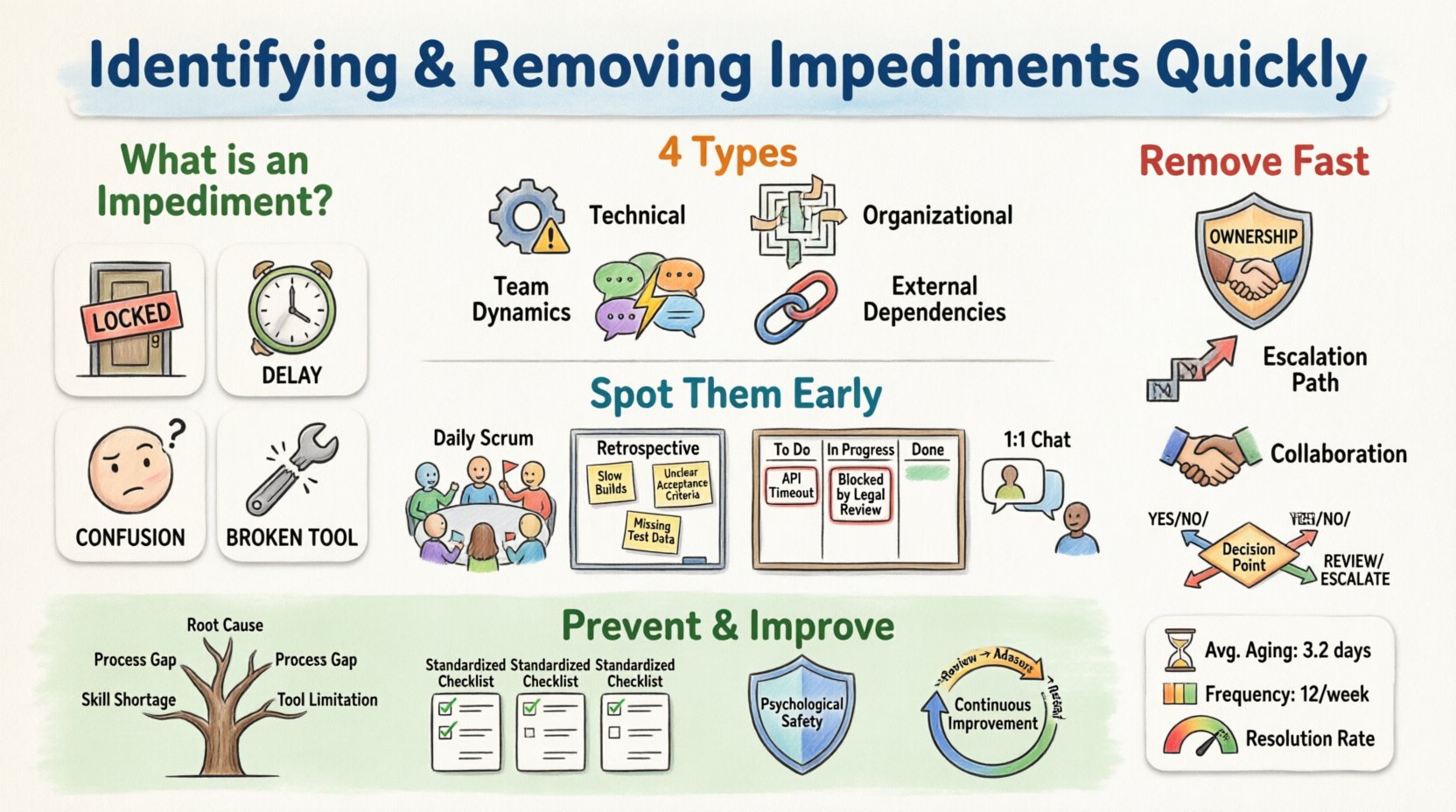
In the fast-paced world of agile development, progress is often measured by the ability to deliver value consistently. However, even the most disciplined teams encounter obstacles that stall momentum. These obstacles are known as impediments. When left unchecked, they erode velocity, damage morale, and delay releases. Understanding how to identify and remove them quickly is a critical competency for any Scrum team.
This guide provides a comprehensive look at managing blockers. We will explore definitions, identification strategies, removal workflows, and prevention techniques. The goal is to maintain flow and ensure the team can focus on creating value without unnecessary friction.
🔍 Defining the Impediment
An impediment is any obstacle that prevents a Scrum Team member from doing their work. It is not just a “bug” or a “task that is hard.” It is something external or internal that stops progress. Unlike standard work items, impediments do not add value to the product. They exist solely to consume time and energy.
- External: Dependencies on other teams, infrastructure issues, or approval bottlenecks.
- Internal: Lack of knowledge, tooling limitations, or unclear requirements.
Identifying these issues early is vital. The sooner a blocker is recognized, the sooner it can be addressed before it impacts the Sprint Goal.
📋 Types of Impediments
Not all blockers are created equal. Some are technical, while others are organizational. Categorizing them helps in assigning the right resources to solve them. The following table outlines common categories and examples.
| Category | Description | Examples |
|---|---|---|
| Technical | Issues related to code, architecture, or tools. | Environment downtime, legacy code complexity, build failures. |
| Organizational | Bureaucratic or process-related hurdles. | Slow approval processes, unclear governance, resource allocation. |
| Team Dynamics | Issues arising from collaboration or communication. | Conflict, lack of shared understanding, availability gaps. |
| External Dependencies | Blockers coming from outside the immediate team. | API from another group, third-party vendor delays. |
👀 Strategies for Identification
Impediments often hide in the shadows of busy schedules. Teams must be proactive in surfacing them. Relying on a single source of truth is rarely sufficient. Instead, a multi-channel approach ensures nothing slips through the cracks.
1. The Daily Scrum
The Daily Scrum is the primary forum for identifying impediments. Each team member should answer the standard questions, but specifically highlight anything stopping them. It is not a status report for management; it is a synchronization point for the team.
- Encourage specific language: “I am blocked by…” rather than “I will work on…”
- Keep it focused. If the team starts solving a problem for more than 10 minutes, take it offline.
- Record the impediment visibly. Use a physical board or digital tracking system.
2. Retrospective Analysis
While the Daily Scrum handles immediate blockers, the Retrospective addresses systemic issues. If a specific type of impediment appears repeatedly, it indicates a process flaw.
- Look for patterns. Is the same team always delayed?
- Discuss the root cause. Why did this happen again?
- Commit to an action item to prevent recurrence.
3. Visual Management
Work boards provide immediate visibility into flow. When a card sits in “In Progress” for too long, it signals a potential issue.
- Set WIP (Work In Progress) limits. If a column is full, no new work enters.
- Use color coding. Red cards indicate blocked items.
- Review the board during planning and review meetings to spot stuck items.
4. One-on-One Conversations
Sometimes, individuals are reluctant to raise blockers in a group setting. Private conversations can uncover personal or sensitive impediments.
- Check in on team members who seem disengaged.
- Ask open-ended questions about their workflow.
- Create a safe environment where admitting a blocker is seen as responsible behavior.
⚙️ The Removal Process
Once an impediment is identified, the focus shifts to resolution. Speed is key, but the method of removal matters. Removing a blocker quickly does not mean bypassing quality checks; it means efficient problem solving.
1. Ownership and Accountability
Every impediment needs an owner. Ambiguity in ownership leads to inaction. The Scrum Master often acts as the facilitator, but the team must share responsibility.
- Assign the impediment to a specific person.
- Define the expected resolution time.
- Track progress until the blocker is cleared.
2. Escalation Paths
If a team member cannot resolve an issue within a reasonable timeframe, it must be escalated. There should be a clear hierarchy of who to contact.
- Team Level: Peers or internal SMEs.
- Scrum Master Level: Process barriers or resource conflicts.
- Management Level: Strategic decisions or external vendor issues.
Escalation should not be seen as failure. It is a mechanism to ensure work continues. Delaying escalation to avoid “bothering” leadership often causes more damage than the issue itself.
3. Collaboration Over Silos
Impediments often require cross-functional input. Teams should not work in isolation.
- Invite relevant stakeholders to a quick huddle.
- Break down the problem into smaller, manageable parts.
- Share knowledge to prevent future occurrences.
4. Decision Making
Sometimes, an impediment requires a decision that is not technical. It might be a trade-off between speed and quality, or scope and timeline.
- Empower the Product Owner to make scope decisions.
- Ensure the team has technical autonomy to choose solutions.
- Document the decision and the rationale.
🛡️ Prevention and Culture
Reactive removal is good, but proactive prevention is better. Building a culture that discourages impediments reduces the friction in the system.
1. Root Cause Analysis
When a blocker is removed, ask “Why?” five times. This technique helps find the underlying cause rather than just treating the symptom.
- Problem: Build server crashed.
- Why? Disk space full.
- Why? Logs were not rotated.
- Why? No automated script.
- Why? Infrastructure team did not prioritize it.
- Fix: Automate log rotation and set alerts.
2. Standardization
Consistency reduces confusion. When everyone follows the same setup and deployment processes, fewer errors occur.
- Use infrastructure as code to manage environments.
- Standardize coding conventions and review processes.
- Create checklists for common tasks like onboarding or deployment.
3. Psychological Safety
Team members must feel safe to speak up. If they fear blame, they will hide impediments until it is too late.
- Focus on the process, not the person.
- Celebrate the identification of issues as a win.
- Encourage transparency in failure.
4. Continuous Improvement
The system must evolve. What worked last year may not work today. Regularly review the workflow.
- Measure cycle time and lead time.
- Identify bottlenecks in the value stream.
- Experiment with new tools or processes in low-risk areas.
📊 Metrics and Tracking
To manage impediments effectively, you must measure them. Data provides insight into where the friction lies.
1. Impediment Aging
Track how long an impediment remains open. A high average age indicates a systemic problem.
- Set a target maximum age for blockers.
- Review aged items in every Retrospective.
- Highlight items that have exceeded the threshold.
2. Frequency of Occurrence
Count how often specific types of impediments appear. This highlights recurring themes.
- Group impediments by category (e.g., Infrastructure, Approval).
- Plot the frequency over time to see trends.
- Address the most frequent categories first.
3. Resolution Rate
Measure the percentage of impediments resolved within the Sprint. A low rate suggests a need for better resources or faster escalation.
- Calculate: (Resolved Impediments / Total Impediments) * 100.
- Compare across different Sprints.
- Use this metric to adjust team capacity planning.
🚦 Common Pitfalls to Avoid
Even with the best intentions, teams often fall into traps that hinder progress. Awareness of these pitfalls is the first step to avoiding them.
- Ignoring Small Blockers: Small issues often grow into large crises. Address them immediately.
- Blaming Individuals: Blame creates a culture of fear. Focus on the system.
- Over-Reliance on the Scrum Master: The Scrum Master facilitates, but the team owns the work. Impediment removal should be a team effort.
- Lack of Visibility: If a blocker is not visible, it cannot be tracked. Use visual boards.
- False Solutions: Applying a quick fix without understanding the root cause often leads to recurrence.
🤝 Collaboration with Stakeholders
Impediments often involve people outside the development team. Managing these relationships is crucial.
- Transparency: Keep stakeholders informed about delays caused by blockers.
- Expectation Management: Ensure they understand the impact of external dependencies.
- Feedback Loops: Regularly ask stakeholders if their needs are being met.
- Joint Problem Solving: Invite stakeholders to help solve complex blockers.
💡 Final Thoughts
Managing impediments is not a one-time task. It is an ongoing practice that requires vigilance and commitment. By defining what constitutes a blocker, establishing clear identification methods, and following a structured removal process, teams can maintain high velocity. Prevention is the ultimate goal, but the ability to react quickly is the safety net that keeps the project on track.
Remember, the Scrum Guide defines the Scrum Master as a servant leader who removes impediments. However, in practice, the entire team shares this responsibility. When everyone is empowered to speak up and act, the flow of work becomes smoother, and value delivery becomes more predictable.
Start today by reviewing your current backlog. Identify any items that are at risk. Assign an owner and set a time to review progress. Small actions lead to significant improvements over time.