


Systems engineering is evolving rapidly. The shift from document-based processes to Model-Based Systems Engineering (MBSE) has introduced powerful tools for managing complexity. Systems Modeling Language (SysML) stands at the center of this transition. However, the learning curve is steep. Many engineers enter the ecosystem with strong domain knowledge but lack proficiency in the modeling syntax and semantics.
When the model does not reflect the system reality, the entire engineering lifecycle suffers. Inefficiencies creep in, requirements become orphaned, and interfaces break. This guide identifies the most frequent errors observed in early-stage SysML adoption. We will explore the root causes of these issues and provide concrete corrective actions. The goal is to build robust, maintainable models that serve as a single source of truth.
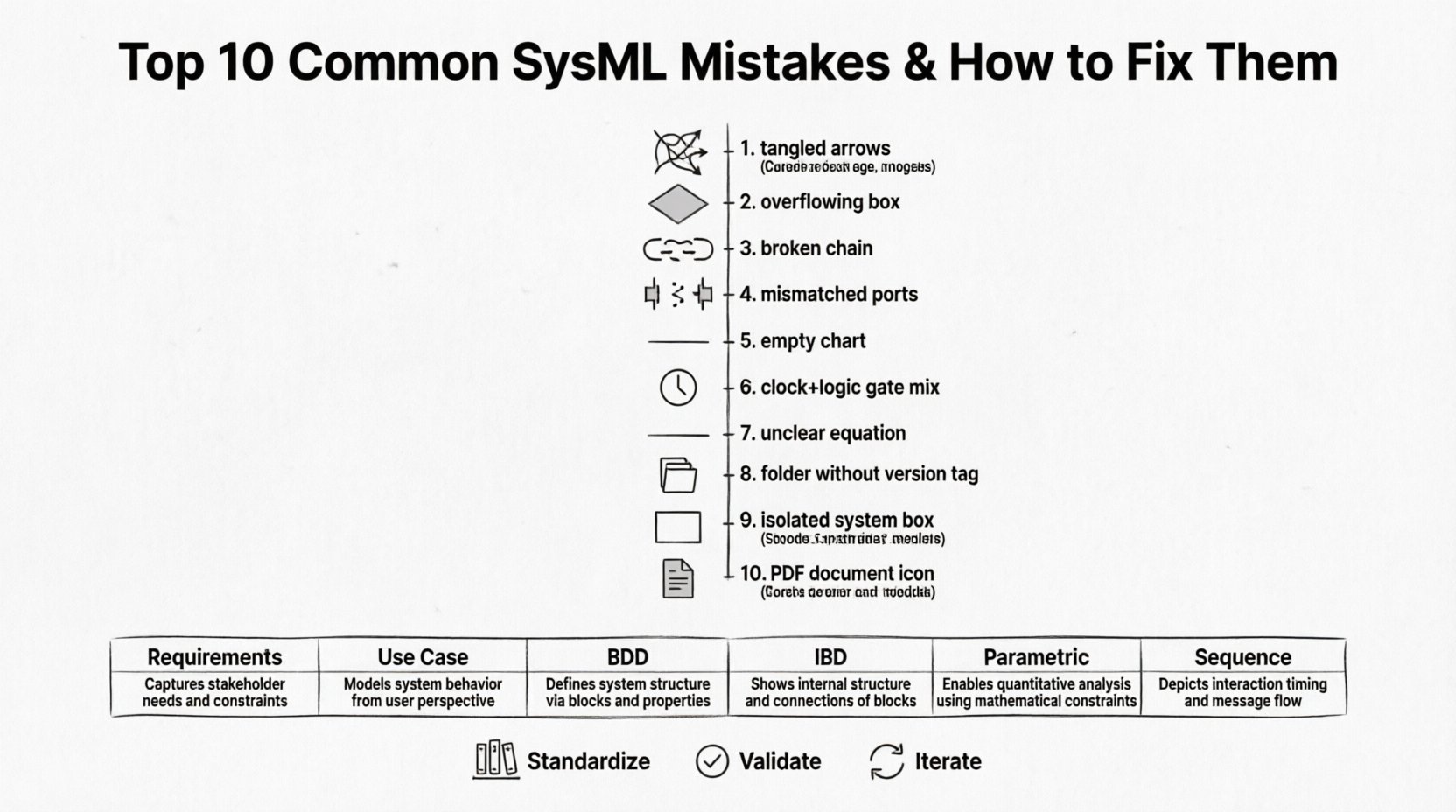
1. Confusing Use Case Diagrams with Activity Diagrams 🔄
One of the first hurdles in SysML is understanding the distinction between Use Case and Activity diagrams. Both involve interactions, but they serve different purposes.
- Use Case Diagram: Focuses on who interacts with the system and what high-level functions are available to external actors. It defines scope and boundaries.
- Activity Diagram: Focuses on how the system behaves internally. It details the flow of control and data within a specific operation or process.
The Mistake: Engineers often flatten the model by using Use Case diagrams to describe detailed logic flows. This results in diagrams that are too dense and obscure the actual operational sequence.
The Fix: Reserve Use Case diagrams for high-level stakeholder interactions. Use Activity diagrams for the internal logic of operations. If you find yourself nesting complex conditional logic inside a Use Case, move it to an Activity diagram.
2. Overusing Block Definition Diagrams (BDD) 🧱
The Block Definition Diagram is the backbone of SysML structure. It defines the types of blocks and their relationships (composition, aggregation, generalization).
The Mistake: New engineers tend to dump every block into a single BDD. This creates a “spaghetti” model where the hierarchy is lost, and navigation becomes difficult. It often leads to a lack of abstraction.
The Fix: Apply the principle of decomposition. Create high-level BDDs for system architecture and lower-level BDDs for subsystems. Use nested blocks to show hierarchy. Keep the top-level BDD clean, focusing on major interfaces and subsystems.
3. Neglecting Requirements Traceability 📋
One of the primary values of SysML is linking requirements to design elements. Without this, the model is just a drawing.
The Mistake: Engineers create requirements but fail to link them to blocks, functions, or tests. Later, when a requirement changes, the impact analysis is impossible because the traceability path is broken.
The Fix: Establish a discipline of mandatory linking. Every requirement should be satisfied by at least one model element (block, operation, or parametric constraint). Every design element should trace back to at least one requirement. Use the Refine or Satisfy relationships consistently.
4. Misinterpreting Internal Block Diagrams (IBD) ⚙️
While BDDs define types, Internal Block Diagrams define instances and their interconnections. They show how blocks are connected via ports and connectors.
The Mistake: Engineers treat IBDs as mere wiring diagrams without defining data flow semantics. They connect ports that do not match in type, leading to validation errors or incorrect data propagation.
The Fix: Ensure strict type matching between ports and connectors. Define flow properties explicitly. Use IBDs to visualize physical connections (power, data, fluid) and logical connections (information flow). Verify that every port has a defined type.
5. Ignoring Parametric Diagrams 📊
Parametric diagrams are unique to SysML and are essential for performance analysis. They define equations and constraints that govern system behavior.
The Mistake: Many teams skip this diagram type entirely, relying on spreadsheets for calculations. This breaks the link between physical architecture and performance metrics.
The Fix: Integrate parametric constraints early. Link variables to block properties. Use constraints to define equations (e.g., Force = Mass * Acceleration). This allows for automated verification of performance requirements against the design.
6. Mixing Time and Logic in Sequence Diagrams ⏱️
Sequence diagrams capture the chronological interaction between objects. They are powerful for defining operational sequences.
The Mistake: Engineers mix state logic (conditions) with time-based interactions on the same diagram. This makes the diagram hard to read and maintain. It blurs the line between “what happens” and “when it happens”.
The Fix: Separate concerns. Use Sequence diagrams for the interaction flow between actors and system components. Use State Machine diagrams for the internal state transitions of a specific block. Keep timing annotations minimal unless critical for synchronization.
7. Poor Constraint Specification 🚫
Constraints in SysML allow you to define mathematical or logical rules that must be satisfied.
The Mistake: Constraints are written in natural language or informal pseudo-code. This makes them impossible for tools to interpret or validate automatically.
The Fix: Use standardized constraint languages (like OCL or mathematical notation supported by your environment). Ensure variables are typed correctly. Keep constraints atomic; do not combine too many conditions into a single block.
8. Lack of Version Control for Models 📂
Just as code requires version control, SysML models require rigorous change management.
The Mistake: Engineers save models as single files on a local drive or a shared folder without history. When errors occur, there is no way to revert to a previous stable state.
The Fix: Treat the model repository like a code repository. Implement branching for feature development. Tag releases. Ensure that changes are documented in the model metadata. Use collaboration features to manage access and prevent simultaneous overwrites.
9. Ignoring External Interfaces 🌐
Systems rarely exist in isolation. They interact with users, other systems, and the environment.
The Mistake: Models focus heavily on internal components while treating external interfaces as afterthoughts. This leads to integration failures when the system meets the real world.
The Fix: Define interfaces explicitly using Interface Blocks. Do not implement interface logic directly in the block. Reference the Interface Block in the block definition. This ensures that the system can be swapped or upgraded without breaking the internal logic.
10. Treating Models as Documentation Only 📄
Some teams build models solely to generate PDF reports for compliance.
The Mistake: The model is not updated during the engineering process. It becomes a static snapshot that diverges from the actual build. This creates a “fake” model that holds no value.
The Fix: Embed the model into the workflow. Use it for simulation, analysis, and code generation. If a change is made in the design, it must be reflected in the model immediately. The model should be the primary artifact, not the report.
Summary of Diagram Usage
To help clarify when to apply which diagram type, refer to the table below.
| Diagram Type | Primary Purpose | Key Elements |
|---|---|---|
| Requirements Diagram | Define and organize stakeholder needs | Requirements, Relations |
| Use Case Diagram | Define external interactions and scope | Actors, Use Cases |
| Block Definition Diagram | Define structure and types | Blocks, Relationships |
| Internal Block Diagram | Define internal connections and flow | Ports, Connectors, Parts |
| Parametric Diagram | Define performance constraints | Constraints, Equations |
| Sequence Diagram | Define interaction timing and order | Lifelines, Messages |
Building a Sustainable Modeling Culture 🏗️
Avoiding these mistakes requires more than just technical knowledge; it requires a shift in mindset. Systems engineering is not just about drawing boxes and arrows. It is about creating a rigorous representation of reality.
- Standardize: Define modeling standards for your team. Consistency reduces cognitive load.
- Validate: Use automated checks to ensure traceability and consistency.
- Iterate: Models should evolve with the system. Do not treat them as static deliverables.
- Collaborate: Engage stakeholders early to ensure the model reflects their understanding.
By addressing these common pitfalls, engineers can leverage SysML to reduce risk and improve quality. The investment in learning the correct syntax pays off in reduced rework and clearer communication. Remember, the model is a tool for thinking, not just a product for delivery.
Continuous improvement is key. Review your models regularly. Ask if the model adds value to the current engineering phase. If a diagram is not being used for decision-making, simplify or remove it. Keep the model lean and meaningful.
Final Thoughts on SysML Adoption 🎯
The transition to model-based engineering is a journey. It involves unlearning old habits and adopting new disciplines. The mistakes outlined above are common stumbling blocks, but they are not permanent barriers.
With careful planning and adherence to best practices, you can build models that withstand the test of time. Focus on clarity, traceability, and automation. These principles will guide you through the complexities of modern systems engineering.
Start small. Pick one project and apply these fixes. Measure the impact. As your confidence grows, expand the scope. The goal is not perfection, but progress. Every corrected model is a step toward a more robust engineering process.