

Systems engineering is undergoing a significant transformation. At the heart of this shift lies the Systems Modeling Language, commonly known as SysML. As complex systems span across domains like aerospace, automotive, and software development, the need for robust modeling standards becomes critical. This guide explores the trajectory of SysML, focusing on version updates, integration with modern technologies, and the pathway for newcomers entering the field.
Understanding the evolution of modeling languages is not merely an academic exercise. It dictates how teams communicate, validate requirements, and ensure system integrity before physical implementation. For those starting their journey, grasping these emerging trends provides a competitive edge and a solid foundation for long-term career growth.
🔄 The Shift from SysML v1 to SysML v2
For years, SysML v1.4 has been the standard for model-based systems engineering (MBSE). However, the Object Management Group (OMG) has been working on a major revision: SysML v2. This is not just a patch update; it represents a fundamental rethinking of the language specification.
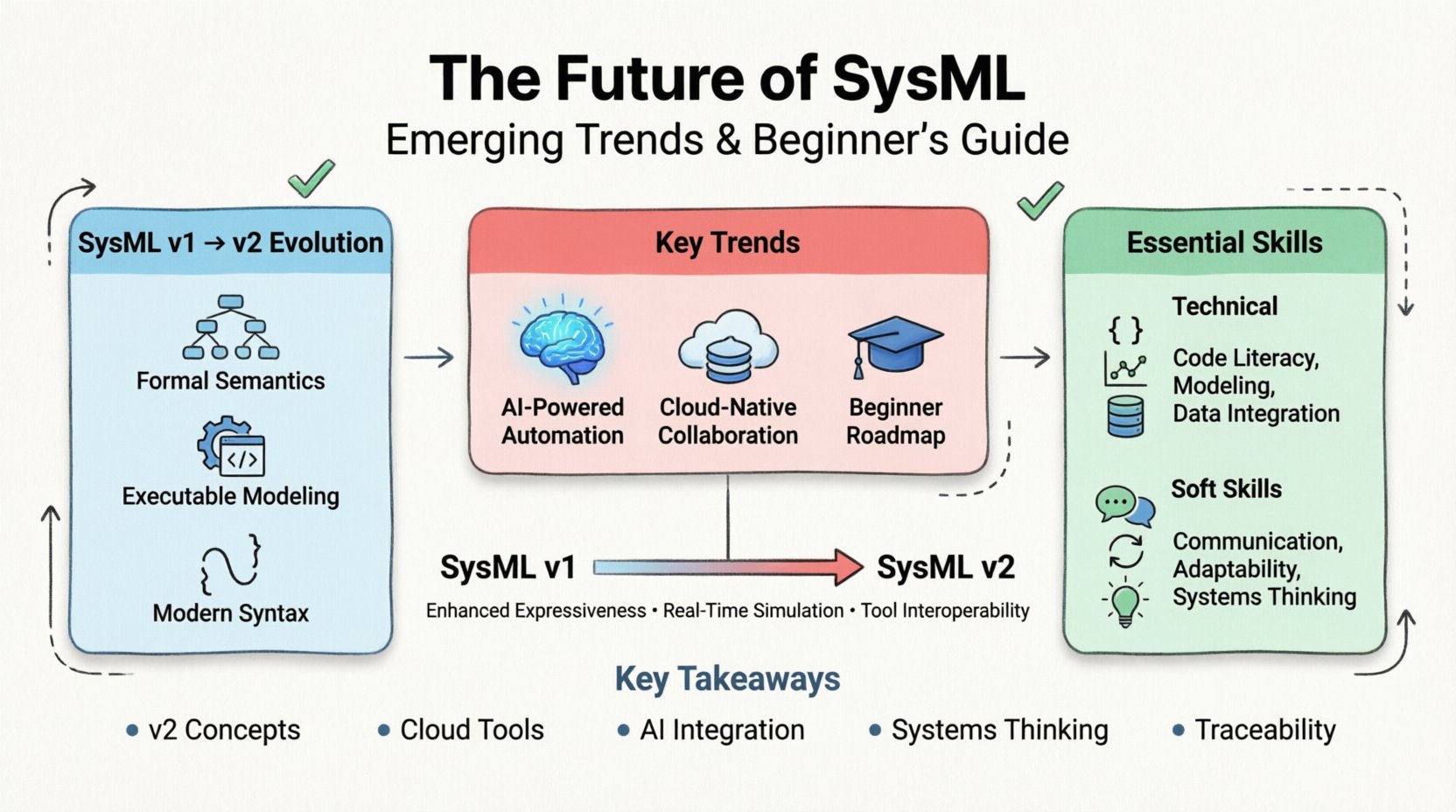
- Formal Semantics: v1 relied heavily on informal semantics which could lead to interpretation errors. v2 introduces a more formal approach, making models easier to parse by machines.
- Integrated Language: The v2 specification integrates features previously found in other modeling standards, reducing the need to juggle multiple syntaxes.
- Executable Modeling: A core goal of v2 is to enable the execution of models. This means simulations can run directly within the modeling environment without exporting to external tools.
- Modern Syntax: The grammar is being cleaned up to reduce ambiguity. This helps beginners learn the language faster as the rules are more consistent.
For practitioners, this means the learning curve may flatten in the long run, even though the initial transition requires understanding new concepts. The industry is currently in a transitional phase where both versions coexist, but the momentum is clearly toward v2.
🤖 AI and Automation Integration
Artificial Intelligence is not replacing systems engineers; it is augmenting their capabilities. The future of SysML involves tighter integration with AI-driven tools that assist in validation, generation, and analysis.
1. Automated Model Checking
Traditionally, engineers manually check models for consistency. AI algorithms can now scan the entire model structure to identify contradictions or missing links between requirements and design elements. This reduces human error and ensures compliance with standards early in the lifecycle.
2. Natural Language to Model
One of the barriers to entry is the complexity of syntax. AI-assisted tools are emerging that allow users to input requirements in plain language. The system then suggests or generates the appropriate SysML blocks and relationships. This lowers the barrier for stakeholders who are not modeling experts.
3. Predictive Analysis
By leveraging historical data from previous projects, AI can predict potential bottlenecks in a system design. For instance, if a specific configuration of components has led to thermal issues in past iterations, the model can flag similar setups for review.
☁️ Cloud-Native Modeling Environments
The era of installing heavy modeling software on individual workstations is fading. The future of SysML is moving toward cloud-native architectures. This shift offers several distinct advantages for distributed teams.
- Real-Time Collaboration: Multiple engineers can work on the same model simultaneously. Changes are synchronized instantly, preventing version control conflicts common in file-based systems.
- Scalability: Complex models require significant computational resources for simulation. Cloud environments allow on-demand scaling of processing power without upgrading local hardware.
- Accessibility: Engineers can access modeling environments from anywhere. This supports remote work and global collaboration across time zones.
- Integration with DevOps: Cloud platforms facilitate better integration with continuous integration and continuous deployment (CI/CD) pipelines. Models can be treated as code, versioned, and tested automatically.
This shift requires a change in mindset. Security and data governance become paramount when models reside in the cloud. Teams must establish protocols for access control and data privacy to protect intellectual property.
🎓 What Beginners Need to Know Next
If you are new to this field, the landscape can seem overwhelming. The key is to focus on fundamentals while keeping an eye on these trends. Here is a roadmap for entering the field effectively.
1. Understand the Core Concepts
Before worrying about software tools, master the underlying systems engineering concepts. SysML is a tool to express these concepts, not the concepts themselves.
- Requirements Engineering: Learn how to write clear, traceable, and testable requirements.
- System Architecture: Understand how systems are decomposed into subsystems and components.
- Behavior and State: Grasp how systems change over time and react to events.
2. Focus on Diagrams, Not Just Syntax
SysML uses various diagrams to represent different aspects of a system. Beginners often get stuck on the syntax rules. Instead, focus on the intent of each diagram type.
- Requirement Diagram: Links requirements to model elements.
- Block Definition Diagram: Defines system structure and relationships.
- Internal Block Diagram: Shows the flow of interfaces and connections.
- Parametric Diagram: Captures mathematical constraints and calculations.
3. Learn to Think in Systems
Systems thinking is a cognitive skill. It involves understanding the interactions between parts and the whole. A common mistake is optimizing a single component at the expense of the overall system. Practice looking at trade-offs and emergent behaviors.
🛠️ Essential Skills for the Modern Engineer
To thrive in the evolving landscape of systems modeling, a specific set of skills is becoming increasingly valuable. These go beyond technical modeling abilities.
Technical Competencies
- Mathematical Logic: Strong background in logic helps in constructing valid parametric diagrams and constraints.
- Programming Basics: Understanding scripting languages allows for automation of model tasks and data extraction.
- Data Management: Knowledge of how to structure and manage model data is crucial for large-scale projects.
Soft Skills
- Communication: Models are a communication tool. You must be able to explain the model to non-technical stakeholders.
- Adaptability: Standards and tools change. The ability to learn new specifications quickly is vital.
- Critical Thinking: Questioning assumptions and validating the model against real-world constraints.
📊 Comparison: SysML v1 vs. SysML v2
To visualize the differences between the current standard and the upcoming version, refer to the comparison below.
| Feature | SysML v1.4 | SysML v2 |
|---|---|---|
| Syntax | UML-based, text-heavy profiles | Integrated, formalized syntax |
| Semantics | Informal, open to interpretation | Formal, machine-readable |
| Execution | Requires external simulation tools | Native execution support |
| Learning Curve | Steep due to UML dependency | Streamlined, self-contained |
| Traceability | Manual links often required | Automated traceability support |
🌐 Integration with Other Standards
Systems do not exist in a vacuum. They interact with software, hardware, and human operators. The future of SysML involves better interoperability with other industry standards.
- ISO 26262: For functional safety in automotive systems, SysML models are increasingly used to demonstrate compliance.
- DO-178C: In aviation, modeling helps verify software safety requirements.
- IEEE Standards: Integration with IEEE standards for software and systems engineering ensures broader adoption.
This interoperability is crucial for certification processes. As regulations tighten, the ability to map SysML models directly to compliance artifacts will save significant time and resources.
🚧 Challenges to Watch
While the outlook is positive, there are hurdles to overcome. Being aware of these challenges helps beginners prepare for the realities of the industry.
- Tool Fragmentation: Different vendors implement standards differently. Choosing the right environment requires research into support for specific language features.
- Legacy Data: Many organizations have decades of models in v1. Migrating this data to v2 is complex and resource-intensive.
- Community Size: While growing, the community is smaller than general programming communities. Support resources may be less abundant for niche questions.
- Performance: Executable models can be computationally expensive. Optimizing models for performance is an emerging sub-discipline.
💡 Building a Portfolio
For those seeking employment or professional recognition, a portfolio is more effective than a resume alone. Here is how to showcase your skills effectively.
- Open Source Contributions: Contribute to modeling libraries or documentation projects.
- Case Studies: Document how you modeled a system. Explain the problem, the model structure, and the outcome.
- Simulation Results: Share data from simulations run on your models. Show that the design works as intended.
- Certifications: Consider professional certifications in systems engineering to validate your knowledge.
🔍 Final Thoughts on the Trajectory
The path forward for Systems Modeling Language is clear. It is moving from a documentation aid to a core engineering asset. The integration of formal methods, cloud capabilities, and AI support positions SysML as a central pillar in modern systems engineering.
For beginners, the opportunity lies in adapting early. Do not wait for the industry to fully adopt v2. Start learning the concepts now, and stay informed about the specifications. The ability to translate complex requirements into structured models is a skill that will remain valuable regardless of the specific tool version.
Focus on the logic, the relationships, and the system behavior. The tools will evolve, but the principles of systems engineering remain constant. By building a strong foundation in these principles, you position yourself to lead the next generation of system design.
Stay curious. Engage with communities. Experiment with new modeling techniques. The future of modeling is not just about drawing boxes and arrows; it is about creating a digital twin of the system that can be analyzed, simulated, and trusted. This is the promise of the evolving SysML standard.
📝 Key Takeaways
- Adopt SysML v2 Concepts: Familiarize yourself with the formal semantics and executable features of the new standard.
- Embrace Cloud Tools: Gain experience with collaborative, cloud-based modeling environments.
- Integrate AI: Look for ways to use AI to validate and automate model tasks.
- Master Systems Thinking: Technical skills are secondary to the ability to understand system-wide interactions.
- Focus on Traceability: Ensure requirements flow clearly through to design and verification.
The landscape is shifting, and the demand for skilled systems engineers is rising. By aligning your learning path with these emerging trends, you ensure your skills remain relevant and valuable in the years ahead.