


Digital transformation is often described as a journey of change, yet many initiatives stall before reaching their intended destination. The root cause frequently lies not in the technology itself, but in the misalignment between strategic intent and operational execution. To navigate this complexity, organizations require a structured approach that bridges the gap between high-level goals and day-to-day activities. This is where the Business Motivation Model (BMM) proves invaluable. By providing a standardized framework for modeling business intent, BMM allows leaders to map the precise motivations driving transformation efforts. This guide details how to structure digital transformation projects using this robust methodology, ensuring clarity, alignment, and measurable outcomes.
🧭 Understanding the Business Motivation Model
The Business Motivation Model is a meta-model developed by the Object Management Group (OMG) to describe the motivational elements of a business. It serves as a language for stakeholders to communicate why they are doing what they do. Unlike process models that focus on how work is performed, BMM focuses on why work is performed and what is needed to achieve specific ends. In the context of digital transformation, where change is constant and often disruptive, having a clear model of motivation is essential for maintaining direction.
Core Elements of the Model
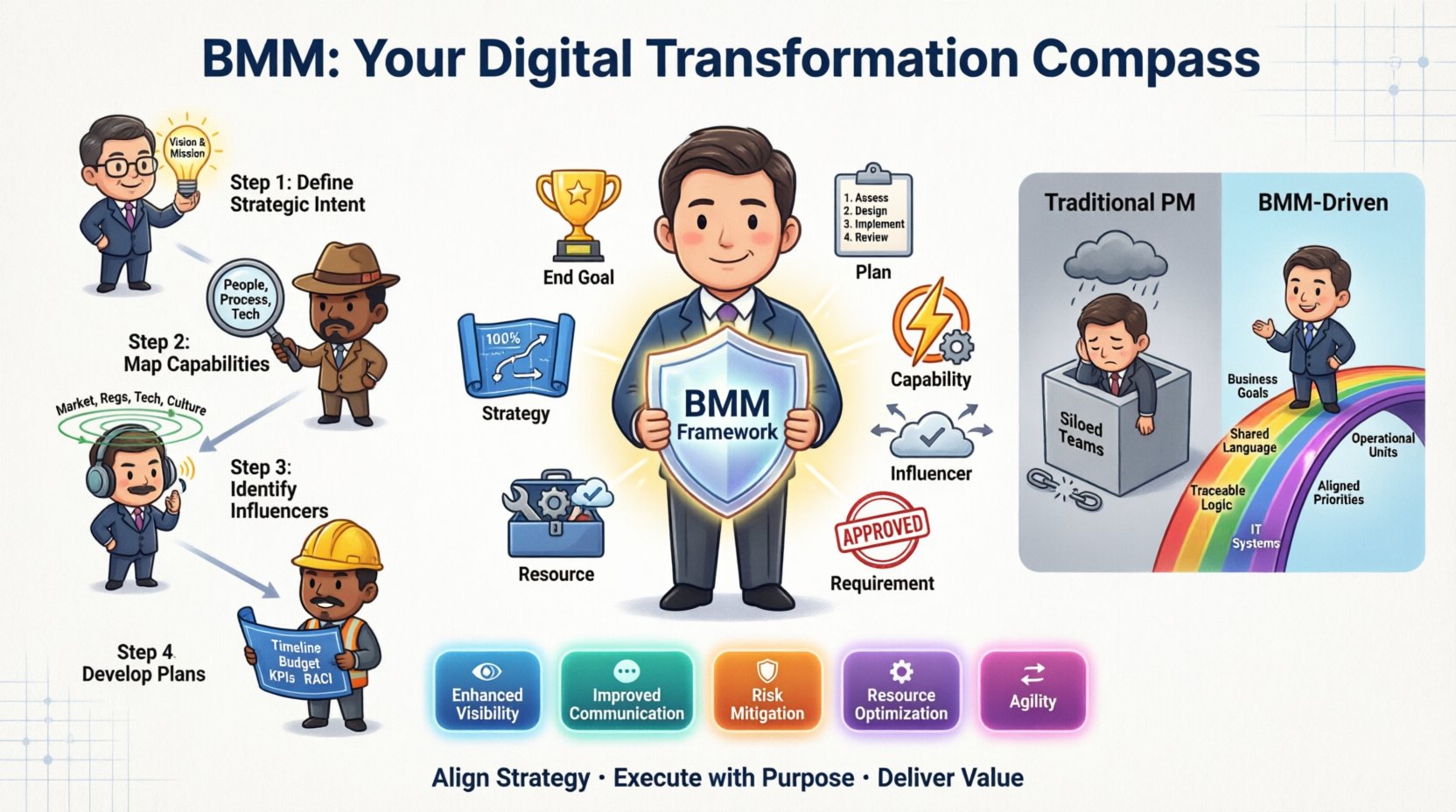
At the heart of the Business Motivation Model are several distinct constructs. Understanding these terms is the first step toward effective structuring.
- End Goal: The highest level of aspiration. In a transformation project, this might be market leadership or operational excellence.
- Objective: A specific target that supports an end goal. Objectives are measurable and time-bound.
- Strategy: The approach chosen to achieve objectives. This defines the path forward without detailing every step.
- Plan: A series of actions and resources required to execute a strategy.
- Capability: The ability of an organization to perform a task. Capabilities often need to be developed or acquired during transformation.
- Resource: The assets required to perform work, including people, systems, and facilities.
- Influencer: External or internal factors that impact the business. These can be opportunities or threats.
- Requirement: A condition that must be met to satisfy an objective or goal.
🔗 Why BMM is Critical for Digital Transformation
Digital transformation projects often fail due to a disconnect between IT and business units. IT focuses on implementation, while business focuses on value. BMM acts as the connective tissue. It forces stakeholders to articulate the business reasons behind technical decisions. This alignment reduces waste and ensures that every line of code or configuration change contributes to a defined business outcome.
Key Benefits of Integration
- Enhanced Visibility: Stakeholders can see how specific tasks link back to high-level strategic goals.
- Improved Communication: The model provides a common vocabulary for technical and non-technical teams.
- Risk Mitigation: By mapping influencers, organizations can anticipate market shifts or regulatory changes that might impact the project.
- Resource Optimization: Understanding capabilities and resources helps in allocating budget and personnel more effectively.
- Agility: When goals shift, the model allows for rapid re-evaluation of strategies and plans without losing sight of the end goal.
📋 Structuring the Project: A Step-by-Step Approach
Implementing the Business Motivation Model into a digital transformation project requires a systematic process. It is not enough to simply draw a diagram; the model must be populated with accurate data and maintained throughout the lifecycle of the project.
Step 1: Define Strategic Intent
The foundation of any transformation is a clear definition of what success looks like. This phase involves identifying the End Goals and Objectives. Leaders must ask questions such as: What is the primary business value we seek? How will we measure success?
- Conduct workshops with executive leadership to identify high-level aspirations.
- Translate aspirations into measurable objectives. Avoid vague terms like “improve efficiency” without defining metrics.
- Ensure objectives are aligned with the broader organizational strategy.
- Document the rationale for each objective to create a traceable link to the End Goal.
Step 2: Map Capabilities and Resources
Once the goals are set, the organization must assess its ability to achieve them. This involves mapping current capabilities against future requirements. Digital transformation often requires new capabilities that do not currently exist.
- List all existing capabilities within the relevant departments.
- Identify gaps between current capabilities and those needed to meet objectives.
- Assess the resources (people, technology, budget) available to close these gaps.
- Document dependencies between capabilities. For example, a new sales capability may depend on a new CRM resource.
Step 3: Identify Influencers and Requirements
No project exists in a vacuum. External market forces and internal constraints will influence the outcome. This step involves cataloging the factors that drive or hinder progress.
- Identify internal influencers, such as company culture or legacy systems.
- Identify external influencers, such as competitor actions or regulatory changes.
- Define requirements that must be met to satisfy the objectives. These are the constraints of the project.
- Assess the impact of each influencer on the strategic plan.
Step 4: Develop Strategies and Plans
With goals, capabilities, and constraints defined, the organization can now formulate the approach. Strategies are the high-level choices, while plans are the specific actions.
- Formulate strategies that leverage existing capabilities to meet objectives.
- Create detailed plans that outline the sequence of activities.
- Assign owners to specific plans and strategies to ensure accountability.
- Establish milestones and checkpoints to monitor progress against the model.
📊 Comparing Traditional vs. BMM-Driven Structuring
To understand the value added by this model, it is helpful to compare it with traditional project management approaches. The following table outlines the differences in focus and outcome.
| Feature | Traditional Project Management | BMM-Driven Transformation |
|---|---|---|
| Primary Focus | Delivering outputs and timelines | Achieving business outcomes and value |
| Alignment | Often siloed by department | Unified across business and IT |
| Change Management | Reactive to scope creep | Proactive based on strategic shifts |
| Stakeholder View | Task-oriented | Goal-oriented |
| Success Metrics | On time, on budget | Strategic alignment and ROI |
🛠️ Integrating with Enterprise Architecture
The Business Motivation Model does not exist in isolation. It integrates seamlessly with broader Enterprise Architecture frameworks. This integration ensures that the motivational model drives the technical architecture.
Alignment with Architecture Layers
- Business Architecture: BMM defines the business goals and strategies that shape the business architecture.
- Information Architecture: Requirements derived from BMM influence data standards and governance.
- Application Architecture: Capabilities identified in BMM dictate the need for specific software systems.
- Technology Architecture: Resources mapped in BMM determine the infrastructure requirements.
By anchoring technical decisions in the Business Motivation Model, organizations ensure that technology serves the business, not the other way around. This prevents the common pitfall of buying technology that looks impressive but fails to solve the underlying business problem.
⚠️ Common Pitfalls and How to Avoid Them
Even with a robust framework, implementation can face challenges. Recognizing these pitfalls early can save significant time and resources.
1. Over-Modeling
It is tempting to model every detail of the business. This can lead to analysis paralysis. The model should be as simple as possible to serve its purpose.
- Focus on the critical paths that drive value.
- Use high-level summaries for areas that are stable and not changing.
- Review the model periodically to prune unnecessary elements.
2. Static Modeling
A model created at the start of a project is useless if it is not updated. Digital transformation is dynamic; the business environment changes.
- Establish a governance process for updating the model.
- Review the model at major project milestones.
- Encourage stakeholders to report changes in their environment that affect the model.
3. Lack of Stakeholder Buy-in
If the people responsible for execution do not understand the model, it will fail. Communication is key.
- Train teams on the terminology and concepts of the model.
- Involve stakeholders in the creation of the model to ensure ownership.
- Visualize the model in dashboards that are accessible to all team members.
🔄 Iterating the Model for Continuous Improvement
Digital transformation is not a one-time event; it is a continuous journey. The Business Motivation Model supports this by allowing for iteration.
- Monitor Performance: Track the achievement of objectives against the plan.
- Analyze Variances: Identify why certain objectives were not met. Was the strategy flawed, or were resources insufficient?
- Adjust Strategies: If the environment changes, update the strategies to align with the new reality.
- Refine Goals: Occasionally, the End Goal itself may need to shift based on market conditions.
💡 Practical Application Scenarios
Consider a scenario where a retail organization wants to move to an omnichannel model. Using BMM, the organization would structure the project as follows:
- End Goal: Become the customer’s preferred shopping destination.
- Objective: Increase online sales by 30% within 18 months.
- Strategy: Integrate inventory systems across all channels.
- Plan: Implement API middleware to connect warehouse and e-commerce systems.
- Capability: Real-time inventory visibility.
- Resource: Cloud infrastructure and data integration tools.
- Influencer: Competitor launching same-day delivery.
- Requirement: Data must be accurate to within 99%.
This structure allows the IT team to understand that the technical integration is not just about code; it is about enabling the capability required to meet the objective. If the competitor launches same-day delivery, the Influencer is updated, triggering a review of the Strategy and Plan.
🌟 Final Considerations
Implementing the Business Motivation Model requires discipline and commitment. It is not a quick fix, but a strategic asset. By structuring digital transformation projects with this model, organizations gain clarity and control. They move from reactive firefighting to proactive management. The result is a transformation that delivers tangible business value, driven by a clear understanding of the motivations behind every action.
As you embark on your own journey, remember that the model is a tool for thinking, not just a document for filing. Use it to facilitate conversations, challenge assumptions, and align teams. The path to successful transformation is paved with clear intent and structured execution. By leveraging the Business Motivation Model, you ensure that every step taken is a step toward the desired future state.