


In modern enterprises, the friction between business units and IT departments is not merely an annoyance; it is a strategic risk. 🚨 Business leaders demand rapid innovation and time-to-market. IT leaders prioritize stability, security, and technical debt reduction. When these priorities collide without a structured framework, projects stall, budgets inflate, and morale plummets. This guide explores how the Business Motivation Model (BMM) provides a neutral ground to resolve these tensions effectively.
By adopting a standardized language for strategy and execution, organizations can move from reactive firefighting to proactive alignment. This approach relies on mapping the Wants and Needs of stakeholders to specific Goals and Objectives, ensuring that every technical initiative supports a tangible business outcome. 💡
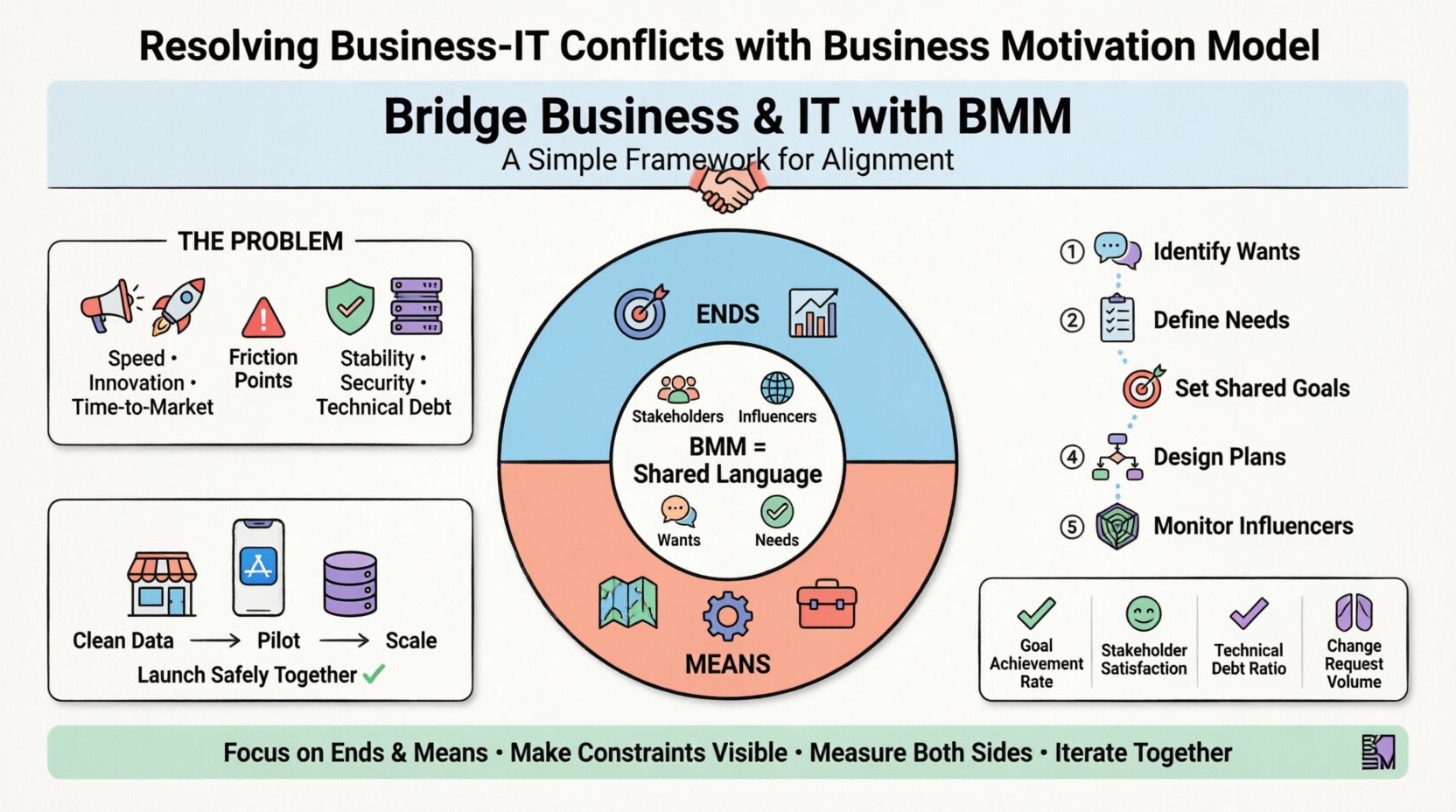
📉 The Anatomy of Business-IT Friction
Conflicts rarely arise from malice. They stem from misaligned incentives and a lack of shared context. To resolve these issues, we must first identify the root causes. These friction points typically manifest in the following areas:
- Speed vs. Stability: Marketing pushes for a new campaign feature immediately, while Engineering warns of potential system outages.
- Resource Contention: Both departments claim the same development capacity for their respective priorities.
- Undefined Value: Business requests features without explaining the ROI, making it hard for IT to justify the effort.
- Communication Gaps: Business speaks in revenue and market share; IT speaks in latency and uptime. Neither fully understands the other’s constraints.
Without a mechanism to translate business intent into technical requirements, assumptions fill the void. These assumptions are where projects go wrong. 🛑
🧩 Understanding the Business Motivation Model (BMM)
The Business Motivation Model is an industry standard designed to model the strategy, planning, and execution of an organization. It was developed to bridge the gap between high-level strategy and low-level execution. In the context of conflict resolution, BMM acts as a translator.
It focuses on two primary dimensions:
- Ends: What the organization wants to achieve (Goals and Objectives).
- Means: How the organization achieves them (Plans, Tactics, and Resources).
When conflicts occur, it is usually because the Means proposed by IT do not align with the Ends desired by the Business Unit. BMM forces a clear definition of both sides before any work begins.
Key BMM Elements Relevant to Conflict Resolution
To apply this model effectively, we must understand the specific artifacts involved:
- Stakeholders: Individuals or groups who have an interest in the outcome.
- Influencers: Factors that affect the ability to achieve Ends (e.g., regulations, market conditions, technical limitations).
- Wants: Specific desires of a stakeholder (e.g., “I want faster checkout.”).
- Needs: The underlying requirements that must be met to satisfy a Want (e.g., “The system must handle 1000 requests per second.”).
- Goals: High-level desired outcomes that must be achieved.
- Objectives: Specific, measurable targets that support a Goal.
- Plans: The strategy for achieving an Objective.
- Tactics: Specific actions taken to execute the Plan.
🔍 Mapping Conflicts to BMM Elements
Every conflict can be mapped to a specific element within the model. By identifying which element is misaligned, you can apply the correct resolution strategy. The table below illustrates common friction points and their corresponding BMM mappings.
| Conflict Type | BMM Element | Resolution Focus |
|---|---|---|
| Business demands unrealistic timelines | Goals / Objectives | Re-evaluate feasibility and resources |
| IT blocks features for “technical debt” | Influencers | Make debt visible as a risk factor |
| Unclear priority between projects | Wants / Needs | Clarify stakeholder value hierarchy |
| Deliverables do not meet business use | Plans / Tactics | Align execution strategy with intent |
This mapping allows teams to stop arguing about the symptom and start addressing the structural cause. 🛠️
🛠️ Step-by-Step Guide to Resolving Conflict
Applying the Business Motivation Model requires a disciplined process. Follow these steps to facilitate alignment between business and IT teams.
1. Identify All Stakeholders and Their Wants
The first step is to gather everyone who has a vested interest in the project. This includes business owners, IT managers, end-users, and compliance officers. For each stakeholder, explicitly document their Wants.
- Business Unit: “We want to increase conversion by 5%.”
- IT Team: “We want to reduce server costs by 20%.”
- Security: “We want to ensure data encryption compliance.”
Do not accept vague statements. If a stakeholder says, “I want better performance,” ask for the metric. Is it latency? Throughput? Uptime? Quantifying wants turns subjective feelings into objective data.
2. Define the Needs Behind the Wants
Once wants are listed, dig deeper to find the Needs. A want is a desire; a need is a requirement for that desire to be realized. Often, conflicts arise because IT satisfies the Need while Business focuses on the Want, or vice versa.
- Want: Launch a mobile app.
- Need: Access to customer data via a secure API.
If IT refuses the app launch due to API security concerns, they are addressing the Need. If Business refuses the API security upgrade, they are ignoring the Need. BMM forces both sides to acknowledge the Need as a constraint.
3. Establish Shared Goals and Objectives
This is the most critical step for alignment. The organization must define a Goal that encompasses the interests of both parties. A Goal is a desired state that must be achieved.
Example:
- Business Goal: Increase Revenue.
- IT Goal: Ensure System Availability.
- Shared Goal: Optimize Customer Experience to Drive Revenue while Maintaining 99.9% Uptime.
By creating a shared Goal, IT’s stability becomes a means to achieve Business’s revenue, rather than an obstacle. The Objectives must be measurable. If an Objective cannot be measured, it cannot be tracked for alignment.
4. Design Plans and Tactics to Satisfy Needs
Once Goals are set, develop Plans. A Plan is the strategy for achieving an Objective. Tactics are the specific actions.
When conflicts arise regarding resource allocation, refer back to the Plan. If a tactic does not contribute to the shared Objective, it should be deprioritized. This removes personal bias from the decision-making process. The decision is based on the model, not the department head.
5. Document and Monitor Influencers
Influencers are external or internal factors that impact the ability to achieve Goals. These include budget changes, regulatory updates, or technical debt.
When IT says “No,” it is often due to an Influencer (e.g., “Legacy infrastructure cannot support this feature”). By documenting this Influencer explicitly, the Business Unit understands the constraint is not a refusal, but a technical reality. This transparency reduces frustration.
📊 Real-World Scenario: The Digital Transformation Clash
To visualize this process, consider a hypothetical scenario involving a Retail Company.
The Situation:
- Business Unit (Retail): Wants to launch a personalized recommendation engine to boost sales.
- IT Department: Resists, citing high technical debt in the data warehouse and security risks.
Applying BMM:
- Identify Wants: Business wants speed of sales. IT wants system stability.
- Define Needs: Business needs data accuracy. IT needs data integrity.
- Set Shared Goal: Maximize sales through data-driven insights while maintaining data integrity.
- Develop Plan: Instead of a full overhaul (IT’s fear) or a quick hack (Business’s desire), create a phased Plan. Phase 1: Clean data. Phase 2: Pilot recommendation engine.
- Assign Tactics: IT allocates resources to data cleaning. Business allocates budget to pilot testing.
- Monitor Influencers: Track data quality metrics. If integrity drops, the Plan pauses.
By using this model, the conflict shifts from “Launch vs. Don’t Launch” to “How do we launch safely?” The BMM provides the structure to negotiate the trade-offs objectively. 🤝
🚧 Common Pitfalls in BMM Implementation
Even with a robust model, organizations often stumble. Be aware of these common mistakes that can undermine the conflict resolution process.
- Skipping the “Needs” Step: Jumping straight from Wants to Goals ignores the technical constraints, leading to unachievable promises.
- Over-Modeling: Creating a model so complex that no one reads it. Keep the BMM artifacts lightweight and relevant to the immediate conflict.
- One-Size-Fits-All: Treating every conflict the same way. High-level strategy conflicts require different BMM depth than tactical execution conflicts.
- Lack of Ownership: If no one is responsible for maintaining the BMM artifacts, they become outdated quickly. Assign a Business Analyst or Architect as the owner.
📈 Measuring the Success of Alignment
How do you know the BMM approach is working? You need metrics that reflect both business value and technical health. Relying on delivery dates alone is insufficient.
Track the following indicators:
- Goal Achievement Rate: Percentage of defined Goals met within the timeframe.
- Stakeholder Satisfaction: Survey business units on their perception of IT support.
- Change Request Volume: A reduction in last-minute changes indicates better initial alignment.
- Technical Debt Ratio: Ensure IT health is not sacrificed for business speed.
- Project Rejection Rate: Fewer projects should be rejected mid-stream due to misalignment.
Consistent monitoring of these metrics ensures that the BMM remains a living tool rather than a one-time exercise. 📉
🔄 Sustaining the Alignment Over Time
Alignment is not a destination; it is a continuous process. Markets change, technology evolves, and business priorities shift. The BMM framework must be reviewed regularly.
- Quarterly Reviews: Revisit the Goals and Objectives to ensure they still match the current market reality.
- Post-Project Retrospectives: Analyze where the conflict arose and if the BMM model could have prevented it.
- Training: Ensure new hires understand the BMM vocabulary. Shared language is the foundation of shared understanding.
When the model is embedded in the culture, conflicts become discussions about how to achieve the Goal, rather than battles over departmental power. This cultural shift is the true value of the Business Motivation Model.
🔑 Key Takeaways for Leaders
To summarize the path forward for resolving Business and IT conflicts:
- Adopt a Shared Vocabulary: Use BMM terms like Goals, Objectives, and Plans to standardize communication.
- Focus on Ends and Means: Clearly distinguish between what you want (Ends) and how you do it (Means).
- Make Influencers Visible: Surface technical constraints early so they do not surprise the business later.
- Measure Both Sides: Track business outcomes and technical health equally.
- Iterate: Treat the model as a dynamic tool that evolves with the organization.
By implementing these practices, organizations can transform the traditional Business-IT divide into a collaborative partnership. The result is not just fewer arguments, but faster delivery of value, lower risk, and a more resilient enterprise. 🏆