
Designing distributed systems requires a clear understanding of internal logic alongside external boundaries. While microservices architecture emphasizes loose coupling and independent deployment, the internal structure of each service remains critical. UML class diagrams provide a standardized way to visualize this internal logic, data models, and interactions within a specific service context. This guide explores how to apply class modeling techniques effectively within a microservices ecosystem, ensuring maintainability and clarity without creating unnecessary complexity.
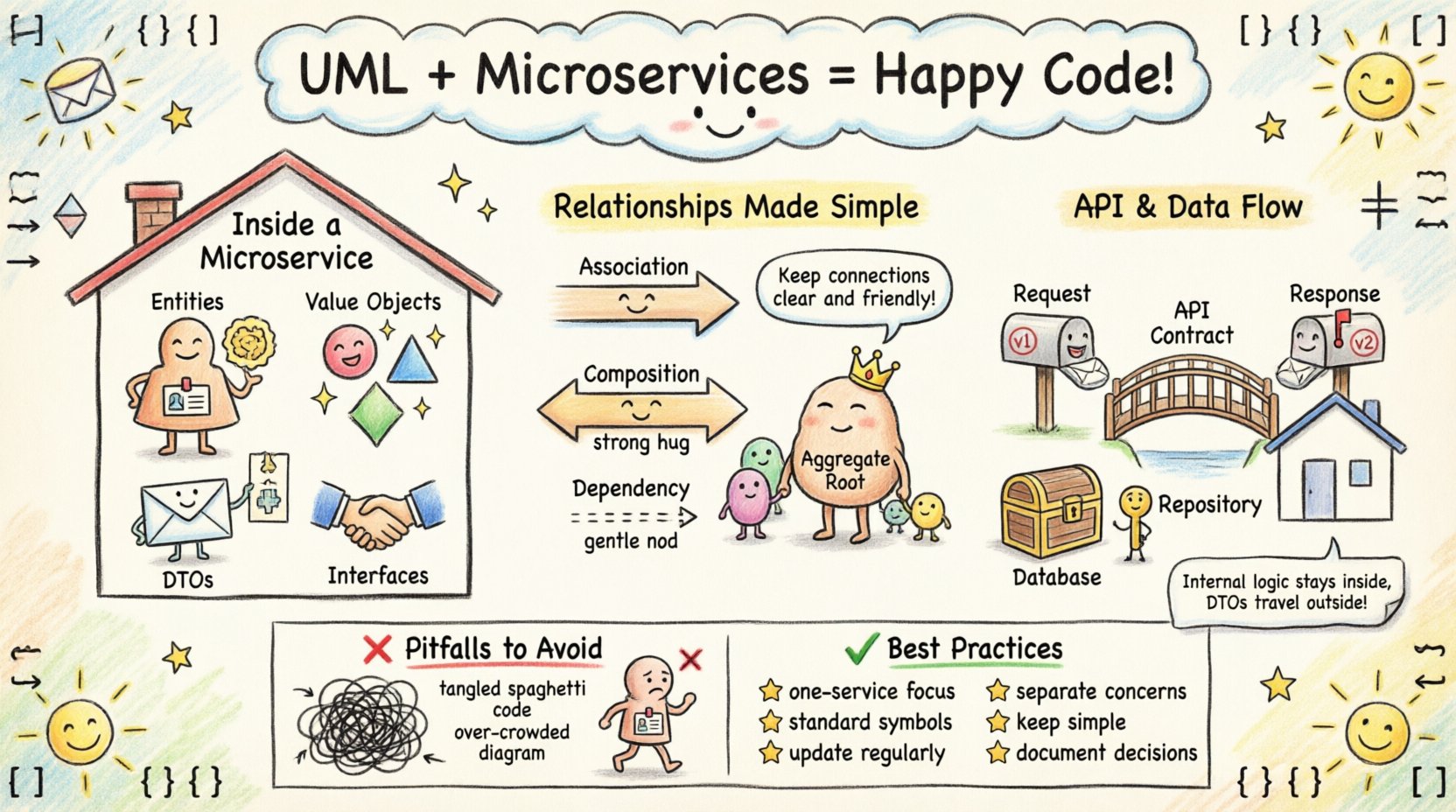
🧩 Understanding the Intersection
Microservices break down monolithic applications into smaller, manageable units. However, this decomposition does not eliminate the need for detailed design. Each service encapsulates a specific business capability, and within that capsule, there are entities, value objects, and logic that must be organized. Class diagrams serve as a blueprint for these internal components.
When architects transition from a monolith to microservices, they often focus heavily on deployment diagrams or sequence diagrams. Yet, the class diagram remains essential for developers working within a single service. It defines:
- The data structures used internally.
- The responsibilities of individual classes.
- The relationships between components within the service boundary.
- The interfaces exposed to other services via API contracts.
Using UML class diagrams in this context prevents internal refactoring from becoming chaotic. It establishes a contract for the code within the service boundary, ensuring that new features align with the established domain model.
📊 Why Class Diagrams Matter in Distributed Systems
In a distributed environment, communication overhead is a primary concern. Misunderstandings between teams often lead to tight coupling disguised as loose coupling. A well-documented class diagram helps clarify the scope of responsibility for a specific service.
Clarifying Boundaries
Microservices rely on clear domain boundaries. A class diagram visually represents what belongs inside a service and what does not. By mapping entities to specific services, teams can avoid the anti-pattern of shared database schemas or shared domain models across multiple services.
Facilitating Communication
When multiple teams own different services, communication regarding data structures is frequent. A class diagram acts as a shared language. Instead of describing a data model in text, a visual representation allows stakeholders to quickly grasp relationships, constraints, and cardinality.
Supporting Domain-Driven Design
Many microservices projects utilize Domain-Driven Design (DDD). Class diagrams are a natural fit for DDD because they allow modeling of:
- Entities: Objects defined by their identity.
- Value Objects: Objects defined by their attributes.
- Aggregates: Clusters of objects treated as a single unit.
- Domain Services: Operations that do not fit within a single entity.
🧱 Core Elements of a Microservice Model
To create an effective class diagram for a microservice, one must distinguish between the different types of classes that make up the system. Not every class needs the same level of detail. The following elements are common in microservice internal models.
Entities and Aggregates
Entities represent the core business objects. In a microservice, an aggregate root controls access to the internal state of the aggregate. The class diagram should highlight which class acts as the root.
- Primary Key: Clearly marked to indicate uniqueness.
- State: Attributes that define the current status of the entity.
- Behavior: Methods that modify the state, ideally encapsulated within the class.
Value Objects
Value objects do not have a unique identity. They are defined by their attributes. Examples include monetary amounts, addresses, or color configurations. In the diagram, these should be distinguished from entities to indicate immutability.
DTOs and Transfer Objects
While the internal model focuses on business logic, data transfer objects are necessary for serialization. DTOs often mirror the domain model but are flattened for network transmission. They should be clearly separated from the domain entities in the diagram to prevent accidental coupling between the service logic and the API layer.
Interfaces and Abstract Classes
Interfaces define contracts. In a microservice, internal interfaces allow for dependency injection and testing. They should be used to define the behavior of services within the same process.
🔗 Managing Relationships and Dependencies
The health of a microservice often depends on how well its internal classes interact. Relationships in UML diagrams indicate how classes depend on one another. Understanding these relationships is vital for maintaining low coupling.
Association
An association represents a structural link between objects. In microservices, this is often a reference to another entity within the same aggregate or a related entity. It should be used sparingly to avoid complex navigation chains that hinder performance.
Aggregation and Composition
These relationships describe part-whole hierarchies.
- Composition: Strong ownership. If the parent is destroyed, the child is destroyed. This is common for temporary state objects.
- Aggregation: Weak ownership. The child can exist independently. This is common when referencing other entities.
Dependency
A dependency indicates that a change in one class may require a change in another. In microservices, dependencies should ideally flow in one direction. A service should not depend on the implementation details of another service’s internal classes.
Interface Segregation
Large interfaces can lead to unnecessary dependencies. The diagram should reflect small, focused interfaces that allow clients to depend only on the methods they actually use. This reduces the impact of changes.
| Relationship Type | Microservice Context | Best Practice |
|---|---|---|
| Association | Internal data linking | Use for logical connections within an aggregate |
| Composition | Lifecycle management | Use for objects that cannot exist independently |
| Dependency | Implementation details | Avoid long chains; prefer interfaces |
| Inheritance | Polymorphism | Use cautiously; favor composition over inheritance |
📡 API Contracts and DTOs
Microservices communicate via network calls. The data sent over the wire is often different from the internal domain model. Class diagrams should include a section for these transfer objects.
Request and Response Models
These classes define the payload for HTTP requests and responses. They should be distinct from the domain entities to prevent exposing internal implementation details. The diagram should show which domain objects are mapped to which DTOs.
Versioning Considerations
API contracts change over time. A class diagram can help visualize versioning strategies. By grouping DTOs by version, teams can see how the contract evolves without breaking existing consumers. Annotations or separate packages can indicate version numbers.
Serialization Metadata
Some classes require specific metadata for serialization frameworks. While UML does not natively support this, notes can be added to the diagram to indicate fields that must be excluded or included during serialization.
💾 Data Models and Persistence Layers
Microservices often follow the database-per-service pattern. This means the data model within the class diagram must align with the persistence strategy. The diagram should reflect the repository pattern if used.
Repository Interfaces
Repositories abstract data access. The class diagram should show the repository interface and its implementation. This separation allows the domain logic to remain independent of the database technology.
Entity-State Mapping
Not all domain entities are stored in the database. Some are in-memory objects. The diagram can use stereotypes or notes to indicate which classes are persisted and which are transient.
Database Schema Alignment
While UML class diagrams are not database schema diagrams, they should align logically. Fields in the class diagram should correspond to columns in the database table. Discrepancies here often lead to performance issues or data integrity problems.
⚠️ Common Pitfalls to Avoid
Creating class diagrams for microservices introduces specific challenges. Architects and developers often fall into traps that undermine the benefits of the architecture.
Over-Engineering
It is tempting to model every edge case and relationship. However, a diagram that is too complex becomes unreadable. Focus on the core domain logic. Details can be added later as the system matures.
Ignoring Service Boundaries
A common mistake is including classes from other services in the diagram. This violates the principle of encapsulation. The diagram should strictly represent the internal structure of a single service.
Static Coupling
If the diagram shows tight coupling between classes, the code will be hard to maintain. Use interfaces to decouple dependencies. Ensure that changes in one class do not cascade through the entire system.
Neglecting Evolution
Software evolves. A class diagram created at the start of a project may be obsolete after a few months. The diagram should be treated as a living document, updated alongside the codebase.
Tooling Complexity
Using complex modeling tools can slow down development. Keep the diagrams simple and focused. If the diagram is not used by the team, it will not be maintained.
🔄 Maintenance and Evolution
Once the diagram is created, it requires maintenance. The goal is to keep the documentation accurate without creating a bottleneck.
Code Generation
Some environments allow generating code from diagrams. While this can save time, it creates a dependency between the model and the code. If the code changes, the model must be updated. In many agile teams, it is better to generate the diagram from the code to ensure accuracy.
Documentation Integration
Place the diagram in the repository alongside the code. This ensures that version control tracks changes to the design. It also makes the diagram accessible to new team members during onboarding.
Refactoring Triggers
If a class diagram shows a class with too many responsibilities, it is a signal for refactoring. The diagram serves as a diagnostic tool for identifying code smells such as God Classes or Spaghetti Code.
🛠️ Integration with Development Workflows
Integrating modeling into the workflow ensures that design remains a priority. It should not be a separate phase but part of the continuous development process.
Design Reviews
Incorporate class diagrams into pull request reviews. This allows peers to check if new classes align with the existing architecture. It catches design issues before code is merged.
Onboarding
New developers can use the class diagram to understand the service structure quickly. It reduces the time needed to navigate the codebase.
Knowledge Transfer
When team members leave, the diagram preserves the architectural intent. It serves as a record of why certain decisions were made regarding class structure and relationships.
🎯 Summary of Best Practices
To ensure success with UML class diagrams in microservices, adhere to the following guidelines:
- Focus on One Service: Do not mix models from different services.
- Use Standard Notations: Stick to standard UML symbols to ensure readability.
- Keep It Current: Update diagrams when code changes significantly.
- Separate Concerns: Distinguish between domain logic and API contracts.
- Limit Complexity: Avoid deep hierarchies and excessive relationships.
- Document Decisions: Add notes to explain architectural choices.
By following these principles, teams can leverage UML class diagrams to build robust, maintainable, and scalable microservices architectures. The visual representation aids in communication, reduces errors, and ensures that the internal logic of each service remains clear and organized throughout the development lifecycle.