
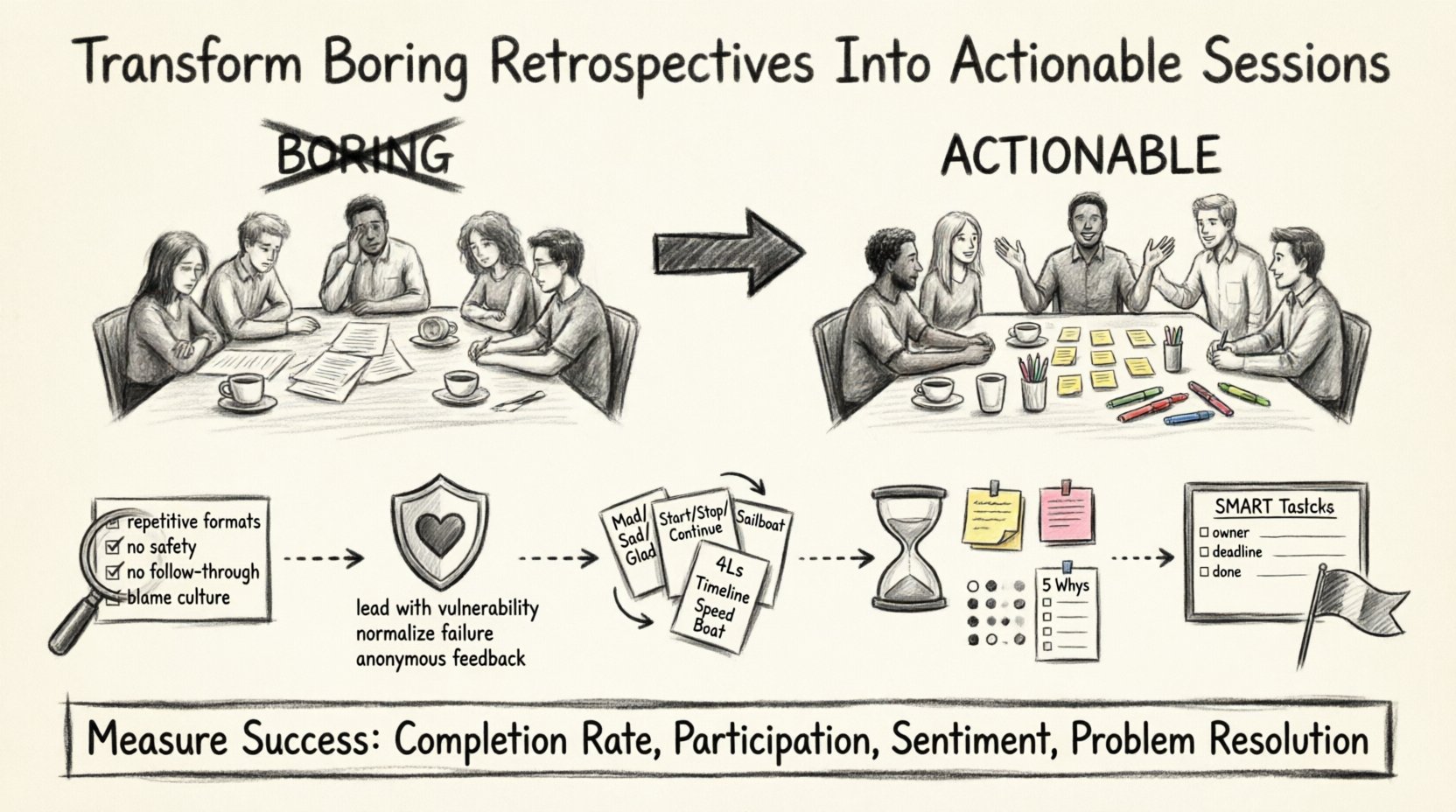
For many Scrum teams, the retrospective is the part of the ceremony that everyone dreads. It is often viewed as a mandatory meeting that consumes valuable time without yielding tangible results. Teams frequently report that these sessions feel repetitive, unproductive, or simply boring. When a retrospective fails to engage the team, the opportunity for continuous improvement vanishes. The cycle of inefficiency continues unchecked, and morale suffers as a result.
This guide provides a structured approach to revitalize your retrospectives. The goal is not merely to hold a meeting, but to facilitate an environment where genuine feedback is shared, analyzed, and converted into action. By shifting the focus from performance reporting to psychological safety and actionable outcomes, you can transform these sessions into the engine of your team’s growth.
🛑 Diagnosing the Problem: Why Retrospectives Feel Boring
Before implementing solutions, one must understand the root causes of disengagement. A boring retrospective is rarely about the lack of time; it is usually about the lack of value perceived by the participants. Several factors contribute to this state:
- Repetitive Formats: Using the same structure every sprint leads to predictability that kills curiosity. If the team knows exactly what will happen, they stop thinking critically.
- Lack of Psychological Safety: If team members fear retribution or judgment, they will withhold honest feedback. This leads to superficial discussions about weather or lunch.
- Missing Follow-Through: When action items are created and never addressed, the team learns that the retrospective is performative. This creates cynicism.
- Too Many Participants: Large groups can lead to dominance by louder voices, silencing quieter contributors who often have the most valuable insights.
- Focus on Blame: If the session turns into a blame game, the energy shifts from problem-solving to defensiveness.
Addressing these issues requires a deliberate shift in facilitation style and session design. It is about creating a container where the team feels safe enough to be honest and structured enough to act.
🛡️ The Foundation: Psychological Safety
Before discussing specific formats, it is crucial to establish the bedrock of any successful retrospective: psychological safety. This concept, popularized by research on high-performing teams, refers to a shared belief that the team is safe for interpersonal risk-taking. Without it, no amount of facilitation technique will work.
To cultivate this environment, consider the following practices:
- Lead with Vulnerability: The facilitator should model openness. Admitting your own mistakes first sets the tone that imperfection is acceptable.
- Normalize Failure: Frame mistakes as learning opportunities rather than reasons for punishment. Use language that focuses on the process, not the person.
- Anonymous Feedback: For sensitive topics, allow team members to submit thoughts anonymously. This ensures that unpopular but necessary opinions are heard.
- Listen Actively: When someone speaks, listen to understand, not to reply. Validate their feelings before moving to solutions.
- Set Ground Rules: Establish norms at the start of the session. Examples include “what is said here, stays here” or “no interruptions.”
When safety is established, the conversation naturally moves from superficialities to the real friction points that impede progress.
📋 Choosing the Right Format
Using the same retro format every sprint leads to stagnation. Varying the structure keeps the team engaged and forces them to look at the process from different angles. Below is a table comparing effective formats based on the team’s current needs.
| Format Name | Best Used When… | Key Focus |
|---|---|---|
| Mad, Sad, Glad | Team morale is low or emotions are running high. | Emotional check-in and team dynamics. |
| Start, Stop, Continue | The team needs clear behavioral changes. | Process adjustments and habits. |
| Sailboat | The team needs to visualize progress and obstacles. | Wind (motivation), Anchors (obstacles), and Direction. |
| 4Ls (Liked, Learned, Lacked, Longed For) | The team wants a balanced view of the sprint. | Positive reinforcement and future desires. |
| Timeline | The team wants to review specific events chronologically. | Contextualizing events in relation to time. |
| Speed Boat | The team wants to identify what is holding them back. | Identifying anchors (problems) and sails (goals). |
Rotate these formats regularly. If the team is stuck in a cycle of technical debt, a “Start, Stop, Continue” session might reveal the need to stop new features and start refactoring. If the team is burnt out, a “Mad, Sad, Glad” session can help address the emotional toll.
🎤 Facilitation Techniques for Engagement
The facilitator plays a critical role in maintaining energy and focus. A passive facilitator leads to a passive session. Here are techniques to keep the energy high and the conversation productive.
1. Timeboxing
Every activity within the retrospective must have a strict time limit. This prevents the team from dwelling too long on a single issue. Use a visible timer. When time is up, move on. This creates a sense of urgency and discipline.
2. Silent Brainstorming
Before discussing, allow 5 to 10 minutes of silence for everyone to write down their thoughts individually. This prevents groupthink and ensures that introverted team members contribute equally. It also allows people to organize their thoughts before speaking.
3. Dot Voting
When there are too many ideas to discuss, use dot voting to prioritize. Give each team member three dots. They place them on the issues they feel are most critical. This democratizes the decision-making process and highlights what matters most to the group.
4. The 5 Whys
Once an issue is identified, use the “5 Whys” technique to find the root cause. Ask “Why did this happen?” five times, digging deeper each time. This moves the team away from symptoms and toward systemic solutions.
5. Affinity Mapping
When ideas are scattered, group similar items together. This helps the team see patterns and themes rather than isolated incidents. It simplifies the discussion and makes the data more digestible.
💡 From Insights to Action Items
The most common failure point in retrospectives is the lack of actionable outcomes. Discussing problems without fixing them is exhausting. To ensure the session yields results, the team must agree on specific actions.
Defining Actionable Items
An action item is not a goal; it is a specific step. “Improve communication” is a goal. “Schedule a daily 15-minute sync for the frontend team” is an action item. Use the SMART criteria (Specific, Measurable, Achievable, Relevant, Time-bound) to frame your actions.
Ensure every action item has:
- A Clear Owner: One person is responsible for seeing it through.
- A Deadline: By when will this be completed?
- A Definition of Done: How will we know it is finished?
Limit the Number of Actions
Do not create a list of twenty action items. It is impossible to deliver on all of them. Aim for one to three high-impact changes per sprint. Quality over quantity ensures that the team actually implements the changes.
Record and Communicate
Write the action items where everyone can see them. They should be visible during the sprint planning and daily stand-ups. If the team does not see them, they will not prioritize them.
🔍 Tracking and Accountability
Accountability is not about policing the team; it is about honoring commitments. If the team agrees to change a process, they should be able to track that change.
- Review Previous Actions: Start the next retrospective by reviewing the action items from the previous session. Did they get done? Why or why not?
- Visual Management: Use a physical board or a digital space to track the status of action items. Keep them visible.
- Celebrate Wins: When an action item is completed, acknowledge it. Positive reinforcement encourages the team to continue improving.
- Adjust Expectations: If an action item is consistently not completed, it may be too ambitious. Adjust the scope or the timeline.
Consistency in tracking builds trust. The team learns that their voice matters and that the retrospective is a tool for real change, not just a meeting.
🚫 Common Pitfalls to Avoid
Even with the best intentions, pitfalls can derail the process. Being aware of these common mistakes helps you steer clear of them.
- Allowing Management to Dominate: If a manager is present, they often dominate the conversation. They should observe or participate only as a team member, not as an authority figure.
- Rehashing Old Issues: If a problem has not been solved, do not bring it up again without a new perspective. Either the action item was not followed, or the root cause was misunderstood.
- Ignoring the Positive: Focus too much on problems, and the team will feel demoralized. Always include time to celebrate what went well.
- Skipping the Follow-Up: Never end a retrospective without explicitly stating what happens next. Assign the next facilitator and confirm the next time.
- Using Jargon: Avoid agile buzzwords that confuse new members. Speak plainly and clearly.
🌐 Adapting for Remote and Hybrid Teams
As teams become more distributed, the challenges of retrospectives increase. Physical cues are lost, and technology can introduce friction.
- Use Digital Whiteboards: Utilize shared spaces for brainstorming. Ensure everyone has access and knows how to use them.
- Breakout Rooms: For large teams, split into smaller groups to discuss specific topics, then report back.
- Camera Etiquette: Encourage cameras to be on if possible to read body language, but respect bandwidth constraints.
- Check Connectivity: Ensure the platform is stable before starting. Technical issues kill momentum quickly.
- Asynchronous Options: For teams in different time zones, consider asynchronous retrospectives where members submit feedback over a few days.
📈 Measuring Retrospective Health
How do you know if your retrospective is working? You need metrics, but not just velocity metrics. Focus on health indicators.
- Completion Rate: What percentage of action items from the previous retro are completed?
- Participation Rate: Is everyone speaking, or are the same few people dominating?
- Team Sentiment: Do team members feel the meeting was valuable? Ask for feedback on the retro format itself occasionally.
- Problem Resolution: Are recurring issues actually being resolved over time?
If the completion rate is low, revisit your action item definitions. If participation is low, try new formats or facilitation techniques. If sentiment is low, check the psychological safety of the group.
🛠️ The Role of the Scrum Master
The Scrum Master is the guardian of the retrospective process. Their job is to ensure the team has the environment and tools to improve. They are not there to teach the content, but to teach the process.
Responsibilities include:
- Facilitating: Guiding the conversation without steering the outcome.
- Protecting: Ensuring no one is attacked or interrupted.
- Coaching: Helping the team understand the “why” behind the improvements.
- Removing Impediments: If the team identifies a process impediment, the Scrum Master helps remove it.
Over time, the Scrum Master should encourage the team to take over the facilitation role. This builds ownership and ensures the process survives even when the Scrum Master is unavailable.
🔄 Continuous Improvement of the Process
Just as the team improves its product, the team must improve its process. This includes the retrospective itself. Every few sprints, ask the team: “Is this format working? Do we need to change how we run this meeting?”
Be willing to experiment. If a format stops working, drop it. If a new idea arises, try it. The retrospective is a living entity that must evolve with the team.
🏁 Summary
Transforming a boring retrospective into an actionable session is not a one-time fix. It requires consistent effort, psychological safety, and a commitment to action. By diagnosing the root causes of disengagement, selecting the right formats, and enforcing accountability, you can turn this meeting into the most valuable part of the sprint.
The goal is not perfection; it is progress. Every small improvement adds up to a high-performing, resilient team. Start by picking one technique from this guide and implementing it in your next session. Observe the results, adjust, and continue the cycle. This is the essence of the Scrum framework.