
In the modern enterprise, the gap between strategic intent and technical execution often leads to inefficiency, compliance risk, and misaligned resources. IT governance is frequently viewed as a set of restrictive rules rather than a strategic enabler. To bridge this divide, organizations must look beyond standard frameworks and examine the underlying motivations driving their operations. The Business Motivation Model (BMM) provides a structured approach to understanding why an enterprise acts, which in turn informs how governance policies should be constructed. This guide explores how to leverage BMM to create robust, meaningful IT governance policies that align with core business objectives.
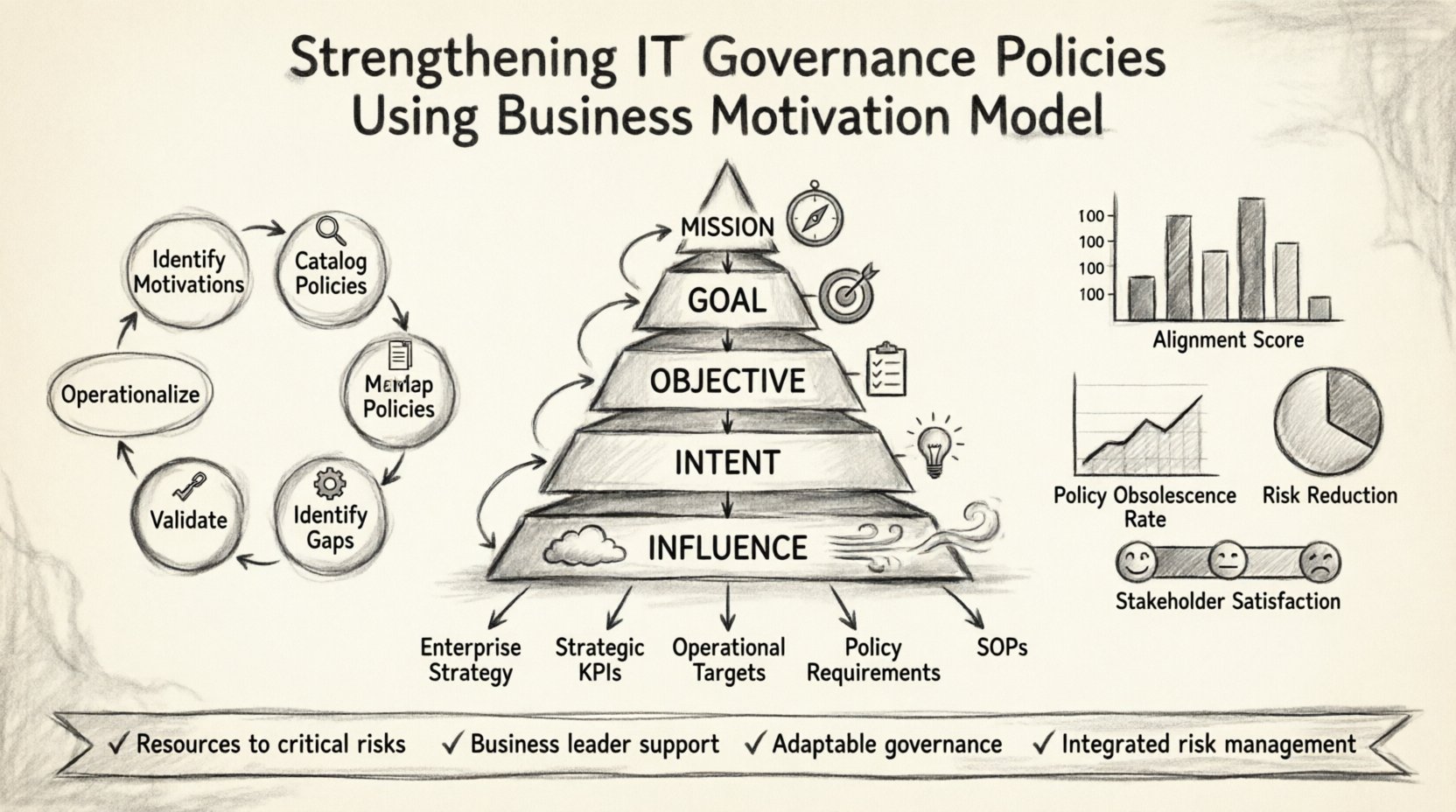
🔍 Understanding the Business Motivation Model (BMM)
The Business Motivation Model is a standard model designed to support enterprise modeling and architecture. It focuses on the motivational elements of an enterprise, distinguishing between what the enterprise wants to achieve and how it plans to achieve it. Unlike traditional architecture models that focus primarily on structure, BMM focuses on the drivers behind that structure.
For IT governance, this distinction is critical. Governance policies are often created based on perceived needs or regulatory requirements without a clear link to the specific business goals they support. By using BMM, governance teams can trace every policy back to a specific business motivation, ensuring that controls add value rather than just adding friction.
- Focus on Motivation: BMM explicitly models the reasons for action.
- Separation of Concerns: It separates the “Why” (Motivation) from the “How” (Enterprise Structure).
- Traceability: It enables clear traceability from high-level strategy to low-level technical controls.
🧱 Core Components of BMM Relevant to Governance
To effectively apply BMM to IT governance, one must understand the specific elements that constitute the model. These elements form the hierarchy of business intent. When building governance policies, these elements serve as the source of truth.
1. Mission
The Mission defines the fundamental reason for the enterprise’s existence. It is the highest level of motivation. IT governance must ensure that all technology investments and controls support this overarching purpose. If a policy hinders the mission, it requires re-evaluation.
2. Goal
Goals are the high-level outcomes the enterprise seeks to achieve. They are often time-bound and measurable. In the context of IT governance, Goals might include “Achieve 99.9% uptime” or “Reduce data breach incidents by 20%.” Governance policies should be designed to facilitate the achievement of these goals.
3. Objective
Objectives are more specific steps taken to achieve a Goal. They break down high-level aspirations into actionable targets. For example, an Objective supporting the uptime Goal might be “Implement automated failover systems.” Governance policies regarding change management or disaster recovery are directly linked to these Objectives.
4. Intent
Intents represent the immediate reasons for specific actions. They are often related to plans or tasks. An Intent might be “Ensure compliance with data privacy regulations.” This drives specific governance policies regarding data encryption and access control.
5. Influence
Influences are the factors that affect the enterprise’s ability to achieve its goals. These can be positive (opportunities) or negative (threats). IT governance must account for Influences such as market volatility, regulatory changes, or technological obsolescence. Policies must be dynamic enough to respond to these influences.
🔗 Mapping BMM to IT Governance Policies
The core value of BMM in governance lies in the mapping process. Instead of creating policies in a vacuum, organizations can derive them directly from the motivational elements. This ensures that every rule has a business justification.
Consider the following relationship:
- Mission ➔ Defines the scope of governance.
- Goal ➔ Defines the success metrics for governance.
- Objective ➔ Defines the specific requirements for controls.
- Intent ➔ Defines the specific policy mandates.
When a policy is written, it should answer the question: “Which BMM element does this support?” If a policy cannot be traced to a Mission, Goal, or Objective, it may be redundant or misaligned.
📋 BMM Elements vs. Governance Artifacts
The table below illustrates how specific BMM elements translate into standard IT governance artifacts. This mapping helps governance teams audit their existing policies for alignment.
| BMM Element | Governance Equivalent | Example |
|---|---|---|
| Mission | Enterprise Strategy / Vision | “To be the market leader in secure cloud services.” |
| Goal | Strategic KPIs / Targets | “Maintain ISO 27001 certification.” |
| Objective | Operational Targets | “Conduct quarterly security audits.” |
| Intent | Policy Requirements | “All servers must have anti-malware installed.” |
| Plan | Implementation Roadmap | “Upgrade firewall infrastructure by Q3.” |
| Task | Standard Operating Procedures | “Admins must reset passwords every 90 days.” |
🛠️ Implementation Framework
Integrating BMM into IT governance requires a systematic approach. It is not a one-time activity but a continuous process of refinement. The following steps outline the implementation path.
Step 1: Identify Business Motivations
Begin by interviewing key stakeholders to understand the Mission and Goals of the organization. Document these clearly. Avoid technical jargon at this stage; focus on business value. This creates the foundation for all subsequent governance work.
Step 2: Catalog Existing Policies
Review all current IT governance policies, standards, and procedures. List them out. At this stage, do not judge them; simply inventory them. This provides a baseline for the mapping exercise.
Step 3: Map Policies to Motivations
For each policy identified, determine which BMM element it supports. If a policy does not map to any element, investigate why it exists. Is it a legacy requirement? Is it a shadow IT policy? This step often reveals redundant controls that can be removed.
Step 4: Identify Gaps
Once mapped, look for high-priority Motivations (Goals and Objectives) that lack corresponding policies. These represent governance gaps where risk is unmanaged. Prioritize the creation of new policies to address these gaps.
Step 5: Validate with Stakeholders
Present the mapped structure to business leaders. Ensure they agree that the governance policies truly support their stated goals. This validation builds trust and ensures the governance framework is viewed as a partner rather than a blocker.
Step 6: Operationalize and Monitor
Embed the BMM mapping into the policy lifecycle. When a policy is updated, verify its link to the motivation. Monitor the effectiveness of policies against the Goals they support. If a Goal is met but the policy remains burdensome, consider revising the policy.
📈 Measuring Effectiveness
Success in this context is not just about policy creation; it is about outcome achievement. Governance effectiveness should be measured using metrics derived from the BMM Goals.
- Alignment Score: Percentage of policies with a documented link to a Business Goal.
- Policy Obsolescence Rate: Number of policies retired due to lack of motivation.
- Risk Reduction: Decrease in incidents related to the specific Goals being protected.
- Stakeholder Satisfaction: Feedback from business units on the utility of governance controls.
By tying measurement to the BMM, governance teams can demonstrate their contribution to business value rather than just compliance.
⚠️ Common Challenges and Considerations
While the Business Motivation Model offers a robust framework, implementation is not without challenges. Organizations should anticipate the following issues.
Complexity of Mapping
Large enterprises may have thousands of policies and complex motivational structures. Mapping every single policy can be resource-intensive. Recommendation: Focus on high-risk and high-value areas first. Do not attempt to map every minor procedural document immediately.
Dynamic Business Environment
Business goals change. A policy created to support a Goal that is no longer relevant will become a burden. Recommendation: Establish a governance review cycle that coincides with strategic planning cycles. This ensures policies evolve as the BMM elements evolve.
Cultural Resistance
Business leaders may not understand the BMM or the value of mapping. They may view it as bureaucratic overhead. Recommendation: Use clear language and focus on benefits. Show how removing unnecessary policies saves time and money.
Tooling Limitations
Many governance tools are designed for static policy management, not dynamic motivational modeling. Recommendation: Use flexible documentation systems or spreadsheets to maintain the BMM mapping before integrating with formal governance platforms.
🚀 The Path Forward
Strengthening IT governance requires a shift from a compliance-centric mindset to a motivation-centric mindset. The Business Motivation Model provides the necessary structure to make this shift. By grounding policies in the “Why” of the business, governance becomes a strategic asset.
This approach ensures that:
- Resources are allocated to the most critical risks.
- Policies are understood and supported by business leaders.
- IT governance is flexible enough to adapt to change.
- Risk management is integrated with business planning.
Adopting the Business Motivation Model does not require a complete overhaul of existing systems. It requires a disciplined approach to documentation and alignment. Start by identifying your Mission and Goals. Trace your policies back to them. Remove what does not fit. Add what is missing.
Through this rigorous process, organizations can build a governance framework that is resilient, relevant, and truly supportive of business success. The result is an IT environment that is not just secure and compliant, but strategically aligned and operationally efficient.