In the fast-paced environment of Agile and Scrum, friction is inevitable. High-performing teams are not devoid of disagreement; they are defined by how they navigate it. When team members hold strong opinions about technical architecture, product priorities, or workflow processes, conflict arises. The critical challenge for the Scrum Master and team leaders is to address these tensions without creating factions or losing objectivity.
This guide explores how to resolve team conflicts neutrally. We will examine the mechanics of healthy disagreement, the role of facilitation, and practical techniques to maintain psychological safety. By focusing on process over personality, you can turn friction into fuel for improvement.
Understanding Conflict in Agile Teams ⚙️
Conflict is often viewed negatively, yet in Scrum, it is a necessary component of innovation. The Scrum Guide emphasizes transparency and inspection. These pillars require that issues be visible. If a team avoids conflict, they may be hiding technical debt or misaligned expectations.
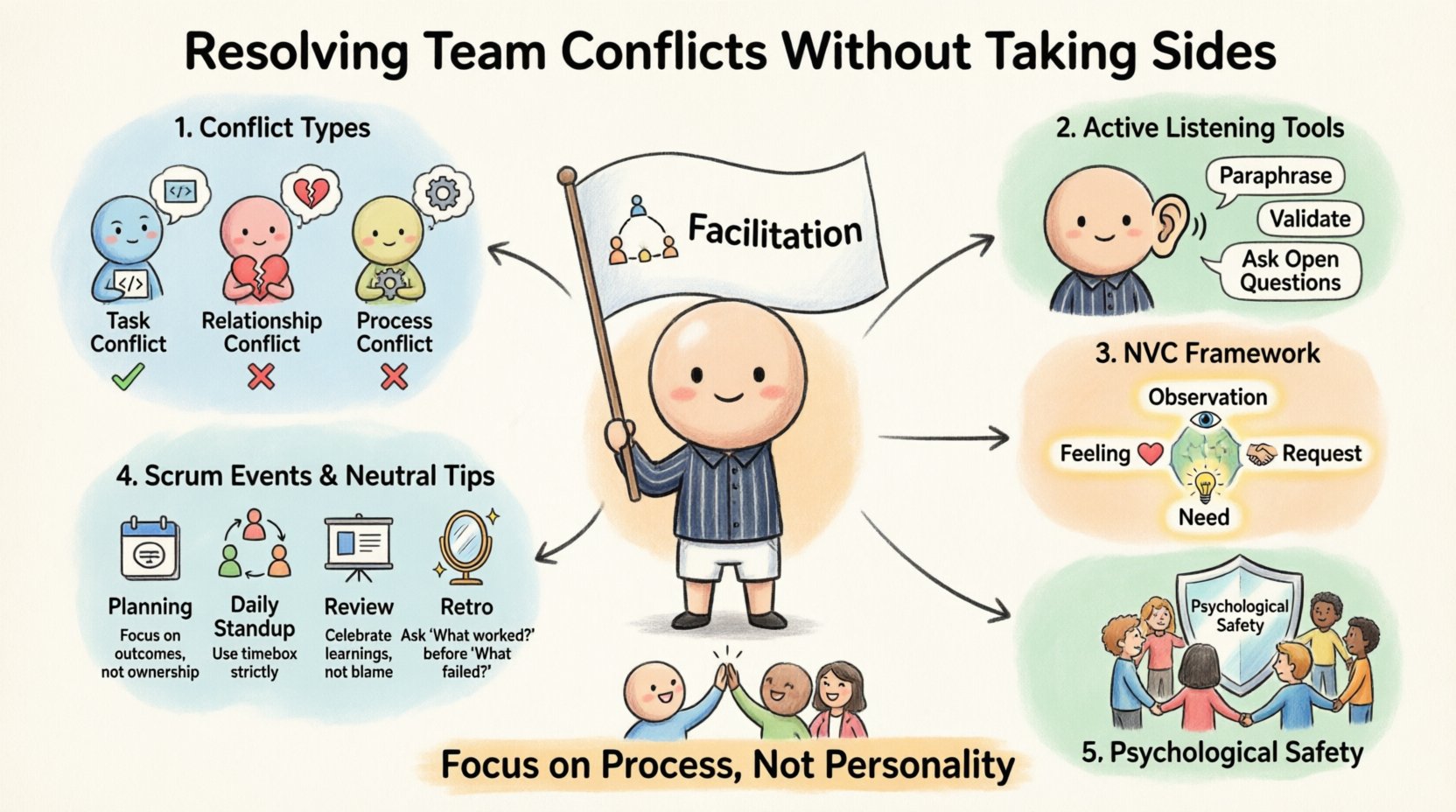
- Task Conflict: Disagreements about the work itself. This is generally healthy and leads to better solutions.
- Relationship Conflict: Disagreements based on interpersonal incompatibilities. This is destructive and requires intervention.
- Process Conflict: Disagreements about how the work gets done. This can be optimized through retrospectives.
Recognizing the type of conflict is the first step. A disagreement about code style (task) requires different handling than a personality clash (relationship). The goal is to keep the focus on the work and the outcome, not on personal attributes.
The Scrum Master’s Role in Disputes 🤝
The Scrum Master acts as a servant leader. This does not mean having no opinion, but rather prioritizing the team’s health over personal authority. Taking sides undermines trust. If a Scrum Master supports one developer over another, the dynamic shifts from a collaborative unit to a hierarchy.
Key Principles for Neutrality:
- Facilitate, Do Not Decide: Your job is to guide the conversation, not to dictate the outcome. The team owns the solution.
- Listen to Understand: Active listening involves hearing the underlying concern, not just the words spoken.
- Protect the Process: Ensure that conflict resolution follows agreed-upon norms. Do not bypass the team to solve a problem externally.
- Model Vulnerability: Admit when you do not have the answer. This reduces the pressure on the team to be perfect.
When you remain neutral, you create a safe space for dissent. Team members are more likely to share critical feedback if they know it will not be weaponized against them.
Techniques for Neutral Resolution 🧭
There are specific methods to de-escalate tension without forcing a decision. These techniques help separate the people from the problem.
1. Active Listening and Reflection
When two parties are speaking, they often listen only to reply. Interrupt this cycle.
- Paraphrase: Repeat back what you heard to confirm understanding. “So, you are concerned that the timeline is too aggressive due to the integration complexity.”
- Validate Feelings: Acknowledge the emotion without validating the accusation. “I can see this is frustrating for you.”
- Ask Open Questions: Avoid yes/no questions. Use “How” or “What” to explore the root cause.
2. Non-Violent Communication (NVC)
NVC focuses on observations, feelings, needs, and requests. It reduces defensiveness.
- Observation: State facts without judgment. “The commit was submitted three days late.”
- Feeling: Express your emotional state. “I feel worried about the release schedule.”
- Need: Identify the underlying value. “I need stability in the deployment pipeline.”
- Request: Ask for a concrete action. “Can we review the code earlier in the cycle?”
3. The “Parking Lot” Technique
If a discussion becomes circular or heated, move it to a separate time.
- Identify that the topic is derailing the current meeting.
- Schedule a specific time to discuss it with the involved parties only.
- This prevents the whole team from getting bogged down in a side debate.
Conflict Across Scrum Events 📅
Different events trigger different types of conflict. Recognizing where the tension usually occurs helps you prepare.
| Scrum Event | Common Conflict Trigger | Neutral Approach |
|---|---|---|
| Sprint Planning | Estimation disagreements, scope creep | Use historical velocity data to ground estimates in reality. |
| Daily Scrum | Reporting status vs. problem solving | Remind the team this is for synchronization, not detailed troubleshooting. |
| Sprint Review | Stakeholder feedback vs. Team capability | Focus on the product increment, not the effort behind it. |
| Retrospective | Blame culture, personal attacks | Use anonymous feedback tools to ensure safety. |
In Sprint Planning, conflicts often arise over story points. Some developers believe a story is simple; others see hidden complexity. The Scrum Master should facilitate a discussion on the definition of done and technical risks, rather than arguing over the number.
During the Daily Scrum, the 15-minute timebox is strict. If two members start debating a solution, intervene gently. “This sounds like a deep technical discussion. Let’s take this offline after the meeting.”
The Retrospective is where relationship conflicts often surface. It is also where they can be resolved. If a member feels blamed, the Scrum Master must ensure the blameless culture is upheld. Focus on the process failure, not the human error.
Building Psychological Safety 🛡️
Long-term conflict resolution requires a foundation of trust. Psychological safety is the belief that one will not be punished for making a mistake or speaking up. Without this, conflict remains hidden until it explodes.
- Normalize Failure: Treat mistakes as data points for learning. Share stories of your own errors.
- Encourage Dissent: Explicitly invite the quietest members to speak. “We haven’t heard from you on this yet.”
- Separate Identity from Work: Remind the team that a critique of the code is not a critique of the person.
- Consistency: Apply rules equally. If one person is interrupted, do not let another person interrupt later.
When safety is high, conflict is viewed as a shared problem to solve. When safety is low, conflict is viewed as a battle to win.
When to Escalate 🚨
Not all conflicts can be resolved within the team. Sometimes, the issue extends beyond the Scrum team’s authority or requires HR involvement.
Signs that escalation is needed:
- Harassment or discriminatory behavior is present.
- One party consistently undermines the other without cause.
- The conflict impacts the organization’s legal or financial standing.
- The team has exhausted all agreed-upon resolution techniques.
In these cases, the Scrum Master should document the facts objectively. Avoid emotional language. Present the timeline of events and the impact on the work. This allows management to intervene without bias.
Prevention Strategies 🛠️
Proactive measures reduce the frequency of conflict. A well-oiled machine runs smoother than one that is constantly repaired.
- Clear Roles: Ensure everyone understands their responsibilities. Ambiguity breeds conflict.
- Definition of Done: Agree on quality standards early to avoid disputes at the end of a sprint.
- Team Charters: Create a document outlining how the team works together. Include norms for meetings and communication.
- Regular Check-ins: Hold informal 1:1s to catch small issues before they grow.
Case Study: The Architecture Dispute 💻
Consider a scenario where two senior developers disagree on the database schema for a new feature. One wants a NoSQL approach for speed; the other wants SQL for consistency.
Incorrect Approach: The Scrum Manager picks the SQL option because they prefer consistency. This alienates the developer advocating for NoSQL.
Correct Approach: The Scrum Master facilitates a spike. Both developers build small prototypes to test latency and complexity. The team reviews the data together. The decision is based on the evidence gathered, not the hierarchy.
This method ensures that the outcome is owned by the team. Even if one developer’s idea is not chosen, they were part of the decision-making process.
Handling Personal Attacks 🗣️
When conflict becomes personal, it must be stopped immediately. A neutral party should intervene.
- State the Boundary: “I need us to keep this focused on the work, not on individuals.”
- Pause the Session: Take a break to let emotions cool down.
- Private Conversation: Speak to the individual involved one-on-one. Explain the impact of their behavior on the team.
- Re-engage: Bring them back only when they are ready to discuss the topic constructively.
It is better to lose time in the moment than to lose trust over weeks. Protecting the team culture is more important than meeting a specific sprint goal.
Final Thoughts on Team Dynamics 👀
Resolving conflict without taking sides is a skill that develops over time. It requires patience, empathy, and a commitment to the process. There will be moments where you feel unsure or where the tension is palpable.
Remember that your goal is not to eliminate all disagreement. That is impossible. Your goal is to ensure that disagreement serves the product and the team. By maintaining neutrality, you empower the team to solve their own problems. You build a resilient organization that can withstand pressure and emerge stronger.
Focus on the system. Improve the workflow. Support the people. When you do this, the conflict naturally loses its power to divide. The team moves forward together, aligned by shared values and a clear purpose.