Information technology departments frequently face a significant communication gap when presenting to executive leadership and the board of directors. While IT teams focus on infrastructure, uptime, and security patches, the board focuses on strategic alignment, risk mitigation, and return on investment. Bridging this divide requires more than just translating technical jargon into business language; it demands a structured approach to demonstrating how technology drives organizational purpose.
The Business Motivation Model (BMM) offers a robust framework for this translation. By mapping technical initiatives directly to business goals, objectives, and motivating factors, IT leaders can articulate value in a language that resonates with stakeholders. This guide explores how to leverage the Business Motivation Model to prove IT value, ensuring that technology investments are recognized as strategic enablers rather than mere cost centers.
Understanding the Business Motivation Model 🧩
The Business Motivation Model is a standard specification developed by the Object Management Group (OMG). It provides a structured way to describe the “why” and “how” of organizational behavior. Unlike traditional IT frameworks that focus heavily on process and architecture, BMM centers on motivation. It connects the high-level aspirations of an organization to the specific actions taken to achieve them.
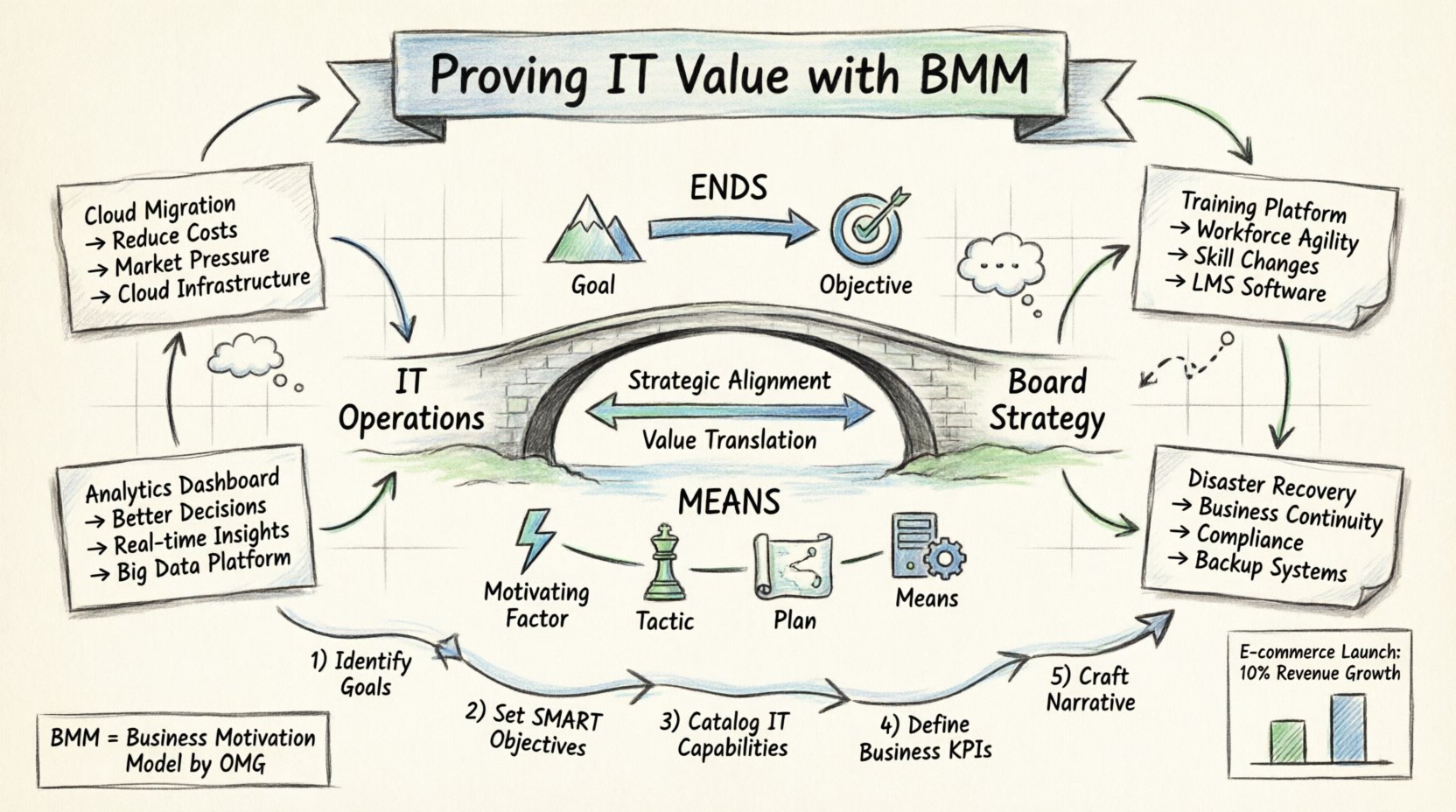
At its core, BMM distinguishes between the ends (what you want to achieve) and the means (how you achieve it). This distinction is critical for IT governance. When presenting to the board, IT must demonstrate that every server upgrade, software purchase, or security protocol is a “means” that directly supports a strategic “end”.
Key components of the model include:
- Goal: A desired state that the organization strives to achieve. Goals are often abstract and directional.
- Objective: A specific, measurable target that contributes to a goal. Objectives are quantifiable.
- Motivating Factor: The external or internal forces that drive the organization toward its goals. This could be a new regulation, market pressure, or a competitor’s action.
- Tactic: A specific approach or strategy chosen to influence the motivating factors or achieve objectives.
- Plan: A detailed course of action that outlines the steps, resources, and timeline for executing a tactic.
- Means: The resources, capabilities, or systems (often IT assets) required to execute the plan.
By utilizing these elements, IT leaders can construct a narrative that traces a direct line from a board-level strategic goal down to the specific IT infrastructure supporting it.
Why the Board Cares About Strategic Alignment 🎯
Board members are not typically interested in the technical specifications of a database or the version of an operating system. Their mandate is to ensure the organization remains viable, profitable, and compliant. They evaluate IT based on how it impacts the bottom line and strategic positioning.
When IT reports on value without a framework like BMM, the conversation often stalls. Common disconnects include:
- Focus on Output vs. Outcome: Reporting on the number of tickets resolved rather than the reduction in customer churn.
- Cost Center Mentality: Presenting IT budgets solely as expenses to be cut, rather than investments in capability.
- Risk Ambiguity: Describing cyber threats in technical terms without explaining the business impact (e.g., reputational damage, regulatory fines).
- Strategy Disconnect: Proposing initiatives that do not align with the current fiscal year’s strategic priorities.
The Business Motivation Model resolves these issues by forcing the IT team to articulate the business context of every project. It shifts the conversation from “we need a new firewall” to “we are implementing a new security control to support the objective of maintaining customer trust and compliance with data privacy regulations.”
Mapping IT Initiatives to BMM Components 🔄
To effectively use BMM for board reporting, IT leaders must translate their operational reality into the model’s terminology. This process involves identifying the strategic drivers and mapping IT resources to them. The following table illustrates how common IT activities translate into BMM concepts.
| IT Activity | Business Goal | Motivating Factor | Means (IT Asset) |
|---|---|---|---|
| Cloud Migration | Reduce Operational Costs | Market pressure to reduce CAPEX | Cloud Infrastructure Services |
| Employee Training Platform | Improve Workforce Agility | Rapidly changing skill requirements | LMS Software |
| Data Analytics Dashboard | Enhance Decision Making | Need for real-time market insights | BIG Data Platform |
| Disaster Recovery System | Ensure Business Continuity | Regulatory compliance requirements | Backup and Recovery Infrastructure |
This mapping ensures that when a board member asks, “Why are we spending money on this?”, the answer is not a technical justification but a strategic one.
Implementing BMM in IT Governance 🛠️
Adopting the Business Motivation Model requires a shift in how IT governance is structured and reported. It is not merely a documentation exercise; it is a cultural change in how value is perceived and measured. The following steps outline a practical approach to implementation.
1. Identify Strategic Drivers
Begin by understanding the organization’s primary goals. These are typically documented in the annual strategic plan or vision statement. Work with executive leadership to confirm which goals are currently the highest priority. These become the primary Goals in your BMM map.
For example, if the company strategy is “Market Expansion,” the IT Goal might be “Enable Scalable Global Operations.” If the strategy is “Customer Experience Excellence,” the IT Goal might be “Ensure Seamless Digital Engagement.”
2. Define Measurable Objectives
Once the high-level goals are set, define specific objectives. Objectives must be measurable. Vague statements like “improve performance” are insufficient. Use SMART criteria (Specific, Measurable, Achievable, Relevant, Time-bound).
- Bad Objective: “Make the website faster.”
- Good Objective: “Reduce page load time to under 2 seconds by Q3 to improve conversion rates.”
By setting clear objectives, IT creates a baseline against which success can be measured and reported to the board.
3. Catalog IT Means and Capabilities
Inventory the current IT capabilities. This includes hardware, software, personnel, and processes. Map each capability to the specific objectives it supports. This step often reveals redundancies or gaps. You may find that multiple systems support a single objective, indicating an opportunity for consolidation, or that a critical objective has no supporting IT means, indicating a risk.
4. Establish Metrics and KPIs
For every objective, establish Key Performance Indicators (KPIs). These metrics should reflect business outcomes, not just technical performance. For example, instead of tracking “Server Uptime,” track “Customer Transaction Success Rate.” This aligns the technical metric with the business outcome.
5. Create the Reporting Narrative
When presenting to the board, use the BMM structure to tell a story. Start with the Goal, explain the Motivating Factor, describe the Objective, and conclude with the Means and the Results achieved. This narrative flow ensures that the board understands the context and the value delivered.
Common Pitfalls in IT Value Reporting ⚠️
Even with a framework like BMM, organizations often stumble when trying to prove value. Awareness of common pitfalls can help IT leaders avoid them.
1. Over-Complicating the Model
BMM is a comprehensive standard, but it does not need to be applied in its entirety to every small project. Over-engineering the model can lead to analysis paralysis. Focus on the high-level strategic initiatives that require board attention. For routine maintenance, a simplified mapping is sufficient.
2. Ignoring Negative Factors
BMM includes Constraints and Risks. These are just as important as opportunities. If a project is delayed, report it within the context of the motivating factors. Explain how the delay impacts the objective and what steps are being taken to mitigate the risk. Transparency builds trust.
3. Focusing on Cost Instead of Value
While cost reduction is a valid objective, IT value is often found in revenue enablement or risk avoidance. Do not limit the conversation to savings. Highlight how technology enables new business models or protects the brand.
4. Disconnecting from Reality
Ensure that the BMM map reflects actual operations. If the business strategy changes, the IT objectives must change accordingly. A static model quickly becomes obsolete. Regular reviews of the BMM alignment are necessary.
Measuring Success and Continuous Improvement 📈
Proving IT value is not a one-time event; it is a continuous cycle. The Business Motivation Model supports this by providing a structure for review and adaptation. As the organization evolves, the goals and motivating factors will shift, requiring IT to adapt its means.
Establish a regular cadence for reviewing the alignment between IT and business. Quarterly business reviews (QBRs) are ideal for this purpose. During these sessions:
- Review the status of all objectives.
- Assess whether motivating factors have changed.
- Re-evaluate the effectiveness of current IT means.
- Identify new opportunities for value creation.
This iterative process ensures that IT remains a dynamic partner in the organization’s success. It moves the relationship from a transactional vendor model to a strategic partnership.
Case Scenario: Aligning a Digital Transformation Initiative 🚀
Consider a scenario where a retail organization wants to launch an e-commerce platform. Without BMM, the IT team might present a list of servers and development hours. Using BMM, the presentation looks different.
Goal: Increase Market Share. Motivating Factor: Competitor launched online store with 20% market growth. Objective: Launch secure e-commerce platform within 6 months. Tactic: Adopt agile development methodology. Plan: Sprint-based development with weekly stakeholder reviews. Means: Cloud hosting environment, payment gateway integration, customer data management system. Outcome: 10% revenue growth in first quarter post-launch.
In this scenario, the board sees the technology as a direct lever for achieving a strategic goal. The risk is understood, the timeline is clear, and the expected return is quantified.
Conclusion 📝
Proving IT value to the board requires a shift in perspective. It is about moving from technical outputs to business outcomes. The Business Motivation Model provides the necessary structure to make this shift. By mapping IT activities to goals, objectives, and motivating factors, IT leaders can demonstrate strategic alignment clearly and effectively.
This approach fosters trust, improves governance, and ensures that technology investments are recognized as critical drivers of organizational success. Implementing BMM takes effort, but the return in terms of stakeholder engagement and strategic clarity is substantial. IT is not just a support function; it is a catalyst for business motivation.