In the high-velocity environment of modern software development, focus is the scarcest resource. When a Scrum Team is constantly pulled away from their work to address ad-hoc requests, status updates, or urgent “quick questions,” the quality of their output suffers. This phenomenon is not merely an annoyance; it is a fundamental threat to the team’s ability to deliver value. The process of protecting the team from external interruptions is a critical competency for any Agile organization.
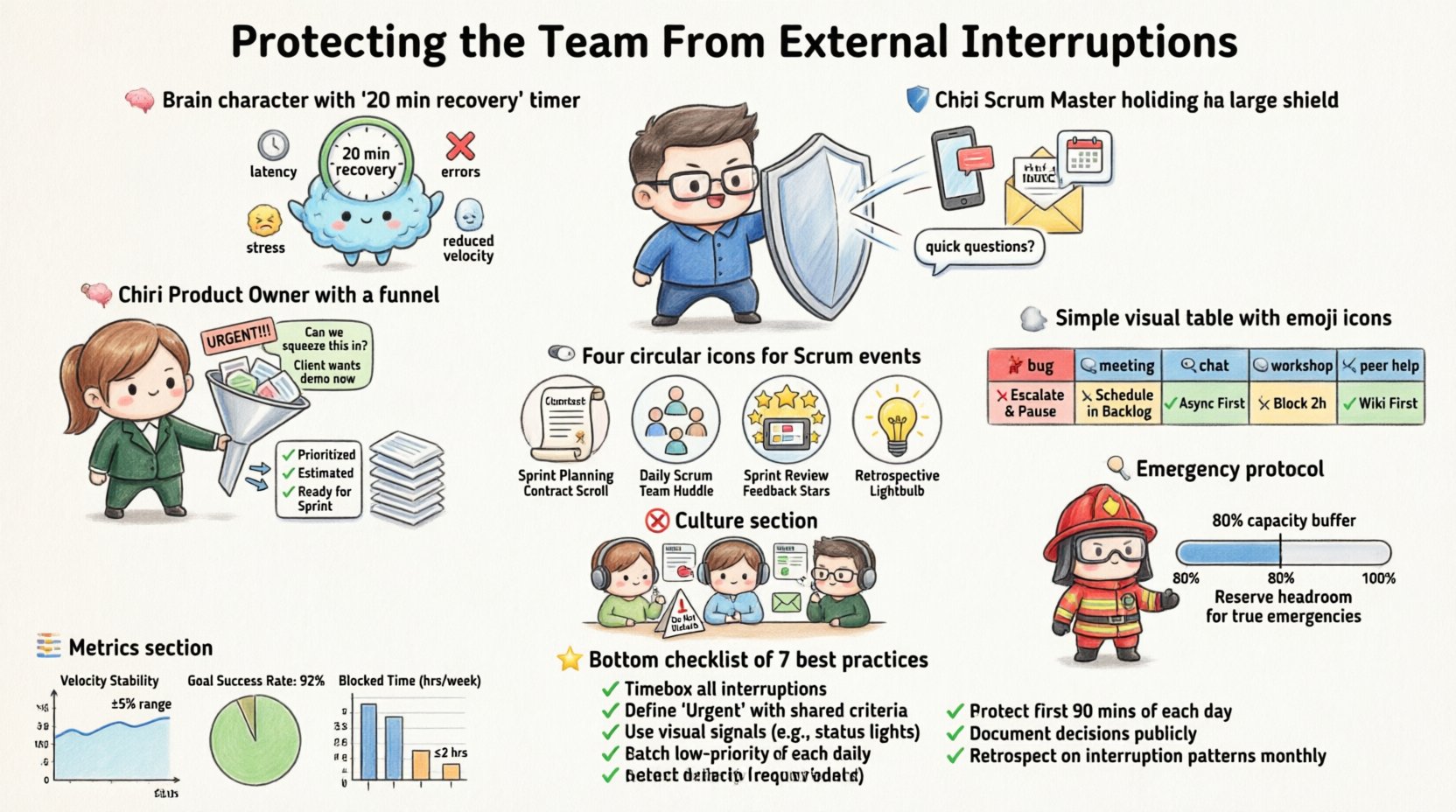
Interruptions break the flow state. They force the brain to switch contexts, incurring a cognitive penalty that can take upwards of 20 minutes to recover from. If this happens repeatedly throughout a Sprint, the team may finish only a fraction of what was planned. This guide explores the mechanisms, responsibilities, and cultural shifts required to build a shield around your Scrum Team without stifling necessary communication.
🧠 The Cognitive Cost of Context Switching
Understanding why protection is necessary begins with understanding human cognition. Deep work requires sustained attention. When an external party enters the workspace—physically or digitally—the team member must pause their current mental model, process the new input, and then return to the previous model. This transition is costly.
- Latency: The time lost to re-orienting to the task.
- Errors: Higher probability of bugs when switching between complex logic.
- Stress: Constant vigilance for new input creates background anxiety.
- Reduced Velocity: Over time, the cumulative loss of time results in slower delivery rates.
In a Scrum context, the Sprint Goal is the primary objective. If the team is interrupted, they deviate from the plan. The Product Owner might see a feature delayed not because of technical debt, but because the team spent three hours answering stakeholder questions that could have been batched.
🛡️ The Scrum Master’s Responsibility
The Scrum Master serves as a servant-leader who promotes and supports the Scrum framework. A significant portion of this role involves shielding the team from external distractions. This does not mean isolating the team from feedback, but rather filtering the noise.
1. Establishing Boundaries
The Scrum Master must work with the organization to define clear boundaries. This includes defining “office hours” for the team, setting up “do not disturb” protocols during specific work blocks, and managing access to the team’s time.
- Physical Space: If working on-site, designate a zone where the team can focus without walking traffic.
- Digital Space: Implement communication norms that respect deep work time.
- Meeting Hygiene: Limit the number of meetings the team attends. The Scrum Master should challenge any meeting request that does not directly contribute to the Sprint Goal.
2. Managing Stakeholder Expectations
Stakeholders often equate “availability” with “productivity.” The Scrum Master must educate stakeholders on the difference. When a stakeholder calls, the Scrum Master should be the first point of contact, not the developers.
The Scrum Master acts as a filter. They assess the urgency of a request. Is it a bug in production? That goes to the top of the queue. Is it a question about a future feature? That can wait for the next refinement session.
🤝 The Product Owner’s Role in Flow
The Product Owner (PO) is the voice of the customer and the guardian of the Product Backlog. They also play a vital role in protecting the team. The PO is responsible for prioritizing work so that the team knows exactly what to do next, reducing the need for clarification during development.
1. Clear Backlog Items
Interruptions often stem from ambiguity. If a team member has to stop and ask, “What does this button do?” that is a product definition failure. The PO must ensure that User Stories are well-defined with clear Acceptance Criteria before the Sprint begins.
- Definition of Ready: Enforce this standard. If a story is not clear, it should not enter the Sprint.
- Just-in-Time Refinement: Conduct backlog refinement sessions regularly so questions are answered before coding starts.
2. Single Point of Contact
External stakeholders should be encouraged to direct all feature questions to the Product Owner. This prevents the team from being bombarded with requests from marketing, sales, or management. The PO aggregates these requests, prioritizes them, and feeds them into the backlog.
📊 Types of Interruptions and Mitigation Strategies
Not all interruptions are created equal. Some are critical emergencies, while others are simply habits. The following table categorizes common interruptions and suggests appropriate responses.
| Interruption Type | Impact Level | Recommended Response |
|---|---|---|
| 🚨 Critical Production Bug | High | Immediate attention. Update the Sprint Goal if necessary. |
| 📞 Stakeholder Meeting Request | Medium | Scrum Master to defer to the next available slot or the Sprint Review. |
| 💬 Instant Message Query | Low | Batch responses at designated times (e.g., morning/afternoon). |
| 📅 Ad-hoc Workshop | Medium | Decline if it conflicts with Sprint commitments. Propose alternatives. |
| 👥 Peer Assistance | Low | Encourage asynchronous documentation or pair programming sessions. |
🗓️ Leveraging Scrum Events for Protection
The Scrum framework provides specific events that can be used to manage interruptions effectively. These events create structured opportunities for communication, reducing the need for unscheduled interactions.
1. Sprint Planning
During Sprint Planning, the team commits to a goal. This commitment acts as a contract. If an external party interrupts during the Sprint, the Scrum Master can refer back to this commitment. “We agreed to focus on this goal for two weeks. Can we address your request after the Sprint Review?”
2. Daily Scrum
The Daily Scrum is for the Developers to synchronize. It is not a status report for management. External parties should not attend unless invited as observers. This event is a barrier against status update interruptions from leadership. The team updates each other, not the organization.
3. Sprint Review
This is the designated time for stakeholders to provide feedback. By consolidating feedback here, you prevent stakeholders from interrupting the team throughout the Sprint with “what if” questions. If a change is requested during the Sprint, it goes into the Product Backlog for future prioritization, unless it is critical.
4. Sprint Retrospective
The Retrospective is a safe space to discuss what is working and what is not. If external interruptions are affecting the team, this is the place to bring it up. The team can experiment with new ways to protect their time in the next Sprint.
🚫 Building a Culture of Focus
Rules and processes alone are not enough. The culture must support deep work. This requires a shift in mindset across the organization.
1. Respect for the Sprint Goal
Every member of the organization, from the CEO to the intern, must respect the Sprint Goal. If the goal changes, the team needs to know. The Scrum Master should facilitate a conversation about the impact of changing the goal mid-Sprint. Often, the answer is “no,” or “yes, but we need to adjust the scope.”
2. Asynchronous Communication
Move away from synchronous communication for non-urgent matters. Use shared documentation, wikis, or project boards for updates. When a developer needs to ask a question, they should write it down. If the answer is needed immediately, they can ask. If not, they wait for the answer.
- Documentation: Create a central knowledge base for common questions.
- Status Updates: Use the project board instead of asking “What are you working on?”
- Office Hours: Designate specific times for open Q&A sessions.
3. Visual Management
Make the work visible. When the team is focused on the board, it signals to others that they are in the zone. If a team member is wearing headphones or has a status indicator set to “Deep Work,” it should be respected.
🔍 Handling Urgent Requests
Sometimes, an interruption is legitimate. A server is down, or a client needs to speak urgently. The team cannot ignore these. The key is having a protocol for these scenarios so they do not become the norm.
1. The “Firefighter” Protocol
When an emergency arises, the team needs a clear path to address it without derailing the entire Sprint. The Scrum Master helps the team decide if the emergency is critical enough to stop current work. If so, the team addresses it. If not, it is logged for the next Sprint.
2. Capacity Planning
The team should plan for interruptions. When estimating capacity for a Sprint, the team should account for potential support tickets or urgent requests. This is often referred to as “buffer capacity.” If the team plans for 100% capacity, they will fail. Planning for 80% allows room for the unexpected.
🧩 The Product Owner’s Defense Line
The Product Owner is the first line of defense. They manage the backlog and the expectations of the business. If the PO is accessible to everyone, the team will be too.
- Gatekeeping: The PO reviews all incoming feature requests. They validate the value before passing it to the team.
- Education: The PO teaches stakeholders about the development process. They explain why “just adding a small thing” takes time.
- Transparency: The PO shares the Sprint Plan publicly. Stakeholders know what the team is working on and can see when they are busy.
📉 Measuring the Impact
To improve, you must measure. How do you know if interruptions are decreasing? Use the following metrics to track progress.
- Velocity Stability: If velocity fluctuates wildly without a change in scope, interruptions may be the cause.
- Sprint Goal Success Rate: How often is the Sprint Goal achieved? A drop indicates external pressure.
- Blocked Time: Track how much time the team spends waiting on external input or dealing with distractions.
- Team Sentiment: During Retrospectives, ask the team how they felt about their focus levels.
🔄 Continuous Improvement
Protecting the team is not a one-time fix. It is a continuous improvement cycle. The team must regularly assess their ability to focus and adjust their boundaries.
1. Experimentation
Try new things in the Retrospective. Maybe the team wants to try “No Meeting Wednesdays.” Maybe they want to close all chat applications for the first half of the day. Experiment, measure, and adopt what works.
2. Feedback Loops
Create feedback loops with stakeholders. Ask them, “Is our current level of responsiveness meeting your needs?” Sometimes, stakeholders want to be less involved. They want to see the outcome, not the process. Aligning on this reduces pressure.
🌟 Summary of Best Practices
To maintain a high-performing Scrum Team, the organization must value depth over breadth. Here are the core principles to remember:
- Respect the Sprint Goal: Treat it as a contract that should not be broken lightly.
- Centralize Communication: Use the Product Owner and Scrum Master as filters for external requests.
- Clarify Requirements: Ensure the Product Backlog is ready to reduce developer confusion.
- Visualize Work: Make the team’s focus visible to discourage interruptions.
- Plan for Buffer: Account for unexpected tasks in capacity planning.
- Use Events: Leverage Sprint Review and Retrospective for feedback, not ad-hoc chats.
- Measure Impact: Track velocity and goal completion to identify distraction trends.
By implementing these strategies, the organization creates an environment where the team can do their best work. The result is higher quality software, happier teams, and more predictable delivery. The Scrum Master, Product Owner, and the Team must work together to build this shield. It is not about hiding from the world; it is about focusing on the work that matters most.
🔐 Final Thoughts on Sustainable Pace
Sustainable pace is a core principle of Scrum. If the team is constantly interrupted, they cannot maintain a sustainable pace. They become reactive rather than proactive. Protecting the team is an investment in the long-term health of the organization.
When you protect the team, you are protecting the value they create. You are ensuring that the complex work required to build a product is done with the attention it deserves. This requires discipline from everyone involved, from leadership to the developers themselves. But the reward is a team that is focused, productive, and capable of delivering the best possible solution.
Start today. Identify the biggest source of interruption in your current Sprint. Discuss it in the Retrospective. Create a plan to mitigate it. Your team will thank you for it.