Stepping into the role of a Scrum Master is not merely about learning a set of ceremonies or managing a backlog. It is a profound shift in mindset. You are transitioning from a person who directs work to a person who enables work to happen. This transition relies heavily on the concept of servant leadership. It is a philosophy where the primary goal is to serve the team, the Product Owner, and the organization, rather than seeking power or authority.
As a new Scrum Master, you may feel a lack of control. This is often intentional. The Scrum framework is designed to distribute authority. However, without the discipline of servant leadership, this vacuum can lead to chaos. This guide provides a deep dive into how to embody this role effectively, using practical examples and actionable strategies.
🧭 Defining the Servant Leader Mindset
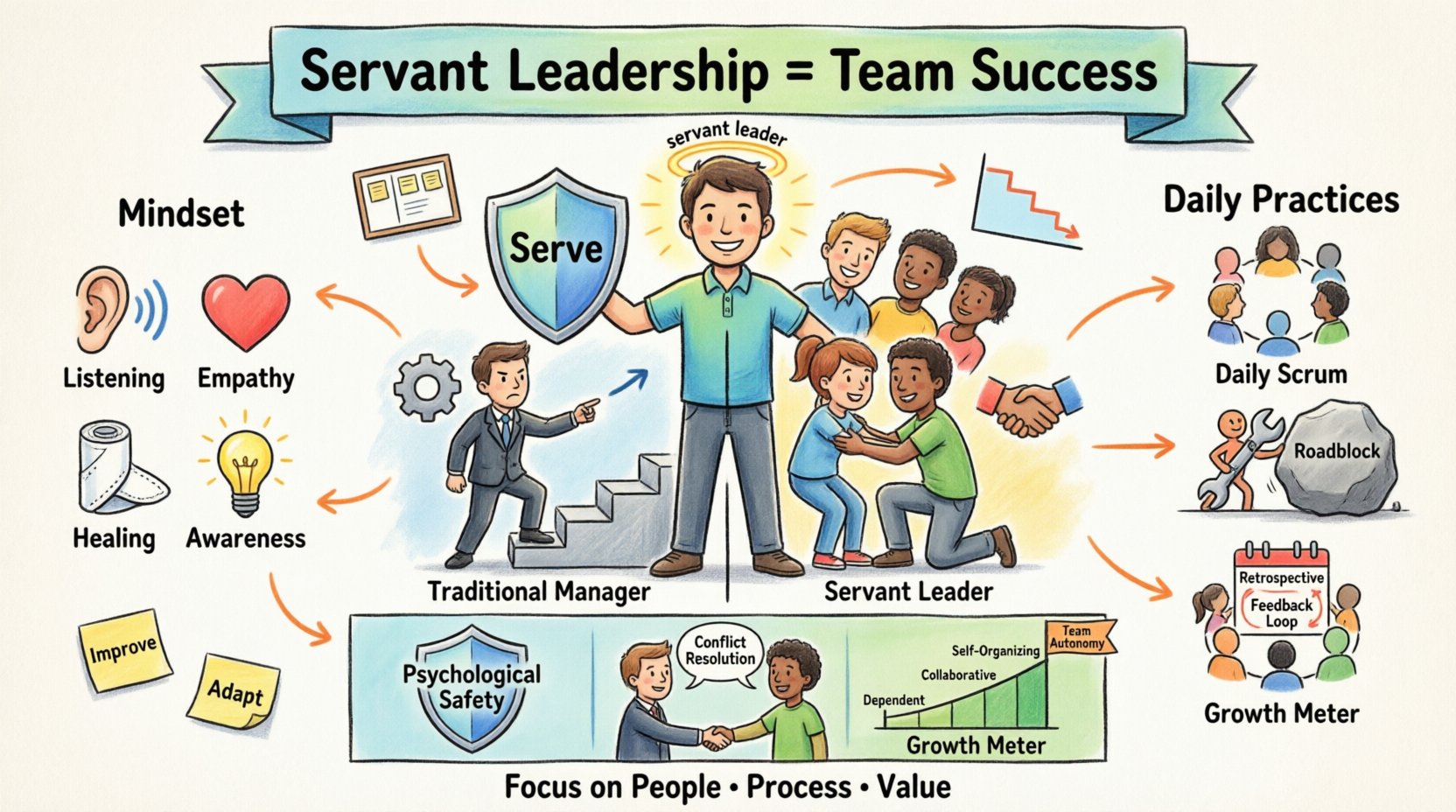
At its core, servant leadership is about prioritizing the needs of others. In the context of Agile development, this means the team comes first. Your success is measured by their success. If the team is blocked, you are blocked. If the team is thriving, you are thriving.
- Listen Actively: It is not enough to hear words. You must understand the intent and emotion behind them. During Sprint Planning or Retrospectives, allow silence. Let team members finish their thoughts before you intervene.
- Empathy: Recognize that team members are human beings with personal lives, stressors, and varying levels of expertise. Acknowledging their feelings builds psychological safety.
- Healing: Address conflicts and interpersonal friction before they become toxic. A healthy team environment is a prerequisite for high performance.
- Awareness: Understand your own strengths and weaknesses. Recognize how your behavior impacts the group dynamic.
This approach contrasts sharply with traditional management. A manager often solves problems for the team. A servant leader helps the team solve problems themselves.
⚖️ Servant Leadership vs. Traditional Management
Understanding the difference is crucial to avoiding old habits. Many new Scrum Masters default to managing because it is familiar. The table below outlines the key distinctions.
| Aspect | Traditional Manager | Servant Leader Scrum Master |
|---|---|---|
| Decision Making | Decisions are made by authority. | Decisions are made by consensus or delegation. |
| Focus | Tasks and output. | People and outcomes. |
| Conflict Resolution | Imposes a solution. | Facilitates a resolution. |
| Accountability | Individual accountability to manager. | Shared accountability to the team. |
| Goal | Efficiency and control. | Empowerment and growth. |
When you start to micromanage the team’s estimates or dictate how they should code, you are reverting to the manager role. This erodes trust. Trust is the currency of a Scrum Master.
🛠️ Practical Daily Practices
Leadership is not a title; it is a series of actions. Here is how you can practice servant leadership in your daily routine.
1. The Daily Scrum
Many Scrum Masters try to facilitate the Daily Scrum too much. They step in when there is silence. Instead, let the team own the meeting. Your presence should be supportive, not directive.
- Do not report: The team reports to each other, not to you.
- Watch for blockers: If you hear a dependency mentioned, note it. Address it after the meeting, not during the 15-minute timebox.
- Encourage engagement: If someone is quiet, invite them in gently. “What are you thinking about, [Name]?”
2. Removing Impediments
This is often cited as the primary duty of a Scrum Master. However, “removing” does not always mean fixing it yourself. It means clearing the path.
- Classify the blocker: Is it technical, organizational, or resource-related?
- Escalate appropriately: If the blocker requires management approval, go to management. Do not leave the team waiting while you figure out the hierarchy.
- Teach problem-solving: If the team is stuck, guide them to find the root cause rather than giving the solution. Ask, “What have you tried?” instead of “Just do this.”
3. Facilitating Meetings
Meetings in Scrum are timeboxed events with specific goals. Your job is to keep them on track without dominating the conversation.
- Sprint Planning: Ensure the team understands the goal. Help them break down items into workable pieces. Do not accept “I don’t know” as a final answer; ask “What do you need to find out?”
- Sprint Review: Protect the time for feedback. Ensure stakeholders know this is a learning session, not a status report.
- Retrospective: This is the most critical meeting for improvement. Use different formats to keep it fresh. Focus on action items. Ensure the team commits to at least one change for the next Sprint.
🤝 Building Trust and Psychological Safety
A high-performing team needs psychological safety. This means members feel safe to take risks and be vulnerable in front of each other. They must feel safe to admit mistakes without fear of retribution.
As a Scrum Master, you set the tone. If you hide your own mistakes, the team will too. Admit when you do not know the answer. Admit when you facilitated poorly. This vulnerability invites others to do the same.
Strategies to Foster Safety
- Normalize failure: Treat bugs and missed deadlines as learning opportunities, not failures of character.
- Blameless Post-Mortems: When things go wrong, focus on the process, not the person. “What in the system allowed this to happen?”
- Private Check-ins: Sometimes issues are personal. Offer 1:1 conversations to understand context before addressing performance in a group setting.
🚧 Handling Conflict
Conflict is inevitable in any group of people working together on complex problems. It is not always bad. Healthy conflict leads to better solutions. Unhealthy conflict creates toxicity. Your role is to manage the difference.
Types of Conflict
- Task Conflict: Disagreement about the work. This is usually good.
- Relationship Conflict: Disagreement based on personal differences. This is usually bad.
- Process Conflict: Disagreement about how work gets done.
When relationship conflict arises, intervene early. Use active listening to de-escalate. Help the parties find common ground. If the conflict persists, you may need to facilitate a mediated discussion where each party speaks without interruption.
📊 Measuring Your Impact
How do you know if you are succeeding? You cannot measure Scrum Master performance by velocity alone, as that belongs to the Developers. Instead, look at qualitative and systemic indicators.
- Team Velocity Stability: Is the team’s output becoming more predictable?
- Retrospective Action Items: Are the team implementing the changes they commit to?
- Impediment Resolution Time: How long does it take to clear blockers?
- Team Sentiment: Are people showing up to work with energy? This can be gauged through informal conversations or anonymous surveys.
- Self-Organization: Is the team making decisions without waiting for you?
If the team relies on you to make every decision, you have not fully stepped back. The goal is to make yourself obsolete in their daily decision-making.
🌱 Continuous Improvement for the Scrum Master
You are not done learning. The landscape of Agile and leadership is constantly evolving. You must commit to your own growth.
Areas for Development
- Communication Skills: Work on your public speaking and writing. Clear communication prevents ambiguity.
- Technical Knowledge: You do not need to be the lead developer, but understanding the technical landscape helps you empathize with challenges.
- Organizational Awareness: Understand how your team fits into the wider business. This helps you navigate bureaucracy.
- Mindfulness: Practice stress management. If you are burnt out, you cannot serve the team.
🚫 Common Pitfalls to Avoid
Even with the best intentions, new Scrum Masters often stumble. Being aware of these traps helps you navigate them.
- The Micro-Manager: Checking tasks on the board too often. This signals a lack of trust.
- The Team Manager: Acting like a team lead and assigning tasks. This violates the self-organization principle.
- The Facilitator of Everything: Trying to run every meeting. Sometimes you should step back and let the Product Owner or a Developer lead.
- The Hero: Stepping in to fix a technical problem yourself. This prevents the team from learning.
- The Bureaucrat: Focusing on rules over outcomes. Scrum is a framework, not a religion. Adapt it to the context.
🔄 The Feedback Loop
Feedback is essential for growth. You need feedback on your coaching skills. This can be uncomfortable.
Ask the team directly. “What can I stop doing to help you work better?” “What can I start doing?” “What should I continue doing?” This is a powerful tool. It shifts the power dynamic. It shows you value their opinion on your performance.
Remember that feedback is not always positive. If someone says you are too quiet, listen. If they say you are too loud, listen. Use this data to adjust your behavior.
🤝 Collaboration with the Product Owner
Your relationship with the Product Owner (PO) is vital. You are partners in value delivery. However, tensions can arise.
- Clarity of Vision: Ensure the PO has a clear vision. Help them refine the backlog.
- Respect the PO: Do not undermine the PO’s authority on the backlog. If you disagree, discuss it privately.
- Protect the Team: Ensure the PO does not impose unrealistic deadlines. Help them understand the risks.
- Transparency: Keep the PO informed about team capacity. Do not hide burnout or blockages.
🌟 Final Thoughts on Growth
Becoming a skilled Scrum Master is a journey, not a destination. There is no final exam. You will face situations where you do not know the answer. That is okay. Your job is to facilitate the search for the answer, not to provide it immediately.
Focus on the people. Focus on the process. Focus on the value. If you keep these three pillars in mind, you will naturally gravitate toward servant leadership. You will find that by serving the team, you actually lead them to greater heights than you ever could alone.
Embrace the uncertainty. Embrace the challenge. And remember that your greatest tool is not a framework or a tool, but your own willingness to serve.