
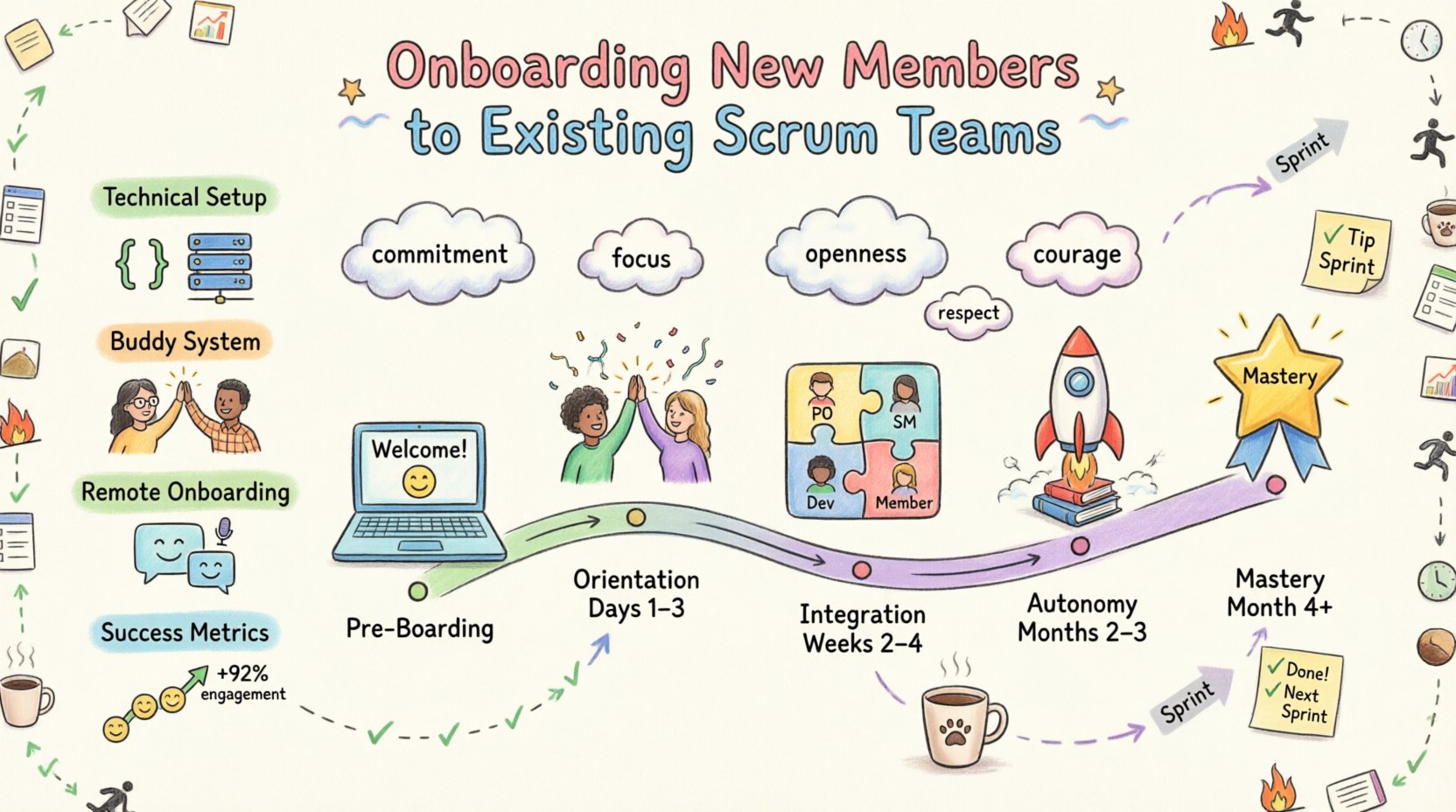
Integrating new talent into an established Scrum team is one of the most critical processes in agile delivery. It is not merely about setting up accounts or granting access to tools. It is a complex social and technical integration that determines velocity, quality, and retention. When a new member joins, the team’s dynamic shifts. The existing rhythm must accommodate the newcomer without disrupting delivery. This guide outlines a structured approach to onboarding new members to existing Scrum teams, focusing on culture, process, and technical competence.
Effective onboarding reduces the time to productivity. It fosters psychological safety. It ensures that the Scrum values of commitment, focus, openness, respect, and courage are demonstrated from day one. This document serves as a blueprint for Scrum Masters, Product Owners, and Team Members who wish to build a welcoming and efficient environment for incoming talent.
1. Why Structured Onboarding Matters 📊
The cost of a bad hire or a slow integration is significant. It impacts team velocity, increases technical debt due to rushed work, and can lower morale among existing members who must absorb the learning curve. A structured approach mitigates these risks.
- Accelerates Time-to-Value: Clear pathways allow new members to contribute to the Sprint Goal sooner.
- Preserves Knowledge: It ensures tribal knowledge is transferred systematically rather than through ad-hoc conversations.
- Enhances Retention: New members who feel supported and understood are more likely to stay long-term.
- Maintains Quality: Proper training on standards and practices prevents the introduction of defects early in the lifecycle.
Scrum is a framework for managing work. Onboarding is the mechanism that ensures the people within the framework are aligned with the work. Without this alignment, the framework becomes a set of empty rituals.
2. Pre-Arrival Preparation (Before Day 1) 📅
The process begins before the new member signs the contract. Preparation ensures that when they arrive, there is no friction caused by missing resources or unclear expectations.
Technical Setup
- Hardware and Access: Ensure all necessary hardware is ready. Set up accounts for the version control system, the issue tracking system, and communication platforms.
- Development Environment: Prepare the local development environment. This includes dependencies, build tools, and sample code repositories.
- Documentation Access: Grant read access to the team’s knowledge base, architecture diagrams, and coding standards.
Communication
- Welcome Message: The team should introduce themselves via the communication channel before the first day.
- First Day Agenda: Send a schedule for the first week. This reduces anxiety and helps the new member prepare mentally.
- Role Clarity: Reiterate the definition of done and the specific responsibilities associated with their role within the Scrum Team.
3. The First 72 Hours (Cultural Immersion) 🤝
The initial days set the tone for the entire tenure. The focus here is not on output, but on connection and understanding.
Day 1: The Welcome
- Introduction Ceremony: Introduce the new member during a Daily Scrum or a dedicated meeting. This establishes their presence in the team.
- Pairing Session: Assign a buddy or mentor for the first week. This person should be available for immediate questions.
- Environment Walkthrough: Show them where physical or virtual resources are located. Explain the team’s communication norms.
Day 2-3: Process Orientation
- Sprint Review Observation: Let them observe a Sprint Review to understand how value is demonstrated to stakeholders.
- Backlog Grooming: Invite them to a backlog refinement session. This helps them understand the priority and context of the work.
- Definition of Done: Review the team’s Definition of Done together. Ensure they understand the quality bar required for their work.
4. The First 30 Days (Skill Acquisition) 🛠️
By the end of the first month, the new member should be capable of completing small, well-defined tasks without constant supervision. The goal is incremental independence.
Technical Tasks
- First Pull Request: Guide them through their first code review. This is a critical learning moment for quality standards.
- Small Story Completion: Assign tasks that can be completed within a single Sprint. This provides a sense of accomplishment.
- Testing Protocols: Ensure they understand the testing strategy, including unit tests, integration tests, and automated pipelines.
Scrum Ceremonies Participation
- Daily Scrum: They should be speaking up. Encourage them to share blockers and progress.
- Sprint Planning: They should be able to estimate tasks and commit to a portion of the Sprint Goal.
- Retrospective: They should feel safe to share feedback about the process.
5. The First 90 Days (Full Autonomy) 🎯
By the end of the quarter, the new member should be fully integrated into the workflow. They are no longer a learner but a contributor.
- Ownership: They take ownership of specific areas of the codebase or product features.
- Mentorship: They may begin to mentor future new members or assist with documentation.
- Decision Making: They participate in technical decision-making discussions with peers.
- Velocity Stability: Their contribution should reflect a stable velocity consistent with the rest of the team.
6. Onboarding Timeline Overview 📋
The following table summarizes the key milestones across the first three months.
| Phase | Duration | Primary Goal | Key Activity |
|---|---|---|---|
| Pre-Boarding | Before Day 1 | Readiness | Hardware and Access Setup |
| Orientation | Days 1-3 | Connection | Team Introductions and Culture |
| Integration | Weeks 2-4 | Competence | First Tasks and Code Reviews |
| Autonomy | Months 2-3 | Independence | Feature Ownership and Estimation |
| Mastery | Month 4+ | Optimization | Mentoring and Process Improvement |
7. Technical Onboarding Standards 🧪
Technical onboarding requires specific attention to the stack and the architecture. It is not enough to know the syntax; one must understand the ecosystem.
- Code Standards: Review the linter configurations and formatting rules. Enforce consistency from the first line of code.
- Architecture Patterns: Explain the high-level architecture. Why did the team choose this pattern over others?
- Deployment Pipeline: Walk through the deployment process. How does code move from development to production?
- Security Practices: Ensure they understand data handling, authentication, and authorization within the system.
Documentation should be living and evolving. If the documentation is outdated, it becomes a barrier to entry. Encourage new members to update documentation as part of their onboarding tasks. This reinforces their understanding and improves the knowledge base.
8. Social and Cultural Integration 🌍
Scrum relies heavily on communication. A member who cannot communicate effectively will struggle, regardless of technical skill.
Communication Norms
- Channels: Define which channels are used for what purpose. For example, urgent matters vs. general discussion.
- Response Times: Set expectations for response times on different platforms.
- Meeting Etiquette: Establish norms for virtual and in-person meetings, including camera usage and listening protocols.
Team Values
- Transparency: Encourage open discussion about mistakes. Blameless post-mortems are essential.
- Respect: Foster an environment where differing opinions are welcomed during planning and retrospectives.
- Focus: Protect the team from context switching. Help the new member understand the importance of deep work.
9. Role-Specific Nuances 👥
Different roles within the Scrum Team have different onboarding needs. A generic approach often fails to address specific requirements.
New Developer
- Focus on codebase familiarity and build pipelines.
- Pair programming is highly effective for knowledge transfer.
- Gradual increase in task complexity.
New Product Owner
- Focus on stakeholder management and vision alignment.
- Understand the market context and user needs.
- Learn the prioritization framework used by the team.
New Scrum Master
- Focus on team dynamics and impediment removal.
- Understand the historical context of team processes.
- Learn the specific impediments the team faces regularly.
10. Common Pitfalls to Avoid 🚫
Even with a plan, things can go wrong. Awareness of common mistakes helps in avoiding them.
- Information Overload: Do not dump all documentation on Day 1. It causes cognitive overload.
- Lack of Mentorship: Leaving a new member to figure things out alone leads to frustration.
- Ignoring Culture: Focusing only on tools and code ignores the human element of the team.
- Expecting Immediate Output: Do not expect full productivity in the first month. Allow for a ramp-up period.
- Skipping the Retro: The first Retrospective should include feedback on the onboarding process itself.
11. Measuring Onboarding Success 📈
How do you know the onboarding is working? You need metrics and qualitative feedback.
- Time to First Commit: Track how long it takes for the new member to make their first meaningful contribution.
- Velocity Stabilization: Monitor when their velocity stabilizes relative to the team average.
- Survey Feedback: Ask the new member about their comfort level and clarity of expectations at 30, 60, and 90 days.
- Retention Rate: Monitor how many new members stay beyond the first year.
- Code Quality: Review the defect rate in their early work compared to later work.
These metrics should be reviewed by the Scrum Master and the Team Lead. They provide data to refine the onboarding process continuously.
12. Adapting the Process 🔄
Scrum is about adaptation. The onboarding process should not be static. It should evolve based on the feedback received from new members.
- Iterate on the Plan: If a step is confusing, document the confusion and fix the documentation.
- Feedback Loops: Use the Sprint Retrospective to discuss onboarding improvements.
- Tool Updates: As tools change, the onboarding checklist must be updated to reflect new requirements.
- Team Growth: As the team grows, the process must scale to handle multiple new members simultaneously.
13. The Role of the Buddy System 🤝
The Buddy System is a cornerstone of successful integration. It provides a safe harbor for questions that the new member might feel uncomfortable asking the whole team.
Responsibilities of the Buddy
- Availability: Be available for quick questions during the first month.
- Context: Explain the “why” behind decisions, not just the “how”.
- Support: Provide emotional support during stressful periods.
- Feedback: Give constructive feedback on their work in a private setting.
Selection Criteria
- Patience: The buddy must be patient and willing to repeat information.
- Experience: They should have enough tenure to understand the team history.
- Communication: They must be a clear communicator.
14. Handling Remote Onboarding 🌐
Remote work introduces unique challenges. Physical presence is replaced by digital interaction.
- Video Calls: Prioritize video calls for introductions to build rapport.
- Screen Sharing: Use screen sharing for walkthroughs of the development environment.
- Asynchronous Documentation: Ensure documentation is written clearly enough to be understood without verbal explanation.
- Virtual Coffee: Schedule informal virtual meetings to simulate water cooler conversations.
15. Final Thoughts on Continuous Improvement 🌱
Onboarding is not a one-time event. It is a continuous journey of integration. The team must remain committed to supporting the new member even after the initial probation period. A culture of continuous learning benefits everyone.
When you invest in the onboarding process, you invest in the stability and growth of the Scrum Team. You reduce friction, increase flow, and build a stronger product. This guide provides a foundation, but the real work lies in the execution and the willingness to adapt.
Ensure that every member of the team understands their role in the onboarding process. It is a collective responsibility. From the Scrum Master facilitating the flow, to the Product Owner clarifying the vision, to the Developers sharing the code, everyone plays a part.
By following these structured steps, you create an environment where new members can thrive. They will bring fresh perspectives, new skills, and renewed energy to the team. This is the essence of a healthy, evolving agile organization.
Remember, the goal is not just to fill a seat. It is to integrate a person who will help the team achieve its goals. Treat the onboarding process with the same rigor and care as the product development itself.
Start today. Review your current process. Identify gaps. Implement the changes outlined here. Your team will thank you for the effort.