
In the complex landscape of modern enterprise architecture, a persistent disconnect often exists between high-level strategy and operational execution. Leadership defines where the organization needs to go, yet technology teams frequently struggle to translate these directives into functional systems. This gap leads to wasted resources, missed deadlines, and strategic drift. To bridge this divide, organizations require a structured framework that connects intent with implementation. The Business Motivation Model (BMM) provides exactly this mechanism. It serves as a robust method for aligning business desires with the technical means required to achieve them.
This guide details the systematic approach to mapping business goals to technology capabilities. It moves beyond abstract theory to offer a practical methodology for ensuring every line of code, every infrastructure decision, and every data structure serves a defined business purpose. By adopting this model, stakeholders gain clarity on how technology investments directly influence organizational success.
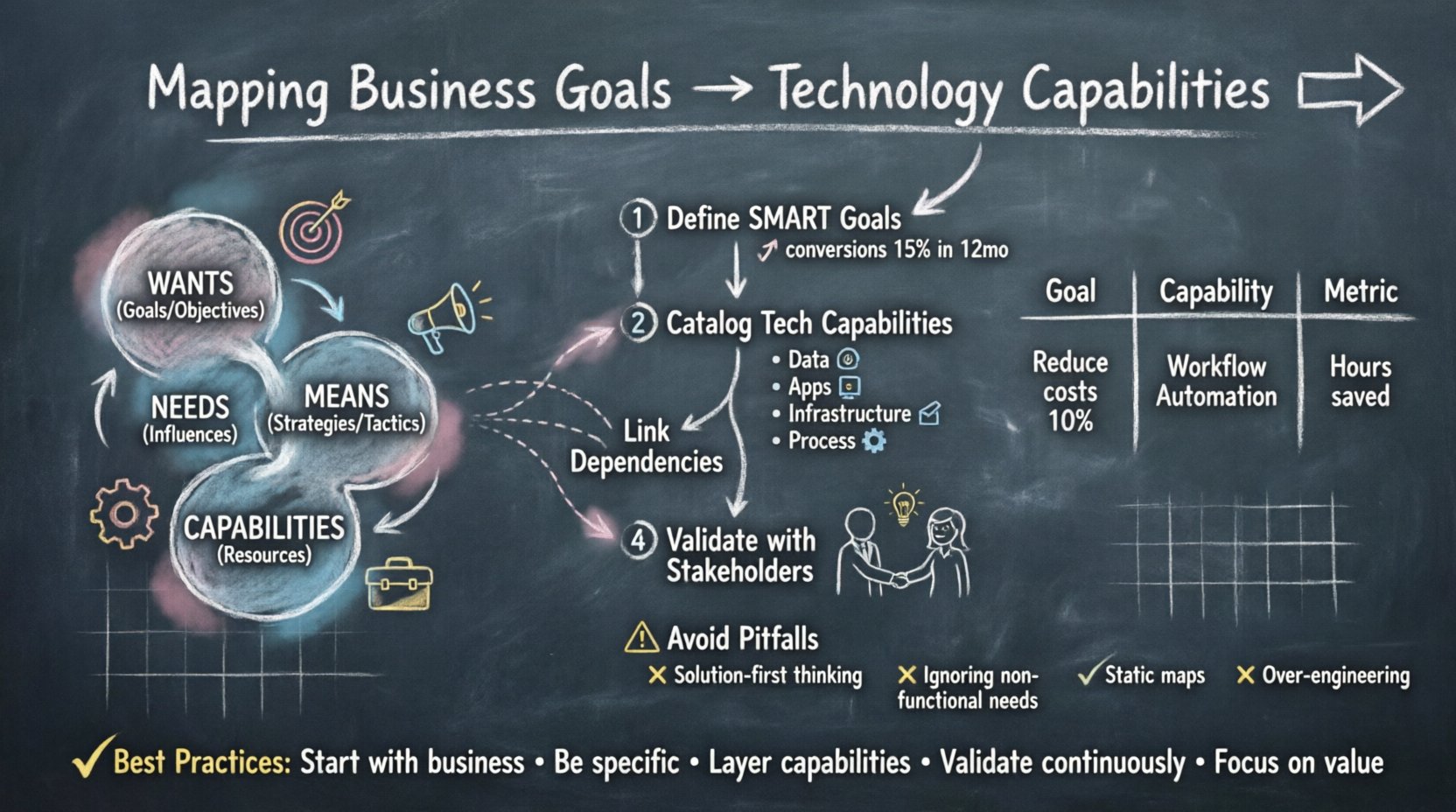
🧠 Understanding the Business Motivation Model Framework
The Business Motivation Model is an open standard designed to model the factors that influence business activities. It distinguishes between what an organization wants to achieve and the means available to achieve it. Rather than treating goals and capabilities as separate silos, BMM integrates them into a cohesive web of influence.
At its core, the model operates on a few fundamental concepts that drive the mapping process:
- Wants (Goals & Objectives): These represent the desired states the organization seeks. They are categorized into Strategic Goals (long-term vision) and Tactical Objectives (short-term milestones).
- Needs (Influences): These are the external or internal factors that motivate the organization to act. They include market pressures, regulatory requirements, and competitive threats.
- Means (Strategies & Tactics): These are the actions taken to satisfy the Wants. In a technology context, these often translate to specific initiatives or projects.
- Capabilities (Resources): These are the assets available to execute the Means. Technology capabilities fall heavily into this category, encompassing software, hardware, data, and skills.
When mapping goals to technology, the focus shifts to the relationship between Means and Capabilities. The model ensures that every technological asset is traced back to a specific business need or goal.
📉 The Cost of Misalignment
Before diving into the mapping process, it is essential to understand the consequences of failing to align goals with capabilities. Without a structured approach, organizations risk building systems that do not solve the right problems. Common issues include:
- Shadow IT: Departments bypassing central IT to build their own solutions because official channels are too slow or misaligned.
- Redundant Investments: Purchasing multiple tools to solve the same problem because the central requirement was unclear.
- Technical Debt: Accumulating complex, unmaintainable systems that no longer serve the current business direction.
- Low ROI: Significant spending on technology that fails to deliver measurable business value.
Using the BMM framework mitigates these risks by forcing explicit documentation of why a capability is being acquired or developed. It answers the question: Which business goal does this technology support?
🔗 Step-by-Step: The Mapping Process
Mapping business goals to technology capabilities is not a one-time event. It is a continuous cycle of analysis, validation, and adjustment. The following steps outline a rigorous workflow for establishing these connections.
1. Identify and Define Strategic Goals
The process begins at the top. Leadership must articulate clear, measurable goals. Vague aspirations like “improve customer experience” are difficult to map. Instead, goals should be specific.
- Bad Example: “Get better at sales.”
- Good Example: “Increase sales conversion rate by 15% within 12 months by reducing checkout friction.”
Documenting these goals requires clarity on success metrics. This definition phase ensures that the subsequent technology mapping has a fixed target.
2. Catalog Available Technology Capabilities
Once goals are defined, the inventory of existing and potential technology capabilities must be audited. A capability is not just a software license; it is the ability to perform a function. Capabilities should be categorized for better management:
- Data Capabilities: Access, storage, governance, and analytics of information.
- Application Capabilities: Specific software functions like order processing, reporting, or communication.
- Infrastructure Capabilities: Compute, network, security, and hosting environments.
- Process Capabilities: Automation of workflows and business rules.
Each capability must be described in terms of what it does, not just what it is called. This prevents ambiguity during the mapping phase.
3. Establish Influence Relationships
This is the critical linking step. In the BMM, you establish how a Goal influences a Strategy, and how a Strategy relies on a Capability. You must draw lines of dependency.
Ask the following questions for every capability:
- Does this capability directly enable a specific goal?
- Is this capability a supporting factor or a primary driver?
- Can this goal be achieved without this capability, or is it a blocker?
Not every technology capability needs a direct link to a strategic goal. Some capabilities are foundational (e.g., security protocols) and support many goals indirectly. These are mapped as Enablers rather than Direct Drivers.
4. Validate with Stakeholders
A map created in isolation is often flawed. Validation requires bringing together business leaders and technical architects. The goal is to verify that the links are logical and that no critical capability has been overlooked.
- Business Stakeholders: Confirm the goals are accurate and the metrics are relevant.
- Technical Stakeholders: Confirm the capabilities are feasible and accurately described.
This collaborative review ensures buy-in and reduces the risk of building the wrong solution.
📊 Visualizing the Alignment
To make the mapping actionable, it is often helpful to visualize the relationships. A matrix can effectively show which goals are supported by which capabilities. Below is a conceptual representation of how these relationships are structured.
| Business Goal | Goal Type | Required Technology Capability | Capability Level | Success Metric |
|---|---|---|---|---|
| Reduce operational costs by 10% | Strategic | Automated Workflow Engine | Application | Hours saved per month |
| Improve customer response time | Tactical | Real-time Notification System | Application | Minutes to first response |
| Ensure 99.9% system uptime | Operational | High-Availability Cloud Infrastructure | Infrastructure | Percentage uptime per quarter |
| Comply with new data privacy regulations | Compliance | Data Encryption & Access Control | Security | Audit pass rate |
| Enable remote workforce collaboration | Strategic | Unified Communication Platform | Application | User adoption rate |
This table demonstrates the granularity required. It moves beyond general statements to specific technologies and measurable outcomes. When creating these matrices, ensure that every row has a clear link to the overarching strategy.
🛠️ Defining Technology Capabilities Deeply
One common error in mapping is treating technology capabilities as monolithic blocks. A deeper understanding of capability layers improves the precision of the alignment. Technology is rarely just “software.” It is a stack of interdependent functions.
Data Capabilities
Data is often the most valuable asset, yet it is frequently treated as an afterthought. When mapping goals involving data, consider:
- Availability: Can the right people access the data when needed?
- Quality: Is the data accurate and timely?
- Security: Is sensitive information protected?
- Integration: Can data flow between different systems seamlessly?
If a business goal is “Personalize customer offers,” the technology capability is not just a marketing tool. It is the capability to aggregate customer data, analyze behavior, and update profiles in real-time.
Application Capabilities
Applications are the visible interface of technology. Mapping here requires understanding user workflows. Does the application support the business process end-to-end, or does it create a bottleneck?
- Functionality: Does the app do what the business needs?
- Usability: Can the staff use the app efficiently?
- Scalability: Can the app handle growth?
Infrastructure Capabilities
While less visible, infrastructure supports everything. Goals regarding speed, security, and continuity rely heavily on this layer.
- Performance: Latency and throughput.
- Reliability: Redundancy and disaster recovery.
- Security: Network and endpoint protection.
A failure to map infrastructure needs can lead to system crashes during peak times, directly impacting the business goal of customer satisfaction.
⚠️ Common Pitfalls in Goal-Capability Mapping
Even with a structured model, organizations often stumble during implementation. Awareness of these common traps helps maintain the integrity of the mapping exercise.
1. The Solution Bias
Teams often start with a technology in mind and try to force goals to fit. For example, “We bought a new analytics tool, so we must find a goal for it.” This reverses the natural order. The goal must drive the capability, not the other way around.
2. Ignoring Non-Functional Requirements
Goals often focus on features (functional requirements), but the quality of the system (non-functional requirements) is equally critical. A system that works but is slow violates the goal of efficiency. Ensure performance and security goals are mapped just as rigorously as feature goals.
3. Static Mapping
Business environments change rapidly. A map created today may be obsolete in six months. The BMM should be treated as a living document. Regular reviews are necessary to update the links as goals shift or technologies become obsolete.
4. Over-Engineering
Complexity adds cost. Sometimes a simple spreadsheet or manual process is the correct capability for a goal. Do not assume that technology must always be the answer. Map the simplest effective capability first.
📈 Measuring the Effectiveness of the Map
How do you know if the mapping is working? You need metrics that track the alignment between the plan and the execution. These metrics should be tracked at the organizational level.
- Goal Achievement Rate: Percentage of strategic goals met that have a mapped technology capability.
- Resource Utilization: Percentage of technology budget spent on capabilities linked to active goals.
- Dependency Visibility: Time taken to assess the impact of a change on business goals.
- Stakeholder Satisfaction: Feedback from business leaders on whether technology initiatives support their objectives.
When these metrics show positive trends, the organization is moving from a technology-driven culture to a value-driven culture. The technology becomes a means to an end, rather than an end in itself.
🔄 Maintaining Alignment Over Time
The relationship between business and technology is dynamic. New competitors emerge, regulations change, and internal priorities shift. The mapping process must accommodate this volatility.
Establish a governance rhythm. Quarterly reviews allow teams to:
- Retire capabilities that no longer support active goals.
- Identify new goals that require new capabilities.
- Adjust the strength of influence links based on changing priorities.
This continuous loop ensures that the technology portfolio remains lean and focused. It prevents the accumulation of “zombie systems”—legacy technologies that consume budget but no longer drive value.
🤝 Bridging the Communication Gap
Perhaps the most significant benefit of the Business Motivation Model in this context is improved communication. Business leaders and IT professionals often speak different languages. BMM provides a shared vocabulary.
When a business leader says they need a “faster system,” they are stating a goal. When IT says they need “more servers,” they are stating a capability. The map connects these two statements. It explains why the servers are needed (to meet the goal of speed) and how speed translates to business value (customer retention).
Facilitating workshops using BMM diagrams helps demystify technology for business stakeholders. Conversely, it helps IT understand the business context behind their requests. This shared understanding reduces friction and accelerates decision-making.
🚀 Future-Proofing Your Architecture
As technology evolves, the capabilities required to meet goals will also evolve. Cloud computing, artificial intelligence, and automation are reshaping what is possible. A robust mapping framework allows you to swap underlying capabilities without disrupting the business goals.
For example, if the goal is “Process transactions securely,” the capability might currently be an on-premise firewall. If the organization migrates to the cloud, the capability changes to cloud-native security groups. The goal remains the same, but the implementation adapts. This abstraction is crucial for long-term agility.
By focusing on the what and why (Goals) rather than just the how (Capabilities), organizations build resilience. They can pivot their technology stack as needed to maintain alignment with their strategic vision.
📝 Summary of Best Practices
To summarize the key takeaways for successful implementation:
- Start with the Business: Define goals before selecting tools.
- Be Specific: Use measurable metrics for all goals.
- Layer Capabilities: Distinguish between data, app, and infrastructure needs.
- Validate Continuously: Keep the map updated as the business evolves.
- Document Relationships: Clearly record how capabilities influence goals.
- Focus on Value: Ensure every capability has a purpose.
Applying the Business Motivation Model to technology mapping is not merely an architectural exercise. It is a strategic discipline that ensures resources are deployed where they matter most. It transforms technology from a cost center into a driver of business value. By adhering to this structured approach, organizations can navigate complexity with confidence and clarity.
The path from strategy to execution is often fraught with ambiguity. However, by explicitly mapping goals to capabilities, that ambiguity is reduced. The result is a technology environment that is responsive, efficient, and directly aligned with the organization’s mission. This alignment is the foundation of sustainable growth in a digital economy.