Organizational transformation is rarely a simple task. It involves shifting mindsets, restructuring processes, and aligning diverse teams toward a common vision. When leaders approach change without a clear framework, initiatives often stall, resources are wasted, and momentum is lost. To navigate this complexity, professionals rely on structured methodologies that connect strategy to execution. The Business Motivation Model (BMM) offers a robust way to understand the “why” behind business decisions, ensuring that every change initiative is rooted in genuine motivation and strategic necessity.
By integrating BMM principles into change management, organizations can map the relationships between high-level goals and the specific actions required to achieve them. This approach moves beyond simple project management into the realm of strategic alignment. It clarifies who is involved, what drives them, and how their contributions impact the broader enterprise. This guide explores how to apply these insights to lead change effectively, ensuring sustainability and measurable results.
Understanding the Business Motivation Model Foundation 🧠
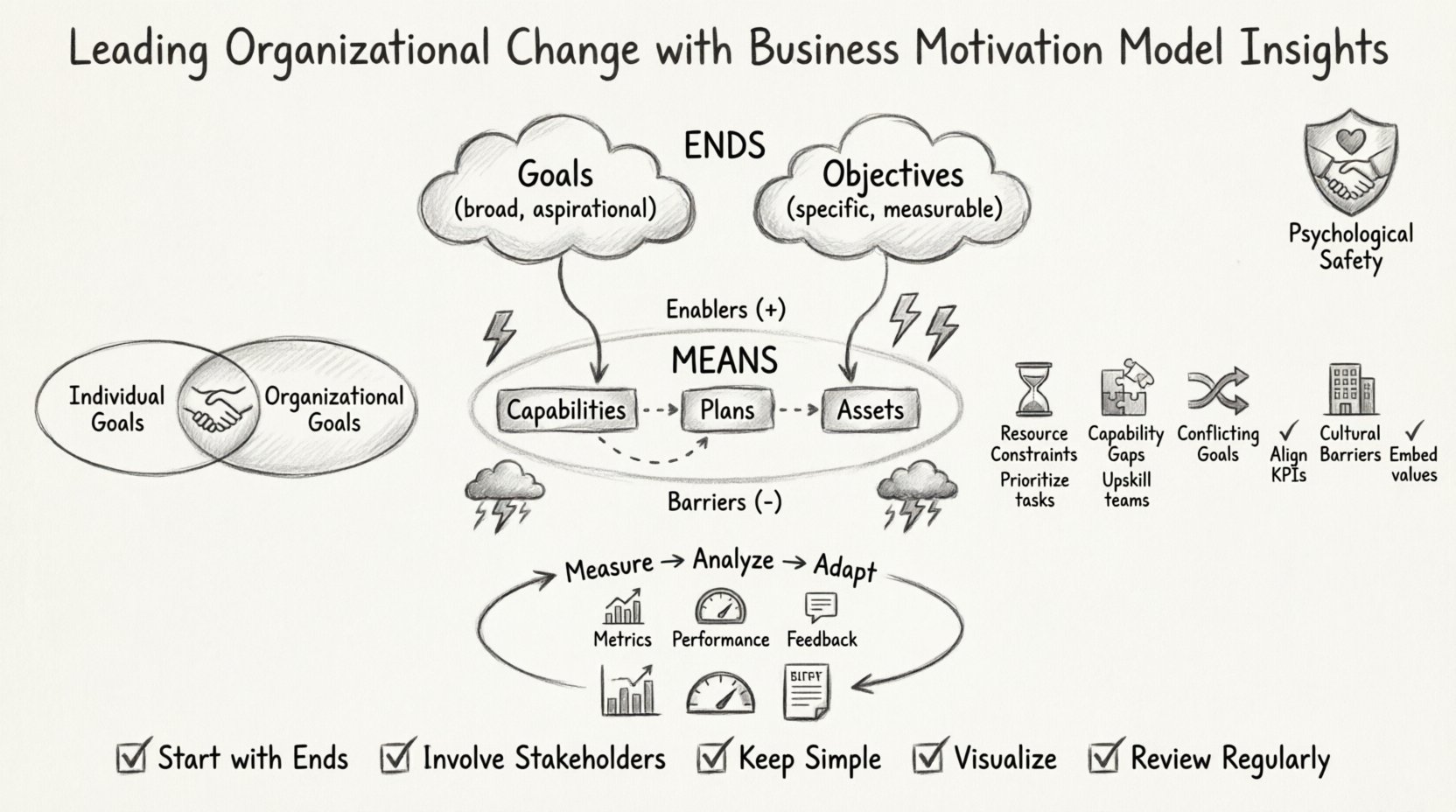
Before implementing change, it is essential to understand the core components that drive business behavior. The Business Motivation Model is not just a diagramming tool; it is a conceptual framework designed to capture the intent of an organization. It breaks down the motivation for action into distinct categories that can be analyzed, prioritized, and managed.
- Ends: These represent what the organization wants to achieve. They are the desired outcomes that define success.
- Means: These are the methods used to achieve the Ends. They include capabilities, plans, and resources.
- Influences: These are the external or internal factors that affect the Means and Ends. They can be positive (enablers) or negative (barriers).
When managing change, confusion often arises because stakeholders focus on the Means without fully understanding the Ends. They build capabilities or execute plans that do not directly contribute to the strategic goals. BMM resolves this by forcing a clear definition of the relationship between actions and outcomes.
Mapping Motivation to Change Initiatives 🔄
Every change initiative must answer a fundamental question: why are we doing this? Without a clear answer, resistance builds, and engagement drops. Using the Business Motivation Model allows leaders to map specific change projects to organizational Ends.
Defining the Ends
The first step is to articulate the desired state. This involves distinguishing between different types of Ends:
- Goals: Broad, aspirational statements. These are often qualitative and long-term.
- Objectives: Specific, measurable targets. These are quantitative and time-bound.
For example, a Goal might be “Improve Customer Satisfaction,” while an Objective could be “Reduce Ticket Resolution Time by 20% within Six Months.” Change initiatives should be selected based on their ability to directly satisfy these Objectives. If a project does not link to an Objective, it lacks strategic justification.
Identifying the Means
Once the Ends are defined, the Means must be identified. In the context of change, Means often include:
- Business Capabilities: The abilities required to perform work (e.g., data analysis, agile delivery).
- Plans: The specific roadmaps or schedules outlining how work will be done.
- Assets: The resources, tools, and people needed to execute the plan.
Change management often fails when the Means are insufficient for the Ends. Leaders must assess whether the organization possesses the necessary capabilities to support the change. If a Gap exists, training or hiring must be part of the change plan.
Stakeholder Alignment Through Motivation 🤝
Change is ultimately a human endeavor. Technology and processes change, but people drive the transition. The BMM provides a lens to analyze stakeholder motivation. Every stakeholder has their own set of Ends and Influences that drive their behavior.
Identifying Stakeholder Motivations
To gain support, you must understand what motivates each group. This requires asking specific questions:
- What are their personal or departmental Goals?
- What Objectives are they trying to hit?
- What Influences might stop them from supporting the change?
When these motivations are mapped against the organizational change, overlaps and conflicts become visible. Conflicts often arise when a departmental Goal contradicts an organizational Goal. For instance, a sales team might want to offer discounts (Goal: Increase Volume), while finance wants to protect margins (Goal: Increase Profit). The change initiative must address this tension.
Creating Shared Value
The most effective change strategies align individual motivations with organizational ones. This means designing the change so that stakeholders achieve their personal or team objectives by contributing to the broader strategy. This alignment reduces friction and increases voluntary participation.
Identifying and Mitigating Resistance 🛑
Resistance is a natural part of change. It signals that there is a disconnect between the proposed change and the existing motivations of the people involved. The BMM treats resistance as a Negative Influence that must be managed rather than ignored.
Classifying Negative Influences
Negative Influences can take many forms. Understanding the type helps in selecting the right mitigation strategy:
- Resource Constraints: Lack of time, budget, or personnel.
- Capability Gaps: Skills or technology that do not exist yet.
- Conflicting Goals: Other initiatives that compete for attention.
- Cultural Barriers: Habits or norms that resist new ways of working.
Strategies for Mitigation
Once the Negative Influences are identified, they can be addressed systematically. The following table outlines common influences and potential responses:
| Influence Type | Impact on Change | Mitigation Strategy |
|---|---|---|
| Resource Constraints | Delays or scope reduction | Reprioritize initiatives or secure additional funding |
| Cultural Barriers | Low adoption or passive resistance | Engage change champions and modify communication |
| Conflicting Goals | Division among teams | Align leadership and redefine cross-functional objectives |
| Capability Gaps | Inability to execute | Invest in training or hire specialized talent |
By treating resistance as a manageable Influence rather than a personal failure, leaders can address the root cause. This shifts the conversation from blame to problem-solving.
Strategic Planning with BMM 📋
Long-term success requires more than just a tactical plan. It requires a hierarchy of motivation that connects daily activities to the vision. The Business Motivation Model supports this hierarchy by allowing goals to be decomposed into sub-goals and objectives.
Decomposing Strategy
Strategy is often too vague for front-line employees. Decomposition makes it actionable. A high-level Goal is broken down into Objectives, which are then broken down into specific tasks or Plans. This ensures that every employee understands how their daily work contributes to the larger picture.
For example:
- Strategic Goal: Become the market leader in sustainability.
- Departmental Objective: Reduce carbon footprint by 15%.
- Team Plan: Implement energy-saving protocols in facilities.
Iterative Planning
Change is rarely linear. Conditions change, and so do motivations. BMM supports iterative planning by allowing the model to be updated as Influences shift. If a Negative Influence becomes stronger, the Plan can be adjusted. If a new Positive Influence emerges, the opportunity can be seized immediately.
Measuring Success and Impact 📊
How do you know if the change initiative is working? Relying on intuition is insufficient. The Business Motivation Model provides a framework for measurement by linking outcomes back to the defined Ends.
Defining Metrics
Metrics should be derived directly from the Objectives. If an Objective is “Reduce Costs by 10%,” the metric is the percentage reduction in cost. If an Objective is “Improve Employee Engagement,” the metric might be an engagement survey score.
- Leading Indicators: Predict future performance (e.g., training completion rates).
- Lagging Indicators: Confirm past performance (e.g., revenue growth).
Feedback Loops
Measurement is useless without action. Establish feedback loops where data is reviewed regularly. If metrics show the End is not being achieved, analyze the Means. Is the capability missing? Is the plan flawed? Is there a Negative Influence that was underestimated? This data-driven approach ensures continuous improvement.
Common Challenges and Solutions ⚠️
Implementing the Business Motivation Model in a real-world environment comes with hurdles. Awareness of these challenges allows teams to prepare effectively.
- Complexity Overload: The model can become too detailed. Solution: Start with high-level Ends and only drill down where necessary.
- Static Documentation: Models often become outdated quickly. Solution: Treat the model as a living document, updated during regular strategy reviews.
- Lack of Ownership: No one feels responsible for the model. Solution: Assign a specific role, such as a Business Architect, to maintain alignment.
- Communication Gaps: Stakeholders do not understand the model. Solution: Use visual representations and avoid jargon when explaining concepts.
Integrating BMM into Enterprise Architecture 🔗
The Business Motivation Model does not exist in isolation. It integrates well with other architectural frameworks. It provides the “Why” for the “What” in other models. For instance, while other frameworks define the structure of systems, BMM defines the value those systems deliver.
Alignment with Process Models
Process improvement initiatives can use BMM to justify the effort. By showing how a process change supports a specific Goal, the investment is easier to justify. This prevents process re-engineering that looks good on paper but delivers no business value.
Supporting Governance
Governance bodies often struggle to evaluate projects. BMM provides a clear criteria for approval. A project should only be approved if it positively influences the strategic Ends and the organization has the Means to execute it. This creates a disciplined investment environment.
Best Practices for Implementation ✅
To ensure success, follow these practical guidelines when applying the Business Motivation Model to change efforts:
- Start with the Ends: Never begin with a solution or a tool. Start with the desired outcome.
- Involve Stakeholders Early: Get input on Goals and Influences from the people who will be affected.
- Keep it Simple: Avoid creating hundreds of nodes. Focus on the critical path from Goal to Execution.
- Visualize Relationships: Use diagrams to show how Plans support Objectives and how Objectives support Goals.
- Review Regularly: Schedule quarterly reviews to update Influences and validate Ends.
- Train the Team: Ensure business analysts and managers understand the core concepts before applying them.
The Human Element in Motivation 🧑💼
While BMM is a structural tool, it is deeply connected to human psychology. People do not change because of diagrams; they change because they see value in the change. The model helps identify that value.
Psychological Safety
When stakeholders understand the “Why,” they feel more secure. Uncertainty creates anxiety. By clearly mapping the End State, leaders reduce the fear of the unknown. This psychological safety is a prerequisite for innovation and risk-taking during transformation.
Empowerment
When teams see how their specific contributions impact the broader Goals, they feel empowered. They move from being passive executors to active owners of the change. This shift in mindset is often the difference between a forced implementation and a cultural evolution.
Sustaining Change Over Time 🌱
Change is not an event; it is a journey. Many organizations succeed in the initial rollout but fail to sustain the improvements. The Business Motivation Model helps maintain focus on the original Ends.
Preventing Drift
Over time, projects can drift away from their original objectives. Regular alignment checks ensure that the Means are still serving the Ends. If the business environment shifts, the Ends may need to change. The model allows for this evolution without losing the connection between strategy and execution.
Continuous Value Realization
The ultimate measure of change is value. By continuously monitoring the Influences on the Ends, organizations can ensure that value is being realized. If a Negative Influence grows too large, the plan must adapt. If a Positive Influence is missed, the opportunity is lost. Vigilance is key.
Conclusion 🏁
Leading organizational change requires more than just good intentions. It demands a clear understanding of the motivations driving the business and the people within it. The Business Motivation Model provides the structure needed to map these motivations, align stakeholders, and track progress. By focusing on Ends, managing Influences, and ensuring the Means are capable, leaders can navigate complexity with confidence.
Adopting this framework transforms change management from a reactive process into a strategic discipline. It ensures that every initiative contributes to the long-term vision, reducing waste and increasing engagement. As organizations continue to evolve, the ability to understand and leverage motivation will remain a critical competency for success.