
Modern enterprises face a persistent challenge: translating technical requirements into business value. IT leaders often find themselves in a position where they must defend significant capital expenditure without a clear line of sight to organizational outcomes. This is where the Business Motivation Model (BMM) becomes a critical framework. It provides a structured approach to aligning infrastructure investments with strategic intent, ensuring that every dollar spent supports a defined business need rather than just maintaining the status quo. 🚀
Infrastructure spend is rarely about the hardware or the cloud instance itself. It is about what those resources enable. By applying BMM analysis, organizations can map technical capabilities directly to business goals, objectives, and strategies. This guide details the methodology for justifying infrastructure investment using this model, removing ambiguity and replacing it with measurable alignment.
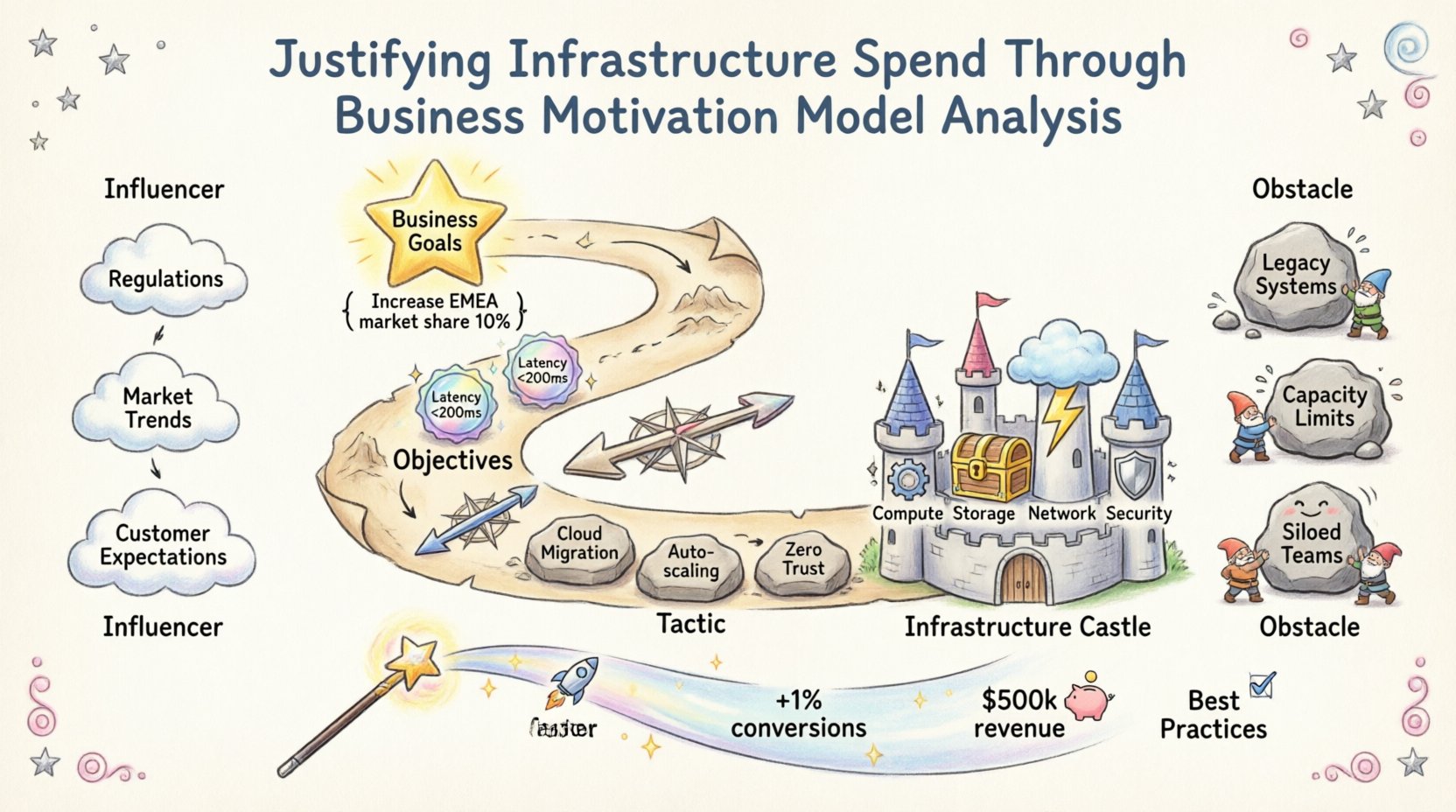
Understanding the Business Motivation Model Framework 🧩
The Business Motivation Model offers a standardized way to describe the elements of business planning and execution. It distinguishes between what an organization wants to achieve and the means used to get there. When applied to infrastructure, it shifts the conversation from “we need more servers” to “we need compute capacity to support the Q4 marketing campaign goal.”
Core Elements of BMM
To utilize this model effectively, one must understand its fundamental components. These elements create the vocabulary for justification:
- Ends: The desired outcomes. In BMM, these are split into Goals (high-level, qualitative) and Objectives (specific, measurable).
- Means: The actions taken to achieve the Ends. These include Strategies (plans to achieve objectives) and Tactics (specific actions).
- Influencers: Internal and external factors that impact the success of the Means or the achievement of the Ends.
- Capabilities: The assets and resources available to execute the Means.
- Obstacles: Barriers that prevent the achievement of Ends.
Infrastructure is typically categorized as a Capability or an Influencer. It is the resource that enables the Tactics, which execute the Strategies, to meet the Objectives, fulfilling the Goals.
The Common Pitfalls of Infrastructure Justification 🛑
Without a structured model, infrastructure proposals often fail due to vague reasoning. Common patterns that lead to budget rejection include:
- Tech-First Language: Focusing on CPU cores, storage IOPS, or bandwidth limits without explaining the business impact of those metrics.
- Reactive Spending: Requesting funds only after a system failure, rather than planning for growth or resilience.
- Lack of Traceability: Inability to link a specific server upgrade to a specific revenue target or customer satisfaction metric.
- Ignoring Obstacles: Failing to identify what would happen if the investment is *not* made (the cost of inaction).
These pitfalls occur because the justification is built on technical debt rather than business motivation. The BMM framework corrects this by forcing a linkage between the technical asset and the business strategy.
Mapping Infrastructure to Business Motivation Elements 🗺️
The core of the analysis involves mapping specific infrastructure components to the BMM elements. This creates a chain of value that stakeholders can follow.
When proposing a new cloud environment or on-premises expansion, consider the following mapping structure:
- Goal: Increase market share in the EMEA region by 10%.
- Objective: Reduce application latency to under 200ms for users in London and Frankfurt.
- Strategy: Deploy localized data centers to improve user experience and compliance.
- Tactic: Provision 5 new high-performance nodes in Frankfurt.
- Capability: The infrastructure budget allocated for the new nodes.
- Influencer: Data sovereignty regulations requiring local storage.
- Obstacle: Existing legacy systems unable to handle the new traffic volume.
This structure transforms a line item in a spreadsheet into a strategic enabler. It answers the “Why” at every level of the hierarchy.
Infrastructure Types and Their Motivational Value
Different infrastructure components serve different motivational purposes. The table below outlines common infrastructure categories and how they map to BMM elements.
| Infrastructure Type | Primary Goal Alignment | Key Objective Metric | Risk of Non-Investment |
|---|---|---|---|
| Compute Resources | Operational Efficiency | Processing speed / Throughput | Bottlenecks in product delivery |
| Storage Solutions | Data Integrity & Compliance | Retention period / Recovery Time | Data loss / Regulatory fines |
| Network Connectivity | Market Reach | Uptime / Latency | Service outages / Lost sales |
| Security Controls | Risk Management | Incident response time | Reputation damage / Breaches |
Step-by-Step Analysis Process for Justification 📝
Implementing this analysis requires a disciplined approach. Follow these steps to build a robust justification document.
1. Identify the Strategic Goal
Begin by identifying the high-level business goal that the infrastructure supports. This should not be an IT goal (e.g., “upgrade servers”). It must be a business goal (e.g., “enable digital transformation”).
- Review the annual corporate strategy document.
- Interview executive stakeholders to understand current priorities.
- Document the specific goal as a qualitative statement.
2. Define Measurable Objectives
Break the goal down into quantitative objectives. These are the metrics that will define success.
- What percentage increase in capacity is required?
- What is the target availability percentage?
- What is the acceptable budget variance?
3. Select the Strategy and Tactics
Outline how the infrastructure investment enables the strategy.
- Strategy: “Improve customer experience by reducing load times.”
- Tactic: “Purchase additional load balancers and edge caching.”
4. Assess Influencers and Obstacles
Justification is strengthened when you acknowledge external pressures. This shows a comprehensive understanding of the business environment.
- Influencers: Are there new competitors entering the market? Is there a shift in consumer behavior?
- Obstacles: Is the current infrastructure preventing the goal? Is there a compliance deadline approaching?
5. Quantify the Return on Investment (ROI)
Finally, attach financial metrics to the BMM elements. This is where the technical capability meets the financial statement.
- Calculate cost savings from efficiency gains.
- Estimate revenue growth from improved service levels.
- Factor in the cost of risk mitigation (insurance, legal, reputation).
Quantifying Value: From Technical Metrics to Financials 💰
One of the most difficult parts of justification is translating technical performance into financial value. The Business Motivation Model helps bridge this gap by linking performance to outcomes.
Consider the following conversion logic:
- Latency Reduction: 100ms reduction ➔ 1% increase in conversion rate ➔ $500k additional annual revenue.
- Uptime Improvement: 99.9% to 99.99% ➔ 8.76 hours less downtime ➔ $25k saved in lost productivity.
- Scalability: Ability to handle 2x traffic ➔ Support for 50% more customers ➔ $1M new market opportunity.
When presenting these figures, ensure they are tied back to the Objectives defined in the BMM. This creates a closed loop of accountability.
Risk Assessment within the BMM Context ⚠️
Infrastructure spend is often justified by risk reduction. The BMM framework allows for a structured risk assessment by treating risk as an Influencer or an Obstacle.
Identifying Technical Risks
- Single Point of Failure: Does the current architecture rely on one component that, if it fails, stops the business?
- Capacity Exhaustion: Will the system crash during peak loads?
- Security Vulnerabilities: Are there known gaps in the current infrastructure that expose data?
Linking Risk to Business Impact
Do not stop at the technical risk. You must articulate the business consequence.
- Technical: Database server crash.
- Business: Inability to process orders for 4 hours.
- Financial: $10,000 lost revenue + $5,000 in customer compensation.
- Strategic: Loss of trust in brand reliability.
By mapping this chain, the infrastructure spend becomes an insurance policy for the business strategy, which is easier to justify to finance teams.
Handling Objections and Challenges 🤔
Even with a strong BMM analysis, objections will arise. Anticipating these allows for a more robust proposal.
Challenge: “We can do this with existing resources.”
Response: Review the Obstacles section of your analysis. If the current resources cannot meet the Objectives (e.g., speed, capacity), then the existing setup is a constraint on the Goal. Show the gap between current capability and required capability.
Challenge: “The ROI timeline is too long.”
Response: Separate the investment into phases. Show immediate value in risk reduction (Obstacle mitigation) while planning for long-term revenue growth (Goal achievement). This demonstrates a balanced approach to capital allocation.
Challenge: “Why not a different vendor or technology?”
Response: Focus on the Goal and Objective, not the specific technology. If the Goal is “Reduce Latency,” evaluate if the proposed technology is the most direct path. If the BMM analysis shows the current technology is the bottleneck, the change is justified regardless of the vendor.
Case Scenario: Scaling for a Product Launch 🚀
To illustrate the practical application, consider a scenario where a company plans to launch a new digital product.
- Goal: Successful market entry for Product X.
- Objective: Support 100,000 concurrent users in the first month.
- Current State: Infrastructure supports 10,000 concurrent users.
- Influencer: Marketing campaign driving traffic spikes.
- Obstacle: Current capacity will result in a 90% rejection rate during launch.
- Strategy: Provision elastic cloud capacity to handle spikes.
- Tactic: Allocate budget for auto-scaling groups and load balancers.
- Justification: Without this, the launch fails (Goal not met). With this, the launch succeeds (Goal met).
In this scenario, the infrastructure spend is not optional; it is a prerequisite for the Goal. The BMM makes this dependency explicit.
Best Practices for Ongoing Alignment 🔄
Justification is not a one-time event. Infrastructure needs change, and so do business goals. Maintain alignment through regular reviews.
- Quarterly Reviews: Re-evaluate the link between infrastructure costs and business objectives.
- Dynamic Updates: If a business Goal changes, does the infrastructure need to change? Update the BMM model accordingly.
- Feedback Loops: Gather data on actual performance vs. projected Objectives. Use this to refine future justifications.
- Stakeholder Communication: Keep business leaders informed of how their infrastructure investments are performing against the original Goals.
Integrating Financial and Technical Planning 📊
Finally, successful justification requires the integration of financial planning with technical roadmaps. The BMM serves as the bridge between these two departments.
- Capital Expenditure (CapEx): Justify large upfront costs by linking them to long-term Goals.
- Operating Expenditure (OpEx): Justify recurring costs by linking them to ongoing Objectives and Service Levels.
- Shadow IT: Use BMM to identify unauthorized spending that does not align with the official Goals and Objectives.
By enforcing this discipline, organizations can reduce waste and ensure that every infrastructure dollar contributes to the strategic mission. This approach moves IT from a cost center to a value driver.
Summary of Key Principles ✅
- Start with the Business Goal, not the Technical Requirement.
- Translate technical metrics into measurable Objectives.
- Identify Obstacles that the infrastructure will remove.
- Quantify the impact of inaction (Cost of Risk).
- Map every infrastructure item to a specific Strategy or Tactic.
- Maintain alignment through regular reviews and updates.
Adopting this structured approach ensures that infrastructure spending is grounded in business reality. It provides a clear narrative for stakeholders, reducing friction in the approval process and ensuring that resources are directed where they create the most value. This is the essence of strategic infrastructure management.