
Organizations frequently invest substantial resources into new technology stacks. Despite the potential for efficiency and growth, many initiatives fail to deliver expected value. The root cause often lies not in the technology itself, but in the disconnect between technical capabilities and business intent. To bridge this gap, a structured approach is necessary. The Business Motivation Model (BMM) offers a robust framework for ensuring that every technological deployment serves a defined business purpose.
This guide explores how to leverage BMM to align technology implementation with business means. By focusing on the relationship between wants, needs, goals, and means, leaders can make informed decisions. We will examine the core elements of the model, the mapping process, and the practical steps for execution. This approach ensures that technology acts as a true enabler rather than a standalone expense.
🧩 Understanding the Business Motivation Model
The Business Motivation Model provides a standard language for describing why an organization exists and how it intends to achieve its aims. It is not merely a planning tool but a structural ontology that clarifies relationships between business elements. When applied to technology, it shifts the focus from “what software do we need” to “what business value do we need to create.”
At its core, BMM distinguishes between the motivation to act and the means by which action is taken. Technology primarily falls under the category of Means. Understanding this distinction is vital for alignment.
📌 Core Elements of BMM
To implement technology successfully, one must understand the specific elements within the model. Each element plays a distinct role in the strategic chain.
- Wants: These are the desires of stakeholders. For technology projects, this might include the desire for faster reporting, improved customer engagement, or reduced operational costs.
- Needs: Needs are the requirements that must be met to satisfy wants. A need might be “real-time data access” or “automated compliance checking.”
- Goals: Goals are the desired states the organization wishes to achieve. They are broader than needs. A goal might be “market leadership in digital services.”
- Goals are typically long-term.
- They provide direction for the entire initiative.
- Objectives: Objectives are specific, measurable targets that support goals. If a goal is market leadership, an objective might be “increase digital revenue by 20% within 12 months.”
- Objectives are quantifiable.
- They allow for tracking progress.
- Strategies: Strategies are the high-level approaches chosen to achieve objectives. They define the path forward without detailing every step.
- Tactics: Tactics are the specific actions taken to execute strategies. In a tech context, a tactic might be “migrate legacy databases to the cloud.”
- Means: Means are the resources or capabilities used to execute tactics. This is where technology resides. It includes hardware, software, personnel, and processes.
- Means are the enablers.
- They must be evaluated for their contribution to the tactics.
- Influences: Influences are external or internal factors that affect the motivation or the ability to achieve goals. Market trends, regulatory changes, and budget constraints fall into this category.
🛠️ Mapping Technology to Business Means
Technology is often purchased based on features rather than strategic fit. The BMM framework corrects this by requiring a clear lineage from the business want to the technological means. This mapping process ensures that no technology is adopted without a corresponding business justification.
🔗 The Connection Chain
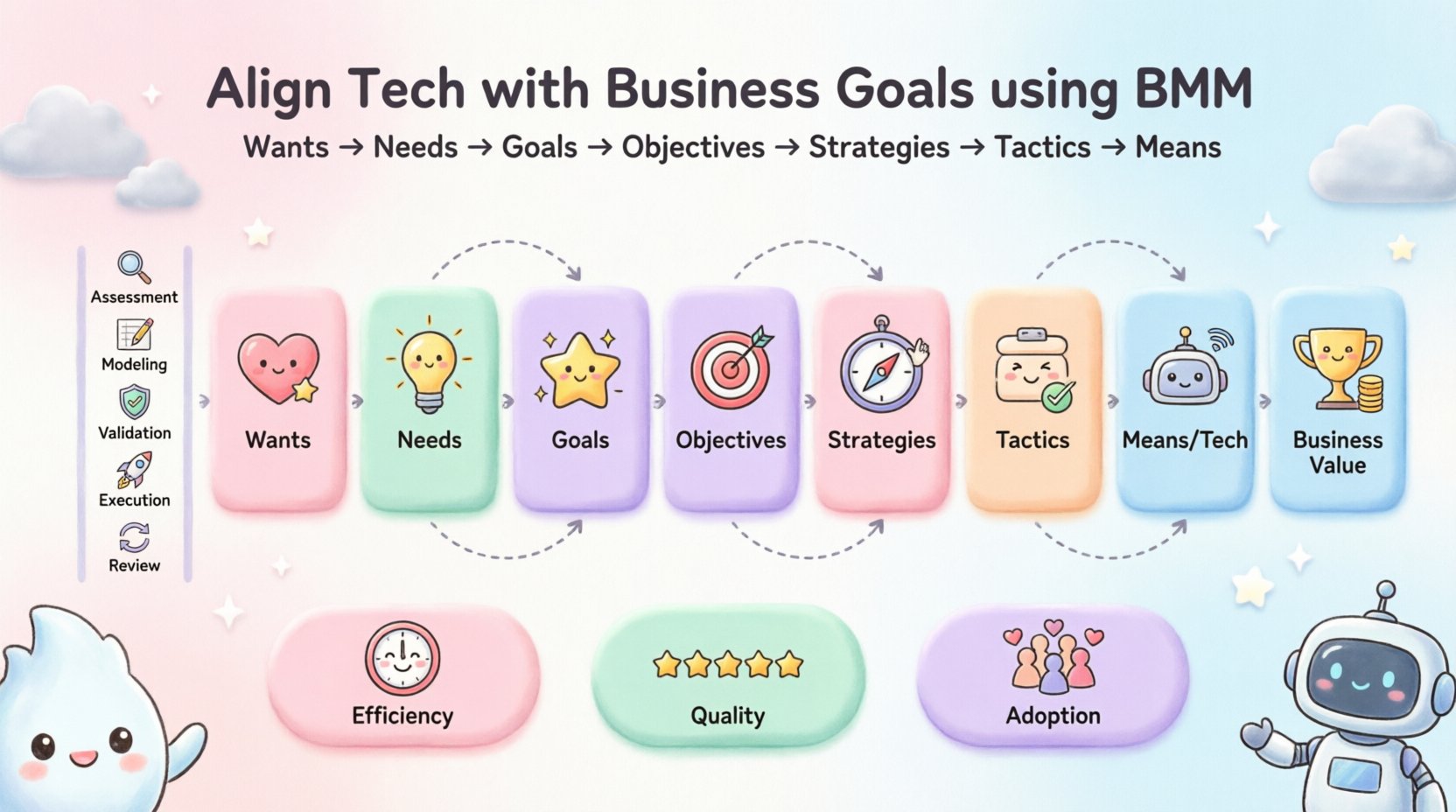
Establishing a clear connection chain prevents scope creep and misalignment. The flow typically moves from the abstract to the concrete.
- Identify Stakeholder Wants: Start with the people who will use or be affected by the technology. What problems do they face?
- Define Business Needs: Translate wants into functional requirements. What must the business do differently?
- Set Goals and Objectives: Ensure the needs support the broader organizational strategy.
- Develop Strategies: Determine the approach to meet the objectives.
Define Tactics: Break strategies into actionable steps.
Select Means: Choose the technology that enables these tactics.
By following this sequence, technology becomes a solution to a defined problem rather than a driver of the problem. This reduces the risk of implementing tools that do not integrate well with existing workflows.
📋 Step-by-Step Implementation Process
Implementing technology through the lens of BMM requires a disciplined process. It is not a one-time event but a continuous cycle of alignment and review. The following steps outline how to operationalize this model.
1. Assessment and Discovery
The first phase involves gathering intelligence. You must understand the current state of the business and its motivation.
- Conduct Stakeholder Interviews: Gather information on what stakeholders value most.
- Analyze Current Capabilities: Review existing technology and processes to identify gaps.
- Document Influences: Note any external pressures such as regulations or competitor actions.
2. Modeling the Motivation
Once data is collected, create a visual or documented model of the business motivation. This does not require complex software but a clear diagram or list.
- Map out the hierarchy from Wants to Means.
- Ensure every Goal has at least one supporting Objective.
- Verify that every Objective has a defined Strategy.
- Confirm that every Strategy has specific Tactics.
- Check that every Technology asset is linked to a specific Means.
3. Validation of Alignment
Before any procurement or development begins, validate the model. This step prevents wasted resources.
- Review with Leadership: Ensure the model reflects the true strategic intent.
- Check Feasibility: Are the proposed Means realistic given current constraints?
- Assess Risk: What happens if the technology fails? Does the business have a fallback?
4. Execution and Deployment
During implementation, maintain the connection to the model. Changes in the technology should be evaluated against the original business motivation.
- Track Progress: Measure development against the defined Objectives.
- Monitor Tactics: Ensure the actions being taken match the planned tactics.
- Manage Changes: If a new feature is requested, trace it back to a Goal. If it does not align, reject it.
5. Review and Optimization
Post-implementation is critical for long-term success. The business environment changes, and so must the model.
- Evaluate Performance: Did the technology meet the Objectives?
- Update Influences: New market conditions may require new Strategies.
- Refine Means: Replace or upgrade technology that no longer serves the Tactics effectively.
📊 Alignment Structure Table
The table below illustrates how BMM elements translate into technology implementation activities. This structure helps teams visualize the flow of value.
| BMM Element | Definition | Technology Implementation Example |
|---|---|---|
| Wants | Desires of stakeholders | Sales team wants faster access to customer history. |
| Needs | Requirements to satisfy wants | Need for a unified customer view across all channels. |
| Goals | Desired organizational states | Improve customer satisfaction scores by 15%. |
| Objectives | Specific measurable targets | Reduce average response time to under 2 hours. |
| Strategies | High-level approaches | Centralize customer data into a single repository. |
| Tactics | Specific actions | Deploy a new CRM module and integrate with email server. |
| Means | Resources/Capabilities | Cloud-based database, API integration tools, training staff. |
| Influences | External/Internal factors | Data privacy regulations, budget limits, legacy system constraints. |
⚠️ Common Challenges and Mitigation
Even with a solid framework, obstacles arise during technology adoption. Recognizing these challenges early allows for proactive management.
🚫 Siloed Decision Making
Departments often make technology choices without regard for the broader business model. IT may buy a tool that marketing cannot use, or HR may select a system that operations rejects.
- Mitigation: Establish a governance committee that reviews all technology proposals against the central BMM.
- Mitigation: Require cross-functional sign-off before procurement.
🚫 Shifting Priorities
Business goals change. A technology that was aligned last year may be irrelevant today. This creates technical debt and wasted investment.
- Mitigation: Schedule quarterly reviews of the BMM to ensure alignment with current goals.
- Mitigation: Design technology with modularity in mind to allow for easier adaptation.
🚫 Lack of Clarity on Means
Teams often confuse strategies with means. They might plan a strategy (e.g., “improve speed”) and immediately jump to a means (e.g., “buy server”) without defining the tactics in between.
- Mitigation: Train staff on the distinction between Strategy, Tactics, and Means.
- Mitigation: Use the model as a checklist for project charters.
📈 Measuring Impact and Success
Success is not just about installation. It is about the realization of the business motivation. Metrics must be derived from the Objectives defined in the model.
🔍 Key Performance Indicators
Track metrics that directly reflect the Objectives.
- Efficiency Metrics: Time saved per task, reduction in manual entry.
- Quality Metrics: Error rates, data accuracy improvements.
- Adoption Metrics: User engagement rates, login frequency.
- Financial Metrics: Cost savings, revenue generated through new channels.
🔄 Continuous Feedback Loops
Data collection should feed back into the BMM. If an Objective is consistently missed, the Means may be insufficient, or the Objective may be unrealistic.
- Adjust Tactics: Change how the technology is used.
- Adjust Means: Invest in better tools or training.
- Re-evaluate Goals: If the market shifts, the Goal may need to change.
🔄 Sustaining Alignment Over Time
Alignment is a dynamic state, not a static destination. The business environment is fluid, and technology evolves rapidly. To maintain the connection between business means and technology, organizations must embed the BMM into their culture.
Regular training on the model helps ensure that new employees understand the strategic context of their work. Documentation should be kept current. When a project ends, the lessons learned should be used to update the model for future initiatives.
By treating the Business Motivation Model as a living document, organizations can navigate changes with agility. Technology remains a servant to the business, driving value rather than consuming budget. This disciplined approach fosters a culture of accountability and strategic thinking.
Ultimately, the goal is a cohesive ecosystem where every digital tool has a clear reason for existence. This clarity reduces waste, improves morale, and drives sustainable growth. When technology and business motivation are in sync, the organization is better positioned to achieve its long-term aspirations.
🎯 Final Thoughts on Strategic Alignment
Implementing new technology is a significant undertaking. It requires vision, resources, and coordination. The Business Motivation Model provides the structure needed to manage this complexity. By anchoring technical decisions in business needs, leaders can ensure that investments yield tangible returns.
Remember that the model is a guide, not a rigid rulebook. It should be adapted to fit the specific context of the organization. However, the core principle remains constant: technology must serve the business. When this relationship is respected, the path to success becomes clearer and more achievable.