Agile development promises flexibility, yet that very flexibility often invites unexpected changes. When a stakeholder requests a new feature or a modification to existing work in the middle of a Sprint, the team faces a critical decision point. This phenomenon is known as scope creep mid-sprint. It is not inherently negative; it is a natural occurrence in dynamic environments. However, how the team responds determines whether the Sprint Goal is achieved or compromised.
This guide provides a structured approach to managing these changes. It focuses on protecting the team’s focus while respecting business needs. We will explore the mechanics of the Sprint, the role of the Product Owner, and the communication strategies required to maintain stability without stifling innovation.
🧐 What Is Scope Creep in Scrum?
Scope creep refers to uncontrolled changes or continuous growth in a project’s scope. In the context of Scrum, it specifically means adding work to the Sprint Backlog after the Sprint has begun. Unlike traditional Waterfall projects where changes are rare, Agile embraces change. The challenge lies in when and how that change is integrated.
- Valid Change: A critical bug or a market-shifting event that threatens the product’s viability.
- Non-Urgent Change: A “nice-to-have” feature that stakeholders remember on Tuesday but was not prioritized for Monday.
- Mid-Sprint Interruption: Requests that arrive during Daily Standups or mid-Sprint reviews.
Understanding the distinction is vital. Not every request is an emergency. Treating every request as an emergency leads to burnout and missed deadlines.
🎯 The Sanctity of the Sprint Goal
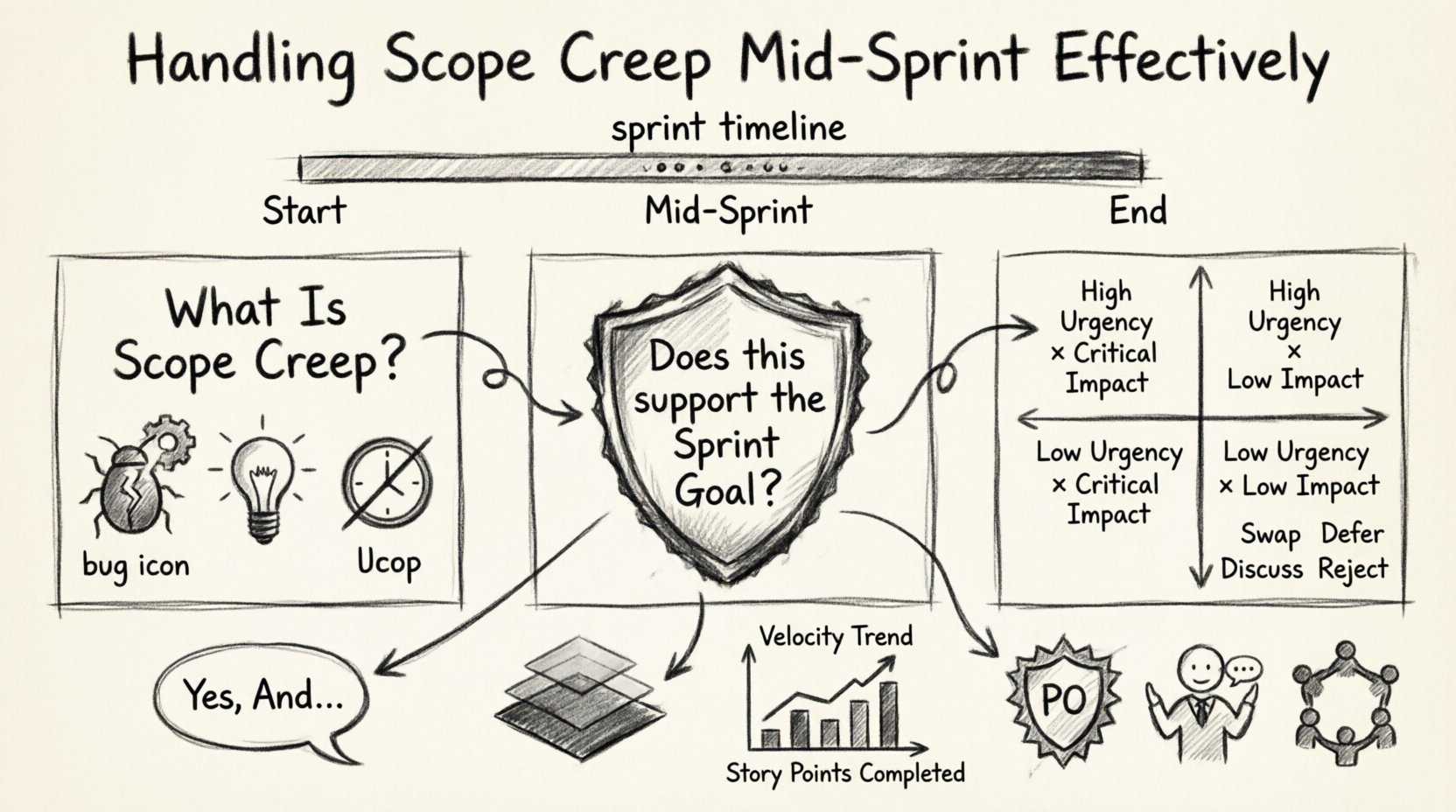
The Sprint Goal is the primary commitment of the team. It provides a target for the Sprint Backlog items. When scope creep enters the picture, the first question is not “Can we do it?” but “Does this support the Sprint Goal?”
If the new request aligns with the Sprint Goal, it may be possible to swap an item. If it does not, accepting it dilutes the focus. The Sprint is a time-boxed period for delivering value, not an infinite pool of tasks.
Impact Analysis
Before making a decision, evaluate the impact on the current commitment.
| Impact Area | Question to Ask | Potential Consequence |
|---|---|---|
| Capacity | Do we have the bandwidth? | Reduced velocity or unfinished work. |
| Focus | Will context switching hurt quality? | Increased technical debt. |
| Stakeholders | Does this delay other commitments? | Loss of trust in the timeline. |
| Team Morale | Are we constantly stopping and starting? | Burnout and disengagement. |
🛡️ Immediate Actions for the Team
When a request lands mid-Sprint, the team must not immediately say “yes.” There is a protocol to follow.
- Pause and Assess: Do not commit during the moment of the request. Acknowledge the input and schedule a discussion.
- Consult the Product Owner: The Product Owner owns the backlog. They are the gatekeeper of priority. The team should not negotiate directly with stakeholders without the Product Owner’s involvement.
- Review the Definition of Done: Ensure that adding new work does not compromise the quality standards of the current work.
The team should protect their focus. If a developer is interrupted, the context switch cost is high. Research suggests it can take 20 minutes to regain deep focus. Protecting the Sprint Goal protects the team’s ability to deliver.
💬 Communication Strategies
Handling scope creep is 20% process and 80% communication. You must communicate the trade-offs clearly to stakeholders.
1. The “Yes, And…” Approach
Instead of a flat “No,” frame the response around trade-offs. This empowers the stakeholder to make the decision.
- Bad: “We can’t do that right now. It’s in the Sprint.”
- Good: “We can add that feature. However, to do so, we will need to remove the current item regarding the login flow. Which do you prefer we prioritize?”
This shifts the burden of prioritization back to the business side. It highlights that capacity is finite.
2. Transparency on Risks
Be honest about the consequences. If you take on more work, the risk of not finishing the original scope increases. Stakeholders often do not understand the physics of software development.
- Explain that quality may drop if rushed.
- Explain that testing time may be cut short.
- Explain that future Sprints may be impacted if debt accumulates.
3. Use Data
Refer to the team’s velocity and historical completion rates. If the team typically completes 20 story points per Sprint, adding 5 points of unplanned work increases the risk of a missed commitment. Show the data, not the opinion.
🔄 Process Improvements to Prevent Future Creep
While handling mid-Sprint changes is necessary, reducing their frequency is the goal. Here are strategies to stabilize the intake process.
1. Refine the Product Backlog
A well-refined backlog reduces ambiguity. If items are clear, stakeholders are less likely to request changes based on misunderstandings. Ensure that stories have clear acceptance criteria before the Sprint Planning begins.
2. Establish Intake Channels
Stakeholders should not send requests directly to developers. All requests must go through the Product Owner. This creates a buffer and ensures that every request is evaluated against the roadmap.
- Create a dedicated channel for feature requests.
- Require a business case for new items.
- Set expectations that mid-Sprint changes are rare and require consensus.
3. Define the “Ready” Criteria
Ensure the team and Product Owner agree on what “Ready” means. If a stakeholder thinks an item is ready but the team sees gaps, friction occurs. Aligning on readiness criteria minimizes surprises during the Sprint.
👩💼 The Product Owner’s Role
The Product Owner is the single point of contact for the team regarding priorities. They must be the shield against unnecessary interruptions.
- Filter Requests: The Product Owner should evaluate incoming requests. Is this urgent? Does this align with the vision? Is it a bug?
- Negotiate Value: If a stakeholder insists on a change, the Product Owner must negotiate the value. “Is this feature worth delaying the payment processing update?”
- Manage Expectations: The Product Owner must communicate the team’s capacity to stakeholders before the Sprint starts.
If the Product Owner cannot say no, the team will fail. The Product Owner must have the backing of leadership to protect the team’s focus.
🧠 Psychological Safety and Team Dynamics
Scope creep creates stress. If the team feels constantly under attack by changing requirements, morale will suffer. The Scrum Master plays a crucial role here.
- Create a Safe Environment: Team members should feel safe saying “I am overloaded” without fear of retribution.
- Focus on Flow: Encourage the team to focus on finishing what they started. Interrupting flow is the enemy of productivity.
- Retrospective Action: Use the Sprint Retrospective to discuss scope creep. Did it happen? Why? How did it feel? What can we do better next time?
If the team feels supported, they can navigate change without resentment. Trust is the currency of Agile.
📊 Decision Matrix for Mid-Sprint Changes
When a request arrives, use this matrix to determine the next step.
| Urgency | Impact on Sprint Goal | Action |
|---|---|---|
| High | Critical | Swap: Remove an existing item to accommodate the new urgent work. Notify stakeholders immediately. |
| High | Low | Defer: Accept the urgency but do not disrupt the Sprint. Add to backlog for next Sprint. |
| Low | Critical | Discuss: Question the urgency. Does it truly impact the goal? If yes, swap. If no, defer. |
| Low | Low | Reject: Politely decline. Add to Product Backlog for future planning. |
📝 Handling the Team’s Capacity
Capacity is not just about hours. It is about cognitive load. Developers need time to think, code, and test. Scope creep eats into this time.
When managing capacity:
- Track Interruptions: Note how many times the team is stopped. This data is valuable for the Retrospective.
- Balance the Load: If work is swapped, ensure the new item matches the complexity of the old item. Don’t swap a small task for a massive architectural change.
- Respect the Time Box: Remember, the Sprint is a container. If you pour too much water in, it spills over.
📈 Post-Sprint Review and Learning
Every Sprint that experiences scope creep is a learning opportunity. The Retrospective is the place to analyze this.
- Root Cause Analysis: Why did the request come mid-Sprint? Was it poor planning? Was it a market shift?
- Process Adjustment: If stakeholders are constantly changing their minds, perhaps the backlog refinement process needs to be more collaborative.
- Celebration: If the team managed the change well and still delivered, acknowledge that. It builds confidence in handling future uncertainty.
Improvement is continuous. The goal is not to eliminate change but to manage it with grace and precision.
🚀 Moving Forward
Scope creep is not a failure of the Scrum framework. It is a test of the team’s discipline and the organization’s respect for the process. By establishing clear protocols, empowering the Product Owner, and maintaining open communication, teams can navigate mid-Sprint changes without losing their rhythm.
Remember that the Sprint Goal is a promise. Breaking that promise casually erodes trust. However, breaking it to accommodate a critical business need is a sign of adaptability. The key is intentionality. Every decision to change the scope must be made consciously, with full knowledge of the consequences.
Keep your focus sharp. Protect your team’s time. And always prioritize the value delivered to the customer over the volume of work completed. This is the essence of effective Agile leadership.