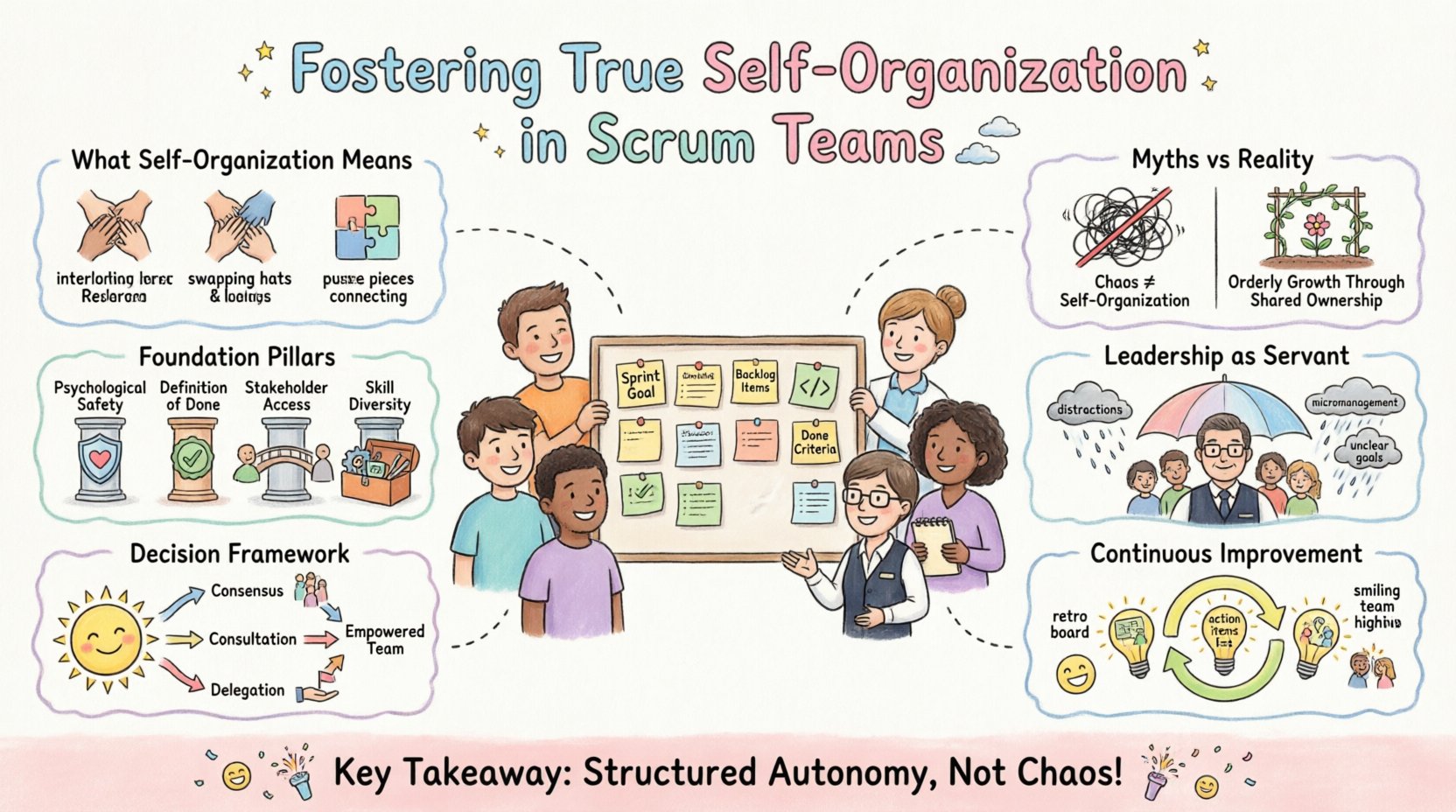
The concept of self-organization sits at the heart of the Scrum framework, yet it remains one of the most misunderstood aspects of Agile adoption. Many organizations interpret this principle as a license for chaos or a lack of management oversight. In reality, true self-organization is a structured form of autonomy where teams possess the authority to decide how best to accomplish their work. This guide explores the mechanics, requirements, and practical steps to build genuinely empowered teams capable of delivering value without constant direction.
🧩 What Self-Organization Actually Means
Self-organization is not an absence of order. It is the presence of a specific type of order that emerges from the interactions of individuals working toward a common goal. In the context of Scrum, the Development Team is responsible for creating the Increment of value. They decide who does what, when, and how. This does not mean they ignore the Product Goal; rather, it means they take ownership of the path to reach it.
When a team is truly self-organized, several key characteristics become visible:
- Shared Accountability: Success and failure are collective. No individual is solely responsible for the outcome of a Sprint.
- Dynamic Roles: While roles exist, the boundaries between them blur during execution to ensure flow. A tester might pair with a developer to fix a bug, and a developer might help clarify requirements.
- Internal Coordination: The team manages their own workload and commitments without external mandates dictating daily tasks.
- Problem Solving: Impediments are identified and removed by the team or the Scrum Master, rather than waiting for a manager to assign a fix.
This level of autonomy requires a shift in mindset from both leadership and the team members themselves. It is not an instant switch but a cultural evolution.
⚠️ Common Misconceptions About Team Autonomy
To move forward, it is necessary to identify and dismantle the myths that often block progress. Below is a comparison of what self-organization is often mistaken for versus what it actually entails.
| Misconception | Reality |
|---|---|
| Teams work without any goals or direction. | Teams work with clear Product Goals but choose the technical path. |
| There is no management or oversight. | Management shifts to servant leadership and strategic alignment. |
| Everyone decides everything together. | Decisions are made through collaboration, often leveraging expertise. |
| Self-organization means no planning. | Planning is frequent, detailed, and owned entirely by the team. |
| It is only about technical tasks. | It includes organizational impediments and process improvements. |
Understanding these distinctions prevents the common pitfall where teams feel abandoned by leadership while simultaneously lacking the structure to succeed independently.
🏗️ Building the Foundation for Autonomy
Creating a self-organized team requires a stable foundation. Without these pillars in place, autonomy can lead to fragmentation and inconsistent quality. The following elements are prerequisites for sustainable self-organization.
1. Psychological Safety
Team members must feel safe to express doubts, admit mistakes, and propose unconventional ideas without fear of retribution. If a developer fears being blamed for a bug, they will hide errors rather than fix them. Psychological safety allows for the open dialogue necessary for continuous improvement.
- Leaders must model vulnerability by admitting their own errors.
- Feedback loops should focus on the process, not the person.
- Conflict is viewed as an opportunity to understand different perspectives, not a sign of dysfunction.
2. Clear Definition of Done
Autonomy requires a shared standard of quality. If the team does not agree on what “done” means, one member might ship incomplete work while another spends days polishing. A transparent Definition of Done ensures that when the team declares a Sprint Goal achieved, the value is real and usable.
3. Access to Stakeholders
Teams cannot organize themselves if they are isolated from the people who define the value. Direct access to stakeholders allows the team to validate assumptions quickly and adjust direction based on feedback. This reduces the need for intermediaries who might distort requirements.
4. Competence and Skill Diversity
A team needs a breadth of skills to handle the work without relying on external specialists for every hurdle. This does not mean everyone is a jack-of-all-trades, but rather that the team has enough cross-functionality to move forward. T-shaped skills, where individuals have deep expertise in one area and general knowledge in others, facilitate this.
🤝 The Role of Leadership in Self-Organization
Leadership does not disappear when a team becomes self-organized; it transforms. Traditional command-and-control models stifle autonomy because they assume the leader knows the best way to execute the work. In a Scrum environment, the leader acts as a servant to the team.
Removing Impediments
The primary role of leadership shifts to clearing the path. If the team is blocked by a budget approval, a legacy system limitation, or a resource constraint, leadership must intervene to resolve it. This allows the team to focus on creation rather than navigation.
Protecting the Team
External pressures often threaten the stability of a Sprint. Leadership acts as a shield, filtering out distractions and preventing scope creep from external stakeholders during the Sprint. This protection gives the team the space to focus on their commitment.
Facilitating Growth
Leadership invests in the long-term capability of the team. This includes providing training, encouraging certification, and facilitating job rotation to build resilience. The goal is to ensure the team remains capable of self-organizing as the work evolves.
🗣️ Decision Making in a Self-Organized Environment
One of the most challenging aspects of autonomy is how decisions are made. Without a manager assigning tasks, the team must establish a decision-making framework. This framework should be explicit and agreed upon by all members.
- Consensus: Everyone agrees on the decision. This is ideal for critical changes but can be slow.
- Consultation: The decision-maker asks for input from relevant parties before deciding. This balances speed with inclusivity.
- Delegation: Specific decisions are assigned to specific roles or individuals based on their expertise.
- Voting: Used when consensus cannot be reached, though this should be a last resort to avoid division.
Transparency is key. The team should document how decisions are made and review this process periodically. If a decision goes wrong, the process is examined to see if the framework was followed or if the framework itself needs adjustment.
🔄 Continuous Improvement and Feedback
Self-organization is not static. It requires constant calibration through feedback. The Sprint Retrospective is the primary vehicle for this, but feedback loops extend beyond the Scrum events.
Metrics That Matter
Teams should track metrics that reflect their health and output, not just productivity. Useful metrics include:
- Lead Time: How long does it take from request to delivery?
- Cycle Time: How long does work stay in progress?
- Defect Rate: How many issues are found after release?
- Sprint Burndown: Are we on track to meet the Sprint Goal?
These numbers are not used to punish the team but to highlight trends. If cycle time spikes, the team investigates the cause. Is it a technical debt issue? Is there an external dependency? The team owns the data and the analysis.
The Retrospective as a Tool
The Retrospective is not just a meeting to complain. It is a structured session to inspect the team’s way of working. To make it effective:
- Rotate the facilitator role to give everyone ownership.
- Focus on one or two actionable improvements per Sprint.
- Follow up on previous improvements to ensure they were implemented.
🧱 Handling Conflict and Disagreement
When a team has the power to decide, disagreements are inevitable. Conflict is not a sign of failure; it is a sign of engagement. However, unchecked conflict can destroy team cohesion. A self-organized team needs conflict resolution mechanisms.
- Direct Communication: Encourage team members to talk to each other directly rather than going through a manager.
- Focus on Interests: Move past positions (what they want) to interests (why they want it). This often reveals common ground.
- Timeboxing: If a debate drags on, use timeboxing to force a decision or schedule a follow-up.
- Escalation: If the team cannot resolve a conflict internally, they can bring in the Scrum Master or a neutral third party to mediate, not to decide.
🌐 Scaling Self-Organization
As organizations grow, the challenge of self-organization multiplies. Multiple teams working on the same product must coordinate without creating bottlenecks. Scaling frameworks often struggle here because they introduce too much structure.
To maintain autonomy at scale:
- Product Ownership Alignment: Ensure all teams share a clear understanding of the Product Goal. The Product Owner must be visible and available to all teams.
- Shared Standards: Maintain a common Definition of Done and technical standards to ensure integration works smoothly.
- Community of Practice: Create groups for specific skills (e.g., architecture, security) where members from different teams share knowledge. This maintains consistency without central control.
- Integration Points: Establish regular integration times where teams demo their work together. This provides early feedback on integration issues.
🛠️ Practical Steps to Implement Self-Organization
Transitioning to a self-organized team is a journey. It requires deliberate action and patience. Here is a roadmap for leaders and teams looking to deepen their autonomy.
Step 1: Assess Current State
Where is the team now? Are they waiting for instructions on daily tasks? Do they feel responsible for the outcome? Use surveys or interviews to gauge the current level of empowerment. Be honest about the gaps.
Step 2: Define Boundaries
Autonomy needs boundaries to function safely. Clearly define what the team can decide independently and what requires management approval. For example, the team decides the technical implementation, but management decides the budget allocation. Clarity reduces friction.
Step 3: Empower Decision Making
Start small. Allow the team to decide how to split user stories. Let them choose the tools for their daily stand-up. Gradually increase the scope of decisions. Celebrate wins when the team makes a good decision on their own.
Step 4: Shift Management Behavior
Managers must stop asking “How is it going?” and start asking “What do you need from me?”. This simple shift changes the dynamic from reporting to supporting. Leaders should resist the urge to step in and fix problems immediately unless requested.
Step 5: Review and Adapt
Regularly check if the self-organization is working. Are decisions being made faster? Is quality improving? If the team feels overwhelmed by the responsibility, scale back the autonomy slightly and add more support. The goal is a sustainable balance.
🎯 The Impact of True Self-Organization
When a team achieves true self-organization, the results are tangible. Innovation increases because individuals are motivated to solve problems creatively. Morale improves because people feel trusted and valued. Delivery speed often accelerates because there is less waiting for approval.
However, this is not a magic solution. It requires effort from every level of the organization. The team must be willing to take responsibility. The leaders must be willing to let go of control. The organization must provide the resources and safety nets necessary for experimentation.
Ultimately, self-organization is about respect. It is a recognition that the people doing the work are the ones who understand the work best. By fostering this environment, organizations unlock their greatest potential for value creation. It is a continuous practice, not a destination. As the market changes and technology evolves, the team must remain flexible enough to adapt their way of working. This adaptability is the true measure of a mature Agile team.
📝 Summary of Key Takeaways
To summarize the path toward self-organization:
- Self-organization is structured autonomy, not chaos.
- Psychological safety is the bedrock of trust within the team.
- Leadership transforms into servant leadership focused on removing obstacles.
- Decision-making frameworks must be explicit and agreed upon.
- Metrics should be used for learning, not judgment.
- Conflict is natural and should be managed constructively.
- Scaling requires alignment on goals and standards.
- Implementation is a gradual process of empowerment.
Building a self-organized team is one of the most rewarding challenges in Agile transformation. It changes the culture of the entire organization. It moves the focus from activity to outcome, from compliance to capability. When done correctly, the team becomes a resilient engine capable of navigating uncertainty and delivering value consistently.