
Organizations frequently face a persistent challenge: the disconnect between IT capabilities and business objectives. Meetings often devolve into technical jargon on one side and vague strategic goals on the other. This misalignment creates friction, delays, and wasted resources. To bridge this gap effectively, a structured approach to communication is required. The Business Motivation Model (BMM) provides a standardized metamodel that defines the relationships between strategic intent and operational execution. By applying BMM principles to meeting structures, teams can foster clarity, ensure alignment, and drive value.
This guide explores how to utilize the Business Motivation Model to transform standard project and strategy meetings into focused, productive sessions. We will examine the core concepts, practical application steps, and the specific vocabulary needed to synchronize IT and business stakeholders.
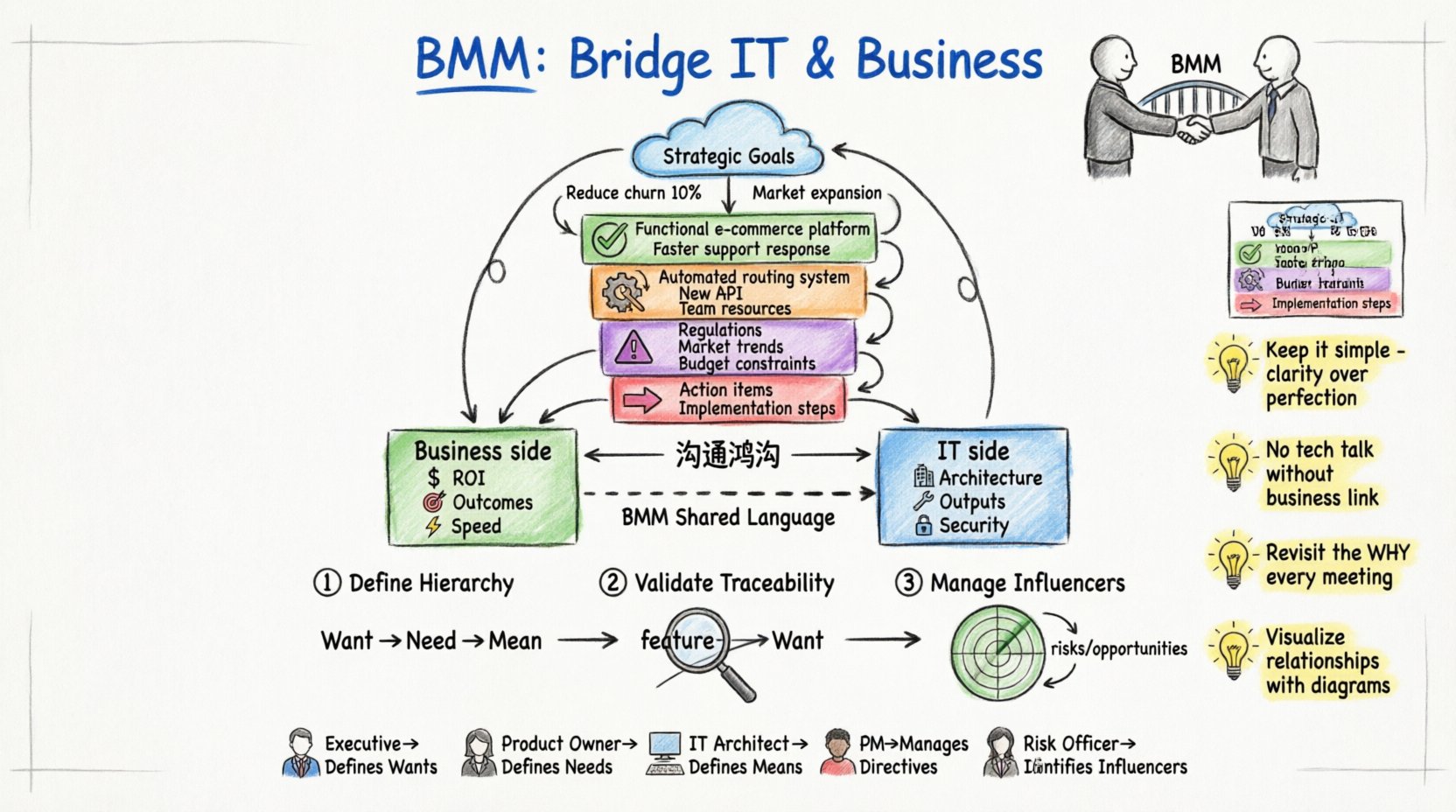
🧩 Understanding the Business Motivation Model (BMM)
The Business Motivation Model is an OMG (Object Management Group) standard designed to provide a common framework for understanding business strategy and planning. It is not a software product, nor is it a specific methodology like Agile or Waterfall. Instead, it is a metamodel—a model of models—that helps define the elements of motivation within an enterprise.
When used correctly, BMM offers a neutral language that both business leaders and IT professionals can understand. It moves the conversation away from “what technology do we need?” to “what value are we trying to achieve, and how do we measure it?”
🏗️ Core Elements of BMM
To facilitate better meetings, participants must understand the fundamental building blocks. These elements form the vocabulary of the conversation:
- Wants: What the enterprise wishes to achieve. These are high-level desires, such as market expansion or improved customer satisfaction.
- Needs: The specific requirements necessary to satisfy the Wants. If the Want is “increase sales,” the Need might be “a functional e-commerce platform.”
- Means: The capabilities, resources, or assets available to meet the Needs. This includes people, processes, and technology.
- Influencers: Factors that impact the realization of Wants or Needs. These can be external (regulations, market trends) or internal (budget constraints, staff availability).
- Directives: The specific actions or instructions given to the organization to achieve the goals. These translate strategy into execution.
By grounding discussions in these definitions, meetings avoid ambiguity. Instead of arguing over features, stakeholders discuss whether a feature satisfies a specific Need derived from a strategic Want.
🚧 The Communication Chasm Between IT and Business
Why do meetings fail? Usually, it is due to a lack of shared context. Each group operates with a different mental model of the project.
🗣️ Typical Friction Points
| Business Perspective | IT Perspective | Resulting Conflict |
|---|---|---|
| Focuses on Value and ROI | Focuses on Architecture and Feasibility | Business feels IT is a blocker; IT feels Business is unrealistic. |
| Uses Outcome-based language (e.g., “Better service”) | Uses Output-based language (e.g., “New API”) | Confusion over what constitutes success. |
| Requires speed and flexibility | Requires stability and security | Disagreement on release cycles and risk tolerance. |
| Sees budget as an investment | Sees budget as a cost center | Funding approvals become political battles. |
BMM addresses this by forcing both sides to map their perspectives to the same model. A “New API” (IT) becomes a “Capability” (BMM) that satisfies a “Need” (Business) which supports a “Want” (Strategy).
🛠️ Applying BMM to Meeting Structures
Transforming a meeting requires a deliberate change in agenda and facilitation techniques. The goal is to ensure every discussion item links back to the motivational hierarchy of the organization.
📋 Pre-Meeting Preparation
Before inviting stakeholders, the facilitator should prepare a BMM map. This document acts as the single source of truth for the meeting.
- Identify the Top-Level Want: What is the primary business outcome this meeting aims to support?
- Define the Needs: List the specific gaps or requirements that must be addressed.
- Map Current Means: Document existing capabilities that might be leveraged.
- Identify Influencers: Note any constraints, risks, or opportunities that might affect the decision.
Sharing this map with participants beforehand ensures everyone arrives with the same context. It prevents the “surprise factor” where business stakeholders discover technical constraints late in the process.
🗓️ The BMM-Informed Agenda
A standard status update meeting looks different when structured around BMM. The agenda shifts from “What did you do?” to “How does this affect our motivation?”
- Review of Strategic Goals (Wants): Start by reaffirming the overarching business objectives. Is the current work still aligned with these?
- Assessment of Capabilities (Means): Review what resources are actually available versus what was planned.
- Analysis of Influencers: Discuss any new external or internal factors that have changed since the last meeting.
- Update on Directives: Confirm that action items are still driving the intended outcome.
🔗 Bridging the Gap: A Practical Framework
Implementing this model requires a step-by-step approach. The following framework guides the facilitator through the alignment process.
Step 1: Define the Motivation Hierarchy
Begin by explicitly stating the hierarchy. Write down the strategic goal at the top. Break it down into measurable objectives. Then, identify the capabilities required to meet those objectives.
- Example:
- Want: Reduce customer churn by 10%.
- Need: Improve response time to support tickets.
- Mean: Implement automated ticket routing system.
When IT and Business agree on this chain, the technical implementation becomes a means to an end, not an end in itself.
Step 2: Validate Traceability
Every technical requirement discussed in a meeting must be traceable to a Need or a Want. If a developer proposes a feature, ask: “Which Want does this satisfy?” If the answer is unclear, the feature should be deferred or re-evaluated.
This validation process prevents scope creep. It ensures that no effort is expended on functionality that does not directly support the business motivation.
Step 3: Manage Influencers Actively
Influencers are often the hidden drivers of project failure. In meetings, these should be treated as active variables rather than background noise.
- Regulatory Changes: Does a new law affect our current architecture?
- Market Shifts: Has a competitor changed the landscape?
- Resource Availability: Do we have the staff to maintain this solution?
By listing these explicitly, the team can develop mitigation strategies rather than reacting to crises later.
📊 Mapping Concepts to Meeting Roles
Different stakeholders play different roles within the BMM framework. Understanding these roles helps assign responsibility during meetings.
| Stakeholder | BMM Role | Primary Question to Ask |
|---|---|---|
| Business Executive | Defines Wants | What is the desired outcome and why does it matter? |
| Product Owner | Defines Needs | What specific requirements must be met to achieve the Want? |
| IT Architect | Defines Means | What capabilities do we have to satisfy the Need? |
| Project Manager | Manages Directives | What actions are we taking to bridge the gap? |
| Risk Officer | Identifies Influencers | What external or internal factors could derail the plan? |
Using this mapping ensures that the right people are consulted on the right topics. It prevents technical decisions from being made by business leaders who lack context, and strategic decisions from being made by technical staff who lack market insight.
⚠️ Common Pitfalls and How to Avoid Them
Adopting a new framework often encounters resistance. Recognizing common pitfalls early helps the team navigate them.
Pitfall 1: Over-Engineering the Model
BMM can be complex. If the model becomes too detailed, it slows down meetings rather than speeding them up. The goal is clarity, not perfection.
- Solution: Keep the map simple. Focus on the top-level Wants and the immediate Needs. Drill down into details only when necessary.
Pitfall 2: Treating BMM as a Tool
Organizations sometimes try to buy software to “do” BMM. This misses the point. BMM is a conceptual framework, not a database schema.
- Solution: Use whiteboards, documents, or simple diagrams. The value lies in the discussion, not the artifact.
Pitfall 3: Ignoring the “Why”
Teams may get so focused on mapping the Needs and Means that they forget to revisit the original Want.
- Solution: Start every meeting by revisiting the top-level Want. If the context has changed, update the hierarchy before discussing tasks.
Pitfall 4: Lack of Traceability
Discussions drift into technical details without linking back to business value.
- Solution: Enforce a rule: No technical discussion without a stated link to a Need or Want. If the link cannot be made, table the item.
📏 Measuring Alignment Success
How do you know if using BMM has improved your meetings? Look for specific indicators of alignment.
- Reduced Rework: Fewer changes to requirements mid-development because needs were clearly defined upfront.
- Faster Decision Making: Decisions are made faster because the criteria for success (the Wants) are clear.
- Increased Transparency: Stakeholders can see how their contributions link to the broader strategy.
- Better Risk Management: Influencers are identified early, allowing for proactive planning.
🔄 Continuous Improvement
The Business Motivation Model is not a one-time setup. It requires maintenance as the enterprise evolves. Markets change, and strategies shift. The motivational hierarchy must be reviewed regularly.
Consider scheduling a quarterly “Motivation Review” separate from operational meetings. During this session, validate that the current Wants are still relevant. If the market has shifted, the Needs and Means must be updated accordingly.
📝 Summary of Best Practices
To ensure sustained success, keep these principles in mind for every interaction between IT and Business.
- Speak the same language: Use BMM terms consistently to avoid confusion.
- Focus on Value: Always tie technical discussions back to business value.
- Visualize Relationships: Use diagrams to show how Means support Needs to achieve Wants.
- Respect Constraints: Acknowledge Influencers as real factors that must be managed.
- Iterate: Treat the model as a living document that evolves with the organization.
🔍 Deep Dive: Influence vs. Capability
One of the most valuable distinctions BMM offers is between Influencers and Capabilities. In many meetings, these are conflated.
📌 Influencers
Influencers are factors that affect the outcome but do not directly constitute the solution. They are conditions.
- Example: A new tax law requires specific data reporting.
- Impact: This influences the design of the database schema.
🛠️ Capabilities (Means)
Capabilities are the assets used to solve the problem. They are the active agents of change.
- Example: A new reporting module within the ERP system.
- Impact: This capability satisfies the requirement imposed by the tax law.
During meetings, distinguishing these two is crucial. IT often focuses on building Capabilities. Business focuses on navigating Influencers. BMM helps IT understand the Influencers, and helps Business understand the Capabilities required.
🎯 Conclusion
Alignment between IT and Business is not a destination; it is a continuous process. By adopting the Business Motivation Model as a shared framework, organizations can create a common ground for dialogue. This approach reduces ambiguity, ensures that technical efforts are directed toward strategic value, and fosters a culture of collaboration. When meetings are structured around Wants, Needs, and Means, the conversation shifts from negotiation to problem-solving. The result is an organization that moves with purpose, clarity, and shared intent.