
Organizations today face a volatile landscape where technology shifts, regulatory changes, and market dynamics converge rapidly. Traditional IT strategy planning often focuses inward, examining internal capabilities and historical data. However, sustainable strategic alignment requires a rigorous examination of external forces. The Business Motivation Model (BMM) provides a structured framework to integrate these external factors directly into strategic decision-making processes.
This guide details how to leverage BMM principles to evaluate external influencers. By mapping market realities to business goals, organizations can ensure their IT investments support actual strategic needs rather than hypothetical scenarios. We will explore the mechanics of the model, identify specific influencer categories, and outline a practical approach for integration.
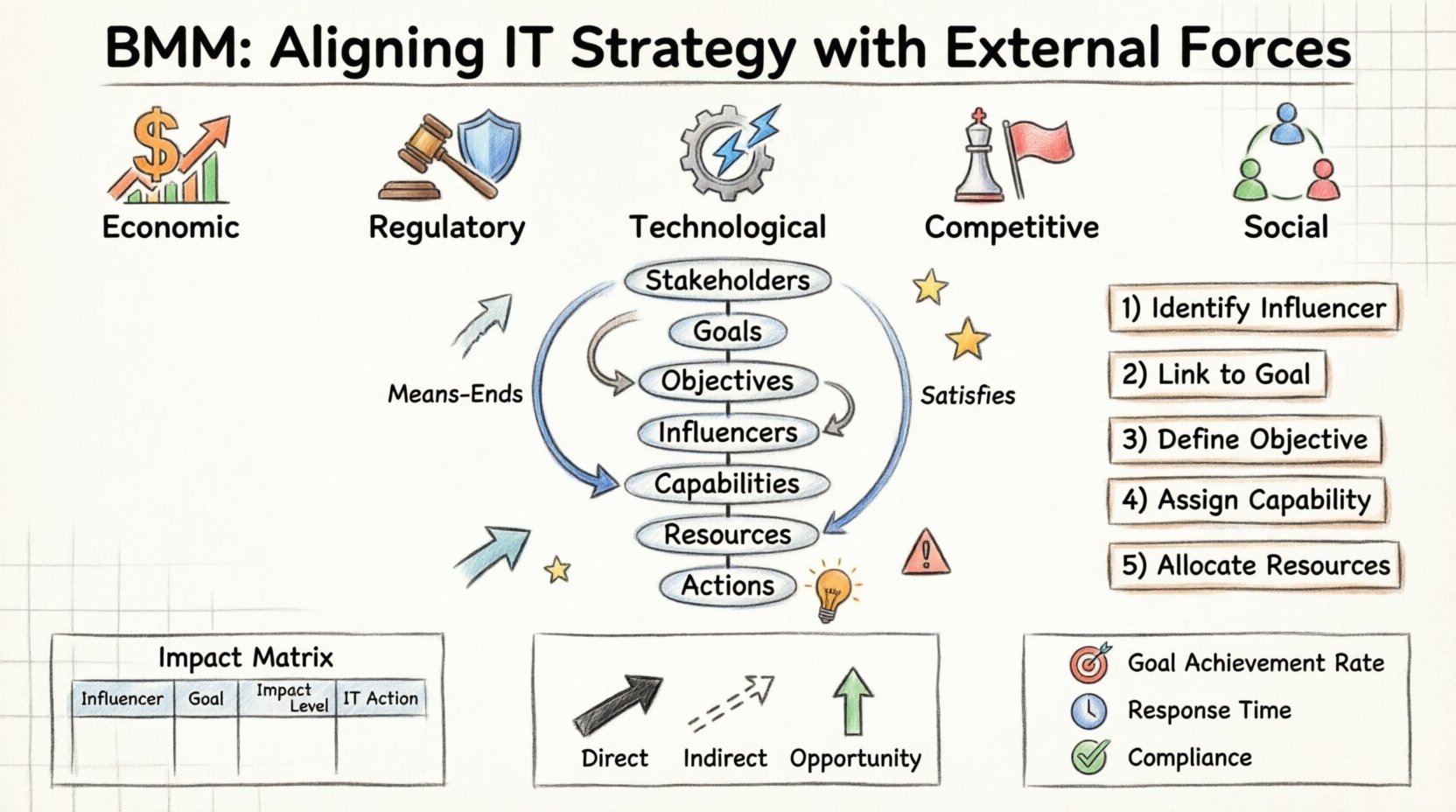
Understanding the Business Motivation Model Core 🧩
The Business Motivation Model is an industry standard for modeling organizational behavior. It breaks down the motivation behind business actions into distinct, interconnected elements. Instead of viewing strategy as a static document, BMM treats it as a dynamic system where causes lead to effects.
At the heart of this model are two primary relationships: Means-Ends and Satisfies. These relationships define how resources and actions contribute to outcomes. When applying this to IT strategy, the focus shifts from “what technology do we need” to “what business value must this technology enable?”
Key BMM Elements
- Stakeholders: Individuals or groups with an interest in the outcome.
- Goals: Desired states or conditions that the organization strives to achieve.
- Objectives: Measurable criteria used to determine if a goal has been met.
- Influencers: Factors that affect the ability to achieve goals.
- Capabilities: Abilities or skills required to perform actions.
- Resources: Assets consumed or utilized during the execution of capabilities.
- Actions: Steps taken to utilize capabilities and resources.
External Influencers sit at the top of the dependency chain. They do not change the organization directly but impact the motivation to achieve specific goals. In the context of IT, these influencers often dictate the urgency and direction of technological upgrades.
Identifying External Influencers 🌍
External Influencers are forces outside the immediate control of the organization that affect its ability to achieve its goals. In IT strategy, these are often the drivers behind change requests, budget reallocations, or architecture overhauls.
To evaluate these effectively, categorize them into specific domains. This ensures comprehensive coverage and prevents blind spots in strategic planning.
Categories of External Influencers
| Category | Description | IT Strategy Impact |
|---|---|---|
| Economic | Inflation rates, currency fluctuation, market demand shifts. | Budget constraints, ROI calculations, cloud vs. on-prem cost analysis. |
| Regulatory | Compliance laws, data privacy acts, industry standards. | Security protocols, data residency requirements, audit trails. |
| Technological | Emerging tech trends, obsolescence of legacy systems. | Migration timelines, vendor selection, skills training. |
| Competitive | Market share shifts, competitor product launches. | Feature parity, time-to-market acceleration, innovation speed. |
| Social | Workforce trends, customer behavior changes, remote work adoption. | Collaboration tools, endpoint security, user experience design. |
Each category requires a different monitoring approach. Regulatory changes are often binary (compliant or not), whereas technological trends are continuous. Understanding this distinction helps in assigning appropriate weight to each influencer during the evaluation phase.
The Flow from Influencer to IT Capability 🔄
Once identified, External Influencers must be mapped through the BMM structure to reach the IT layer. This process ensures that technology decisions are traceable back to a specific external pressure or opportunity.
The Logic Chain
- Identify the Influencer: For example, a new data privacy regulation.
- Link to Goal: This creates a Goal to “Ensure Compliance”.
- Define Objective: Set a measurable target, such as “Zero non-compliance incidents in FY2024”.
- Assign Capability: Determine the IT capability needed, such as “Data Encryption at Rest”.
- Allocate Resources: Assign budget and personnel to build the capability.
This chain prevents the common pitfall of implementing technology without a clear business justification. If an External Influencer cannot be traced to a Goal, it may not warrant immediate strategic attention. This filtering mechanism is crucial for resource optimization.
Means-Ends Relationships
In BMM, the relationship between an Action (or Capability) and a Goal is a Means-Ends relationship. The IT action is the Means; the Business Goal is the End. When evaluating External Influencers, you must assess how strongly they impact the End. Some influencers are critical path items, while others are secondary considerations.
Consider the following breakdown of relationship strength:
- Direct Influence: The influencer immediately blocks progress toward the goal.
- Indirect Influence: The influencer affects a prerequisite for the goal.
- Opportunity Influence: The influencer allows for faster or better achievement of the goal.
By quantifying this influence, IT leaders can prioritize projects that address critical blockers over those that offer marginal improvements.
Practical Evaluation Framework 🛠️
Implementing this evaluation requires a systematic approach. The following steps outline how to integrate external analysis into the strategic planning cycle without relying on proprietary tools.
Step 1: Environment Scanning
Begin by gathering data from the external environment. This involves monitoring industry reports, regulatory updates, and competitor announcements. The goal is to create a raw list of potential Influencers. At this stage, quantity is less important than breadth.
- Review annual reports of key competitors.
- Subscribe to regulatory update feeds.
- Engage with industry analyst groups.
- Conduct customer satisfaction surveys for emerging needs.
Step 2: Categorization and Tagging
Take the raw list and tag each item with the categories defined earlier (Economic, Regulatory, etc.). This allows for grouping similar pressures. For instance, multiple data privacy laws might be grouped under a single “Compliance Pressure” tag.
Step 3: Goal Alignment
Review the existing business goals. Determine which External Influencers map to which goals. If an Influencer does not map to a current goal, it may indicate a gap in the strategic vision or an area for new goal formulation.
Use a matrix to visualize this alignment:
| External Influencer | Related Goal | Impact Level (1-5) | IT Action Required |
|---|---|---|---|
| New Encryption Law | Secure Data Storage | 5 | Upgrade Storage Systems |
| Remote Work Trend | Employee Productivity | 3 | Enhance Collaboration Tools |
| Cloud Cost Volatility | Cost Optimization | 4 | Review Vendor Contracts |
Step 4: Capability Assessment
Once the required actions are identified, assess the current IT capabilities. Do you have the skills and infrastructure to address the Influencer? If there is a gap, this defines the scope of the IT strategy. This step often reveals the need for training, hiring, or partnerships.
Step 5: Continuous Review
External Influencers are not static. A regulatory change today might be resolved tomorrow, or a new competitor might emerge next quarter. The BMM evaluation must be a recurring activity, not a one-time event. Establish a quarterly review cycle for the Influencer list.
Common Pitfalls in Strategic Alignment ⚠️
Even with a solid framework, organizations often stumble when integrating external factors into IT planning. Recognizing these pitfalls early helps maintain the integrity of the strategy.
Pitfall 1: Confusing Symptoms with Causes
An increase in help desk tickets might be a symptom of a system issue, but the root cause could be an External Influencer like a new software update released by a vendor. BMM helps drill down to the root cause by linking symptoms back to Goals and Influencers.
Pitfall 2: Over-indexing on Short-term Noise
Market trends can be fleeting. Investing heavily in a technology based on a temporary hype cycle can drain resources. The evaluation framework should weigh the longevity of the Influencer. Is this a permanent shift or a temporary spike?
Pitfall 3: Ignoring Internal Constraints
While External Influencers are critical, they must be balanced against internal constraints. A regulatory requirement might demand immediate action, but if the internal capability does not exist, the risk of failure increases. The BMM model accommodates this by explicitly modeling Resources and Capabilities.
Risks and Mitigation Strategies 🛡️
Every strategic decision carries risk. When IT strategy is driven by External Influencers, the risks often relate to implementation timelines and technology suitability.
- Implementation Delay: External pressures often demand immediate action. Mitigation involves having a flexible architecture that allows for phased rollouts.
- Technology Obsolescence: Rushing to meet a regulatory deadline might lead to choosing a short-term fix. Mitigation requires evaluating the lifecycle of the chosen solution.
- Resource Strain: Multiple External Influencers hitting simultaneously can overwhelm IT teams. Mitigation involves prioritizing goals based on impact levels.
Proactive risk management ensures that the organization remains agile. By modeling these risks within the BMM, you can assign specific objectives to risk mitigation activities, ensuring they are treated with the same importance as core business goals.
Measuring Alignment Effectiveness 📈
How do you know if the evaluation process is working? You need metrics that reflect the relationship between External Influencers and Business Outcomes.
Strategic Metrics
- Goal Achievement Rate: Percentage of business goals met within the target period.
- Influencer Response Time: Average time between identifying an Influencer and initiating a strategic response.
- Compliance Adherence: Number of regulatory incidents avoided due to proactive IT changes.
Operational Metrics
- IT Spend Efficiency: Ratio of IT budget spent on strategic initiatives versus maintenance.
- Capability Utilization: How effectively current IT capabilities are used to address new Influencers.
Tracking these metrics provides feedback loops. If the Response Time is high, the evaluation process needs streamlining. If the Goal Achievement Rate is low, the alignment between Influencers and Capabilities may be weak.
Summary of Best Practices ✅
Integrating the Business Motivation Model into IT strategy evaluation transforms planning from a reactive exercise into a proactive discipline. By systematically mapping External Influencers to internal Goals and Capabilities, organizations gain clarity on where to invest.
Key takeaways for successful implementation include:
- Define Influencers Clearly: Ensure every external factor is categorized and understood.
- Trace the Lineage: Never allow an IT initiative to exist without a link to a Business Goal.
- Monitor Continuously: External environments change; your model must evolve with them.
- Focus on Capabilities: Ensure the organization has the skills to act on the strategy.
- Measure Outcomes: Use metrics to validate the effectiveness of the alignment.
Adopting this approach does not guarantee immunity from market volatility. However, it provides the structure needed to navigate uncertainty with confidence. The Business Motivation Model serves as the connective tissue between the chaotic external world and the structured internal operations of IT.