In the fast-paced world of software delivery, the ability to adapt is often more valuable than static expertise. Scrum emphasizes the importance of a team that can pull together to deliver value without external handoffs. This requires a specific type of organization: a cross-functional team. However, building this capability is not an event; it is a continuous journey of learning and unlearning. This guide explores the mechanics of developing cross-functional skills, moving beyond buzzwords to practical implementation strategies.
🧩 Defining Cross-Functionality in a Scrum Context
A cross-functional team is defined by the collective skills required to deliver a product increment. It is not merely a group of individuals working in the same room. It is a cohesive unit where the necessary competencies exist internally to take a product idea from concept to completion. In a traditional waterfall model, work often flows through departments like analysis, development, and testing. This creates handoff points that introduce delay and risk. Scrum aims to eliminate these silos.
True cross-functionality means that if the team is tasked with a specific feature, it possesses the inherent ability to design, code, test, and deploy it without waiting for approval or resources from outside the group. This structure fosters ownership. When a team owns the full lifecycle of a feature, accountability shifts from “who wrote the code” to “who delivered the value”.
🔍 The T-Shaped Professional
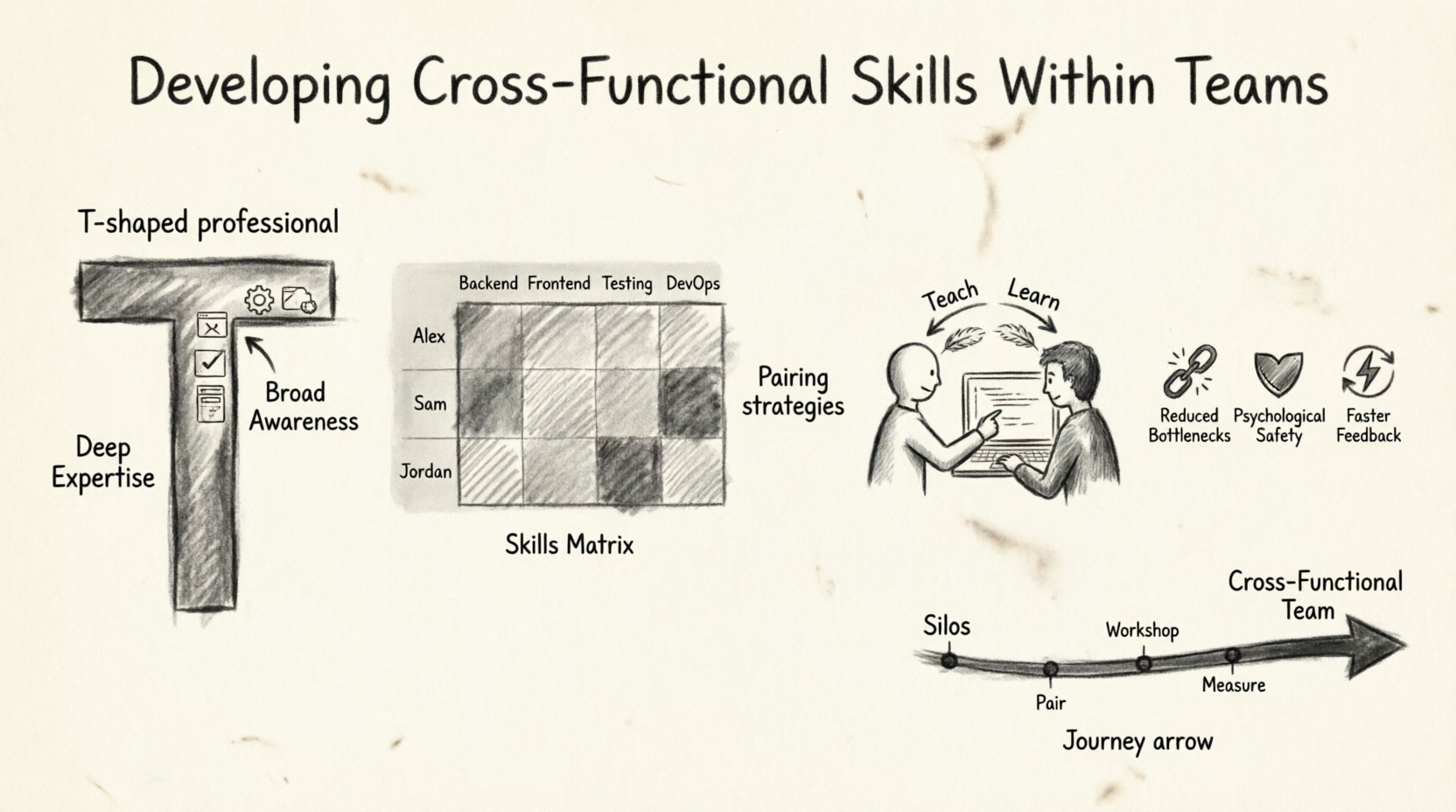
To achieve this, individual team members often strive to become T-shaped. This concept illustrates a person with deep expertise in one area (the vertical bar of the T) but also a broad understanding of many other areas (the horizontal bar of the T).
- Deep Expertise: A developer might be a backend specialist. This provides the anchor of the team’s capability.
- Broad Awareness: That same developer understands enough about frontend design, testing protocols, and database architecture to collaborate effectively and cover for others.
- Collaborative Mindset: The horizontal bar represents the willingness to share knowledge and step outside one’s comfort zone.
When a team is composed of T-shaped individuals, the collective capability expands. The vertical bars ensure quality in specialized tasks, while the horizontal bars ensure flow when bottlenecks occur.
📈 Why Invest in Cross-Functional Development?
Developing these skills requires time and effort. It slows down initial velocity as people learn new tasks. However, the long-term benefits justify the investment. Organizations that prioritize this growth see distinct advantages in stability and speed.
1. Reduced Bottlenecks
When a specific skill is concentrated in one person, that person becomes a single point of failure. If they are on vacation or focused on a different task, work halts. Cross-functional skills distribute this knowledge. If a tester is needed for a specific build but is occupied, a developer with testing knowledge can assist. This ensures the work stream remains fluid.
2. Enhanced Psychological Safety
Learning new skills within a team environment builds trust. When members help each other learn, they break down barriers of hierarchy and specialization. It signals that the team values collective success over individual heroics. This environment encourages experimentation and honest feedback, which are critical for continuous improvement.
3. Faster Feedback Loops
When roles overlap, communication becomes more natural. A developer asking a tester about a user story clarifies requirements instantly. There is no need for formal documentation or ticket updates to bridge the gap. This proximity reduces the time spent on clarification and increases the time spent on delivery.
🛠 Strategies for Skill Development
Building these capabilities does not happen by accident. It requires intentional planning and structured activities. Below are proven methods to facilitate this growth within a Scrum team.
🔄 Job Rotation and Pairing
Pairing is a well-known technique in Agile, but it serves a dual purpose here. It is not just for code quality; it is a primary vehicle for knowledge transfer.
- Pair Programming: Two developers working on one machine. One writes, one reviews. This spreads logic and syntax understanding.
- Pair Testing: A developer and a tester working together to explore a feature. The developer learns testing criteria; the tester learns system logic.
- Job Rotation: Occasionally swapping roles for a sprint. A backend developer might take on frontend tickets. This forces them to learn the constraints and nuances of that layer.
📊 The Skills Matrix
A Skills Matrix is a simple visual tool that tracks the proficiency level of each team member across various required competencies. It should be visible to everyone.
| Team Member | Frontend | Backend | Testing | DevOps | Design |
|---|---|---|---|---|---|
| Member A | Expert | Beginner | Intermediate | Beginner | Novice |
| Member B | Intermediate | Expert | Intermediate | Intermediate | Beginner |
| Member C | Beginner | Intermediate | Expert | Novice | Intermediate |
Using this matrix, the team can identify gaps. If everyone is a Beginner in DevOps, the team might schedule a dedicated workshop or assign a mentor. It makes the learning path visible and objective.
🎓 Internal Workshops and Showcases
Dedicated time for learning is essential. Teams should allocate a portion of their sprint capacity for internal education. This could take the form of:
- Tech Talks: A team member presents a deep dive on a topic they have mastered.
- Workshops: Hands-on sessions where the team solves a problem together using a new technique.
- Showcases: Demonstrating what was built in a previous sprint, allowing others to ask questions about the implementation details.
🛑 Overcoming Common Barriers
Even with the best intentions, resistance often arises. Understanding these barriers helps in navigating them effectively.
⏱ Time Pressure
Teams often face tight deadlines. Learning takes time, which feels like it conflicts with delivery. The counter-argument is that lack of cross-functionality slows delivery in the long run due to dependencies. The solution is to treat learning as a task, not a distraction. If a team commits to learning a new skill, they must protect that time in their sprint planning.
🧠 Fear of Failure
Specialists often fear losing their status if they try something new and fail. They prefer to stay in their comfort zone where they are known to be good. Leaders must model vulnerability. When a leader admits they are learning something new, it gives permission for others to do the same. Mistakes should be viewed as data points for improvement, not reasons for punishment.
🏢 Organizational Silos
Sometimes the team wants to be cross-functional, but the wider organization is not. For example, if HR hires people by specialty, or if there are separate budget lines for developers vs. testers, the team structure is constrained. In this case, the team must advocate for their needs. They can demonstrate the value of flexibility to stakeholders by showing improved flow metrics. Sometimes, a pilot project can prove the concept to management.
📏 Measuring Progress
How do you know if the team is becoming more cross-functional? Traditional velocity metrics can be misleading here. If a team learns a new skill, velocity might dip temporarily. Instead, look at qualitative and flow-based indicators.
1. Dependence Count
Track how often the team relies on external parties to complete a story. A decreasing trend indicates success. If the team can finish 100% of stories without external help, they are fully cross-functional.
2. Swarming Capability
Observe the team during a crisis or a difficult sprint. Can multiple people work on the same story simultaneously? Can they swarm a bug without waiting for a specific “fixer”? High swarming capability is a strong sign of shared knowledge.
3. Retrospective Insights
Ask the team directly in retrospectives. Use questions like:
- “Did we have any blockers this sprint that could have been solved internally?”
- “Did anyone try a task outside their usual scope? How did it go?”
- “Did we feel stuck waiting for someone specific?”
👥 The Role of Leadership
The Scrum Master and Product Owner play distinct roles in this journey. They are not just facilitators; they are enablers of this culture.
🔨 The Scrum Master’s Responsibility
The Scrum Master acts as a coach. They facilitate the identification of skills gaps. They protect the team from external interruptions that prevent learning. They also ensure that the team is not overworked to the point where there is no energy for development. They might introduce concepts like “guilds” or communities of practice if the team needs broader exposure.
🎯 The Product Owner’s Responsibility
The Product Owner must understand the implications of tasks. When assigning work, they should not just dump tickets based on who is free. They should consider the growth opportunity. If a story is high priority, can it be assigned to someone who needs to learn that skill? The PO must balance business value with team development. They should encourage the team to self-organize the work, allowing them to pick tasks that stretch their abilities.
🧱 Scaling Cross-Functionality
As organizations grow, teams multiply. Maintaining cross-functionality across multiple groups becomes harder. However, the principles remain the same.
- Communities of Practice: Create groups that span multiple teams to share knowledge. A “Testing Community” might meet weekly to discuss new techniques.
- Shared Backlogs: When teams work on the same product area, they might share a backlog. This forces interaction and shared understanding of the domain.
- Rotation Programs: Allow team members to move between teams for a period. This spreads culture and skills across the organization.
🧭 Navigating the Journey
This path is not linear. There will be days when specialization feels more efficient. There will be moments when the team feels spread too thin. This is normal. The goal is not to make everyone an expert in everything. The goal is to create a safety net where knowledge is shared, and work can flow even when individual circumstances change.
Start small. Pick one skill to improve in the next sprint. Identify who can mentor and who can learn. Document the progress. Celebrate the small wins. When a developer successfully completes a test case without help, acknowledge that. When a tester writes a unit test, recognize that. These moments build the foundation of a resilient team.
Remember that cross-functionality is about more than just technical skills. It is about empathy. It is about understanding the constraints of your colleagues. It is about realizing that when you help someone else succeed, you strengthen the entire unit. This mindset shift is the most critical component of the process.
💡 Key Takeaways for Implementation
To summarize the actionable steps for your team:
- Audit your skills: Create a matrix to see where you stand.
- Protect learning time: Schedule it in sprint planning.
- Pair often: Make it a habit, not an exception.
- Measure flow: Track dependencies and swarming ability.
- Culture first: Foster psychological safety before expecting technical growth.
- Leadership support: Ensure management understands the value of the dip in velocity during the learning phase.
By committing to this approach, you build a team that is not just productive today, but adaptable for tomorrow. The market changes, technologies shift, and requirements evolve. A team with deep, shared skills is the only one capable of surviving and thriving in that environment. It transforms the team from a collection of individuals into a single, powerful organism capable of delivering value continuously.
Begin the conversation in your next sprint planning. Ask your team: “What is one skill we can all learn together in the next month?” The answer will set the direction for your team’s evolution.