
Chief Information Officers operate at the intersection of technology and strategy. For a CIO, the challenge is not merely managing infrastructure but demonstrating tangible value to the broader organization. The Business Motivation Model (BMM) provides a structured framework to bridge this gap. It allows leaders to translate high-level vision into specific, actionable, and measurable outcomes. This guide explores the mechanics of defining objectives within this framework, ensuring clarity and accountability across IT and business units.
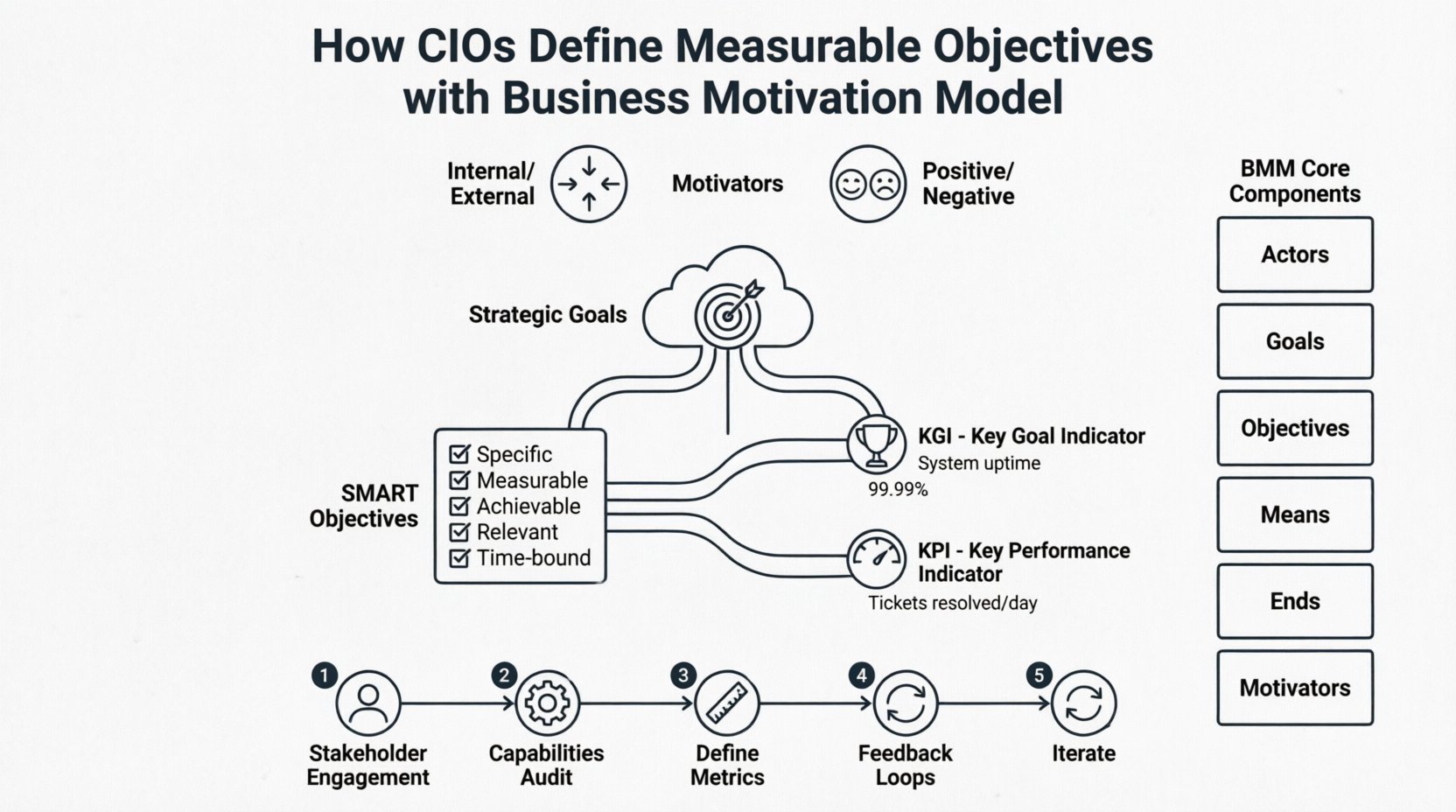
🧩 Understanding the Business Motivation Model Context
The Business Motivation Model is a standard for business architecture. It offers a way to model the what, why, and how of an organization without getting bogged down in technical implementation details. For a CIO, adopting this model means shifting focus from project delivery to outcome realization.
At its core, BMM distinguishes between the actors who drive change, the goals they wish to achieve, and the mechanisms used to measure success. This separation is vital. Often, IT teams focus on output (e.g., “deployed the server”) rather than outcome (e.g., “reduced latency by 20%”). BMM corrects this misalignment by forcing a linkage between effort and impact.
Key components relevant to CIOs include:
- Actors: The people or organizations involved (e.g., CIO, Development Team, Stakeholders).
- Goals: Desired states or results the organization wants to reach.
- Objectives: Specific, measurable steps taken to achieve a goal.
- Means: The resources or actions used to reach the objective.
- Ends: The ultimate result or value delivered.
- Motivators: Factors that drive behavior (e.g., cost reduction, regulatory compliance).
By mapping these elements, a CIO creates a narrative that connects technical tasks to business value. This narrative is essential for budget justification and strategic planning.
📏 The Anatomy of a Measurable Objective
Defining an objective is not about setting a target; it is about defining the metric that proves the target is met. In the context of BMM, an objective must be traceable back to a goal. If a CIO sets a goal of “Improve System Reliability,” the objective must specify what “reliability” looks like numerically.
Here is the distinction between a goal and an objective within this model:
| Component | Description | Example for CIO |
|---|---|---|
| Goal | A general desired state or direction. | Enhance customer experience through digital platforms. |
| Objective | A specific, measurable, achievable, relevant, and time-bound (SMART) target. | Reduce page load time to under 2 seconds by Q4. |
| Motivator | The reason behind the goal. | Competitive pressure to provide faster services. |
| Indicator | The data point used to measure progress. | Average latency in milliseconds. |
When CIOs define objectives, they often struggle with ambiguity. Terms like “optimize,” “improve,” or “modernize” are vague. BMM demands precision. An objective is only valid if it can be measured. This requires establishing a baseline before setting the target.
🤝 Aligning IT Strategy with Business Goals
One of the primary functions of the CIO is alignment. Technology exists to serve the business, not the other way around. The Business Motivation Model facilitates this by creating a visual and logical map of dependencies.
1. Identifying Strategic Motivators
Before defining objectives, a CIO must understand the drivers. Motivators can be internal or external. Internal motivators include cost efficiency or employee satisfaction. External motivators include market trends or regulatory requirements.
Common motivators in the IT sector include:
- Compliance: Meeting data privacy laws (e.g., GDPR, CCPA).
- Security: Reducing vulnerability exposure.
- Agility: Speed of time-to-market for new features.
- Cost: Optimizing cloud spend or infrastructure overhead.
2. Decomposing High-Level Goals
A strategic goal is too broad to manage directly. BMM supports decomposition. A high-level goal is broken down into sub-goals, and eventually into specific objectives. This ensures that every task contributes to the larger picture.
For example:
- Strategic Goal: Become a leader in cloud-native architecture.
- Sub-Goal: Migrate legacy monolithic applications to microservices.
- Objective: Complete migration of three core systems by June 30th.
- Key Performance Indicator (KPI): Number of successful deployments per week.
📊 Measurement Frameworks: KGI vs. KPI
Measurement is the backbone of the Business Motivation Model. CIOs must understand the difference between Key Goal Indicators (KGI) and Key Performance Indicators (KPI). Confusing these leads to misaligned incentives.
KGI (Key Goal Indicator): This measures the achievement of a goal. It is outcome-oriented. If the goal is “Increase Revenue,” the KGI is the actual revenue figure.
KPI (Key Performance Indicator): This measures the performance of the process that leads to the goal. It is activity-oriented. If the goal is “Increase Revenue,” a KPI might be “Number of sales calls made” or “Website traffic volume”.
In the context of IT objectives, a CIO must track both. A KPI might show that the team is working hard (high activity), but a KGI shows that the business value is not being realized (low outcome).
Table: Distinguishing KGI and KPI in IT
| Feature | Key Goal Indicator (KGI) | Key Performance Indicator (KPI) |
|---|---|---|
| Focus | End result / Outcome | Process / Activity |
| Timeframe | Long-term | Short-term / Real-time |
| Example | System uptime of 99.99% | Number of tickets resolved per day |
| Relevance | Directly impacts the goal | Indirectly supports the goal |
🗺️ Implementation Roadmap for CIOs
Implementing the Business Motivation Model requires a methodical approach. It is not a one-time exercise but a continuous cycle of planning, measuring, and adjusting. The following steps outline how a CIO can operationalize this framework.
Step 1: Stakeholder Engagement
The first step is to gather input from business leaders. Objectives cannot be defined in a vacuum. The CIO must interview department heads to understand their pain points and targets. This ensures the IT objectives support the actual business needs.
Step 2: Cataloging Assets and Capabilities
Once goals are understood, the CIO must assess current capabilities. What infrastructure exists? What skills are available in the team? What are the budget constraints? This assessment forms the “Means” in the BMM framework.
Step 3: Defining the Metrics
For every objective, define the metric. This includes the formula for calculation, the data source, and the reporting frequency. Ambiguity in data collection is a common failure point. If the data is not accessible, the objective cannot be measured.
Step 4: Establishing Feedback Loops
Measurement is useless without feedback. Regular review cycles (monthly or quarterly) should be established. During these reviews, the CIO compares actual performance against the defined objectives. Deviations must be analyzed to understand root causes.
Step 5: Adjustment and Iteration
Business environments change. An objective that was relevant last year might be irrelevant today. The BMM framework allows for flexibility. If a motivator changes (e.g., a new regulation), the goals and objectives must be recalibrated.
🚧 Common Pitfalls and Challenges
Even with a robust framework, CIOs face challenges. Understanding these pitfalls helps in avoiding common traps that derail strategic alignment.
1. Over-Measurement
Collecting too much data can obscure the signal. CIOs should focus on the vital few metrics that truly drive value. If a dashboard requires 50 pages to understand, it is likely too complex.
2. Siloed Objectives
IT objectives often conflict with other departments. Sales might want speed, while Security wants caution. The BMM model helps visualize these conflicts. The CIO must negotiate trade-offs and ensure objectives are balanced.
3. Static Goals
Setting an objective and never looking at it again is a waste of time. Technology evolves rapidly. Goals set for a fiscal year may need mid-year adjustments to remain relevant.
4. Ignoring Cultural Factors
Technology is adopted by people. If the team does not understand the “why” behind the objectives, execution will suffer. Communication is key. The CIO must articulate how individual tasks contribute to the organizational goal.
🔍 Deep Dive: Motivator Types
Understanding the type of motivator driving an objective is crucial for prioritization. Motivators generally fall into two categories: Internal and External.
- Internal Motivators: Driven by the organization’s own policies and needs. Examples include reducing operational costs or improving employee productivity.
- External Motivators: Driven by market forces or regulations. Examples include new compliance laws or competitor actions.
Additionally, motivators can be classified as Positive (opportunities) or Negative (threats). A CIO should balance these. Relying solely on negative motivators (fear of failure) can lead to a defensive culture. Positive motivators (growth potential) foster innovation.
Here is a breakdown of how these motivators influence objective setting:
- Positive Internal: “We want to increase market share by 10%.” → Objective: Launch new feature set.
- Negative Internal: “We must reduce technical debt.” → Objective: Refactor legacy code.
- Positive External: “Customers demand mobile access.” → Objective: Build mobile app.
- Negative External: “Regulators fine non-compliant firms.” → Objective: Audit data privacy controls.
📈 Sustaining the Model Over Time
Implementing the Business Motivation Model is not a project with an end date. It is a discipline. To sustain it, CIOs must embed it into the governance structure of the IT department.
Regular governance meetings should review the BMM map. This ensures that new projects are vetted against existing objectives. If a new project does not align with a defined goal, it should be questioned. This prevents resource dilution.
Furthermore, training is essential. Project managers and architects should understand the language of BMM. They need to know how to write requirements that link back to motivators and goals. This creates a shared vocabulary across the organization.
🛠️ Practical Application: A Scenario
Consider a scenario where a CIO needs to improve disaster recovery capabilities. Using BMM, the process looks like this:
- Actor: CIO and Infrastructure Team.
- Motivator (Negative External): Risk of data loss due to cyberattacks.
- Goal: Ensure business continuity during a security incident.
- Objective: Achieve a Recovery Time Objective (RTO) of 4 hours for critical systems.
- Means: Implement automated backup systems and redundant sites.
- Indicator (KGI): Time taken to restore service during a drill.
- Indicator (KPI): Percentage of systems with active backups.
This structure provides clarity. The team knows exactly what success looks like. It moves the conversation from “we need backups” to “we need an RTO of 4 hours.” This specificity drives better decision-making regarding budget and technology selection.
🔗 Integrating with Enterprise Architecture
The Business Motivation Model does not exist in isolation. It integrates with Enterprise Architecture (EA). EA provides the structural view of the organization, while BMM provides the motivational view. Together, they form a complete picture.
When defining objectives, CIOs should reference the architectural roadmaps. If the architecture dictates a move to cloud, the objectives should reflect cloud-native capabilities. If the architecture prioritizes data governance, the objectives should focus on data quality.
This integration ensures that the “how” (Architecture) supports the “why” (Motivation). Without this link, technology investments may become obsolete quickly. BMM ensures that architectural decisions remain aligned with business intent.
📝 Summary of Best Practices
To maximize the effectiveness of the Business Motivation Model, CIOs should adhere to these principles:
- Clarity: Use precise language. Avoid jargon where possible.
- Traceability: Ensure every objective links back to a strategic goal.
- measurability: Every objective must have a defined metric.
- Visibility: Make the model visible to stakeholders. Transparency builds trust.
- Flexibility: Be willing to adjust objectives as the business environment shifts.
- Collaboration: Involve business partners in the definition process.
🌟 Final Thoughts on Strategic Alignment
The role of the CIO is evolving. It is no longer just about keeping the lights on. It is about driving business value. The Business Motivation Model offers a proven path to achieve this. By defining measurable objectives, CIOs can demonstrate the impact of technology in terms that the board and executive team understand.
This framework reduces ambiguity and increases accountability. It transforms IT from a cost center into a strategic partner. The journey requires discipline and consistent effort, but the result is a technology organization that is responsive, effective, and aligned with the broader mission of the enterprise.
Success is not defined by the technology deployed, but by the value realized. The Business Motivation Model provides the lens through which that value can be seen, measured, and improved upon continuously.