In the modern enterprise landscape, technology is not merely a support function; it is the backbone of operational continuity and growth. However, aligning IT initiatives with broader business goals often proves difficult. Many organizations struggle with disjointed strategies where technology investments do not translate into tangible business value. To address this, the Business Motivation Model (BMM) offers a structured approach to understanding the motivations behind business decisions. By integrating BMM frameworks, organizations can construct IT strategies that are robust, adaptable, and deeply rooted in organizational intent. This guide explores how to leverage BMM to build resilient IT strategies that withstand market shifts and internal changes 🔄.
Understanding the Business Motivation Model 🧠
The Business Motivation Model is a conceptual framework designed to capture the motivations and actions of a business entity. It provides a common language for describing the reasons behind business decisions. Unlike traditional planning models that focus solely on processes, BMM focuses on the why and the what before the how. This distinction is critical for IT strategy. When IT leaders understand the underlying motivations, they can prioritize projects that deliver actual value rather than just technical upgrades.
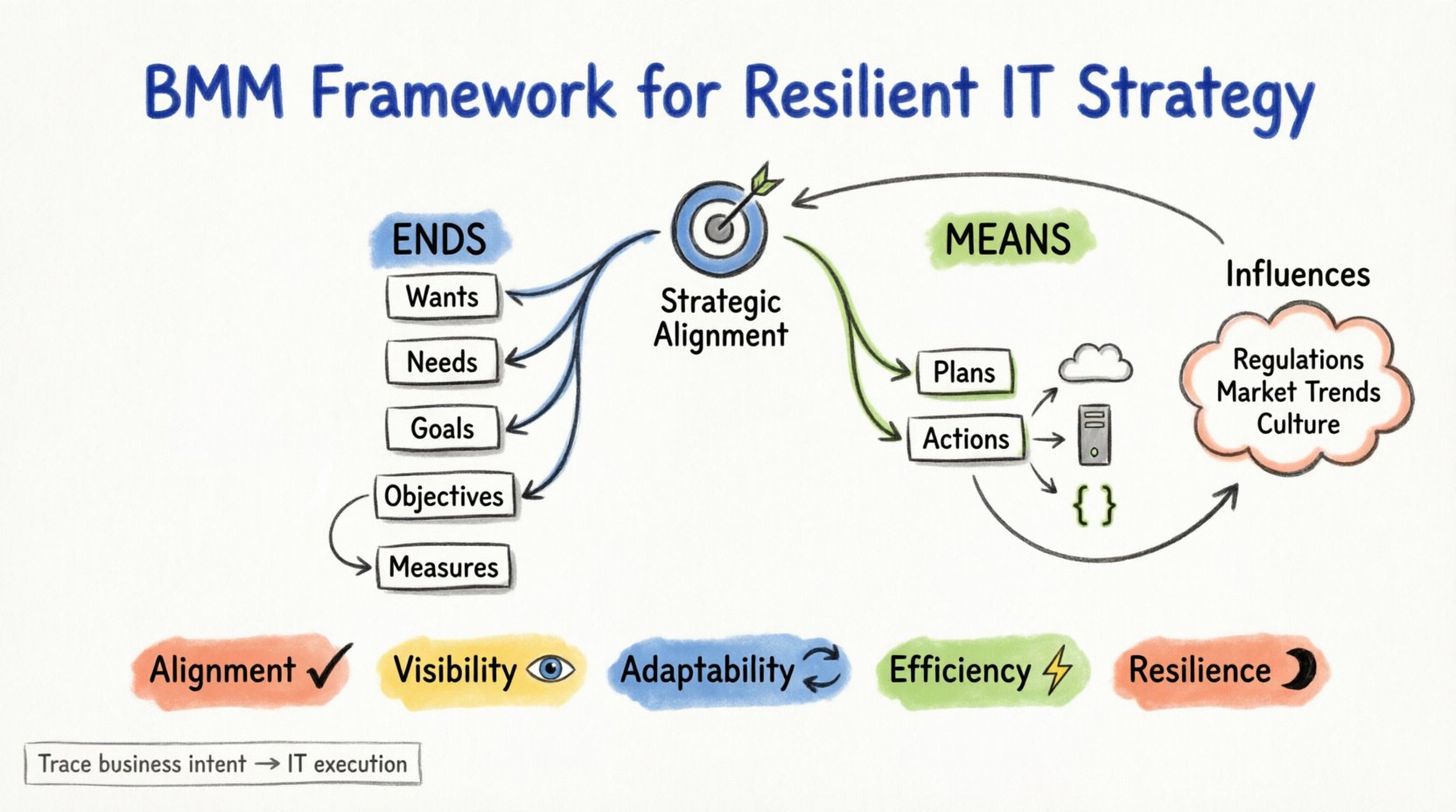
At its core, BMM distinguishes between the Means and the Ends. This separation allows for flexibility. The Ends represent the desired outcomes, while the Means represent the actions taken to achieve them. In an IT context, the Ends might be customer satisfaction or revenue growth, while the Means could be cloud migration or software development. Understanding this relationship ensures that every line of code or infrastructure change serves a specific strategic purpose.
Key Components of the Framework 🏛️
To utilize BMM effectively, one must understand its ontology. The model consists of several interconnected elements:
- Wants: These are the desires or needs of the business stakeholders. They define what the organization hopes to achieve.
- Needs: These are the requirements that must be met to satisfy the Wants. In IT, a Need might be increased system availability or faster data processing.
- Objectives: Specific, measurable targets derived from Wants. Objectives provide clarity on success.
- Goals: Higher-level aspirations that guide the Objectives. They are often broader and longer-term.
- Measures: Metrics used to track progress toward Goals and Objectives. Without measures, success is subjective.
- Plans: High-level strategies designed to achieve Goals. Plans outline the approach without detailing every step.
- Actions: Specific tasks executed to implement Plans. These are the operational activities.
- Influences: Internal or external factors that affect the business environment. These can be market trends, regulatory changes, or internal culture.
The Anatomy of Strategic Alignment 🎯
Resilience in IT strategy begins with alignment. When IT projects are disconnected from business motivations, resources are wasted, and the organization becomes vulnerable to market shifts. BMM facilitates alignment by creating a traceable link from high-level business vision down to specific IT tasks.
Means vs. Ends Relationship
The most powerful aspect of BMM is the Means-Ends relationship. In traditional IT planning, teams often focus on the Means (the technology) first. They buy servers, buy licenses, or build platforms without fully validating the End (the business value). BMM reverses this flow. It starts with the Ends.
Consider a scenario where a business wants to improve customer retention. The End is retention. The Means might be a new customer support portal. BMM ensures that the decision to build the portal is directly tied to the retention goal. If the portal does not contribute to retention, the project should be re-evaluated. This discipline prevents technology drift.
Directives and Constraints
Every business operates within constraints. Regulations, budget limits, and technical debt act as Directives or Influences in the BMM framework. A resilient strategy acknowledges these constraints early. By mapping them explicitly, IT leaders can design solutions that comply with rules without stifling innovation. For example, if a directive states that data must remain within specific geographic boundaries, IT architecture can be designed to enforce this at the database level rather than as an afterthought.
Why Resilience Matters in IT 🛡️
Resilience is the ability of a system to recover quickly from difficulties. In IT strategy, this means the ability to pivot when business conditions change. A rigid strategy breaks when the market moves. A resilient strategy bends but does not break. BMM supports resilience by making the links between business intent and technical execution visible. When a business goal changes, the model allows leaders to trace exactly which IT Actions and Plans need to be adjusted.
Adapting to Change
Change is the only constant in the technology sector. New competitors emerge, regulations shift, and customer behaviors evolve. A BMM-based strategy treats these changes as Influences. When an Influence is detected, the model provides a mechanism to assess its impact on Goals and Objectives.
For instance, if a new data privacy regulation is introduced, it acts as an External Influence. The BMM model allows the organization to update its Measures and Directives immediately. IT teams can then adjust their Actions to ensure compliance. This agility is the definition of resilience. It moves the organization from reactive fire-fighting to proactive adaptation.
Resource Optimization
Resilience also involves resource management. Organizations often have limited budgets and talent. BMM helps prioritize these resources by highlighting which Actions directly contribute to which Goals. Resources are allocated to the highest-value Means. This ensures that even during economic downturns, the critical paths to business survival are funded. It prevents the dilution of effort across too many low-priority projects.
Integrating BMM into IT Architecture 🏗️
Integrating the Business Motivation Model into IT architecture requires a shift in mindset. It is not just a documentation exercise; it is a governance mechanism. The following steps outline how to embed this framework into the strategic planning process.
Step 1: Define Business Intent
Before discussing technology, define the business intent. Gather stakeholders to articulate their Wants and Needs. Document these clearly. Avoid technical jargon at this stage. Focus on the outcome. For example, instead of saying “We need a faster database,” say “We need to reduce transaction latency to improve customer satisfaction.”
Step 2: Map Goals to Objectives
Break down the high-level Goals into measurable Objectives. Ensure every Objective has a corresponding Measure. This creates a baseline for success. If an Objective cannot be measured, it is not actionable. IT teams need these metrics to know when they have succeeded.
Step 3: Identify Means and Plans
Once the Ends are defined, identify the Means. These are the IT solutions required. Develop Plans that outline how these Means will be deployed. Ensure that every Plan traces back to a specific Objective. This traceability is the core of the strategy.
Step 4: Assign Actions
Finally, define the Actions. These are the specific tasks assigned to teams. Assign owners and timelines. The Actions are the daily work, but they are guided by the higher-level Plans.
The table below illustrates how BMM elements translate into IT Strategy components.
| BMM Element | IT Strategy Equivalent | Example |
|---|---|---|
| Wants | Business Vision | Expand market share in the APAC region. |
| Needs | Capability Gaps | Need multi-region support for low latency. |
| Objectives | KPIs | Reduce latency to under 50ms in APAC. |
| Goals | Strategic Pillars | Global Infrastructure Expansion. |
| Plans | Architectural Roadmaps | Deploy edge computing nodes. |
| Actions | Project Tasks | Configure CDN nodes in Singapore. |
| Influences | Constraints & Risks | Data sovereignty laws in Japan. |
Managing Influences and Dependencies ⚖️
A resilient strategy must account for dependencies. In BMM, these are often categorized as Influences. They can be positive (enablers) or negative (blockers). Understanding these helps IT leaders anticipate risks before they become issues.
Internal Influences
Internal influences include organizational culture, budget cycles, and talent availability. For example, a skills gap in a specific technology area might slow down a Plan. Recognizing this early allows the organization to invest in training or adjust the timeline. Ignoring internal influences leads to unrealistic plans that fail upon execution.
External Influences
External influences include market trends, competitor actions, and regulatory changes. A resilient IT strategy monitors these factors continuously. If a competitor launches a new feature, the Influence is recorded. The organization then assesses if its Goals need adjustment. This external awareness prevents the organization from building the wrong technology for the wrong market.
Measuring Success and Adaptation 📏
Without measurement, there is no improvement. The BMM framework places a heavy emphasis on Measures. These are not just vanity metrics; they are indicators of strategic health. In IT, this means tracking performance against the objectives defined in the model.
Feedback Loops
Establishing feedback loops is essential. Data collected from Measures should flow back into the planning process. If an Objective is missed, the Plan must be revised. This creates a cycle of continuous improvement. It ensures that the strategy evolves as the business evolves.
Review Cadence
Strategies should not be static documents. They require regular review. A quarterly review cadence is often sufficient to check alignment. During these reviews, stakeholders revisit the Wants and Needs. They verify if the current IT Actions are still driving the desired Ends. If the business has pivoted, the IT strategy must pivot with it.
Common Pitfalls to Avoid ⚠️
While BMM is powerful, implementation can be challenging. Organizations often stumble when applying the framework. Awareness of these pitfalls helps ensure success.
- Over-Documentation: Creating massive documents that no one reads. Keep the model lightweight and accessible.
- Lack of Stakeholder Buy-in: If business leaders do not own the Wants and Goals, the model will fail. IT cannot do this alone.
- Ignoring Influences: Focusing only on the plan and ignoring external risks leads to brittle strategies.
- Confusing Plans with Actions: Plans are high-level; Actions are specific. Confusing them leads to micromanagement or lack of direction.
- Static Metrics: Measures must change as the business changes. Fixed KPIs can become obsolete quickly.
Future-Proofing Your Strategy 🔮
The landscape of technology continues to evolve. Artificial intelligence, quantum computing, and decentralized systems are emerging. A BMM-based approach prepares an organization for these changes. Because the focus is on business motivation rather than specific technology, the strategy remains valid even as the tools change.
When a new technology emerges, it is evaluated as a potential Means. Does it help achieve the Ends? If yes, it is adopted. If no, it is ignored. This discipline prevents chasing every new trend. It keeps the organization focused on value creation.
Furthermore, BMM supports scalability. As the organization grows, the number of Goals and Objectives increases. The model provides the structure to manage this complexity. It ensures that new departments or divisions remain aligned with the core business intent. This alignment is crucial for maintaining resilience during periods of rapid expansion.
Implementing the Framework Today 🚀
Adopting the Business Motivation Model requires commitment. It is not a quick fix. It is a cultural shift. Start small. Pick one strategic initiative and apply the BMM framework to it. Define the Wants, map the Goals, and track the Measures. Learn from the process. Then expand to other areas of the organization.
Training is also vital. Teams need to understand the vocabulary of BMM. They need to know how to articulate their work in terms of business value. This shared language improves communication between IT and business units. It reduces friction and accelerates decision-making.
Ultimately, building resilient IT strategies is about clarity. It is about knowing exactly why you are doing what you are doing. The Business Motivation Model provides the structure to achieve that clarity. By grounding technology in business motivation, organizations build a foundation that can support growth, withstand disruption, and deliver lasting value.
Summary of Strategic Benefits ✅
To recap, integrating BMM into IT strategy offers several distinct advantages:
- Alignment: Ensures IT work directly supports business goals.
- Visibility: Makes the link between actions and outcomes transparent.
- Adaptability: Allows for quick pivots when business conditions change.
- Efficiency: Focuses resources on high-value initiatives.
- Resilience: Creates a robust framework that withstands market volatility.
By adhering to these principles, organizations can move beyond reactive IT management. They can build systems that drive the business forward. The path to resilience is clear. It lies in understanding the motivation behind the work and ensuring that every technical decision serves that motivation. This is the essence of a resilient IT strategy.
Start mapping your motivations today. Define your Ends. Identify your Means. Measure your progress. And build a strategy that stands the test of time.