
Organizational strategy often stalls not because of a lack of vision, but due to a disconnect between those who define the vision and those who execute it. When different departments, leadership tiers, or external partners operate with divergent understandings of purpose, alignment becomes impossible. The Business Motivation Model (BMM) offers a structured ontology to clarify these distinctions. By standardizing the language used to describe strategic intent, organizations can navigate complex negotiations and arrive at a shared understanding. This guide explores how to leverage this model to foster genuine agreement among stakeholders without resorting to forced directives.
Understanding the Core of Business Motivation Model 🧩
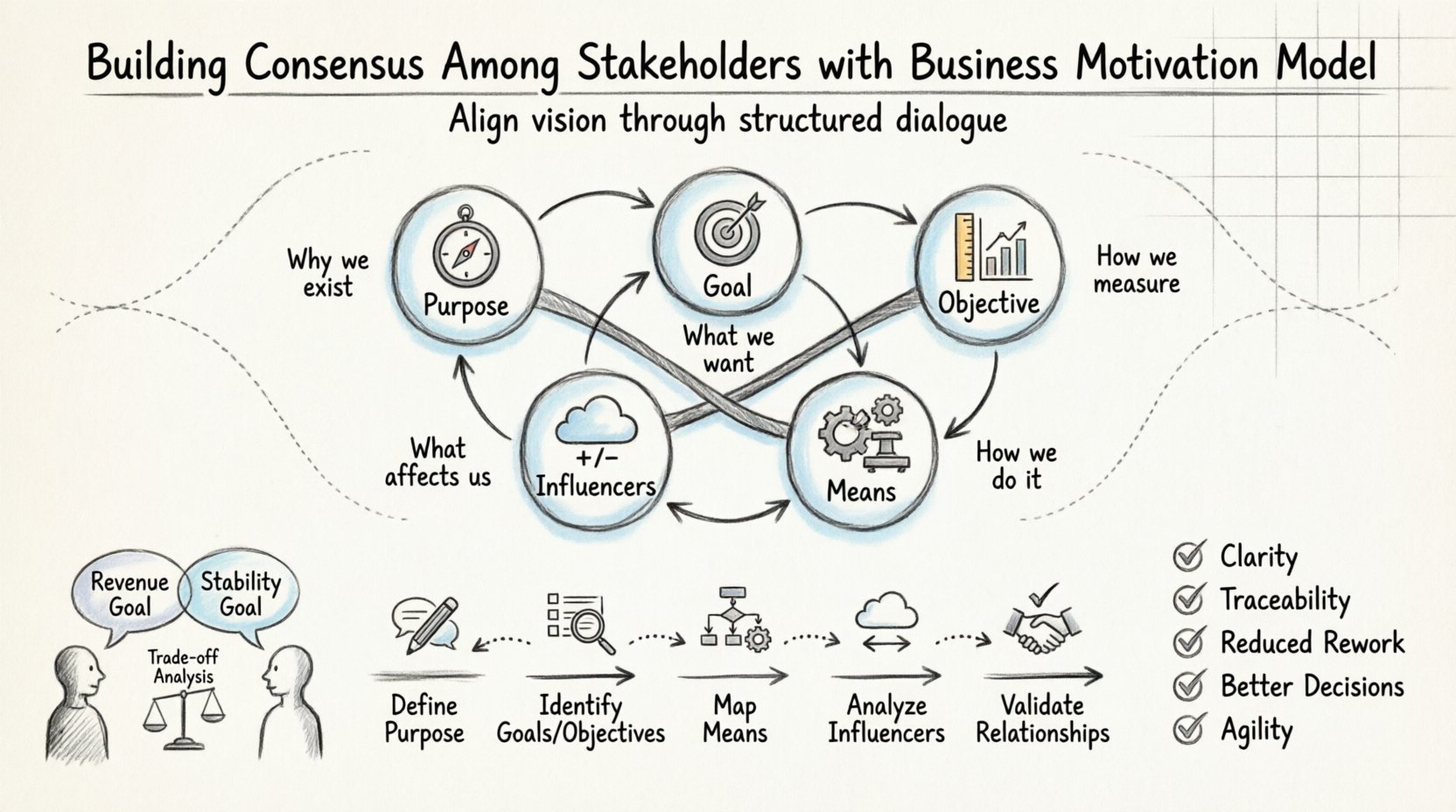
The Business Motivation Model provides a framework for representing the factors that influence business behavior. It is not merely a diagramming tool but a semantic structure that distinguishes between what an organization wants to achieve and the means used to achieve it. When stakeholders disagree, it is often because they are conflating different categories of motivation. Clarifying these categories is the first step toward consensus.
At the heart of the model are specific elements that describe motivation:
- Purpose: The broadest level of motivation. It defines the “why” of the organization or a specific unit within it.
- Goal: A specific outcome that the organization seeks to achieve. Goals are often qualitative and long-term.
- Objective: A measurable target used to verify if a goal has been met. Objectives are quantitative and time-bound.
- Means: The actions, resources, or capabilities required to achieve goals and objectives.
- Influencers: Factors that impact the achievement of goals or objectives, either positively or negatively.
Using these definitions consistently allows teams to move from vague aspirations to concrete commitments. When a stakeholder says they want “better performance,” the model forces a question: Is that a Goal (strategic intent) or an Objective (measurable target)? This distinction alone resolves many debates about resource allocation and success criteria.
The Challenge of Stakeholder Alignment 💔
Disagreement among stakeholders is natural. Different roles prioritize different outcomes. IT teams focus on stability and architecture, while sales teams prioritize speed and revenue. Marketing may emphasize brand perception, while operations prioritize efficiency. Without a structured approach to reconcile these views, projects suffer from scope creep, conflicting priorities, and delayed delivery.
Common sources of friction include:
- Hidden Assumptions: Stakeholders assume everyone understands the underlying purpose, but they do not.
- Conflicting Definitions: One department defines “customer satisfaction” as speed, while another defines it as accuracy.
- Resource Competition: Multiple goals require the same limited means (budget, personnel, time).
- Risk Perception: Stakeholders view the same Influencers differently; one sees a threat, another sees an opportunity.
The Business Motivation Model addresses these issues by making assumptions explicit. It forces the group to document the relationships between what they want (Purpose/Goal) and what they have (Means). This transparency reduces the emotional charge of negotiations and grounds the discussion in the model’s structure.
Key BMM Elements for Negotiation 📐
To build consensus, stakeholders must agree on the definitions and relationships within the model. The following table illustrates the critical distinctions that often lead to confusion during planning sessions.
| Element | Focus | Question Asked | Example |
|---|---|---|---|
| Purpose | Direction | Why do we exist? | To improve community health. |
| Goal | Strategic Intent | What do we want to achieve? | Reduce patient wait times. |
| Objective | Measurable Target | How do we measure success? | Reduce wait time by 20% in Q4. |
| Means | Execution | How will we do it? | Implement new scheduling software. |
| Influencer | Context | What affects us? | Staff availability (Negative), Budget increase (Positive). |
When a stakeholder proposes a new initiative, ask them to categorize it using this table. If they claim it is a “Goal” but describe a specific software purchase, it is actually a “Means.” Correcting this categorization early prevents misalignment later. It ensures that resources (Means) are matched to the correct strategic intent (Goals/Purpose).
Facilitating Workshops Using BMM 🛠️
Building consensus requires a structured environment. A workshop format works best when the model serves as the visual backbone. The goal is not to dictate the strategy but to facilitate the articulation of it.
Step 1: Define the Purpose
Start with the highest level. Ask the group to agree on the Purpose. If the organization cannot agree on the “Why,” they cannot agree on the “How.” Document this clearly. This becomes the anchor for all subsequent discussions.
Step 2: Identify Goals and Objectives
Break the Purpose down into Goals. Then, for each Goal, identify Objectives. Use the distinction table above to ensure clarity. This step often reveals where stakeholders have different expectations for success.
Step 3: Map the Means
Once the targets are set, identify the capabilities required to reach them. This is where resource constraints become visible. If two stakeholders want different Means to achieve the same Goal, the model highlights the trade-off clearly.
Step 4: Analyze Influencers
Identify what could help or hinder the plan. This step transforms risk management into a proactive discussion. Stakeholders can agree on which Influencers need mitigation and which can be leveraged.
Step 5: Validate Relationships
Review the connections. Does the Means actually support the Goal? Does the Objective measure the Goal? This validation phase is where consensus is solidified. If a connection does not make logical sense, it is removed or redefined.
Mapping Conflicting Interests 🗺️
Even with a clear model, conflicting interests will arise. The Business Motivation Model does not eliminate conflict, but it provides a mechanism to manage it. Instead of arguing over opinions, stakeholders argue over the structure of the model.
Consider a scenario where the Sales team wants a new feature (Means) to increase revenue (Goal), but the Engineering team claims it will degrade system stability (Negative Influencer). In a traditional discussion, this is a battle of wills. In the BMM framework, this is a trade-off analysis.
- Identify the Conflict: The Means proposed by Sales conflicts with the stability Goal.
- Quantify the Impact: Use Objectives to measure the risk. How much stability is lost? How much revenue is gained?
- Adjust the Model: Perhaps the Goal needs to change. Perhaps the Means needs modification. Perhaps the Objective for stability needs to be accepted as a constraint.
This approach shifts the conversation from “I want this” to “This is the impact on the model.” It allows stakeholders to see the systemic consequences of their preferences. It encourages compromise based on data and structure rather than hierarchy.
Managing Influencers and Risks ⚠️
Influencers are the external or internal factors that impact the achievement of goals. They are critical for consensus because they represent the reality of the environment. Ignoring Influencers leads to plans that fail in practice.
There are two types of Influencers:
- Positive Influencers: Factors that help achieve the goal (e.g., a new market trend, a strategic partnership).
- Negative Influencers: Factors that hinder the goal (e.g., regulatory changes, competitor actions, resource shortages).
When building consensus, stakeholders must agree on the status of these Influencers. One stakeholder might view a regulation as a Negative Influencer (compliance cost), while another views it as a Positive Influencer (market barrier for competitors). Resolving this requires data.
To manage this effectively:
- Document the Source: Where does the belief about the Influencer come from?
- Assign Ownership: Who is responsible for monitoring this Influencer?
- Define Response Strategies: What is the plan if the Influencer changes?
This level of detail ensures that when risks materialize, the organization does not have to re-negotiate the strategy. The response plan was part of the initial consensus.
Sustaining Consensus Over Time ⏳
Consensus is not a one-time event. Business conditions change, and the Motivation Model must evolve. A static model quickly becomes obsolete. To maintain alignment, the model requires governance.
Regular Reviews
Schedule periodic reviews of the model. This ensures that the Goals and Objectives remain relevant. If an Objective is met early, does the Goal need to be adjusted? If an Influencer becomes a reality, does the Means need to change?
Change Management
Any change to the model should follow a change control process. This prevents ad-hoc modifications that undermine the original agreement. If a new Goal is added, it must be traced back to the Purpose to ensure it still fits the strategy.
Communication
Keep the stakeholders informed of updates. The model is a living document. Sharing the updated version ensures that everyone remains on the same page as the organization adapts.
Common Pitfalls to Avoid 🚫
While the Business Motivation Model is powerful, it can be misapplied. Awareness of common mistakes helps ensure the process remains effective.
- Over-Engineering: Creating a model with too many details can paralyze decision-making. Keep the hierarchy manageable.
- Ignoring Non-Functional Requirements: Focus too much on Goals and Objectives while neglecting the Means and Influencers that constrain them.
- Lack of Ownership: If no one is responsible for maintaining the model, it will decay. Assign a steward for the BMM artifacts.
- Confusing Means with Goals: As mentioned earlier, do not treat a tool or process as a strategic outcome. This leads to solutioning before problem definition.
Summary of Benefits ✅
Implementing the Business Motivation Model for stakeholder consensus offers tangible advantages beyond simple documentation.
- Clarity: Everyone speaks the same language regarding strategy and execution.
- Traceability: You can trace every action back to a strategic purpose.
- Reduced Rework: Misaligned projects are identified early, saving resources.
- Improved Decision Making: Decisions are made based on how they impact the model, not just immediate pressure.
- Agility: When changes occur, the model helps quickly assess the impact on the overall strategy.
Building consensus is about creating a shared reality. The Business Motivation Model provides the structure to build that reality. By distinguishing between what we want, how we measure it, and what we need to get there, organizations can navigate complexity with confidence. The result is not just a plan, but a commitment that is understood and supported by all parties involved.
The path to alignment is not about eliminating differences, but about understanding them within a coherent framework. When stakeholders see how their interests fit into the broader Purpose, resistance often turns into collaboration. The model acts as the bridge between individual agendas and collective success.