
In the fast-paced environment of Agile development, the difference between a successful sprint and a chaotic one often lies in the preparation. Backlog refinement, sometimes referred to as grooming, is the engine that keeps the product development machine running smoothly. Without clarity, teams waste time debating scope during sprint planning rather than executing work. This guide explores the essential best practices for backlog refinement to ensure maximum clarity, alignment, and velocity.
Clarity in the backlog is not just about writing good user stories; it is about shared understanding, realistic estimation, and prioritized value. When the team understands what needs to be built and why, they can build it faster and with fewer errors. This comprehensive look at refinement practices covers the philosophy, the mechanics, the roles, and the metrics that define a healthy backlog.
Understanding the Core Purpose 🎯
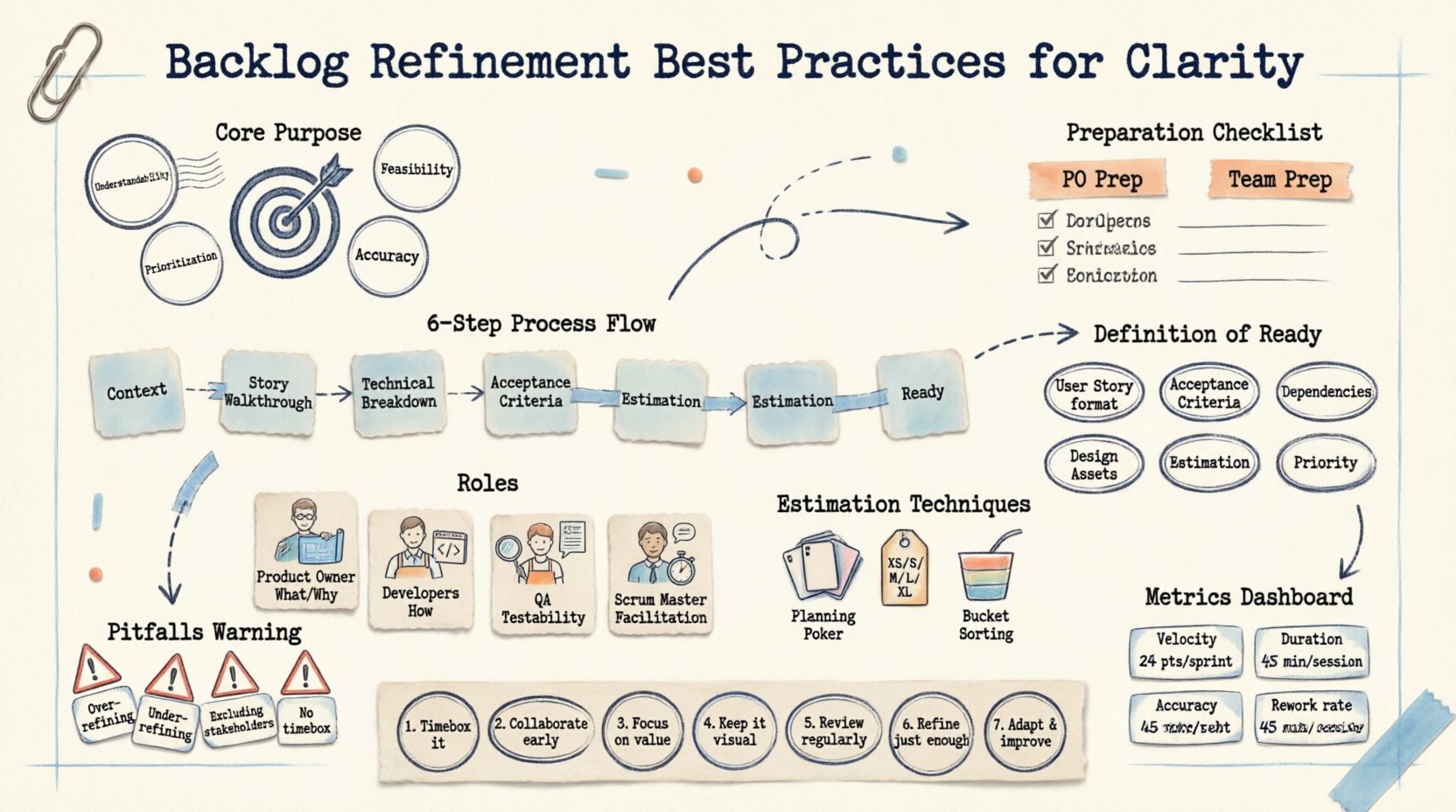
Backlog refinement is a continuous activity, not a one-time event. Its primary goal is to keep the product backlog organized, prioritized, and ready for selection. During these sessions, the Product Owner and the Development Team collaborate to break down large epics into smaller, manageable stories, add acceptance criteria, and estimate effort.
Without this process, the backlog becomes a graveyard of vague ideas and unfinished tasks. Teams face constant interruptions, unexpected technical debt, and unclear requirements during the sprint. Refinement acts as a filter, ensuring only the most valuable and understood items reach the top of the list.
Key objectives include:
- Ensuring Understandability: Every team member must grasp the value and scope of the item.
- Verifying Feasibility: Technical risks are identified early before commitment.
- Optimizing Prioritization: High-value items are moved to the top, while low-value items are discarded or deprioritized.
- Improving Accuracy: Estimates become more reliable as items are discussed and broken down.
Preparing for the Session 🛠️
The quality of a refinement session depends heavily on what happens before it begins. Preparation reduces cognitive load during the meeting and allows the team to focus on collaboration rather than discovery.
The Product Owner’s Preparation
The Product Owner (PO) bears the responsibility for the content of the backlog. Before the refinement session, the PO should:
- Review Stakeholder Feedback: Gather recent input from users or business stakeholders to ensure the next items address real needs.
- Draft Initial Stories: Write the skeleton of the user story with a clear title and initial description.
- Identify Dependencies: Map out any external dependencies, such as third-party APIs or work from other teams, to flag potential blockers.
- Set a Goal: Define a specific objective for the session, such as “Prepare 5 stories for the next sprint” or “Clarify technical architecture for the login feature.”
The Team’s Preparation
Developers and testers should also come prepared to contribute effectively:
- Review Context: Read the context of the feature or problem statement provided by the PO.
- Identify Knowledge Gaps: Note areas where technical knowledge is missing and flag them for discussion.
- Check Availability: Ensure all necessary roles, such as QA or UX, are available to participate in the discussion.
The Refinement Process Mechanics 🔄
The actual refinement meeting follows a structured flow. While flexibility is key in Agile, a loose structure prevents the conversation from drifting. A typical session lasts between 45 minutes to one hour, depending on the complexity of the items.
1. Context Setting
Begin by reminding the team of the current sprint goals and the overall product roadmap. This aligns everyone on the “why” behind the work. Remind the team of the current Definition of Ready (DoR) to ensure consistency.
2. Story Walkthrough
The PO presents the user story. This is not just reading the text aloud. It involves explaining the user’s problem, the desired outcome, and the business value. The team asks clarifying questions to ensure no ambiguity remains.
3. Technical Breakdown
Developers discuss the implementation details. This is where the conversation shifts from “what” to “how.” The team identifies subtasks, potential technical risks, and necessary architectural changes. If an item is too large, it should be split into smaller stories immediately.
4. Acceptance Criteria Definition
Acceptance criteria define the boundaries of the work. They should be specific, measurable, and testable. The team should use the Given-When-Then format to ensure clarity on edge cases and expected behaviors.
5. Estimation
Once the scope is clear, the team estimates the effort. Relative estimation techniques, such as Planning Poker or T-shirt sizing, help avoid the false precision of hours. The goal is to establish a relative size to aid in planning.
6. Commitment to Ready
Items that meet the Definition of Ready are moved to a “Ready” column or state. Items that are too vague remain in the backlog for further investigation.
Definition of Ready: A Critical Standard ✅
The Definition of Ready (DoR) is a checklist of conditions that must be met before a user story can enter a sprint. It prevents the team from committing to work they do not fully understand. While the DoR is team-specific, it generally includes the following criteria.
| Criteria | Description |
|---|---|
| User Story | Follows the standard format: As a [user], I want [feature], so that [benefit]. |
| Acceptance Criteria | Clear, testable conditions that define when the story is complete. |
| Dependencies | All external dependencies are identified and managed. |
| Design Assets | UI/UX designs, mockups, or wireframes are available if needed. |
| Estimation | The team has agreed on a relative effort estimate. |
| Priority | The item is prioritized higher than other items in the backlog. |
Enforcing the DoR requires discipline. If an item is pulled into a sprint but fails the DoR, the team should pause and refine it immediately rather than building the wrong thing. This protects the team from context switching and rework.
Common Pitfalls to Avoid ⚠️
Even with good intentions, teams often fall into traps that reduce the effectiveness of refinement. Recognizing these pitfalls allows you to course-correct quickly.
- Over-Refining: Spending too much time on details that are not needed yet. Not every item needs a full technical specification. Refine just enough to be confident in the estimate.
- Under-Refining: Moving items to the sprint without enough detail. This leads to surprises during development and delays.
- Ignoring Technical Debt: Focusing solely on new features while ignoring the underlying code health. Refinement sessions should allocate time to address technical debt items.
- Excluding Stakeholders: While the core team runs refinement, they should occasionally invite subject matter experts to clarify domain-specific questions.
- Lack of Timeboxing: Allowing refinement to drag on endlessly. Use a timer to keep the session focused and energetic.
Roles and Responsibilities 🤝
Clear division of labor ensures that refinement is efficient. The Product Owner and the Development Team have distinct but overlapping responsibilities.
| Role | Primary Responsibility | Secondary Contribution |
|---|---|---|
| Product Owner | Defines the “What” and “Why”. Prioritizes the backlog. | Answers domain questions. Validates acceptance criteria. |
| Developers | Defines the “How”. Estimates effort. Identifies technical risks. | Suggests architectural improvements. Breaks down stories. |
| QA / Testers | Ensures testability. Reviews acceptance criteria. | Identifies edge cases. Suggests automation needs. |
| Scrum Master | Facilitates the session. Removes impediments. | Coaches on DoR adherence. Protects timeboxes. |
Collaboration is the glue that holds these roles together. The Product Owner cannot dictate requirements without technical feasibility checks, and the Developers cannot estimate without clear value context.
Estimation Techniques for Clarity 🧮
Estimation during refinement is about planning capacity, not predicting the future with precision. Several techniques help the team align on effort.
Relative Sizing
Instead of hours, use points or T-shirt sizes (XS, S, M, L, XL). This focuses the conversation on complexity and effort rather than time. It reduces the pressure of accuracy and encourages honest discussion about difficulty.
Planning Poker
A consensus-based technique where everyone selects a card representing their estimate simultaneously. This prevents anchoring, where one person’s opinion influences the rest. If estimates vary widely, it indicates a lack of shared understanding, which requires further discussion.
Bucket Size Estimation
For large backlogs, group items into buckets (e.g., “Small”, “Medium”, “Large”). This allows the team to quickly sort and categorize items without getting bogged down in individual numbers. It is useful when there are hundreds of items to review.
Handling Technical Debt 🛠️
Technical debt is often the invisible enemy of clarity. It accumulates when shortcuts are taken, and it slows down future development. Refinement sessions must explicitly address debt.
- Allocate Capacity: Reserve a percentage of sprint capacity (e.g., 10-20%) for debt reduction.
- Make it Visible: Create specific stories for refactoring. Do not hide it in the description of a feature story.
- Justify the Cost: Explain to stakeholders why paying down debt improves speed and stability in the long run.
- Pair with Features: Sometimes, refactoring can be done alongside a feature. This ensures the debt is reduced as value is delivered.
Metrics and Measurement 📊
To improve refinement over time, you need data. Tracking specific metrics helps identify bottlenecks and areas for improvement.
Pipeline Velocity
Measure how many items move from “Refined” to “In Sprint”. A low conversion rate suggests that the refinement process is too slow or the Definition of Ready is too strict.
Refinement Duration
Track the time spent per story during refinement. If it takes 30 minutes to refine a small story, the team is over-analyzing. If it takes 5 minutes, they may be under-preparing.
Sprint Commitment Accuracy
Monitor how much of the refined backlog is actually completed in the sprint. High completion rates indicate that the refinement process is effective at filtering out ambiguity.
Rework Rate
Track how often stories are returned to the backlog due to lack of clarity. A high rework rate is a direct indicator of poor refinement quality.
Scaling Refinement 🚀
In large organizations, multiple teams may work on the same product. This requires a scaled approach to refinement.
- Cross-Team Refinement: Hold joint sessions where dependencies are cleared across teams. This prevents one team from blocking another due to late communication.
- Chapter Leads: Use technical leads to refine architecture-level stories before they are broken down for individual teams.
- Centralized Backlog: Maintain a single source of truth for the product backlog to avoid siloed requirements.
- Integration Points: Schedule regular integration ceremonies to ensure that refined stories from different teams fit together technically.
Culture and Continuous Improvement 🌱
Process is only as good as the culture surrounding it. Refinement requires psychological safety. Team members must feel comfortable saying “I don’t understand” or “This story is not ready.” If the culture punishes questions, refinement becomes a formality rather than a value-add.
Regular retrospectives should include a discussion on the refinement process itself. Ask the team:
- Did we feel prepared for the sprint?
- Were there any surprises during development?
- Is the Definition of Ready still accurate?
- Is the time spent on refinement proportional to the value gained?
Adjust the frequency of refinement sessions based on the pace of change. If the product roadmap is volatile, refinement should happen more frequently. If the work is stable, less frequent sessions may suffice.
Summary of Best Practices 📝
Clarity in the backlog is the foundation of a predictable delivery flow. By adhering to these best practices, teams can reduce waste, improve morale, and deliver value consistently.
- Prepare before you meet: The PO and the team must do their homework.
- Follow a structured flow: Context, walkthrough, breakdown, criteria, estimation.
- Enforce Definition of Ready: No surprises in the sprint.
- Collaborate on estimation: Use relative sizing to build consensus.
- Address technical debt: Make it a visible, prioritized item.
- Measure outcomes: Use metrics to refine the refinement process.
- Foster safety: Encourage questions and admit uncertainty.
Backlog refinement is not a task to be completed; it is a mindset to be adopted. When the entire organization values clarity and preparation, the result is a team that can focus on building great software rather than deciphering vague instructions. The effort invested in the backlog pays dividends in every sprint that follows.