
In the modern enterprise landscape, regulatory pressure and strategic ambition often appear to be at odds. Organizations strive for growth, agility, and innovation, yet they are simultaneously bound by a web of compliance requirements that dictate strict operational boundaries. This tension creates a strategic friction that can stall progress or expose the organization to risk. The Business Motivation Model (BMM) offers a structured framework to bridge this gap. By treating compliance not as an external burden but as an integrated component of business intent, leaders can harmonize regulatory adherence with core objectives.
This guide explores how to leverage the Business Motivation Model to align compliance requirements with business goals. We will examine the architecture of BMM, identify where compliance fits within the model, and provide a practical pathway for integration. The goal is to create a resilient strategy where compliance supports rather than hinders business value.
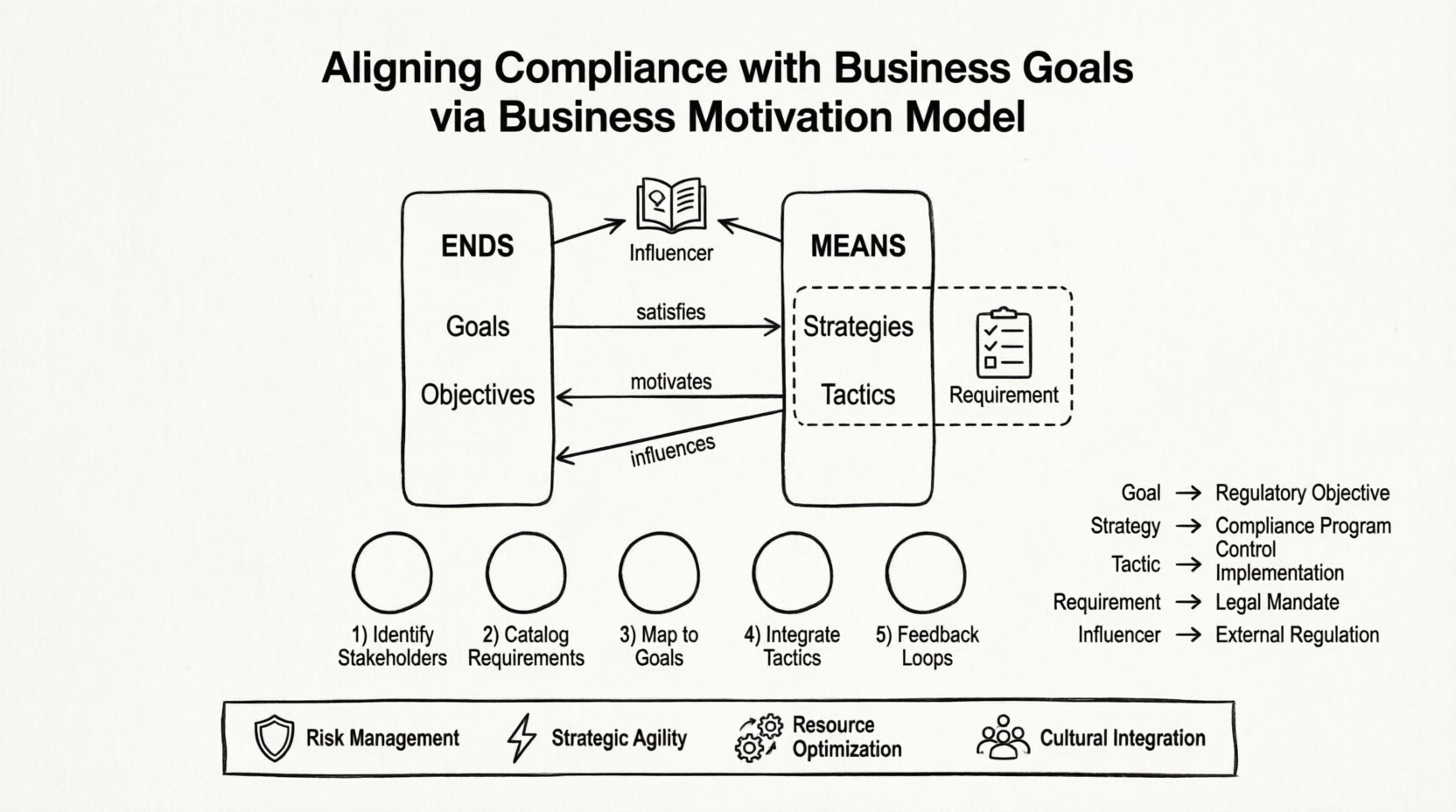
Understanding the Business Motivation Model (BMM) 🧩
Before integrating compliance, one must understand the underlying structure of the Business Motivation Model. Standardized by the Object Management Group (OMG), BMM is a metamodel designed to capture the reasons behind business decisions. It does not focus on processes or data structures, but rather on the why and how of business activity.
The model is built upon two primary dimensions:
- Ends: The goals and objectives the organization seeks to achieve.
- Means: The strategies, tactics, and plans used to achieve those ends.
These dimensions are further influenced by Stakeholders, Agents, and Context. Every element in the model connects to others through specific relationships, such as “satisfies,” “motivates,” “influences,” or “decomposes.”
Key Components of BMM
To align compliance effectively, you must map regulatory constraints to specific BMM elements. The core components include:
- Intention: This represents the desired outcomes. It includes Goals (qualitative outcomes) and Ends (quantitative measures of achievement).
- Actor: The entity responsible for action. This can be a person, a department, or an external partner.
- Strategy: A high-level plan to achieve a goal. Strategies are often broad and may not have immediate measurable outcomes.
- Tactic: A specific action or step that contributes to a strategy. Tactics are more concrete than strategies.
- Requirement: A constraint or condition that must be met. In the context of compliance, these are regulatory mandates.
- Influencer: Anything that affects the execution of the model without being a direct action. This includes laws, market conditions, or organizational culture.
The Friction Between Compliance and Strategy ⚖️
Traditionally, compliance is viewed as a gatekeeping function. Legal and risk teams impose rules that the business must follow, often after strategies are formulated. This reactive approach leads to silos. Compliance is treated as a separate layer of overhead rather than a foundational element of the business model.
When compliance is siloed, several negative outcomes occur:
- Reactive Implementation: Changes are made only when audits occur or regulations shift, leading to technical debt and emergency fixes.
- Resource Drain: Teams spend time navigating workarounds to satisfy conflicting requirements.
- Missed Opportunities: Compliance requirements often signal market trends or customer expectations. Ignoring them means missing chances to differentiate.
- Risk Exposure: If compliance is not tied to business goals, it is often deprioritized during cost-cutting or scaling phases.
The Business Motivation Model offers a solution by repositioning compliance from a blocker to a motivating factor. By explicitly modeling compliance as an Influencer or a Requirement that directly impacts Goals, the organization acknowledges its strategic importance.
Mapping Compliance to BMM Elements 🗺️
To achieve alignment, you must translate regulatory language into BMM terminology. This translation allows compliance officers and business strategists to speak the same language. Below is a breakdown of how compliance maps to the model.
| BMM Element | Compliance Equivalent | Example Scenario |
|---|---|---|
| Goal | Regulatory Objective | Ensuring 100% data privacy for EU citizens. |
| Strategy | Compliance Program | Implementing a Global Data Governance Framework. |
| Tactic | Control Implementation | Deploying encryption standards for data at rest. |
| Requirement | Legal Mandate | Adherence to GDPR Article 32 (Security of Processing). |
| Influencer | External Regulation | New SEC Disclosure Rules impacting financial reporting. |
Compliance as an Influencer
One of the most powerful applications of BMM is treating compliance as an Influencer. Influencers are external or internal factors that affect the model but are not necessarily under direct control. Laws and regulations fit this definition perfectly.
When a new regulation is introduced, it acts as an Influencer that impacts specific Goals or Strategies. For example, a change in environmental laws might influence the “Sustainability” Goal of a manufacturing company. By modeling this relationship, the organization can see exactly which business objectives are affected and adjust Tactics accordingly without losing sight of the overall strategy.
Compliance as a Requirement
Alternatively, compliance can be modeled as a Requirement. Requirements are conditions that must be satisfied for a Strategy or Goal to be considered valid. This ensures that no business plan is approved without satisfying the necessary regulatory constraints.
This approach shifts the conversation from “Can we do this?” to “How do we do this within constraints?” It embeds compliance into the design phase of business initiatives rather than the review phase.
Step-by-Step Alignment Process 📋
Integrating compliance into the Business Motivation Model requires a systematic approach. The following steps outline how to operationalize this alignment within an organization.
1. Identify Stakeholders and Actors
Compliance is not just the responsibility of the legal department. It requires input from various actors across the organization. In BMM terms, define who is responsible for which compliance obligations.
- Define Actors: List all departments involved in regulatory adherence (e.g., IT, HR, Finance).
- Assign Responsibility: Link specific compliance requirements to specific Actors. Who is accountable for maintaining the control?
- Identify Stakeholders: Determine who is impacted by these requirements (e.g., customers, regulators, shareholders).
2. Catalog Compliance Requirements
Before mapping, you must have a clear inventory of requirements. This inventory should be granular enough to link to specific business activities.
- Categorize: Group requirements by domain (e.g., Data Security, Financial Reporting, Labor Law).
- Prioritize: Rank requirements based on risk and impact. Not all compliance rules carry the same weight.
- Document Relationships: Note which requirements depend on others. For instance, a reporting requirement may depend on a data collection requirement.
3. Map Requirements to Business Goals
This is the core alignment phase. Connect the cataloged requirements to the existing BMM Goals and Strategies.
- Review Existing Goals: Look at your current strategic objectives. Do they address regulatory needs?
- Link Influencers: Tag relevant laws and regulations as Influencers on specific Goals.
- Define Constraints: Mark regulatory mandates as Requirements that must be satisfied for a Goal to be met.
- Visualize: Create diagrams showing the flow from Regulation → Influencer → Strategy → Goal.
4. Integrate into Tactical Planning
High-level alignment is insufficient; it must trickle down to tactics. Tactics are the actionable steps teams take daily.
- Embed Controls: Ensure that daily operational tasks include compliance checks.
- Update Metrics: Define Key Performance Indicators (KPIs) that reflect compliance status alongside business performance.
- Enable Monitoring: Establish mechanisms to track whether tactics are satisfying the regulatory requirements they were designed to meet.
5. Establish Feedback Loops
The business environment and regulatory landscape are dynamic. The BMM must be a living document, not a static artifact.
- Regular Reviews: Conduct periodic reviews of the model to ensure compliance mappings remain accurate.
- Change Management: When a new law passes, immediately update the Influencer nodes and assess impact on Goals.
- Communication: Share updates with Actors to ensure everyone understands how changes affect their responsibilities.
Benefits of Integrated Alignment 🚀
When compliance is successfully aligned with business goals through the Business Motivation Model, the organization gains several strategic advantages.
1. Enhanced Risk Management
Risk is often defined as the probability of a negative event occurring. By explicitly modeling compliance requirements as constraints on business goals, you make risk visible. You can see exactly which goals are vulnerable to regulatory breaches. This visibility allows for proactive mitigation rather than reactive damage control.
2. Strategic Agility
Agility is the ability to adapt quickly to change. If compliance is a silo, adapting to a new regulation requires a major overhaul. If compliance is modeled as an Influencer, you can see the ripple effect of a new law and adjust Tactics immediately. This reduces the friction of change.
3. Resource Optimization
Resources are finite. When compliance is aligned with goals, resources are allocated to areas where they satisfy both business and regulatory needs simultaneously. You avoid building redundant controls or spending effort on low-impact compliance activities.
4. Cultural Integration
Compliance becomes part of the business culture rather than a policing function. When employees see the connection between their daily tactics and the organization’s strategic goals, they understand the value of compliance. It transforms from “following rules” to “protecting the business mission.”
Common Pitfalls to Avoid 🚧
Despite the clear benefits, many organizations struggle with this integration. Understanding common pitfalls can help you navigate the process more effectively.
- Over-Modeling: Trying to map every single regulation to every single goal creates a complex web that is impossible to maintain. Focus on high-risk, high-impact areas first.
- Static Thinking: Treating the BMM as a one-time project. Compliance models must evolve with the business and the legal landscape.
- Disconnecting Actors: If the BMM is built by strategists without input from compliance officers, the links will be weak. Collaboration is essential during the modeling phase.
- Ignoring Context: The BMM includes context factors. Ignoring external context (like market shifts) can make compliance alignment brittle. Always consider the broader environment.
Case Study: Data Privacy and Product Launch 📱
To illustrate the practical application of this alignment, consider a software company planning a new product launch. The product involves user data collection, triggering GDPR and CCPA requirements.
Without Alignment:
- Product team defines the launch goal.
- Legal team reviews the product later in the cycle.
- Legal identifies non-compliant data practices.Product team must redesign features, delaying the launch.
With BMM Alignment:
- Intention: Launch Product X to capture market share.
- Influencer: GDPR Article 5 (Data Minimization).
- Requirement: Product must collect only necessary data.
- Strategy: Privacy by Design.
- Tactic: Implement data consent management module.
In this scenario, the compliance requirement (Data Minimization) is an Influencer that shapes the Strategy (Privacy by Design) from the start. The Tactic (Consent Module) is built specifically to satisfy the Requirement. The Goal (Launch) is achieved without delay because compliance was part of the plan, not an obstacle to it.
Sustaining the Alignment Over Time ⏳
Alignment is not a destination; it is a continuous state. To maintain the integrity of the Business Motivation Model over time, organizations should adopt specific governance practices.
- Ownership: Assign a specific role or team to own the BMM compliance mappings. This ensures accountability for updates.
- Training: Train business analysts and strategists on how to read and interpret the BMM. They need to understand the significance of Influencers and Requirements.
- Tooling: Use enterprise architecture tools that support BMM standards. Manual spreadsheets often fail to capture the complex relationships required for this alignment.
- Audit Trails: Keep records of why specific compliance requirements were linked to specific goals. This provides context during audits and helps explain decisions to stakeholders.
Final Considerations for Strategic Leaders 👔
Aligning compliance requirements with business goals is a fundamental shift in organizational maturity. It moves compliance from the periphery to the center of strategy. By utilizing the Business Motivation Model, leaders can visualize these connections clearly.
The process requires discipline. It demands that compliance teams engage with strategists early. It requires that business goals are defined with regulatory constraints in mind. However, the payoff is a more resilient organization capable of navigating complex regulatory landscapes without sacrificing growth.
When you view compliance as a motivator rather than a constraint, you unlock new possibilities for innovation within safe boundaries. The Business Motivation Model provides the vocabulary to make this shift. It allows you to document, analyze, and execute a strategy where regulatory adherence and business success are not competing forces, but complementary drivers of value.
Start by mapping your top five strategic goals to their corresponding regulatory influencers. Identify the gaps where compliance is currently siloed. Then, begin the process of linking them within your BMM framework. This small step sets the foundation for a compliant, agile, and strategically sound enterprise.