
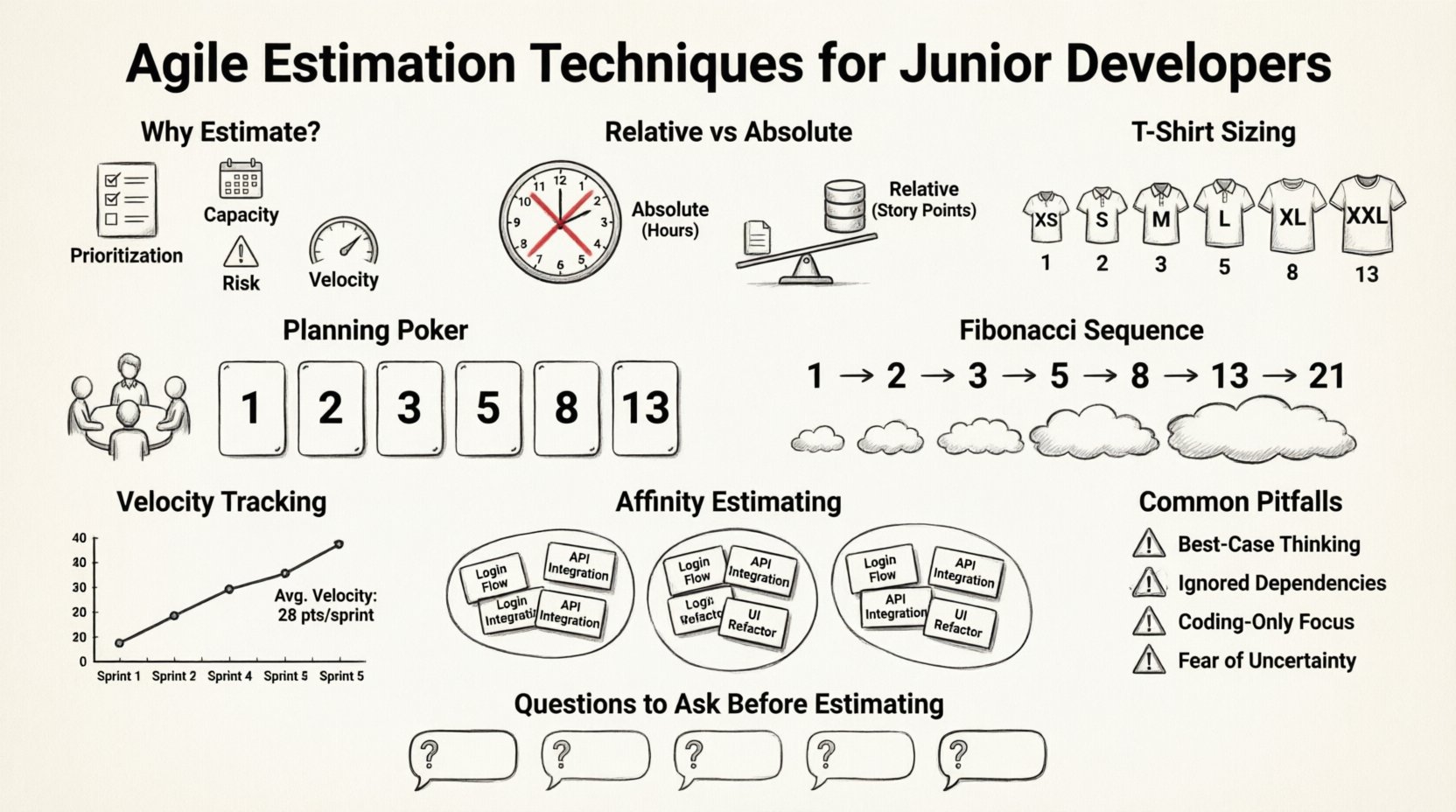
Entering the world of Scrum and Agile development often brings a mix of excitement and uncertainty. One of the most common sources of anxiety for junior developers is the estimation process. How do you predict how long a task will take? How do you communicate complexity to your team? Accurate estimation is not about guessing; it is about understanding scope, risk, and effort.
This guide breaks down the essential estimation techniques used in Scrum environments. We will explore relative sizing, collaborative planning, and how to build confidence in your predictions without relying on specific software tools. Whether you are new to the team or looking to refine your skills, these methods will help you contribute effectively to sprint planning.
Why Estimation Matters in Scrum 🤔
Estimation is often mistaken for a promise of delivery dates. In reality, it is a tool for planning and risk management. For a junior developer, understanding the “why” behind estimation helps reduce the pressure to be perfectly accurate every time. Here are the core reasons why we estimate:
- Prioritization: Product Owners need to know the effort required to decide what goes into the next sprint.
- Capacity Planning: The team needs to understand how much work can realistically fit into a timebox.
- Risk Identification: Large estimates often signal high risk or unclear requirements that need investigation.
- Team Velocity: Over time, estimates help the team measure their actual performance and improve predictability.
When you participate in estimation, you are not just assigning a number. You are engaging with the team to clarify the requirements. This dialogue is where the real value lies.
Understanding Relative vs. Absolute Estimation ⚖️
There are two main approaches to sizing work in Agile. As a junior developer, it is crucial to understand the difference to avoid common pitfalls.
Absolute Estimation
Absolute estimation uses fixed units of time, such as hours or days. While this seems intuitive, it often leads to inaccurate predictions because it ignores context.
- Pros: Easy for stakeholders to understand.
- Cons: Ignores individual differences in skill and experience. Encourages a focus on time rather than value.
Relative Estimation
Relative estimation compares one task to another. Instead of saying “this will take 4 hours,” you might say “this is twice as hard as that task.” This is the standard in Scrum teams.
- Pros: Reduces cognitive load. Focuses on complexity and effort rather than time.
- Cons: Stakeholders may find it harder to translate into calendar dates.
Most Agile teams prefer relative estimation because it accounts for the unique context of the team. It allows you to leverage past experiences without needing to predict the future with a stopwatch.
Planning Poker: The Gold Standard 🃏
Planning Poker is the most widely used technique for collaborative estimation. It combines individual thinking with group discussion to reach a consensus. Here is how the process typically works during a sprint planning session:
- Review the User Story: The team reads the description and acceptance criteria together.
- Ask Questions: Developers ask clarifying questions to ensure everyone understands the scope.
- Private Selection: Each developer selects a card representing their estimate without showing others.
- Simultaneous Reveal: Everyone reveals their card at the same time.
- Discussion: If estimates vary significantly, the highest and lowest estimators explain their reasoning.
- Re-Vote: The team votes again until a consensus is reached.
This technique prevents “anchoring bias,” where one person’s opinion influences the group before everyone has thought independently. It ensures that the quietest voices are heard alongside the most vocal ones.
The Fibonacci Sequence Explained 🔢
You will notice that Planning Poker cards often use the numbers 0, 1, 2, 3, 5, 8, 13, 21, 34, 55, 89, and 120. This is based on the Fibonacci sequence. Why not use 1, 2, 3, 4, 5? The math behind this is simple but profound.
As the size of a task increases, the uncertainty also increases. A 1-point task is simple and predictable. A 13-point task has many unknowns. By skipping numbers, we acknowledge that the difference between a 5 and an 8 is much larger in terms of risk than the difference between a 2 and a 3.
- Small Numbers (1-5): Represent tasks that are well understood and low risk.
- Medium Numbers (8-13): Indicate moderate complexity with some unknowns.
- Large Numbers (21+): Signal that the story is too big and should be broken down into smaller pieces.
Using this sequence helps the team avoid the false precision of saying something will take exactly 7 days. It encourages thinking in buckets of effort rather than exact hours.
T-Shirt Sizing for High-Level Estimates 👕
Sometimes, you are estimating at a feature level rather than a user story level. In these cases, Planning Poker might be too granular. T-Shirt Sizing is a great technique for high-level planning.
Instead of numbers, you use sizes like XS, S, M, L, XL, and XXL. This method is often used in backlog refinement to prioritize work before it enters a sprint.
| Size | Meaning | Typical Story Point Equivalent |
|---|---|---|
| XS | Very small, trivial effort | 1 |
| S | Small, simple changes | 2-3 |
| M | Medium effort, moderate complexity | 5 |
| L | Large effort, requires multiple days | 8 |
| XL | Very large, high risk | 13+ |
| XXL | Too big, must be split | Epic |
This technique is visual and fun, which can help engage the whole team. It is particularly useful when you do not have enough detail to assign specific story points.
Affinity Estimating and Grouping 📦
Affinity Estimating is a method used to group similar items together quickly. It is often used when you have a large backlog and need to size many items in a short time.
The process involves:
- Creating a Reference Story: The team agrees on one story that represents a “5” effort.
- Grouping: Developers place stories into piles based on how they compare to the reference story.
- Refining: Once grouped, the team assigns points to each pile.
This approach is efficient for large backlogs. It reduces the time spent discussing every single item in detail. However, it works best when the team has a shared understanding of what the reference story entails.
Velocity and Predictability 📈
Once you have been estimating for a few sprints, you will start to see a pattern. This is called Velocity. Velocity is the amount of work a team completes in a sprint, measured in story points.
- Tracking Velocity: Sum the points of all completed stories at the end of a sprint.
- Averaging: Look at the last 3 to 5 sprints to find an average velocity.
- Planning: Use this average to decide how many points to commit to in the next sprint.
Velocity is not a performance metric to judge individuals. It is a planning tool for the team. If a junior developer consistently underestimates, the team can provide support and coaching. If the velocity fluctuates wildly, it may indicate that the team is taking on too much or that requirements are changing frequently.
Common Pitfalls for Juniors ⚠️
Even with the best techniques, it is easy to make mistakes. Being aware of these common pitfalls will help you avoid them.
- Estimating Based on Best Case: Never estimate for the perfect scenario. Always account for bugs, code reviews, and unexpected issues.
- Ignoring Dependencies: If your work relies on another team or an API that is not ready, your estimate will be wrong. Make this explicit.
- Confusing Coding with Implementation: Estimation includes design, coding, testing, and documentation. Do not count only the coding time.
- Being Afraid to Say “I Don’t Know”: It is better to estimate conservatively and ask for help than to overpromise and miss a deadline.
Transparency is key. If you feel uncertain about a story, vote high. It is better to have a slightly inflated estimate than to fail to deliver.
Questions to Ask Before Estimating ❓
Before you pick a card or assign a number, ask the team these questions. They will help you uncover hidden complexity.
- What does “Done” mean? Review the Definition of Done for the team.
- Are there edge cases? Does this handle error states or specific user behaviors?
- Is the environment ready? Do we need to set up new infrastructure or databases?
- Who else is involved? Do we need help from designers, QA, or backend engineers?
- Is the acceptance criteria clear? If you have to guess, the story is not ready.
Asking these questions shows engagement and critical thinking. It also helps the Product Owner realize that a story needs more detail before it can be estimated accurately.
Summary of Techniques Table 📊
Here is a quick reference guide to help you choose the right technique for the situation.
| Technique | Best Used For | Complexity | Time Required |
|---|---|---|---|
| Planning Poker | Specific User Stories | Medium | 5-10 mins per story |
| T-Shirt Sizing | Features or Epics | Low | 1-2 mins per item |
| Affinity Estimating | Large Backlog Refinement | Low | Grouping session |
| Bucket System | Quick High-Level Sizing | Low | Very Fast |
| Hours | Non-Agile Contexts | High | Variable |
Remember that the tool is less important than the conversation. The goal is to reach a shared understanding of the work.
Moving Forward with Confidence 🏁
Estimation is a skill that improves with practice. As a junior developer, do not expect to be perfect on your first try. The goal is to get better over time.
- Participate in Retro: Discuss estimation accuracy during retrospectives.
- Seek Feedback: Ask senior developers why they chose a specific number.
- Track Your Learning: Keep a log of stories you estimated and compare them to the actual outcome.
- Stay Calm: If the estimate is wrong, analyze why. It is a learning opportunity, not a failure.
By adopting these techniques and maintaining an open mindset, you will contribute more effectively to your Scrum team. You will help build a culture of predictability and trust. This is the foundation of a successful Agile environment.