


In the modern landscape of software development and product delivery, technical proficiency alone does not guarantee success. High-performing teams share a common foundation that is often overlooked: psychological safety. This concept is not merely about being nice or creating a comfortable atmosphere. It is about creating an environment where team members feel secure enough to take risks, admit mistakes, and voice dissenting opinions without fear of punishment or humiliation. For Agile teams, specifically those operating under the Scrum framework, this safety is the bedrock of continuous improvement and sustainable velocity.
When a Scrum team operates without safety, the Sprint Backlog may look full, but the velocity will be artificial. Work is hidden, blockers are masked, and learning is stifled. Conversely, a team with high psychological safety engages in honest Retrospectives, challenges the Product Owner when necessary, and collaborates on solutions rather than assigning blame. This guide explores the mechanics of building this safety, the specific barriers found in Scrum environments, and actionable strategies to foster a culture of trust.
🧠 Defining Psychological Safety in Scrum
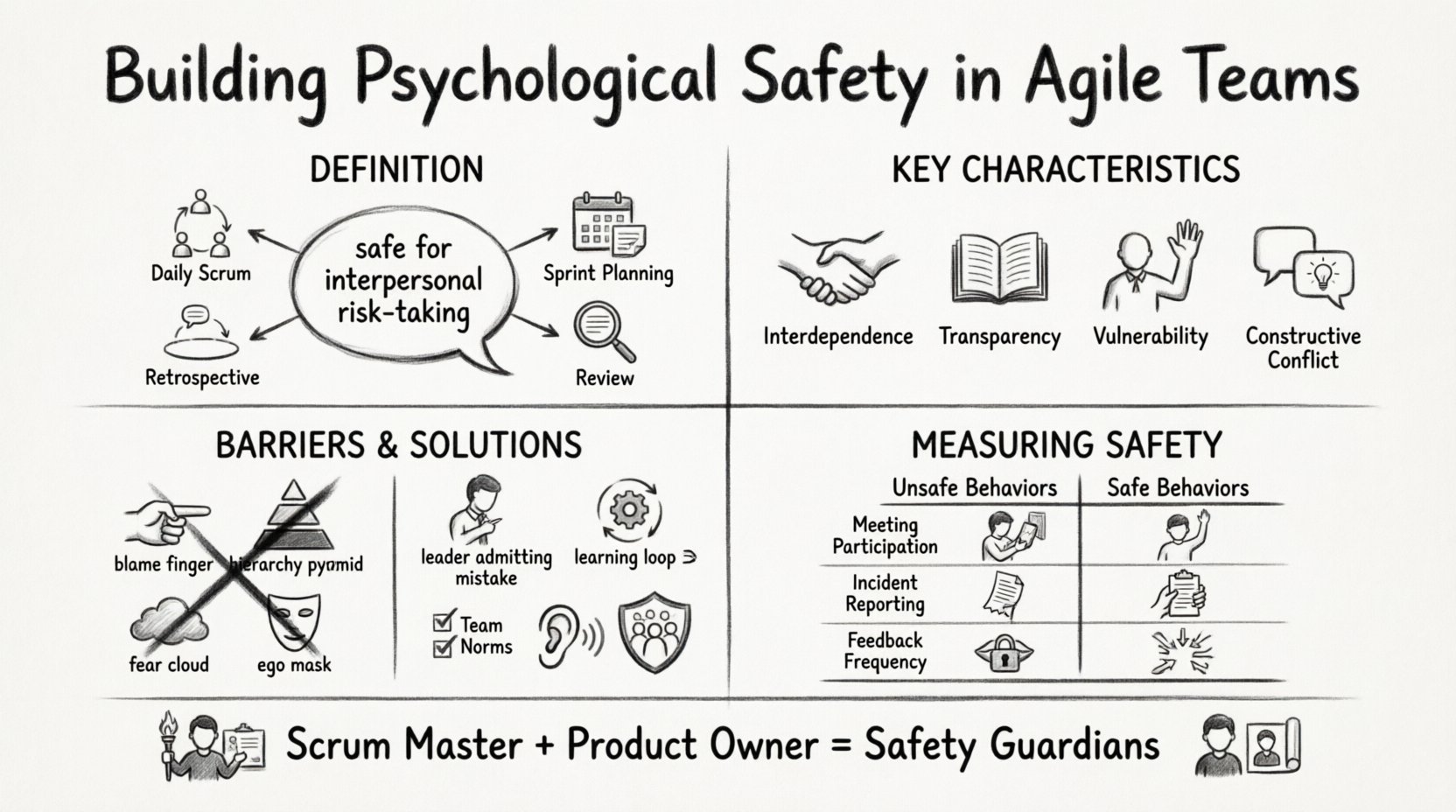
The term was popularized by researcher Amy Edmondson, who defined psychological safety as a shared belief held by members of a team that the team is safe for interpersonal risk-taking. In the context of Scrum, this translates directly to the team’s ability to interact during events like the Daily Scrum, Sprint Planning, Sprint Review, and Sprint Retrospective.
It is crucial to distinguish safety from comfort. Comfort implies a lack of friction or challenge. Safety implies the presence of friction, but without the threat of negative consequences. A safe team is a team that argues about the best technical approach, questions the value of a user story, and admits when they have underestimated a task. They do not do this to be difficult; they do it to improve the outcome.
Key Characteristics of a Safe Team
- Interdependence: Members rely on one another and trust that help is available when needed.
- Transparency: Work, progress, and impediments are visible to everyone.
- Vulnerability: Admitting “I don’t know” or “I made a mistake” is met with support, not judgment.
- Constructive Conflict: Disagreements focus on ideas and processes, not personal attributes.
Without these characteristics, the Scrum framework functions mechanically but fails to deliver its intended value. The Scrum Guide emphasizes empirical process control, which relies on transparency, inspection, and adaptation. If transparency is compromised due to fear, the other pillars collapse, and the team cannot adapt effectively.
🤝 Why Safety Matters for Agile Performance
Agile methodologies thrive on feedback loops. The shorter the loop, the faster the learning. Psychological safety accelerates these loops by removing the social barriers that delay feedback.
Impact on Sprint Planning
During Sprint Planning, the team commits to work. If safety is low, developers may commit to unrealistic goals to avoid looking incompetent. They might agree to a story point count they know is impossible. This leads to a failed Sprint, which erodes trust further. In a safe environment, the team discusses capacity honestly. If a story is too complex, they raise it immediately. The commitment becomes a shared agreement based on reality, not fear.
Impact on Daily Scrum
The Daily Scrum is a plan for the next twenty-four hours. It is not a status report for management. When safety is present, the conversation is tactical. Team members discuss what they are doing to help the goal. When safety is absent, the Daily Scrum becomes a performance review. People hide their blockers to avoid being seen as a liability. They speak in vague terms to avoid accountability. This destroys the utility of the event.
Impact on Retrospectives
The Retrospective is the primary engine for improvement. If a team cannot speak freely here, the process is worthless. High safety allows the team to identify root causes of failure. They can say, “The deployment process failed because we lacked a rollback strategy,” rather than “The deployment failed because someone pushed the wrong button.” The former leads to process improvement; the latter leads to blame and defensiveness.
🚧 Common Barriers to Psychological Safety
Building safety is an active process. It is not passive. Without intervention, natural organizational tendencies can erode it. Understanding these barriers is the first step to dismantling them.
1. The Blame Culture
When a production incident occurs, the immediate reaction determines future behavior. If the response is to identify the individual responsible and penalize them, safety is destroyed. In Agile, we focus on fixing the system, not the person. A barrier exists if the team believes that mistakes are character flaws rather than process opportunities.
2. Hierarchy and Power Dynamics
Even in flat Agile structures, power imbalances exist. The Product Owner may hold significant power over the team’s priorities. A Senior Developer may dominate conversations in a way that silences Junior Developers. When junior members feel their input is undervalued, they disengage. They stop offering ideas, and the team loses valuable perspectives.
3. Fear of Job Security
If team members believe that admitting a mistake could lead to termination or reduced hours, they will hide the truth. This is often a result of organizational policies that do not distinguish between negligence and honest error. The team must feel that their employment is not contingent on perfection.
4. Lack of Psychological Maturity
Teams need to develop emotional intelligence. Some individuals may struggle to separate their ego from their work. They may view criticism of their code as a criticism of themselves. Without the maturity to handle this, safety remains fragile.
🛠️ Practical Strategies for Implementation
Constructing a safe environment requires deliberate actions. It is not enough to simply say “be nice.” The Scrum Master and leadership must model and enforce behaviors that reinforce safety.
1. Model Vulnerability
Leaders must go first. If the Scrum Master admits, “I didn’t facilitate that meeting as well as I hoped, here is what I will change,” it gives permission for others to do the same. When a Product Owner says, “I prioritized this wrong, and we need to adjust the backlog,” it validates that planning is an iterative process, not a prophecy.
2. Frame Work as Learning
Reframe the purpose of the Sprint. Instead of viewing the Sprint as a delivery contract, view it as a learning experiment. This shifts the metric of success from “did we deliver everything” to “did we learn something valuable.” When failure is part of the learning process, it loses its stigma.
3. Establish Norms and Agreements
Create explicit team norms regarding communication. These should be discussed and agreed upon during the team formation phase. Examples include:
- Assume Positive Intent: When someone speaks, assume they mean well.
- One Voice: Only one person speaks at a time.
- Right to Pass: Anyone can choose not to contribute in a specific moment without penalty.
- Focus on Issues: Criticize the problem, not the person.
4. Active Listening
Listening is not just waiting for your turn to speak. It involves paraphrasing, asking clarifying questions, and validating emotions. When a team member shares a concern, acknowledge it before offering a solution. “I hear that you are worried about the timeline. That is a valid concern. Let’s look at the data.”
5. Protect the Team
The Scrum Master must shield the team from external interruptions and unreasonable demands. If stakeholders try to bypass the team and demand work directly, the Scrum Master must intervene. This protection signals to the team that their time and focus are valuable, reinforcing their sense of security.
📊 Measuring Team Health
You cannot improve what you do not measure. While psychological safety is qualitative, there are quantitative indicators and feedback mechanisms that can track progress.
| Indicator | Unsafe Behavior | Safe Behavior |
|---|---|---|
| Meeting Participation | Only a few dominant voices speak. | Rotating facilitation; diverse voices contribute. |
| Incident Reporting | Mistakes are hidden or minimized. | Blameless post-mortems are conducted regularly. |
| Feedback Frequency | Feedback is only given when things go wrong. | Continuous feedback is given throughout the Sprint. |
| Disagreement | Agreement is forced to maintain peace. | Disagreement is openly discussed and resolved. |
| Workload | Members work overtime to hide delays. | Overcommitment is discussed openly in planning. |
Beyond observation, teams can use anonymous surveys to gauge sentiment. Tools like the Team Health Check or the DORA metrics (Deployment Frequency, Lead Time for Changes, etc.) can provide indirect evidence of team stability and flow.
Mapping Scrum Events to Safety Opportunities
| Scrum Event | Safety Opportunity | Actionable Focus |
|---|---|---|
| Sprint Planning | Capacity and Risk Assessment | Ensure no one feels pressured to overcommit. |
| Daily Scrum | Impediment Visibility | Encourage asking for help without shame. |
| Sprint Review | Feedback Reception | Accept feedback without defensiveness. |
| Sprint Retrospective | Process Improvement | Focus on systemic fixes, not individual blame. |
👨💻 Leadership Responsibilities
Leadership in Agile is not about command and control. It is about service and enablement. The Product Owner and Scrum Master have distinct but complementary roles in maintaining safety.
The Scrum Master’s Role
The Scrum Master is the guardian of the process and the team’s health. Their responsibilities include:
- Coaching: Helping individuals understand their impact on the team dynamic.
- Conflict Resolution: Stepping in when interpersonal conflicts threaten to derail the team.
- Environment Design: Ensuring the physical and virtual space supports collaboration.
- Removing Impediments: Eliminating external factors that cause stress or anxiety.
The Product Owner’s Role
The Product Owner manages the value and the backlog. Their role in safety involves:
- Clarity: Providing clear goals reduces ambiguity, which reduces anxiety.
- Transparency: Sharing the rationale behind decisions helps the team understand the “why”.
- Respect: Valuing the team’s estimates and technical constraints.
🔄 Sustaining Safety Over Time
Psychological safety is not a one-time achievement. It is a dynamic state that requires maintenance. Teams change. New members join. Organizational pressures shift. A culture that was safe last year may not be safe today without vigilance.
Regular check-ins on team dynamics are essential. This does not mean adding new meetings, but rather integrating these conversations into existing events. During the Retrospective, dedicate time specifically to discussing team health. Ask questions like:
- Do you feel comfortable speaking up?
- Did anyone feel unheard this Sprint?
- What is one thing we can do to make this space safer?
These questions must be treated with seriousness. If the team raises a concern, it must be addressed. Ignoring a safety concern is a violation of the trust established. Action taken on feedback reinforces the belief that safety is real.
🔍 Handling Conflict and Failure
Conflict is inevitable in high-performing teams. The goal is not to eliminate conflict, but to manage it constructively. In a safe environment, conflict is viewed as a resource. It brings diverse perspectives to the surface.
When a failure occurs, the team must have a standard protocol. This protocol should be:
- Immediate: Address the issue as soon as it is known.
- Fact-Based: Focus on the data and the timeline of events.
- Forward-Looking: Spend 20% of the time analyzing the past and 80% planning the future.
This approach prevents the team from dwelling on the error. It turns a negative event into a learning opportunity. It also prevents the development of a “cover-up” culture where the team tries to hide the next mistake to avoid another investigation.
🚀 The Long-Term Value
The investment in psychological safety yields compounding returns. Over time, the team becomes more resilient. They can weather organizational changes without losing cohesion. They can innovate more boldly because the cost of failure is not existential. They attract and retain top talent who seek environments where they can do their best work.
For organizations, this translates to better products, faster time to market, and lower turnover costs. For the individuals within the team, it translates to reduced stress, higher job satisfaction, and professional growth. The technical skills are necessary, but the human element is what sustains the engine of Agile delivery.
Building this safety requires patience. It requires the humility to admit when you do not have the answer. It requires the courage to speak when the room is quiet. It requires the discipline to listen when you disagree. These are not soft skills. They are the critical infrastructure of modern software development.
📝 Summary of Actions
- Audit your current culture: Observe meetings. Who speaks? Who stays quiet? Why?
- Update your norms: Ensure your team agreements explicitly support safety.
- Train on feedback: Teach the team how to give and receive feedback effectively.
- Lead by example: Leaders must demonstrate vulnerability and openness.
- Measure regularly: Use surveys and retrospectives to track sentiment.
- Protect the team: Shield them from external chaos and unreasonable demands.
The journey to a truly safe team is ongoing. It is a practice, not a destination. By prioritizing the human element within the Scrum framework, teams unlock their true potential for innovation and delivery. The result is not just better software, but a better way of working together.