


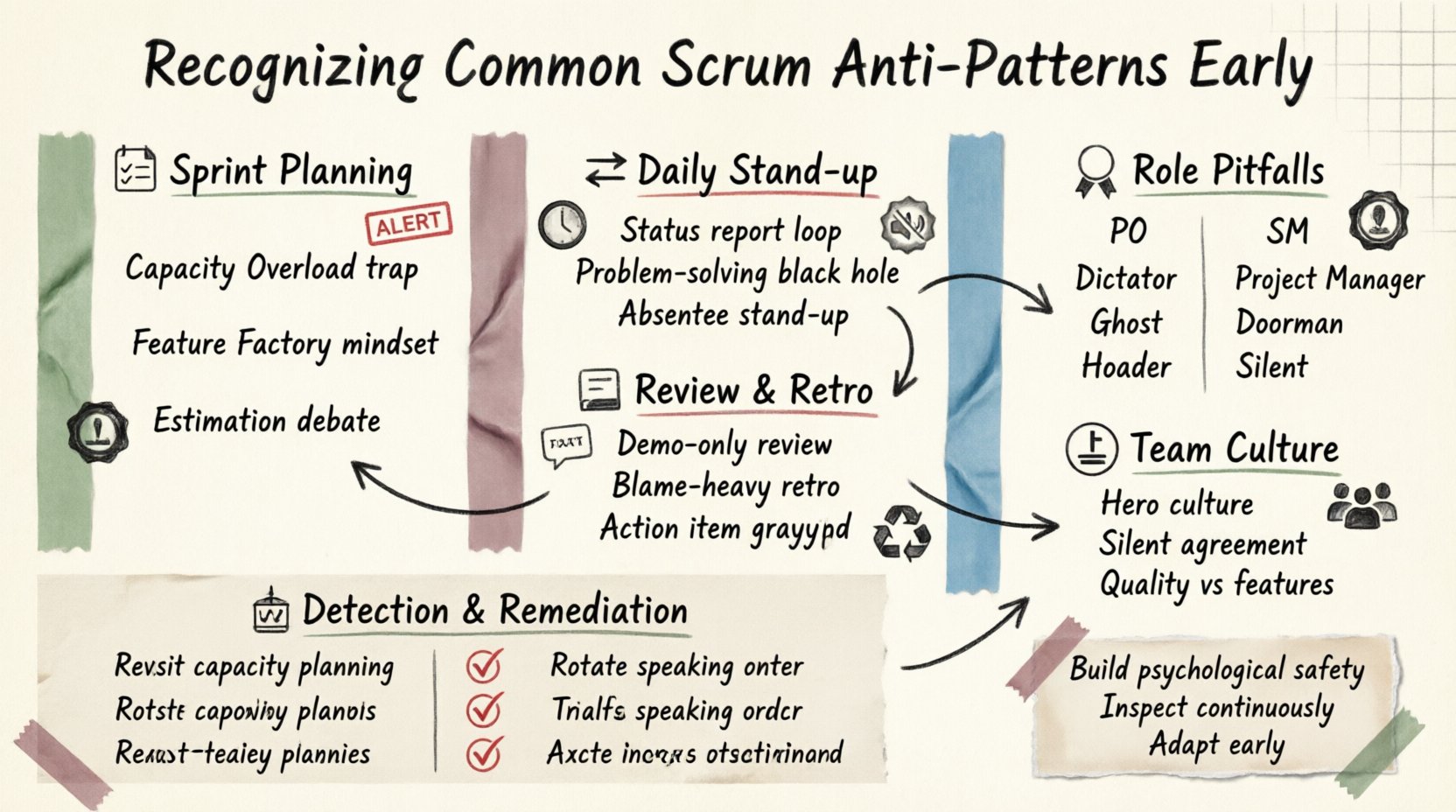
Agile frameworks like Scrum are designed to foster adaptability, transparency, and continuous improvement. However, the mere presence of ceremonies does not guarantee success. Teams often drift into behaviors that mimic Scrum while undermining its core principles. These behaviors are known as Scrum anti-patterns. They are subtle, often normalized over time, and can silently degrade team velocity and morale.
Identifying these patterns early is critical. Left unchecked, they transform a high-performing unit into a group of individuals simply going through the motions. This guide provides a detailed examination of common Scrum anti-patterns, their indicators, and the underlying mechanics that sustain them. By understanding these dynamics, organizations can intervene before dysfunction becomes entrenched.
📅 Sprint Planning Anti-Patterns
Sprint planning is the engine that drives the Scrum cycle. It sets the direction for the work ahead. When this ceremony fails, the entire sprint suffers. Several specific anti-patterns frequently emerge during this session.
1. The Capacity Overload Trap
Teams often feel compelled to commit to maximum capacity. They calculate available hours and assign every minute to tickets. This leaves no room for unplanned work, technical debt, or unforeseen bugs.
- The Symptom: Every developer is booked to 100% utilization for the sprint.
- The Reality: Context switching, communication overhead, and unexpected issues always occur. 100% capacity is a myth.
- The Impact: When reality hits, commitments are missed, and the team feels they have failed the plan.
2. The Feature Factory Mindset
Planning sessions sometimes devolve into a feature list creation exercise. The focus shifts entirely to output rather than outcome. The team selects items based on what is easiest to estimate, not what delivers the most value.
- The Symptom: Stories are large, monolithic, and lack clear value propositions.
- The Reality: The Product Owner is under pressure to ship volume, not value.
- The Impact: The team builds things that do not solve user problems, leading to waste.
3. The Estimation Debate
Some teams spend more time debating the hours required for a task than the task itself. This often stems from a lack of trust in the team’s ability to self-manage or a management culture that demands precise predictions.
- The Symptom: Long meetings discussing whether a story takes 4 hours or 8 hours.
- The Reality: Estimates are inherently uncertain. Precision is an illusion.
- The Impact: Energy is wasted on numbers rather than technical strategy.
🔄 Daily Stand-up Anti-Patterns
The daily stand-up is intended to be a synchronization point, not a status report for management. Yet, it frequently becomes a place where these functions are blurred. Recognizing the deviation is the first step to correction.
1. The Status Report Loop
Instead of discussing impediments and coordination, the meeting becomes a list of what each person did yesterday. This is a waste of collective time.
- The Symptom: Long monologues where team members talk past each other.
- The Reality: The goal is to identify blockers and adjust the plan, not report history.
- The Impact: The meeting drags on, consuming valuable development time.
2. The Problem-Solving Black Hole
When a specific technical issue is raised, the team often stops the ceremony to solve it. While collaboration is good, this derails the daily rhythm.
- The Symptom: The meeting extends 15 to 20 minutes as two engineers discuss code architecture.
- The Reality: Detailed discussion requires focused time, not a synchronized check-in.
- The Impact: The team loses the discipline of the daily cadence.
3. The Absentee Stand-up
In remote or hybrid settings, some members log in but remain muted and disengaged. They do not contribute to the conversation, treating the meeting as a passive broadcast.
- The Symptom: One person talks while others are silent or multitasking.
- The Reality: The stand-up requires active participation to be effective.
- The Impact: Information silos form, and alignment is lost.
🔍 Sprint Review & Retrospective Anti-Patterns
The review and retrospective are the mechanisms for inspection and adaptation. If these are treated as formalities, the Scrum framework loses its ability to evolve.
1. The Review as a Demo
The sprint review is often mistaken for a polished demonstration. It becomes a showcase of completed work rather than a feedback session with stakeholders.
- The Symptom: Stakeholders are silent observers rather than active participants.
- The Reality: The goal is to gather feedback to refine the product backlog.
- The Impact: The product drifts away from user needs because feedback was not solicited.
2. The Blame-Heavy Retrospective
Retrospectives should be safe spaces for improvement. If they turn into a place to assign blame for missed goals, psychological safety is destroyed.
- The Symptom: Focus is on who made mistakes rather than what processes failed.
- The Reality: People do not fail systems; systems fail people.
- The Impact: Team members hide issues in the future to avoid punishment.
3. The Action Item Graveyard
Teams generate a list of action items but never revisit them. Without follow-through, retrospectives become a ritual of futility.
- The Symptom: Action items are listed but not assigned or tracked.
- The Reality: Improvement requires accountability and time allocation.
- The Impact: The same problems recur in every subsequent sprint.
⚖️ Team Dynamics & Culture Anti-Patterns
Beyond the ceremonies, the way the team interacts defines its health. Cultural anti-patterns are often harder to spot because they are woven into the daily fabric of the organization.
1. The Hero Culture
This occurs when success is attributed to one individual who “saves the day.” This creates a dependency on specific individuals and discourages collaboration.
- The Symptom: One person is always called in to fix critical bugs or tight deadlines.
- The Reality: Sustainability relies on collective knowledge and shared ownership.
- The Impact: The team becomes fragile if the hero is unavailable.
2. The Silent Agreement
Teams may appear to agree during planning or reviews but harbor dissent privately. This lack of open disagreement prevents the team from identifying risks.
- The Symptom: No one challenges the plan, but execution falters later.
- The Reality: Constructive conflict is necessary for robust planning.
- The Impact: Surprises arise because concerns were never voiced.
3. The Feature Focus Over Quality
Pressure to deliver features often leads to technical debt accumulation. The team sacrifices code quality for speed, believing they will fix it later.
- The Symptom: Velocity increases initially, then drops as bugs mount.
- The Reality: Technical debt compounds interest over time.
- The Impact: Future development slows to a crawl as the codebase becomes unstable.
👤 Role Specific Anti-Patterns
The Scrum Guide defines three specific roles. Deviations in how these roles are performed can cripple the framework.
Product Owner Anti-Patterns
- The Dictator: The PO decides everything without consulting the team. This removes the team’s ability to self-manage.
- The Ghost: The PO is unavailable for questions during the sprint. This stalls development and creates ambiguity.
- The Backlog Hoarder: The backlog is either empty or overwhelmingly large with no prioritization. This confuses the team about what to build next.
Scrum Master Anti-Patterns
- The Project Manager: The Scrum Master starts assigning tasks and tracking hours. This undermines the team’s self-organization.
- The Doorman: The Scrum Master protects the team from everything, including necessary feedback. This shields the team from reality.
- The Silent Observer: The Scrum Master does not facilitate or coach. They believe the team should figure it out without guidance.
🛠️ Detection and Remediation Strategies
How does an organization know if these patterns exist? What steps should be taken to correct them? The following table summarizes key indicators and remediation approaches.
| Anti-Pattern | Key Indicator | Remediation Strategy |
|---|---|---|
| Capacity Overload | Commitments missed every sprint | Review historical velocity; plan for 60-80% capacity |
| Status Report Loop | Meeting exceeds 15 minutes | Enforce timeboxes; shift focus to blockers |
| Blame-Heavy Retro | Low attendance or silence | Train facilitators on psychological safety; focus on process |
| Hero Culture | Single point of failure identified | Implement pair programming; cross-train skills |
| Feature Factory | Value not measured | Shift focus to outcome metrics rather than output |
Building Psychological Safety
Remediation requires a foundation of trust. Team members must feel safe to admit mistakes or raise concerns without fear of retribution. Leaders must model vulnerability. When a leader admits a mistake, it signals that perfection is not the goal; improvement is.
This environment allows for the honest conversation required to dismantle anti-patterns. Without safety, patterns persist because the truth is hidden.
Continuous Inspection
Scrum is an empirical process. It relies on observation and adaptation. Teams should regularly inspect their own health. This can be done through anonymous surveys or health checks during retrospectives.
Questions to ask include:
- Are we making decisions together?
- Do we have time to do quality work?
- Do stakeholders understand our progress?
- Is the work we are doing aligned with business goals?
📉 The Cost of Ignoring Anti-Patterns
The financial and cultural cost of ignoring these patterns is high. It manifests as:
- Reduced Velocity: As technical debt mounts, speed decreases.
- High Turnover: Talented individuals leave toxic or dysfunctional environments.
- Stakeholder Frustration: Unmet expectations lead to loss of trust in the team.
- Product Stagnation: The product fails to evolve with market needs.
Early recognition allows for course correction before these costs become irreversible. It is better to address a small process issue today than to manage a crisis next quarter.
🧭 Moving Forward
Scrum is a framework, not a guarantee. It provides structure, but the human element determines success. Anti-patterns are natural byproducts of human systems trying to fit into rigid boxes. The goal is not to eliminate all friction but to manage it productively.
By staying vigilant and maintaining a focus on the core values of Scrum—Commitment, Focus, Openness, Respect, and Courage—teams can navigate away from dysfunction. The path to high performance is not a straight line; it is a continuous cycle of inspection and adaptation.
Start by observing your current practices. Look for the subtle signs discussed in this guide. Be willing to change them. The effort invested in recognizing these patterns early pays dividends in long-term sustainability and team well-being.