


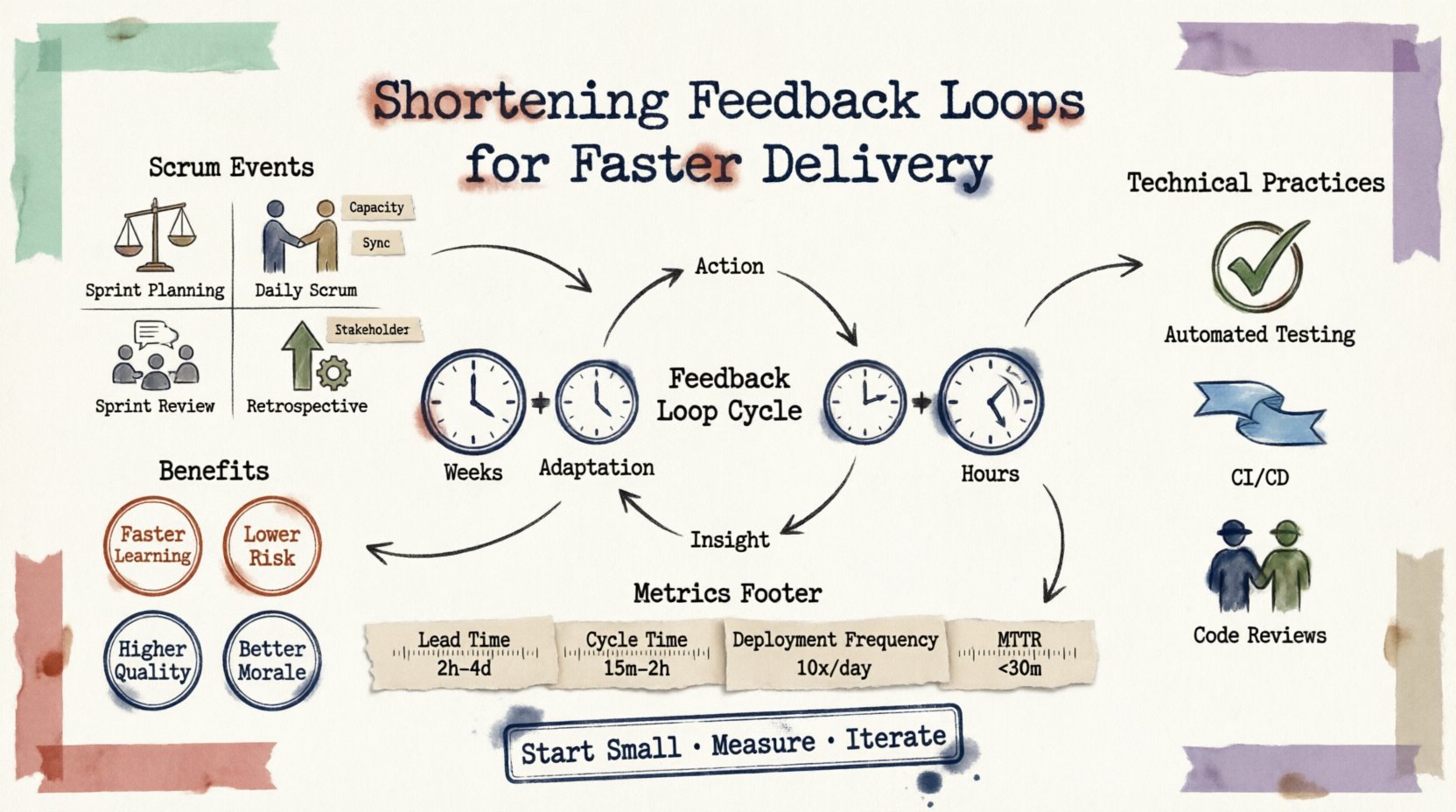
In the dynamic landscape of software development and product management, speed is often conflated with velocity. However, true velocity is not merely about pushing commits faster; it is about learning faster. The mechanism that drives this learning is the feedback loop. When teams understand how to shorten these loops, they reduce waste, increase quality, and deliver value to stakeholders with greater predictability. This guide explores the mechanics of feedback loops within the Scrum framework and provides actionable strategies to accelerate delivery without compromising stability.
Feedback is the difference between guessing and knowing. In a long feedback loop, a decision made today might not show its consequences for weeks or months. In a short feedback loop, the same decision reveals its impact within hours or days. The goal is not just to move faster, but to reduce the distance between action and insight.
Understanding the Feedback Loop Mechanism 🔍
A feedback loop is a system where the outputs of a process are circled back and used as inputs to modify the process itself. In Scrum, this concept is embedded in the empirical process control pillars: Transparency, Inspection, and Adaptation. Every event, artifact, and interaction serves a purpose in closing the gap between the current state and the desired state.
Consider a standard software delivery process. A developer writes code, pushes it to a repository, and waits for a review. After approval, it moves to a staging environment, then to production. If a bug is found in production, the team must identify, reproduce, fix, and deploy the solution. This entire sequence represents a loop. The shorter the time between writing the code and knowing if it works, the faster the team can correct course.
When loops are elongated, several negative outcomes emerge:
- Increased Context Switching: Developers wait on approvals or environments, losing focus.
- Accumulated Risk: Small errors compound over time, making major releases risky.
- Delayed Value: Features that do not meet user needs are delivered after significant investment.
- Reduced Morale: Teams feel like they are pushing water uphill due to friction.
Conversely, shortening these loops creates a rhythm of continuous improvement. It shifts the culture from “build and hope” to “build and verify.”
Scrum Events as Feedback Mechanisms 📅
The Scrum framework is designed with specific events that act as natural feedback checkpoints. Optimizing these events is the first step toward faster delivery. Each event serves a distinct purpose in the feedback hierarchy.
Sprint Planning: Feedback on Capacity and Scope
This event provides immediate feedback on the team’s ability to commit to work. If the team consistently pulls in more work than they can finish, the feedback is clear: the capacity estimation is flawed, or the definition of done is too loose. Shortening this loop means reviewing historical velocity data closely and adjusting the plan within the sprint boundaries rather than carrying over unfinished work indefinitely.
- Strategy: Use historical data to set realistic goals.
- Strategy: Break down stories into smaller, verifiable units.
- Strategy: Discuss risks early during the planning session.
Daily Scrum: Feedback on Blockers and Progress
The Daily Scrum is a short feedback loop designed to inspect progress toward the Sprint Goal. It is not a status report for management but a synchronization point for the developers. A long loop occurs when blockers are reported but not resolved for days. A short loop means blockers are identified and addressed immediately.
- Focus: Identify impediments that prevent progress.
- Focus: Re-align the plan for the next 24 hours.
- Focus: Ensure no single person is waiting on external dependencies.
Sprint Review: Feedback on Value and Requirements
This is perhaps the most critical feedback loop regarding the market and the user. It brings the product back to the stakeholders to inspect the increment. If stakeholders do not provide feedback here, the team risks building the wrong thing. Shortening this loop involves frequent stakeholder engagement, not just at the end of the sprint.
- Strategy: Demo working software, not slides or mockups.
- Strategy: Invite end-users when possible, not just managers.
- Strategy: Accept that “no” is a valid and valuable answer.
Sprint Retrospective: Feedback on Process and Team Dynamics
The Retrospective focuses on the team’s internal feedback loop. It is where the team inspects itself and creates a plan for improvements. If the Retrospective is treated as a complaint session without actionable outcomes, the loop remains long. Shortening it requires immediate implementation of small changes.
- Strategy: Select only one or two actionable improvements per sprint.
- Strategy: Assign ownership to each improvement item.
- Strategy: Review the status of previous improvements in the next Retrospective.
Technical Feedback Loops 🛠️
While Scrum events provide organizational feedback, technical practices provide the granular, second-by-second feedback necessary for quality delivery. In modern software engineering, the code itself must speak. If the code does not compile, the build fails, or the test suite breaks, this is an immediate signal that something is wrong.
Automated Testing
Manual testing introduces significant latency. A tester might find a bug three days after a commit. Automated testing brings that feedback back to minutes. Unit tests, integration tests, and end-to-end tests run in the background of the development workflow.
- Unit Tests: Provide feedback on individual components immediately.
- Integration Tests: Verify that components work together.
- End-to-End Tests: Simulate real user flows to catch workflow issues.
Continuous Integration and Deployment
Continuous Integration (CI) ensures that code changes are automatically built and tested. Continuous Deployment (CD) ensures that validated code is automatically released. This removes the manual handoff between development and operations, which is a common source of delay.
- Frequency: Integrate code multiple times a day.
- Automation: Remove manual steps from the release pipeline.
- Rollback: Enable instant rollback if issues are detected post-deployment.
Code Reviews
Code reviews are a form of peer feedback. They are essential for knowledge sharing and quality assurance. However, if reviews sit in a queue for days, they become a bottleneck. The goal is to keep the queue shallow and the review time short.
- Size: Keep pull requests small and focused.
- Timing: Review code as soon as it is ready, not at a specific time.
- Culture: Focus on learning, not judging.
Organizational and Stakeholder Feedback 🤝
Technical loops are useless if they do not align with business goals. Organizations often create barriers that lengthen the feedback loop between the development team and the market.
Stakeholder Availability
If stakeholders are only available for meetings once a month, the feedback loop is monthly. If they are available via chat or quick syncs, the loop becomes daily. The Product Owner plays a key role here, acting as the bridge between the team and the business.
Bureaucracy and Governance
Approval chains can add weeks to the delivery timeline. Security reviews, legal checks, and architectural governance are necessary but can become bottlenecks. These processes need to be embedded into the workflow rather than placed at the finish line.
Table: Comparing Long vs. Short Feedback Loops
| Aspect | Long Feedback Loop | Short Feedback Loop |
|---|---|---|
| Correction Time | Weeks or Months | Hours or Days |
| Cost of Change | High | Low |
| Risk Level | High | Low |
| Team Confidence | Low | High |
| Learning Rate | Slow | Fast |
| Customer Satisfaction | Unpredictable | Consistent |
Barriers to Shortening Loops 🚧
Even with the right tools and processes, teams face obstacles that keep loops long. Identifying these barriers is essential for progress.
1. Fear of Failure
If team members fear punishment for bugs, they will hesitate to deploy. This leads to large, infrequent releases where the risk is concentrated. A culture that treats failures as learning opportunities encourages faster iteration.
2. Siloed Teams
When developers, testers, and operations work in separate departments with separate goals, handoffs create delays. Cross-functional teams that own the feature from idea to production reduce these handoffs.
3. Technical Debt
Legacy code and poor architecture slow down new development. Every new feature requires navigating a maze of outdated systems. Investing time in refactoring shortens the loop for future work.
4. Tooling Inefficiencies
Slow build times, manual testing environments, and clunky project management tools add friction. Automating these tools reduces the wait time between actions.
Measuring Loop Efficiency 📊
You cannot improve what you do not measure. To shorten feedback loops, you must track metrics that reflect the flow of work and the speed of learning.
- Lead Time for Changes: The time it takes for a commit to move to production. This is a direct measure of the technical feedback loop.
- Cycle Time: The time a task spends in the active state. Shorter cycle times indicate less waiting and more flow.
- Deployment Frequency: How often you release value. Higher frequency usually correlates with smaller, safer changes.
- Change Failure Rate: The percentage of deployments causing a failure. This ensures that speed is not coming at the cost of stability.
- Mean Time to Recovery (MTTR): How quickly the team restores service after an incident. Shorter recovery times mean the feedback loop on errors is tight.
Cultural Shifts for Sustainable Speed 🌱
Tools and processes are enablers, but culture is the foundation. A culture that values feedback over ego will naturally shorten loops. This requires a shift in mindset for everyone involved.
Psychological Safety
Teams must feel safe to admit mistakes without fear of retribution. When a developer pushes code that causes an outage, the reaction should be “how do we prevent this next time?” not “who did this?”. This openness accelerates the correction process.
Shared Ownership
When everyone owns the product, not just their specific task, feedback flows more freely. Developers care about production performance. Testers care about user experience. Operations care about developer productivity.
Continuous Learning
Feedback is useless without learning. The team must dedicate time to reflect on the data. Post-mortems and retrospectives are not just meetings; they are engines for organizational knowledge.
Practical Steps to Begin Today 🏁
Implementing these changes does not require a complete overhaul overnight. Start with small, high-impact adjustments.
- Reduce Batch Sizes: Break work into smaller pieces. Smaller pieces are easier to test, review, and deploy.
- Visualize Work: Use boards to make flow visible. Blockers become obvious when they sit on a column for too long.
- Limit Work in Progress (WIP): Focus on finishing one thing before starting another. This reduces context switching and speeds up completion.
- Automate Repeats: Identify any manual task that happens more than twice and write a script to do it.
- Invite Feedback Early: Share drafts and prototypes before the work is “done”. This allows for course correction before significant investment.
Common Bottlenecks and Solutions 🔧
Below is a breakdown of common friction points and how to address them specifically.
| Bottleneck | Impact | Solution |
|---|---|---|
| Dependency Wait | Stops progress on features | Reschedule work or find a workaround |
| Approval Delays | Blocks deployment | Delegate authority or automate checks |
| Environment Instability | False positives in testing | Stabilize infrastructure and use containers |
| Meeting Overload | Reduces coding time | Reduce meeting frequency and duration |
| Knowledge Silos | One person becomes a blocker | Pair programming and documentation |
The Path Forward 🛤️
Shortening feedback loops is not a destination but a continuous journey. As technology evolves and teams grow, the definition of “fast” changes. What works for a team of five may not work for a team of fifty. The principle remains the same: reduce the time between action and insight.
By embedding feedback into every layer of the organization, from the code level to the stakeholder level, teams create an environment where speed and quality coexist. This is the essence of effective delivery. It is not about working harder or longer hours; it is about working smarter with a clear view of the path ahead.
Start by auditing your current loops. Where do you wait? Where do you guess? Where do you fear? Address those points first. Then measure the impact. Over time, these small adjustments will compound into a significant competitive advantage. The goal is a system that learns, adapts, and delivers value continuously.