


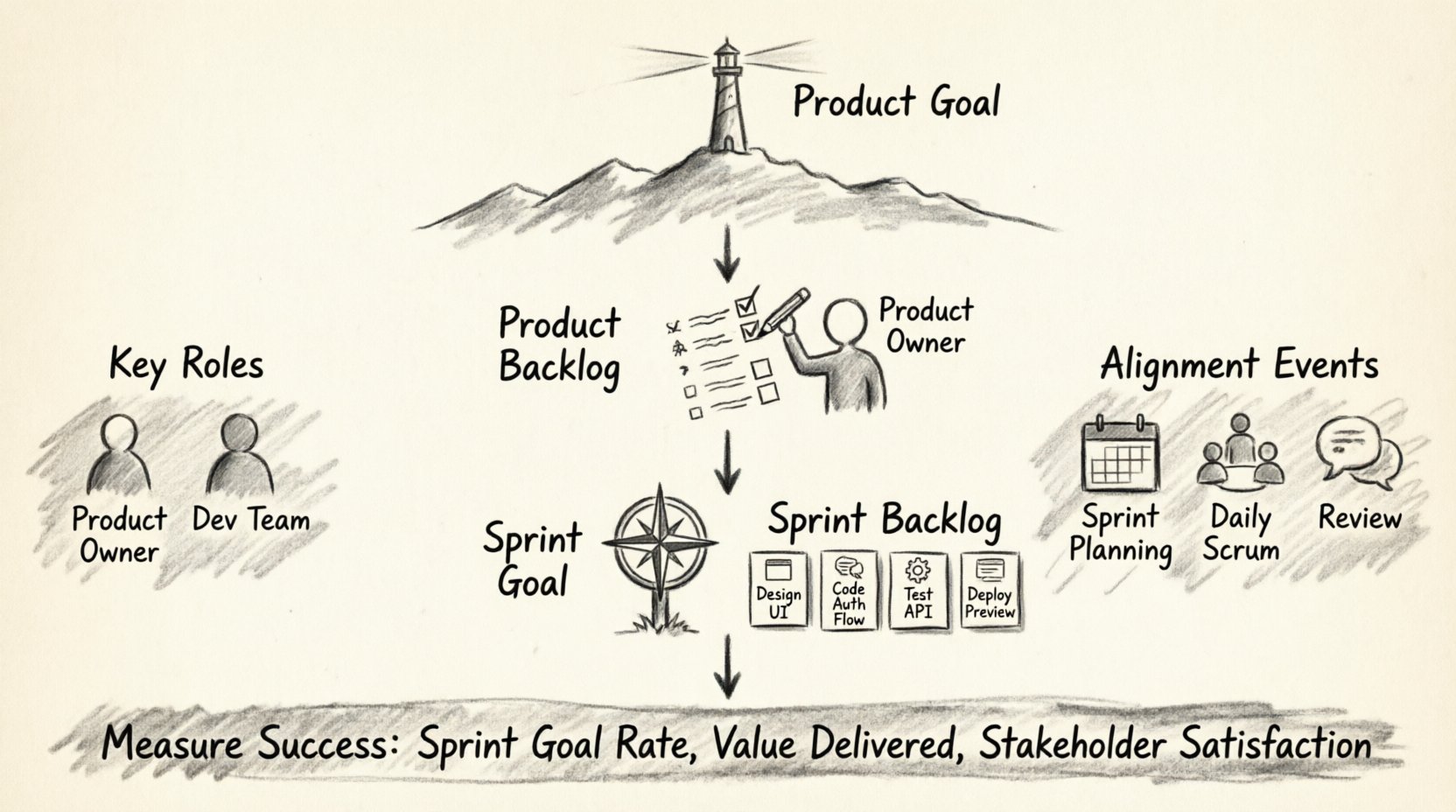
In the fast-paced environment of software development and product creation, focus is currency. A team can be busy, productive, and technically proficient, yet still miss the mark if their daily efforts drift away from the broader vision. This is where the concept of aligning sprint work with the product goal becomes critical. Within the framework of Scrum, this alignment is not optional; it is a fundamental requirement for delivering value.
When the development team, the product owner, and stakeholders move in unison, the result is a cohesive flow of work that directly contributes to the product’s success. This guide explores the mechanics, responsibilities, and strategies necessary to ensure that every sprint contributes meaningfully to the long-term vision.
Understanding the Core Concepts 🧩
To achieve alignment, we must first define the terms involved. The Scrum Guide outlines specific artifacts and events designed to facilitate this connection. Understanding the distinction between the Product Goal and the Sprint Goal is the first step.
What is the Product Goal?
The Product Goal describes a future state of the product. It serves as a target for the Scrum Team to strive for. It is long-term, often spanning multiple sprints, quarters, or even years, depending on the complexity of the product. It provides the necessary context for the Product Owner to order the Product Backlog.
- Long-term focus: It looks beyond the immediate release cycle.
- Evolutionary: It may change as market conditions or user needs shift.
- Outcome-oriented: It focuses on value delivered to the customer, not just features built.
What is the Sprint Goal?
The Sprint Goal is an objective set for the Sprint. It is short-term, typically lasting one to four weeks. It provides flexibility to the Development Team regarding the functionality implemented within the Sprint. The Sprint Goal binds the Sprint Backlog together and provides a coherent target for the Sprint.
- Short-term focus: It covers the duration of the current Sprint.
- Commitment: It represents a commitment to a specific value increment.
- Flexibility: The scope within the Sprint can be adjusted to ensure the goal is met.
The Relationship Between Goals
Alignment occurs when the Sprint Goal is a stepping stone toward the Product Goal. If the Product Goal is the destination, the Sprint Goal is the next checkpoint. Without this connection, the team risks building a collection of features that do not form a coherent product.
Visualizing the Alignment Hierarchy 📊
Visualizing the relationship between different levels of work helps clarify responsibilities and expectations. The table below breaks down the differences and connections between the key Scrum artifacts.
| Artifact | Time Horizon | Primary Owner | Focus |
|---|---|---|---|
| Product Goal | Long-term (Months/Years) | Product Owner | Strategic Value & Vision |
| Product Backlog | Ongoing | Product Owner | Ordered Items to Reach Goal |
| Sprint Goal | Short-term (Sprint Duration) | Scrum Team | Tactical Objective |
| Sprint Backlog | Sprint Duration | Development Team | Tasks to Achieve Sprint Goal |
The Role of the Product Owner in Alignment 👤
The Product Owner plays a pivotal role in maintaining this alignment. They are responsible for optimizing the value of the product resulting from the work of the Scrum Team. This responsibility extends beyond writing user stories; it involves constant communication and prioritization.
1. Defining and Communicating the Goal
The Product Owner must ensure the Product Goal is clear and understood by everyone. If the Development Team does not understand the destination, they cannot navigate the path effectively. This requires:
- Explicit articulation: Writing the goal in clear, non-technical language.
- Visual aids: Using roadmaps or vision boards to make the goal tangible.
- Continuous reinforcement: Reminding the team of the “why” during planning and daily work.
2. Prioritizing the Product Backlog
Alignment is maintained through prioritization. Items at the top of the Product Backlog must be the ones that move the needle on the Product Goal. If high-priority items are technically interesting but do not support the strategic goal, they should be deferred. The Product Owner must say “no” to distractions.
3. Collaborative Refinement
Refinement sessions are not just about sizing tasks; they are about ensuring understanding. The Product Owner should invite questions during these sessions to verify that the team interprets the requirements in a way that aligns with the goal. Ambiguity here leads to drift later.
Sprint Planning: The Alignment Engine ⚙️
Sprint Planning is the primary event where alignment is established for the upcoming work. It is a collaborative session between the Product Owner and the Development Team. The goal is to create a plan that respects the Sprint Goal while contributing to the Product Goal.
Part 1: What can be delivered?
In the first part of Sprint Planning, the Product Owner discusses the Product Goal and the highest priority items in the backlog. The team selects items that are ready to be developed. The conversation should explicitly link these items back to the Product Goal.
- Question to ask: “How does this specific item move us closer to the Product Goal?”
- Selection criteria: Choose items that offer the most value relative to effort.
- Capacity check: Ensure the team has the bandwidth to complete the selected work without burnout.
Part 2: How will the work get done?
In the second part, the Development Team plans the work required to turn the selected Product Backlog items into a “Done” increment. They define tasks and estimate effort. Crucially, this plan must support the Sprint Goal.
- Task breakdown: Break down user stories into technical tasks.
- Dependency mapping: Identify any dependencies that might block progress.
- Goal validation: Review the plan to ensure it realistically achieves the Sprint Goal.
Daily Scrum: Maintaining Course 🧭
Alignment is not a one-time event at the start of the Sprint. It must be maintained daily. The Daily Scrum is a 15-minute event for the Development Team to inspect progress toward the Sprint Goal and adapt the Sprint Backlog for the next 24 hours.
Focusing on the Sprint Goal
Many teams turn the Daily Scrum into a status report for the Product Owner. This is a misalignment. The Daily Scrum is for the team to synchronize activities. The focus should be on:
- Progress toward the Sprint Goal: Are we on track to meet the objective set for the Sprint?
- Impediments: What is stopping us from achieving the goal?
- Adjustments: Do we need to change our plan to stay aligned with the goal?
If the team realizes during the Daily Scrum that the Sprint Goal is at risk, they must communicate this immediately. Waiting until the end of the Sprint to report bad news is a failure of alignment. Early detection allows for course correction.
Sprint Review: Validating Value 📈
The Sprint Review is an opportunity to inspect the Increment and adapt the Product Backlog if needed. It is a collaborative session where the Scrum Team and stakeholders review what was accomplished.
Inspection and Adaptation
During the review, the focus is on the Product Goal. Stakeholders provide feedback on the increment. The team demonstrates the work done. This feedback loop is essential for alignment because it validates whether the work being done is actually what is needed.
- Demonstrate value: Show how the increment contributes to the Product Goal.
- Collect feedback: Ask stakeholders if the work meets their expectations.
- Update the backlog: If the Product Goal has shifted, update the Product Backlog accordingly.
If the feedback indicates a shift in direction, the Product Owner must update the Product Goal or the ordering of the backlog. This ensures future Sprints remain aligned with the current reality.
Common Pitfalls in Alignment 🚧
Even with the best intentions, teams often drift. Recognizing these patterns early allows for corrective action. Below are common anti-patterns that break alignment.
1. The Feature Factory
This occurs when the team focuses solely on delivering a high volume of features without regard for the Product Goal. They build many things, but not the right things. The metric here is output (stories completed) rather than outcome (value delivered).
2. Ignoring the Sprint Goal
Teams often treat the Sprint Goal as a suggestion. If a high-priority bug appears, or a new request comes in, the team abandons the Sprint Goal to fix it. While priorities change, the Sprint Goal should only change if the team agrees it is no longer viable. Constantly shifting goals erodes focus.
3. Siloed Communication
If the Product Owner works in isolation and the Development Team works in isolation, alignment becomes impossible. Regular interaction is required. The Product Owner must be available to answer questions, and the Team must proactively communicate progress.
4. Lack of Definition of Done
If the team does not have a clear Definition of Done, they may deliver work that is incomplete. This creates technical debt and distracts from the Product Goal. Future sprints must spend time fixing past work rather than moving forward.
Measuring Alignment 📏
How do you know if you are aligned? You cannot rely on feelings alone. You need metrics and indicators that reflect the health of the alignment between sprint work and the product goal.
1. Sprint Goal Success Rate
Track how many Sprints end with the Sprint Goal met. A high success rate indicates that the planning and execution are aligned. A low success rate suggests that goals are unrealistic or that priorities are shifting too frequently.
2. Product Goal Progress
Review the Product Goal periodically (e.g., every quarter). Are we closer to the target? This can be measured through user metrics, revenue, or adoption rates, depending on the product.
3. Cycle Time and Lead Time
Monitoring the time from idea to delivery helps identify bottlenecks. If cycle time is increasing, the team may be blocked or distracted. If lead time is high, the product may be moving too slowly to adapt to market changes.
4. Stakeholder Satisfaction
Regular surveys or feedback sessions with stakeholders can reveal if they feel the product is moving in the right direction. Their perception of value is a key indicator of alignment.
Stakeholder Engagement and Expectations 🤝
Alignment is not just internal. It extends to stakeholders who provide requirements and expect value. Managing their expectations is crucial for maintaining focus.
Transparency
Stakeholders should have visibility into the Product Goal and the progress toward it. Transparency builds trust. When stakeholders understand the trade-offs involved in Sprint Planning, they are less likely to demand scope changes that break alignment.
Collaborative Prioritization
Involve key stakeholders in refinement sessions. This allows them to understand the technical constraints and the value of different items. It creates a shared sense of ownership over the Product Goal.
Managing Change
Change is inevitable. When a major change occurs, it can disrupt the Product Goal. The Scrum Team must assess the impact of this change. If the change is significant, the Product Goal may need to be re-evaluated. If it is minor, it can be absorbed into the backlog without derailing the team.
Building a Culture of Alignment 🌱
Alignment is not just a process; it is a cultural attribute. It requires a team that values focus and understands the bigger picture. Leaders and managers play a role in fostering this culture.
- Encourage questions: Create an environment where team members ask why a task is important.
- Celebrate value: Recognize work that delivers value, not just work that is finished.
- Protect the team: Shield the team from unnecessary interruptions and context switching.
- Retrospective focus: Use the Sprint Retrospective to discuss alignment issues. Ask, “Did our work contribute to the goal? What blocked us?”
When alignment becomes part of the team’s identity, it requires less effort to maintain. The team naturally filters out work that does not serve the Product Goal. This self-organization is the hallmark of a mature Scrum Team.
Adapting to Remote and Distributed Teams 🌍
In modern work environments, teams are often distributed. Alignment can be harder to achieve without face-to-face interaction. Specific strategies help bridge the gap.
- Digital Whiteboards: Use tools to visualize the Product Goal and Sprint Backlog.
- Video Calls: Prioritize video for Sprint Planning and Reviews to maintain connection.
- Asynchronous Documentation: Ensure the Product Goal is documented clearly in a central location accessible to all time zones.
- Over-communication: In remote settings, assume less understanding. Provide more context than you might in a co-located team.
Final Thoughts on Sustainable Alignment 🛠️
Aligning sprint work with the product goal is an ongoing practice, not a destination. It requires constant attention, clear communication, and a willingness to adapt. When a team achieves this alignment, they stop building features and start building value. They stop guessing and start knowing.
The journey toward alignment improves the quality of the product, the satisfaction of the team, and the confidence of the stakeholders. It transforms Scrum from a set of rules into a powerful engine for delivering meaningful results. By focusing on the Product Goal, every Sprint becomes a deliberate step forward, ensuring that effort translates into impact.
Start today. Review your current Product Goal. Ask your team if they can articulate it. Ensure your next Sprint Goal is a direct contribution to that vision. This simple act of verification is the foundation of successful product delivery.