


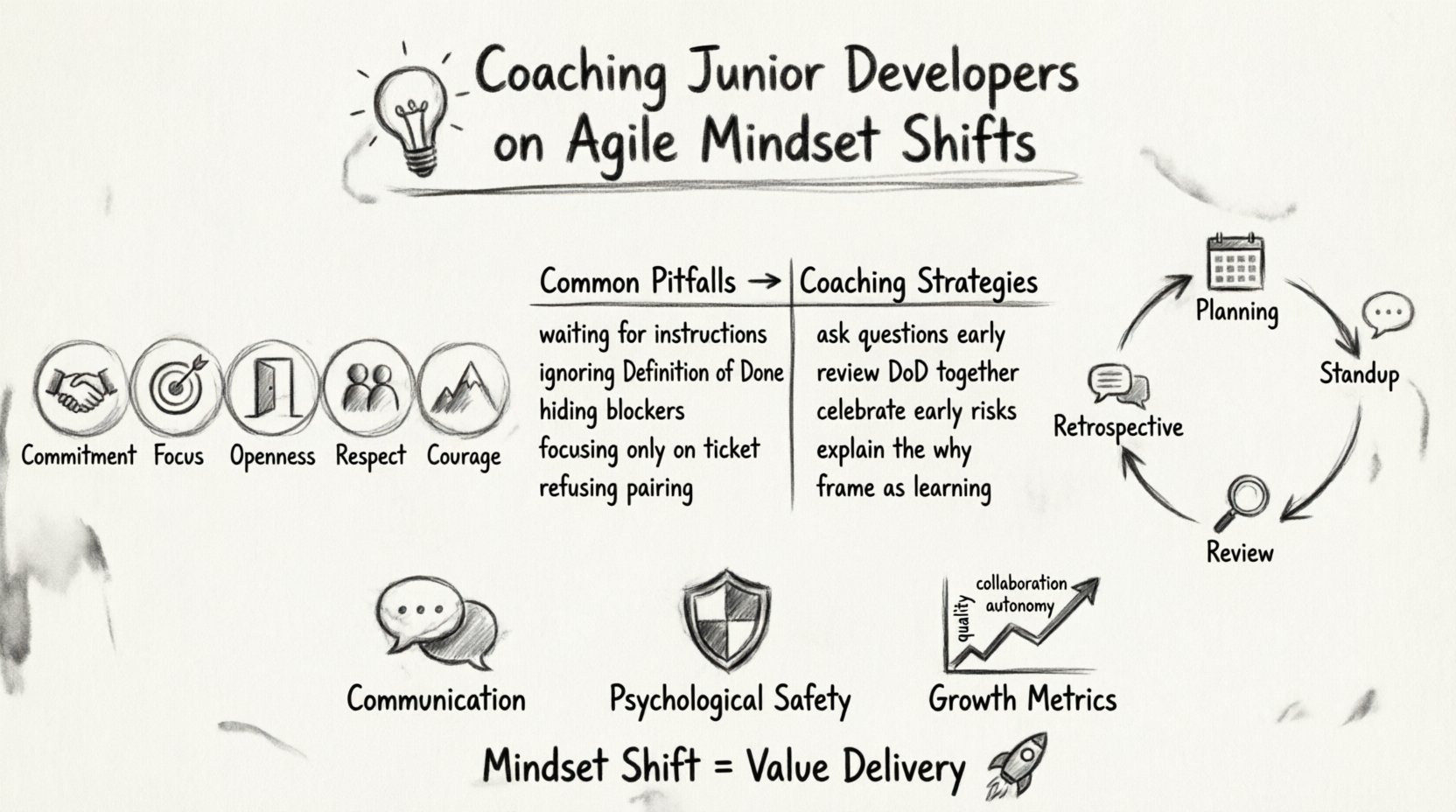
Transitioning from academic environments or entry-level roles into a professional Scrum team requires more than just learning a framework. It demands a fundamental shift in how a developer perceives their work, their responsibilities, and their value to the organization. Coaching junior developers to adopt an Agile mindset is a critical task for senior engineers and Scrum Masters. This process is not about enforcing rules; it is about cultivating a culture of adaptability, collaboration, and continuous improvement.
Many juniors enter the workforce expecting code to be the primary output. In Agile environments, however, the output is value. Understanding this distinction is the cornerstone of successful mentorship. This guide outlines the essential shifts required, the common pitfalls to avoid, and practical strategies for fostering growth within a Scrum context.
Why the Mindset Shift Matters 💡
Junior developers often come from educational backgrounds where assignments have fixed deadlines, single correct answers, and individual grading. Scrum operates on a different axis. It relies on empirical process control, where complexity is managed through inspection and adaptation. Without a mindset shift, a developer might view a sprint as a rigid contract rather than a learning opportunity.
The gap between “writing code” and “delivering value” is where most friction occurs. When a junior developer focuses solely on the technical implementation without considering the user story or the business goal, they risk building features that do not solve the right problem. Coaching involves bridging this gap.
Key reasons for this shift include:
- Collaboration over Isolation: Agile thrives on collective ownership. Code reviews and pair programming are not just quality checks; they are knowledge transfer mechanisms.
- Adaptability over Rigidity: Requirements change. A junior developer must learn to pivot without feeling that their previous effort was wasted.
- Feedback Loops: Waiting for a final release to hear feedback is inefficient. Agile encourages early and frequent feedback to correct course quickly.
- Transparency: Hiding problems delays resolution. Openly discussing blockers builds trust and accelerates problem-solving.
The Core Scrum Values for Developers 🤝
Scrum is built on five specific values. For a junior developer, these are not abstract concepts but daily behaviors that guide decision-making.
1. Commitment
Commitment in Scrum is about the team’s dedication to the Sprint Goal, not just individual task completion. A junior developer learns that saying “yes” to a story requires understanding the dependencies and risks involved. It is about making a promise to the team and honoring it.
2. Focus
Context switching is the enemy of flow. Coaching involves teaching juniors how to manage their attention. When a developer is blocked, they should communicate that immediately rather than spinning their wheels. Focus means working on one thing at a time to completion where possible.
3. Openness
This value is often the hardest to instill. Openness means admitting when you do not know something, when you are behind, or when you have made a mistake. A culture of openness prevents small bugs from becoming major production incidents.
4. Respect
Respect is shown by listening to the Product Owner’s vision, helping the Scrum Master remove impediments, and supporting fellow developers. It means valuing the diverse perspectives within the team, including the junior voice.
5. Courage
Courage is required to challenge the status quo, to say no to scope creep that jeopardizes the sprint goal, and to ask difficult questions during planning. It is about speaking up when something does not make sense.
Common Pitfalls and How to Address Them 🛠️
Every junior developer faces similar hurdles when starting their Agile journey. Identifying these patterns early allows for targeted coaching.
| Common Pitfall | Underlying Mindset Issue | Coaching Strategy |
|---|---|---|
| Waiting for perfect instructions | Fear of making mistakes | Encourage asking clarifying questions early. Normalize uncertainty as part of the process. |
| Completing tasks but ignoring the definition of done | Focus on activity over outcome | Review the Definition of Done together. Explain why testing and documentation matter. |
| Hiding blockers until the deadline | Perfectionism or fear of judgment | Create psychological safety. Celebrate early risk identification rather than punishing delays. |
| Focusing only on their ticket | Lack of holistic view | Invite them to contribute to the retro and planning meetings. Explain the “why” behind stories. |
| Refusing to pair program | Desire for autonomy or insecurity | Frame pairing as learning and knowledge sharing, not supervision. Start with short sessions. |
Navigating Scrum Ceremonies 🔄
Ceremonies are the heartbeat of the Scrum process. For a junior developer, these meetings can feel like interruptions or bureaucratic hurdles. Coaching them to see the utility in these gatherings is essential.
Sprint Planning
During planning, juniors often feel silent. They may wait for seniors to decide what gets done. Coaching should encourage them to offer estimates and ask questions about acceptance criteria. It is their right to understand the work they are committing to.
Daily Standup
This meeting is for synchronization, not status reporting to a manager. Juniors often recite what they did yesterday in detail. The goal is to focus on the Sprint Goal. They should learn to say, “I am blocked by X, I need help with Y,” rather than listing every line of code written.
Sprint Review
This is the showcase. Juniors often feel nervous about demonstrating their work. Encourage them to demo their features, even if imperfect. This reinforces that the product is a living entity and feedback is welcome. It shifts their identity from “worker” to “creator”.
Sprint Retrospective
The retro is for improvement. Juniors may fear criticizing the process. They should be guided to focus on the process, not the people. “The testing environment was slow” is better than “The environment is bad.” This builds a habit of continuous improvement.
Communication Protocols in Scrum 🗣️
Agile relies heavily on communication. However, the medium and timing matter significantly.
- Asynchronous vs. Synchronous: Not every question needs a meeting. Juniors should learn to document their questions in tickets or chat channels first. This respects the flow of others.
- Written Over Verbal: Documentation is not dead. It is a requirement for clarity. Encourage writing clear commit messages and updating tickets.
- Active Listening: During grooming sessions, listening to the Product Owner is as important as speaking. It helps the developer understand the user context.
- Feedback Delivery: When reviewing code, juniors must learn to give constructive feedback. Focus on the code, not the person. “This function could be more readable” rather than “You wrote this poorly.”
Handling Failure and Feedback 📉
In a traditional model, failure is a mark of incompetence. In Agile, failure is data. It tells the team that the process needs adjustment or the estimate was wrong. A junior developer needs to learn how to process failure without shame.
When a story is not completed by the end of the sprint, the goal is not to blame the individual. The goal is to understand why. Was the scope too large? Was there a technical debt issue? Was there an external dependency?
Coaching strategies for handling failure:
- Separate Person from Problem: Discuss the technical challenge, not the developer’s capability.
- Blameless Post-Mortems: When bugs reach production, focus on the root cause in the system, not the person who wrote the code.
- Normalize Imperfection: Acknowledge that the first draft of a solution is rarely the final one. Refactoring is part of the process, not a failure.
Tools vs. Process ⚙️
It is easy for juniors to get obsessed with the tools used to manage the backlog. While a task board is a valuable visual aid, it is not the process itself. Coaching must emphasize that the board is a reflection of reality, not the reality itself.
If the board is up to date, it helps the team. If the team is working but the board is not updated, the board becomes a lie. The priority is the work, not the ticket status. However, keeping the board accurate is a form of respect for the team’s visibility.
Building Psychological Safety 🧠
Psychological safety is the foundation of high-performing Agile teams. It is the belief that one will not be punished for making a mistake. For a junior, this environment is crucial for growth.
Seniors play a massive role in building this. If a senior developer mocks a junior’s question, the team culture suffers. If a senior admits their own mistakes, it sets a precedent.
To build this safety:
- Ask Questions: Encourage juniors to ask “stupid” questions. Frame them as opportunities for the team to learn together.
- Validate Contributions: Acknowledge when a junior suggests a good idea during a meeting.
- Protect Time: Ensure juniors have time to learn and do not feel pressured to deliver 100% velocity immediately.
Measuring Growth without Metrics Gaming 📊
Velocity is a planning tool, not a performance metric. A common mistake is coaching juniors to maximize their velocity. This leads to cutting corners, reducing quality, and gaming the system.
Instead of focusing on speed, focus on:
- Quality: Are the tests passing? Is the code maintainable?
- Collaboration: Are they helping others? Are they participating in the retro?
- Autonomy: Are they solving problems without constant hand-holding?
- Business Understanding: Do they understand why they are building the feature?
Developing a Long-Term Perspective 🌱
Agile is not a sprint; it is a marathon. Junior developers often want quick wins. Coaching them to think in terms of technical debt and long-term maintainability is vital.
Explain that a feature delivered today might need to be maintained for years. Writing clean, documented code is an investment in the future. This mindset shift moves them from “fixing bugs” to “building systems”.
Encourage them to read the code of their peers. Encourage them to explore the architecture. Encourage them to understand the deployment pipeline. These activities build a holistic view that is essential for seniority.
Practical Exercises for Coaching 🛠️
Here are specific actions to take during the onboarding and early development phases:
- Shadowing: Have the junior shadow a senior during the Daily Standup or Planning to observe the cadence and tone.
- Role Rotation: Let the junior act as the Scrum Master for one sprint. This forces them to understand the facilitation challenges.
- Story Grooming: Ask them to pick a story and explain the acceptance criteria back to the Product Owner.
- Code Review Pairs: Pair them with a senior for code reviews to discuss the “why” behind the changes.
- Definition of Done Workshop: Have them help define the DoD for a specific project to increase ownership.
Conclusion: Sustaining the Shift 🚀
The transition from a junior developer to a mature Agile practitioner is a journey of continuous learning. It requires patience from mentors and resilience from the junior. The goal is not to create clones of senior developers, but to empower individuals who understand the value of collaboration, adaptability, and quality.
By focusing on the core values, addressing common pitfalls, and fostering a safe environment, teams can nurture talent that thrives in complex, changing landscapes. The mindset shift is the most important deliverable of the coaching process. When a developer understands that they are part of a system designed for value delivery, the quality of their work naturally improves.
Remember that this is not a linear path. There will be regressions and challenges. The key is to maintain the conversation, keep the feedback loop open, and celebrate the progress, however small. This approach builds a resilient team capable of delivering high-quality software in a dynamic world.