

In the fast-paced environment of software development and product delivery, the relationship between the development team and external stakeholders often determines project success. While the Scrum framework provides a robust structure for iterative work, the human element of expectation management remains a critical variable. When business needs clash with technical realities, friction occurs. This guide details practical strategies to align goals, maintain transparency, and foster trust throughout the sprint cycle without resorting to jargon or sales pitches.
🤝 The Core Challenge of Agile Delivery
Stakeholders represent the business voice, focusing on value, ROI, and market timing. Development teams focus on quality, sustainability, and technical feasibility. These perspectives are not inherently opposed, but they often operate on different timelines. A stakeholder might want a feature released by Friday to capture a marketing window, while the team knows the code requires two more weeks of testing.
Failure to manage this gap leads to:
Scope Creep: Uncontrolled changes to the sprint backlog.
Loss of Trust: Repeated missed commitments damage credibility.
Team Burnout: Pressure to deliver too much too quickly.
Quality Degradation: Cutting corners to satisfy immediate demands.
📊 Common Misalignments Between Business and Development
Understanding where friction points typically occur allows teams to proactively address them. The table below outlines frequent expectation gaps and the underlying causes.
Expectation | Reality | Root Cause |
|---|---|---|
Features are done by the Sprint Review | Features are often not 100% complete | Unclear definition of done |
Estimates are fixed deadlines | Estimates are probabilistic forecasts | Confusion between planning poker and commitment |
Product Owner says “No” to new ideas | Product Owner prioritizes based on value | Lack of context on backlog strategy |
Sprints are flexible for urgent tasks | Sprints are protected for focus | Perception of “Agile” as “Change Everything Instantly” |
📅 Pre-Sprint Alignment Strategies
Expectations are largely set before the first line of code is written. Preparation is the most effective tool for preventing misunderstandings. These steps should be integrated into the refinement and planning phases.
1. Define the Definition of Done (DoD)
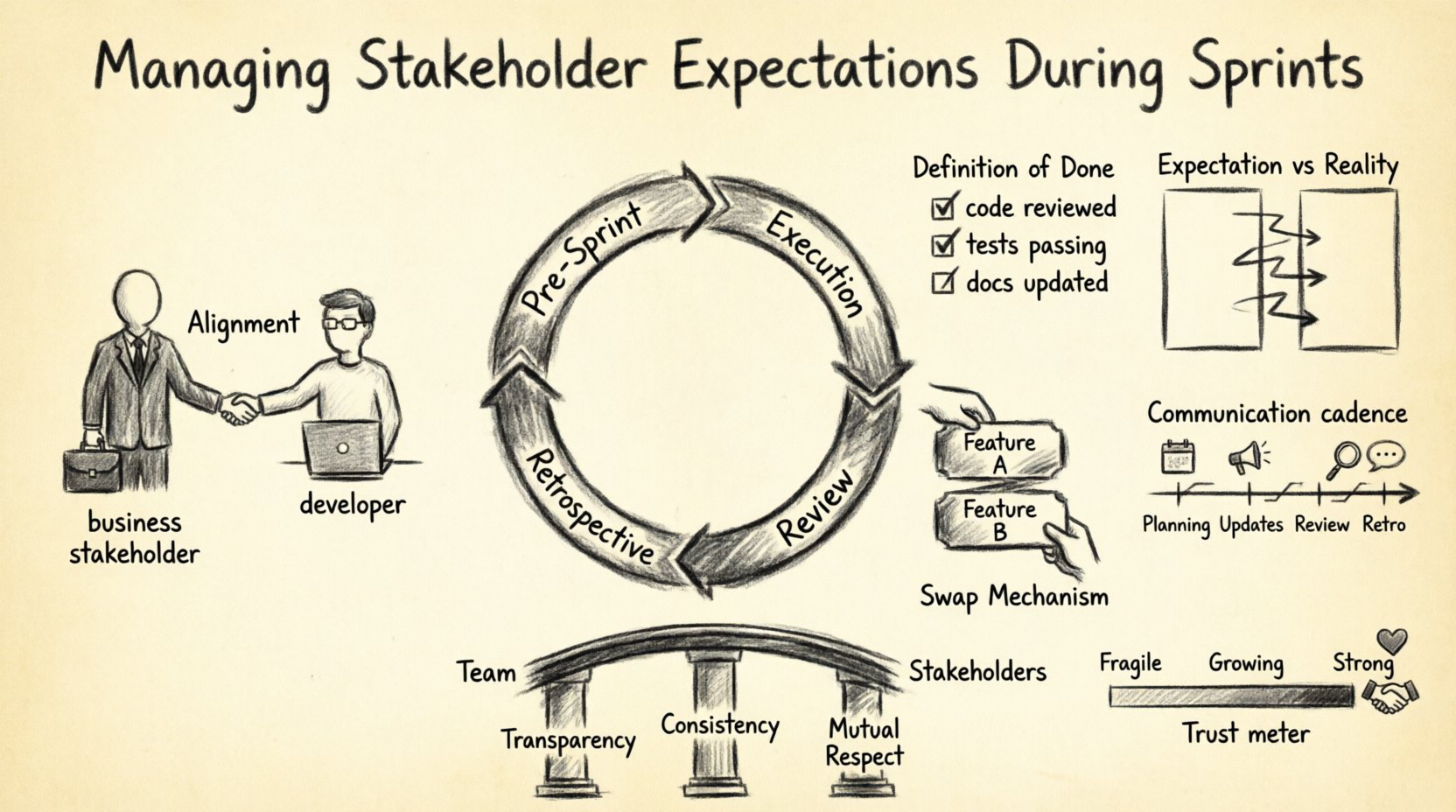
Stakeholders often assume a feature is complete when it looks right on a screen. The team needs a shared agreement on what “done” means. This includes:
Code reviewed and merged
Automated tests passing
Documentation updated
Performance benchmarks met
Security checks cleared
When stakeholders understand these criteria, they stop asking “Why isn’t this live yet?” and start asking “What is preventing the DoD from being met?”
2. Collaborative Backlog Refinement
Invite stakeholders to refinement sessions. This does not mean they dictate the backlog, but it allows them to hear technical constraints firsthand. When a stakeholder sees the complexity behind a small UI change, they adjust their expectations naturally.
Frequency: Bi-weekly or weekly sessions.
Attendees: Product Owner, Development Team, and key Stakeholders.
Goal: Clarify acceptance criteria and estimate effort.
3. Set Realistic Sprint Goals
A Sprint Goal acts as a beacon for the team. It should be a short statement describing what the team plans to achieve. Stakeholders must agree to this goal during Sprint Planning. If a stakeholder pushes for a different outcome, it becomes a negotiation about scope, not an instruction.
🔍 Transparency During Execution
Once the sprint begins, the team must maintain visibility. Silence creates anxiety, and anxiety leads to micromanagement.
Daily Check-Ins
The Daily Scrum is for the team, but the status should be visible to stakeholders. This can be achieved through:
A shared digital board accessible to all.
A daily email digest from the Product Owner.
A Slack channel dedicated to sprint updates.
These channels should focus on progress toward the Sprint Goal, not just a list of completed tasks.
Managing Interruptions
Stakeholders often interrupt the sprint with “quick questions” or “urgent changes.” While some interruptions are necessary, others disrupt flow. Establish a protocol:
Emergency: Direct contact to the Product Owner.
High Priority: Add to the backlog for next planning.
Normal Inquiry: Document and answer during a scheduled sync.
This protects the team’s focus while ensuring stakeholders feel heard.
🎯 The Sprint Review as a Negotiation Tool
The Sprint Review is often misunderstood as a demo. It is actually a working session where the team inspects the increment and adapts the Product Backlog. It is the primary forum for expectation management.
Best Practices for the Review
Invite the Right People: Ensure decision-makers are present, not just observers.
Focus on Value: Demonstrate how the work solves a business problem, not just technical implementation.
Invite Feedback: Ask stakeholders what they would like to see next. This shifts the conversation from “Why didn’t you do X?” to “What is the priority for the next sprint?”
Be Honest About Risks: If a feature is partially done, show it. Explain the trade-offs. Hiding unfinished work destroys trust.
🚫 Handling Scope Changes Mid-Sprint
Changes happen. Sometimes market conditions shift, or a competitor launches a feature. The question is not “Can we change?” but “How do we change without breaking the sprint?”
The Swap Mechanism
When a stakeholder requests a new item during a sprint, the team should not simply add it. They should offer a swap. This maintains the total capacity of the sprint.
Stakeholder: “We need this new report by Friday.”
Team: “We can prioritize this. To fit it in, we need to move Task B to the next sprint. Do we agree to drop Task B?”
This forces the stakeholder to make a value-based decision. It highlights the cost of the change in terms of other work not being delivered.
When to Break a Sprint
There are rare cases where a sprint must be cancelled. This happens if the Sprint Goal becomes obsolete. However, this is a last resort. Cancellation wastes resources and signals instability. The team should only propose cancellation if the work being done has zero value.
🗣️ Communication Cadence and Channels
Effective communication is not about sending more messages; it is about sending the right messages at the right time. A structured cadence reduces the need for ad-hoc meetings.
Event | Frequency | Audience | Key Message |
|---|---|---|---|
Sprint Planning | Bi-weekly | Team + PO + Stakeholders | What we are building and why |
Progress Update | Weekly | Stakeholders | Current status and risks |
Sprint Review | Bi-weekly | Stakeholders + Team | Demo of work and feedback |
Retrospective | Bi-weekly | Team Only | Process improvement (internal) |
📈 Measuring Relationship Health
How do you know if your expectation management is working? Look at qualitative and quantitative indicators beyond just delivery speed.
Quantitative Metrics
Commitment Reliability: How often is the Sprint Goal met?
Scope Stability: How many items are added or removed mid-sprint?
Review Attendance: Are stakeholders attending the Review regularly?
Qualitative Indicators
Meeting Tone: Are meetings tense or collaborative?
Feedback Quality: Is feedback specific and constructive?
Trust Level: Do stakeholders ask for help before requesting changes?
🤝 Building Long-Term Trust
Expectations are not managed in a single sprint; they are built over time. Consistency is the key to trust. When a team consistently delivers what they promise, stakeholders become more flexible when the team encounters challenges.
Own the Mistakes
If the team misses a goal, communicate it early. Do not wait until the Sprint Review to reveal a delay. Early warnings allow stakeholders to adjust their plans. Admitting a mistake quickly shows integrity and professionalism.
Bad: Waiting until the deadline passes.
Good: “We are at risk of missing the goal. Here is why, and here is our plan to recover.”
Understand Their Context
Stakeholders face their own pressures. Understanding their KPIs helps you frame your updates in a way that resonates. If their goal is user growth, explain how the technical work contributes to that growth. If their goal is cost reduction, explain how the work prevents technical debt that costs money later.
🛠️ Tools for Facilitation
While software tools exist, the principles of management remain the same regardless of the platform. The focus should be on the flow of information, not the features of the application.
Visual Management: Use physical or digital boards to show work in progress. Visuals make bottlenecks obvious.
Shared Documentation: Keep requirements in a central location accessible to all parties.
Meeting Agendas: Always send an agenda for stakeholder meetings to ensure time is used efficiently.
🌱 The Path Forward
Managing stakeholder expectations is not about controlling people; it is about aligning interests. It requires a shift from “I will tell you what I am doing” to “Let us agree on what value we are creating together.” By adhering to these structured approaches, teams can maintain focus, stakeholders can maintain confidence, and the product can deliver genuine value without the constant friction of misalignment.
The goal is a partnership where the team feels safe to innovate and the business feels secure in the delivery process. This balance is achieved through clear communication, consistent delivery, and mutual respect for the constraints each party faces.