

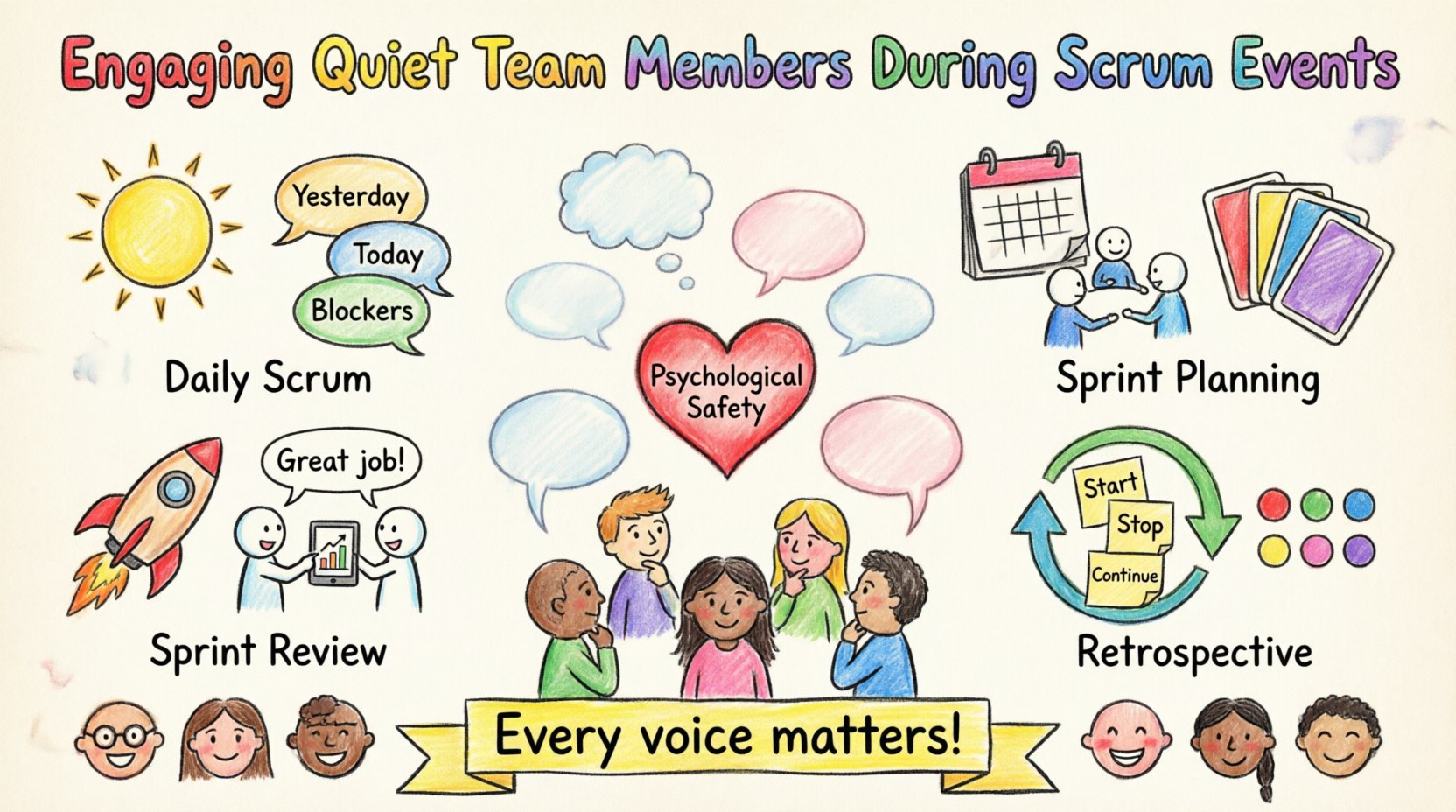
In the fast-paced world of Agile development, the Scrum framework relies heavily on transparency and collaboration. However, a common challenge arises when team members remain silent during key ceremonies. This silence is not always a sign of disengagement. Often, it reflects a different communication style, a lack of psychological safety, or a preference for thoughtful reflection over spontaneous speech.
As a Scrum Master or Agile Coach, recognizing these nuances is vital. Creating an environment where every voice contributes to the product and the process ensures better outcomes and higher morale. This guide explores practical, evidence-based strategies to engage quieter individuals during Daily Scrums, Sprint Planning, Reviews, and Retrospectives.
Understanding the Silence 🧐
Before attempting to change behavior, it is essential to understand the root causes of quietness in a team setting. Labeling someone as “quiet” without context can lead to misunderstandings. The reasons behind limited verbal participation often fall into several categories:
- Introversion: Many individuals recharge through solitude and process information internally before speaking. They are not necessarily disengaged; they are processing deeply.
- Psychological Safety: If a team culture punishes mistakes or prioritizes the loudest voices, individuals will withhold ideas to avoid risk.
- Cultural Norms: In some cultures, speaking out of turn or challenging a senior member is seen as disrespectful.
- Neurodiversity: Conditions such as autism spectrum disorder or social anxiety can make spontaneous public speaking exhausting or overwhelming.
- Lack of Preparation: If a team member feels they haven’t done enough work to contribute, they may stay silent to avoid scrutiny.
Addressing these factors requires a shift in facilitation rather than a demand for louder participation. The goal is inclusion, not uniformity.
Daily Scrum: The Morning Check-In 🌅
The Daily Scrum is often the most challenging event for introverted members. It requires rapid-fire updates in front of peers. Here are specific ways to facilitate engagement:
Pre-Circulation of Updates
Allow team members to post their updates in a chat channel or wiki page 15 minutes before the meeting starts. This gives them time to formulate thoughts without the pressure of a live timer.
- Benefit: Reduces cognitive load during the meeting.
- Benefit: Allows for text-based contributions from those who type better than they speak.
Structured Turn-Taking
While a free-flowing discussion is often encouraged, round-robin styles can ensure everyone has a designated space to speak without interruption. This prevents dominant voices from monopolizing the conversation.
- Technique: Pass a virtual or physical token.
- Technique: Go around the room (or video grid) in a fixed order.
Alternative Update Formats
Not everyone needs to speak. Consider allowing written status reports for those who prefer it, especially for routine updates. Focus the meeting on blockers and collaboration rather than status reporting.
Sprint Planning: Setting the Course 📅
Planning sessions involve estimation, discussion, and commitment. Quiet members often have valuable insights regarding technical feasibility or risk that go unspoken.
Pre-Work and Pre-Reading
Share user stories and acceptance criteria at least 24 hours before the session. This allows team members to review the material privately and formulate questions or estimates.
- Why it works: Deep work requires uninterrupted time.
- Why it works: Prep reduces anxiety about being put on the spot.
Breakout Groups
Divide the team into smaller groups of 2 to 4 people to discuss specific stories. Smaller groups reduce the intimidation factor and encourage more balanced dialogue.
Written Estimation
Instead of shouting out story points, use a silent estimation technique like Planning Poker cards. This prevents the “anchoring effect” where early numbers influence the group.
- Process: Everyone reveals cards simultaneously.
- Process: Discuss outliers, but do not pressure those with extreme estimates to justify them immediately.
Sprint Review: Showcasing Value 🚀
The Review is often a demo-heavy event. For quiet developers, presenting to stakeholders can be daunting. The focus should remain on the product, not the presenter.
Support the Demo
Encourage pairings for demos. If a developer prefers coding over presenting, pair them with a product owner or another team member who can lead the narrative while they demonstrate technical details.
- Benefit: Reduces performance anxiety.
- Benefit: Allows the quiet member to contribute their expertise without being the sole speaker.
Feedback Channels
Stakeholders should be encouraged to provide feedback in writing or via a shared board during the session. This allows for thoughtful critique rather than reactive comments.
Focus on Artifacts
Direct the conversation toward the increment itself. Use phrases like “The feature handles…” rather than “I built…”. This shifts the spotlight from the person to the work.
Sprint Retrospective: Continuous Improvement 🔄
The Retrospective is where the team inspects itself. It is often the most vulnerable event. Quiet members hold critical insights here, but fear of judgment can silence them.
Silent Brainstorming
Start the session with 5 to 10 minutes of silent writing. Ask everyone to write down their thoughts on sticky notes or a digital board. This levels the playing field immediately.
- Benefit: Prevents groupthink.
- Benefit: Ensures introverted thinkers get their ideas on the board.
The 1-2-4-All Technique
This structured facilitation method scales discussion naturally:
- 1 Minute: Reflect individually.
- 2 Minutes: Discuss with a partner.
- 4 Minutes: Discuss with a pair of pairs.
- All: Share key insights with the whole group.
This gradual escalation allows team members to test their ideas in a safe environment before presenting to the whole team.
Dot Voting
Allow team members to vote on improvement topics anonymously. This reduces the fear of being the one who “brought up the problem.”
General Facilitation Techniques 🛠️
Beyond specific events, general facilitation habits play a huge role in team dynamics. The Scrum Master acts as a guardian of the process and the culture.
Active Listening
Practice active listening during all interactions. When a quiet member does speak, give them your full attention. Do not interrupt. This reinforces that their input is valued.
One-on-Ones
Private conversations can reveal barriers that public settings hide. Use these sessions to understand individual preferences for communication and feedback.
Asynchronous Communication
Encourage the use of text-based channels for non-urgent matters. Many quiet members are excellent writers. Leveraging this strength can improve documentation and clarity.
Technique Mapping Table 📊
Refer to this table to select the right approach for the specific event and team dynamic.
| Scrum Event | Challenge | Recommended Technique | Goal |
|---|---|---|---|
| Daily Scrum | Pressure to speak on the spot | Pre-written updates or Chat | Reduce anxiety, maintain flow |
| Sprint Planning | Estimation anchoring | Written estimation (Planning Poker) | Independent thought, accurate estimates |
| Sprint Review | Public speaking fear | Paired demos, artifact focus | Showcase work without spotlight pressure |
| Retrospective | Groupthink or intimidation | Silent brainstorming, 1-2-4-All | Inclusive feedback, psychological safety |
Building a Supportive Environment 🌱
Engagement is not a one-time fix; it is a culture. Building a supportive environment requires consistent effort from the entire team, not just the Scrum Master.
Prioritize Psychological Safety
Psychological safety means team members feel safe to take risks and be vulnerable in front of each other. It is the foundation of high-performing teams.
- Admit your own mistakes publicly to model vulnerability.
- Respond to errors with curiosity, not blame.
- Explicitly invite input from those who have not spoken yet.
Respect Different Styles
Do not force extroverted behaviors on introverted team members. Accept that some of your best ideas will come via email or a document rather than a meeting. Value the output over the delivery method.
Recognition
Recognize contributions publicly, but ensure the recognition matches the individual’s comfort level. Some prefer a private thank you, while others enjoy public acknowledgment. Ask them what they prefer.
Final Thoughts on Inclusion 🤝
Creating a space where quiet voices are heard is not about forcing everyone to be the same. It is about expanding the range of communication styles that are valued within the team. By adapting Scrum events to accommodate different working styles, teams can unlock the full potential of their diverse talent.
Remember, the goal is not to make everyone talkative. The goal is to ensure that every perspective that matters is represented. When a team leverages the strengths of both vocal and reflective members, the result is a more robust, resilient, and successful product.
Start small. Pick one technique from this guide, such as silent brainstorming in your next Retrospective, and observe the impact. Iterate on your process just as you would with the product itself. Continuous improvement applies to the team dynamics as much as it does to the code.