


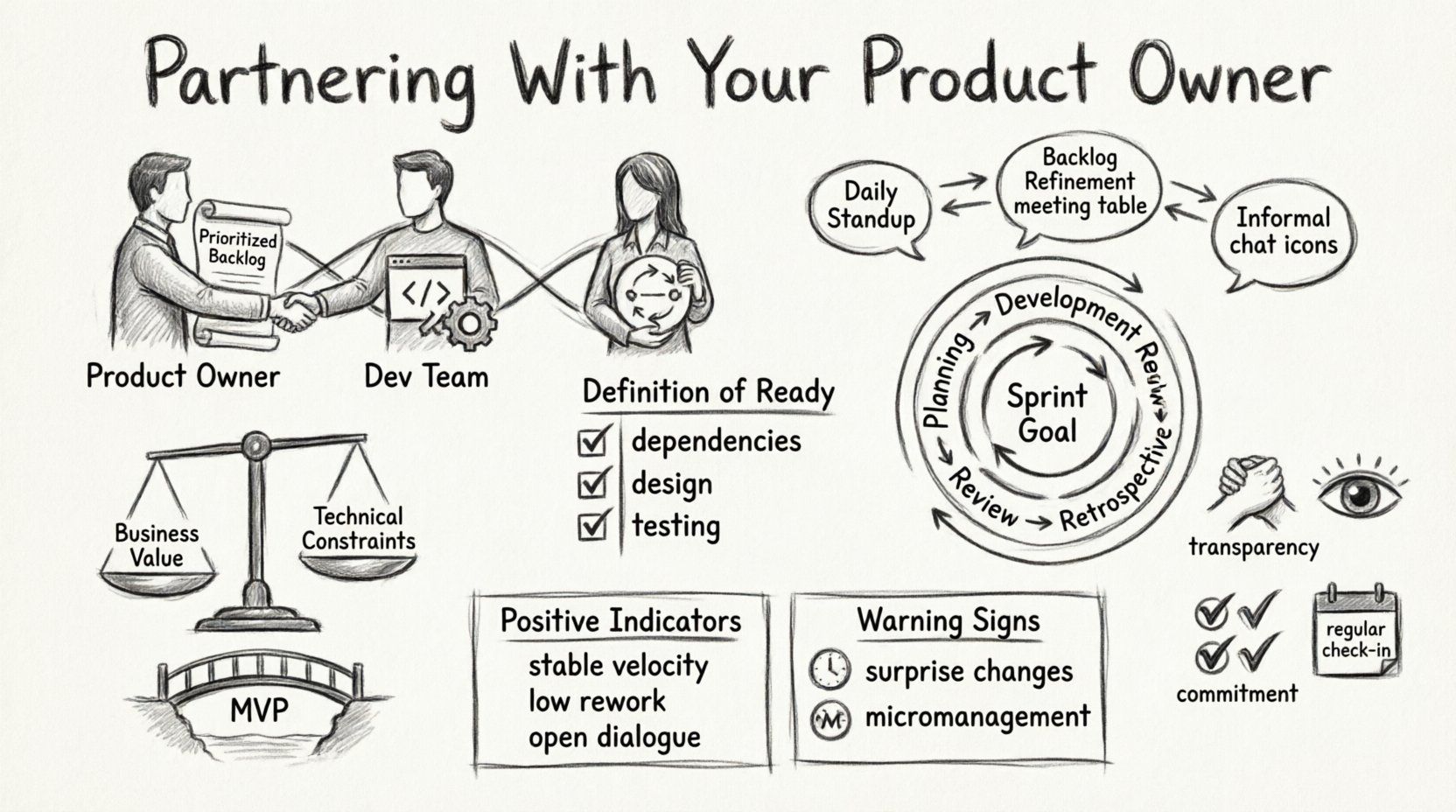
In the Scrum framework, the relationship between the Development Team and the Product Owner is not merely a reporting line; it is a strategic partnership that determines the value delivered to the end user. A successful collaboration relies on mutual respect, clear communication, and a shared vision for the product. When these elements align, the team can navigate complex challenges and deliver high-quality increments consistently.
This guide explores the dynamics of working alongside a Product Owner (PO). We will examine the core responsibilities, communication strategies, and conflict resolution techniques required to build a robust working relationship. The goal is to create an environment where technical constraints and business value are balanced effectively.
Understanding the Core Roles 🧩
Before diving into collaboration, it is essential to understand the distinct responsibilities of each role. While they work toward the same goal, their focus areas differ significantly.
- Product Owner: Focuses on what to build. They manage the Product Backlog, prioritize value, and represent the stakeholders.
- Development Team: Focuses on how to build. They handle the technical architecture, implementation, and quality assurance.
- Scrum Master: Focuses on process. They facilitate the framework and remove impediments.
When these three roles operate in silos, friction occurs. The Product Owner may request features without understanding technical debt. The Team may over-estimate complexity without considering business urgency. Bridging this gap requires intentional effort.
Establishing Communication Protocols 💬
Effective communication is the backbone of any successful partnership. In Scrum, communication is both formalized through events and informal through daily interactions.
1. The Daily Standup
While the Product Owner is not required to attend the Daily Standup, their presence can be beneficial if they are part of the core team. If they are not present, ensure there is a mechanism for them to receive updates on progress and blockers.
- Share Progress: Keep the PO informed about completed work.
- Highlight Risks: If a technical risk affects the timeline, communicate it immediately.
- Clarify Requirements: Use the meeting to ask quick questions about acceptance criteria.
2. Backlog Refinement
This event is critical for the PO-Team relationship. It is where the “what” meets the “how”.
- Collaborative Estimation: Discuss the effort required for items before they are committed.
- Acceptance Criteria: Ensure the team fully understands the conditions for satisfaction.
- Splitting Stories: Work together to break large epics into manageable chunks.
3. Informal Channels
Formal meetings do not cover every nuance. Informal chats, instant messaging, or quick pair-programming sessions can resolve misunderstandings faster than a scheduled call.
Managing the Product Backlog 📋
The Product Backlog is the single source of truth for work. It belongs to the Product Owner, but the Development Team contributes to its health. A well-managed backlog reduces ambiguity and increases predictability.
Refinement Best Practices
Refinement should happen continuously, not just before Sprint Planning.
- Top Priority: The top items must be clear enough to be pulled into a Sprint.
- Clear Definitions: Every item needs a clear title, description, and acceptance criteria.
- Technical Tasks: Ensure technical tasks are visible and tracked alongside functional stories.
Definition of Ready (DoR)
Establishing a Definition of Ready helps prevent the team from pulling in items that are not prepared. This protects the team from context switching and ensures focus.
- Dependencies: Are external dependencies resolved?
- Design: Are UI/UX designs available?
- Testing: Is there a plan for testing this specific feature?
Collaboration During Sprint Planning 🗓️
Sprint Planning is where the team commits to work. It is a negotiation, not a directive.
The Two Parts of Planning
- What can be done? The Product Owner presents the top items. The team asks questions to clarify scope.
- How will it be done? The team breaks down tasks and estimates capacity.
- Capacity Management: The team decides how much work fits based on their velocity and available hours.
- Scope Flexibility: The Product Owner should be prepared to negotiate scope if the team feels over-committed.
- Goal Setting: The Sprint Goal provides a unifying objective that guides decision-making throughout the Sprint.
The Sprint Review: Feedback Loop 🔍
The Sprint Review is a working session where the team demonstrates the increment to stakeholders. The Product Owner plays a key role in guiding this feedback.
- Inspect the Increment: Show working software, not slides.
- Gather Feedback: Listen to stakeholders. Their reaction determines the next steps.
- Update the Backlog: Based on feedback, the Product Owner adjusts the backlog priorities.
This event is not a gatekeeper; it is a learning opportunity. If the product does not meet expectations, the team and PO discuss why and adjust the approach.
Handling Conflict and Disagreement ⚖️
Conflict is natural in any partnership. Technical constraints often clash with business ambitions. The key is to handle disagreement professionally.
Common Friction Points
| Scenario | PO Perspective | Team Perspective | Resolution Strategy |
|---|---|---|---|
| Feature Deadline | Market window is closing; we must launch. | Quality is at risk; we need more time. | Find a Minimum Viable Product (MVP) approach. |
| Technical Debt | Why aren’t we building new features? | We need to refactor to maintain velocity. | Allocate a percentage of capacity to debt. |
| Requirement Ambiguity | I thought it was clear. | We are guessing and might build the wrong thing. | Conduct a joint discovery session. |
Strategies for Resolution
- Data-Driven Decisions: Use metrics to back up claims about velocity or quality.
- Focus on Value: Ask: “What value are we trying to deliver?” rather than “Who is right?”
- Escalation Path: If a disagreement cannot be resolved between the PO and the Team Lead, involve the Scrum Master to facilitate a resolution.
Measuring Partnership Health 📊
How do you know if the partnership is working? Look for specific indicators in your process and outcomes.
Positive Indicators
- High Velocity Stability: The team consistently delivers what they commit to.
- Low Rework: Few stories are rejected during the Sprint Review.
- Open Dialogue: The team feels safe challenging the PO on priorities.
- Shared Ownership: Both parties feel responsible for the product’s success.
Warning Signs
- Surprise Changes: The PO introduces major changes mid-Sprint without discussion.
- Micro-management: The PO dictates technical implementation details.
- Refusal to Attend Events: The PO is absent from Planning or Reviews.
- Unrealistic Expectations: The PO expects features without acknowledging constraints.
Building Trust Over Time 🏗️
Trust is not built overnight. It accumulates through consistent behavior and reliability.
- Deliver on Commitments: If the team says they will do it, they do it. If the PO says they will provide info, they do it.
- Transparency: Share bad news early. Hiding problems erodes trust quickly.
- Respect Expertise: The PO respects technical knowledge; the Team respects business knowledge.
- Regular Check-ins: Hold a bi-weekly or monthly 1:1 between the PO and the Team Lead to discuss relationship health.
Stakeholder Management 🗣️
The Product Owner is the bridge to external stakeholders. The Development Team must support this function by providing clear information.
- Limit Direct Requests: Stakeholders should go through the PO to avoid overwhelming the team.
- Clear Communication: The PO must translate stakeholder needs into clear requirements.
- Manage Expectations: The PO must explain why certain requests cannot be fulfilled immediately.
Common Pitfalls to Avoid ⚠️
Avoiding common mistakes saves time and energy. Here are frequent issues that damage the partnership.
- The “Order Taker” PO: A PO who simply writes tickets without understanding the value behind them.
- The “Glass Box” Team: A team that exposes every internal detail to the PO, overwhelming them with noise.
- Ignoring Retrospectives: Skipping the Retrospective means missing opportunities to improve the working relationship.
- Scope Creep: Adding items to the current Sprint without adjusting the commitment.
Adapting to Change 🔄
Agile is about adapting to change. The partnership must be resilient enough to handle shifting priorities.
- Flexible Planning: Accept that plans will change. Focus on the goal, not the specific tasks.
- Iterative Learning: Treat every Sprint as a learning opportunity. Adjust based on what is learned.
- Continuous Improvement: Regularly ask: “How can we work better together next time?”
Conclusion on Partnership Dynamics
The relationship between a Scrum Team and its Product Owner is the engine that drives product success. It requires ongoing maintenance, clear boundaries, and mutual respect. By focusing on shared goals, transparent communication, and collaborative problem-solving, you can create a high-performing unit that delivers consistent value.
Remember, the framework provides the structure, but the people provide the value. Invest in the relationship, and the results will follow.